
HSE-375 · Lesson 11 of 12 · 20 min
Incident reporting and investigation duties
At 7:52 on the Monday morning of the level 5 fall, Jordan Pike called Ben Nakamura on the radio: 'Man down on five, by the shaft.' Within ten minutes, a Tallgrass first aid attendant was with the injured worker, an ambulance had been called and directed to the north gate, and Ben had stopped work on level 5 and taped off the area around the opening. Within the hour, the incident had been reported to the regulator. Within the week, a joint investigation by Tallgrass, the three subcontractors involved and the worker co-chair of the committee had found five failed layers of protection, as lesson 1 described, and agreed on the fixes in lesson 7.
This lesson sets out what must be reported, to whom and when, and how a general contractor leads an investigation on a site with many employers.
The first hour
Whatever the jurisdiction, the first priorities after a serious incident are the same, and Tallgrass's emergency plan lists them in order.
- Care for the injured. First aid, emergency services, and someone to meet the ambulance at the gate.
- Make the area safe. Stop the work, control any continuing hazard, and keep others out without putting rescuers at risk.
- Preserve the scene. Leave things as they are, except to rescue or to prevent further harm. Tape it off and post someone to keep people out.
- Notify. Inside the company and the subcontractor, and to the regulator and others as the law requires.
- Record. Names of witnesses, the time, photographs of the scene before anything is moved, and the conditions: weather, lighting, equipment in use.
What must be reported in Manitoba
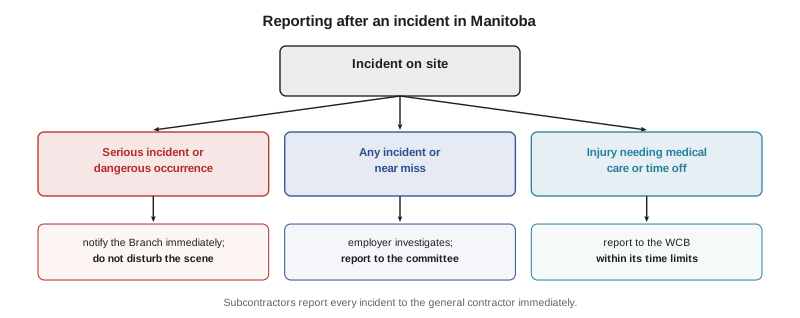
Manitoba's Act and regulation require the employer to notify the Branch immediately of a serious incident, which includes a death and a range of serious injuries such as injuries requiring admission to hospital, fractures of certain bones, amputations and loss of consciousness, as well as dangerous occurrences that could have caused serious injury even if no one was hurt, such as the collapse of a crane, a structure, scaffold or excavation, or an uncontrolled explosion or fire. Except to rescue people or prevent further injury, the scene must not be disturbed until an officer gives permission. The employer must also investigate incidents, prepare a written report setting out what happened, the causes and the corrective actions, and give it to the committee or representative. Separately, injuries that need medical treatment or cause time off work must be reported to the WCB within the time limits it sets, and workers must report injuries to their employer promptly.
Who reports on a multi-employer site
The legal duty to report usually falls on the employer of the injured worker. On a construction site, the prime contractor also needs to know immediately, because it controls the site, must coordinate the response and may itself have duties. Tallgrass's subcontracts require every subcontractor to report any injury, near miss or dangerous occurrence to Tallgrass immediately, and Tallgrass makes the call to the Branch jointly with the employer for serious incidents, so that nothing is missed and the regulator hears one consistent account. For the level 5 fall, Pinecrest's office and Owen called the Branch together, nineteen minutes after the fall.
Near misses
A near miss is an event that could have caused injury or damage but did not, such as a tool dropped from a height that landed in an empty area, or a worker who slipped at an edge and caught a guardrail. Near misses are free lessons: the causes are the same as those of injuries, but no one has been hurt. Tallgrass asks every worker to report near misses, by telling their foreman, by a card in the lunchroom box or through the site app, anonymously if they prefer. Near misses with serious injury or fatality potential are investigated with the same depth as injuries.
Leading the investigation
An investigation has one purpose: to understand why the event happened so that it does not happen again. It is not a search for someone to blame, and an investigation that becomes one will not get honest answers. On a multi-employer site, Tallgrass leads or coordinates investigations of serious events, with the employers involved and a worker member of the committee. The level 5 investigation team was Owen, Ben, the safety leads from Pinecrest, Keystone Mechanical Ltd. and Highline Scaffold Ltd., and Lena Petrov.
The team followed Tallgrass's five-step method.
- Gather facts. Photographs, measurements, the condition of equipment, records (the opening register did not yet exist, but the mechanical contractor's work order showed the opening cut on Friday), and interviews with the injured worker, witnesses, foremen and the people who last worked in the area.
- Build a timeline. What happened, in order, from the cutting of the opening on Friday to the fall on Monday.
- Find the causes. For each event in the timeline, ask why it happened and keep asking until the answers reach the system: the procedures, training, supervision, planning and coordination that should have prevented it.
- Decide corrective actions. Use the hierarchy of controls, give each action an owner and a date, and prefer fixes that do not depend on people remembering.
- Share and follow up. Tell the site what happened and what has changed, check that the actions are done and working, and close the investigation.
From events to causes
The team built its timeline and asked 'why' at each step. Owen recorded it in a simple structure.
# Timeline and why-chain for the level 5 fall.
timeline = [
    ("Fri 15:30", "Mechanical crew cuts 1.2 m x 0.9 m shaft opening; installs guardrail"),
    ("Sat 10:15", "Scaffold crew removes rail to move material; leaves without reinstating"),
    ("Mon 07:30", "Drywall crew sent to level 5 without a floor walk"),
    ("Mon 07:52", "Worker steps back while handling board and falls through opening"),
]
whys = [
    "Why was the opening unguarded? The scaffold crew removed the rail and did not replace it.",
    "Why was it not replaced? No rule required it, and no one owned the rail.",
    "Why did no one notice from Saturday to Monday? No one walked level 5 after Thursday.",
    "Why was there no walk? The foremen's start-of-shift check was not required in writing.",
    "Why were there no such rules? Openings and shared rails had never been assigned at the coordination meeting.",
]
for t, e in timeline:
    print(t, "-", e)
print()
for i, w in enumerate(whys, 1):
print(f"{i}. {w}")Fri 15:30 - Mechanical crew cuts 1.2 m x 0.9 m shaft opening; installs guardrail Sat 10:15 - Scaffold crew removes rail to move material; leaves without reinstating Mon 07:30 - Drywall crew sent to level 5 without a floor walk Mon 07:52 - Worker steps back while handling board and falls through opening 1. Why was the opening unguarded? The scaffold crew removed the rail and did not replace it. 2. Why was it not replaced? No rule required it, and no one owned the rail. 3. Why did no one notice from Saturday to Monday? No one walked level 5 after Thursday. 4. Why was there no walk? The foremen's start-of-shift check was not required in writing. 5. Why were there no such rules? Openings and shared rails had never been assigned at the coordination meeting.
The final 'why' pointed at the system, not at any one person: shared hazards had no owners. That is why the corrective actions were the shared-hazard list, the opening register and the guardrail removal permit, rather than only discipline for the scaffold crew or retraining for the injured worker.
| Corrective action | Control type | Owner | Due |
|---|---|---|---|
| Shared hazard ownership list in the site plan | Administrative (system) | Carla Mendes | One week |
| Opening register on every floor | Administrative | Ben Nakamura | One week |
| Guardrail removal permit | Administrative | Ben Nakamura | One week |
| Covers bolted and marked for openings up to 1.2 m, in place of removable rails | Engineering | Each trade cutting openings | Immediately |
| Written start-of-shift floor walk for every foreman | Administrative | Each subcontractor | One week |
| Drywall crew fall protection retraining | Training | Pinecrest | Two weeks |
One action moved up the hierarchy: for smaller openings, a bolted cover that cannot be removed without tools replaced a guardrail that could simply be lifted off. Engineering controls do not depend on someone remembering a rule.
Interviews
Most of what an investigation learns comes from people. Owen's guidance for interviews is to talk to each person separately and soon, in a quiet place, to explain that the purpose is to prevent a recurrence, to ask open questions ('Tell me what happened from when you arrived') before specific ones, to avoid suggesting answers, and to write down what the person said in their own words. The injured worker was interviewed in hospital two days later, briefly and with his consent. He said he had been told the floor was ready and had not expected an opening behind the board stack. That detail, that the drywall foreman had told the crew the floor was ready without walking it, became a key finding.
Sharing lessons
An investigation report that sits in a file prevents nothing. Within a week of the fall, Carla presented the findings at a site-wide safety meeting, without naming the injured worker or blaming any crew, and explained each new rule. The investigation summary was posted on the site board and sent to Tallgrass's other projects, two of which adopted the opening register within a month.
Owen also gave the written investigation report to the committee, as the regulation requires, and the committee reviewed whether the corrective actions were done at its next two meetings.
Worked problem
The near miss that changed the crane plan
Show solution
- In the second summer, a bundle of steel studs being lifted by the tower crane caught the edge of the level 7 slab as it came over and swung, and two studs slid out of the bundle and fell to the closed lane below.
- Nobody was hurt; the lane was inside the lift exclusion zone.
- A worker reported it through the site app within minutes. Because it had fatality potential, Owen opened a full investigation.
- The team found that stud bundles were being rigged with a single choker, and that the lift path crossed the slab edge at a point where the signaller could not see the load.
- Corrective actions: stud bundles lifted in a cradle or with two slings in a basket hitch, a second signaller at the slab edge for lifts over the building, and a revised lift path.
Answer: Near misses with serious potential deserve the same investigation as injuries; they reveal the same causes at no cost in harm.
Caring for the people involved
A serious incident affects more people than the injured worker. The coworkers who saw it, the foreman who sent the crew up, the first aid attendant and the crew who cut the opening may all be shaken. Tallgrass's procedure after a serious incident includes offering the employee and family assistance program to everyone involved, checking in with witnesses over the following days, and making sure the injured worker's employer stays in contact with the worker and their family. On Cottonwood Place, Carla visited the injured drywall worker in hospital with Pinecrest's owner, and his return to modified work six weeks later was planned with his doctor, his employer and Tallgrass together.
Common mistakes
MistakeMoving equipment or cleaning up before the scene is recorded.
InsteadPreserve the scene except for rescue or preventing further harm, until the officer allows it to be disturbed.
MistakeMissing the reporting deadline because everyone assumed someone else had called.
InsteadName who reports, and confirm the report was made, for every serious incident.
MistakeStopping the investigation at 'worker error'.
InsteadKeep asking why until the answers reach the system: planning, procedures, training, supervision, coordination.
MistakeChoosing only training and discipline as fixes.
InsteadUse the hierarchy of controls; engineering fixes do not rely on memory.
MistakeFiling the report without sharing it.
InsteadShare the lessons on site and across the company, and check that actions are done.
Summary and key terms
- After a serious incident: care for the injured, make the area safe, preserve the scene, notify and record.
- Manitoba requires immediate notification of serious incidents and dangerous occurrences, scene preservation, an employer investigation report to the committee, and WCB reporting.
- On a multi-employer site, subcontractors must report to the general contractor immediately, and the general contractor confirms legal reports are made.
- Investigations gather facts, build a timeline, ask why until the system is reached, and set corrective actions using the hierarchy of controls.
- Near misses with serious potential get full investigations, and lessons are shared across the site and company.
- Serious incident
- An incident causing death or one of the serious injuries listed in the regulation, which must be reported to the Branch immediately.
- Dangerous occurrence
- An event such as a structural, crane or excavation collapse that could have caused serious injury, reportable even if no one was hurt.
- Near miss
- An event that could have caused injury or damage but did not.
- Root cause
- A cause at the level of the system that, if corrected, prevents recurrence.
- Corrective action
- A change made to prevent recurrence, with an owner and a due date.
- Scene preservation
- Leaving the incident scene undisturbed, except for rescue, until the officer permits otherwise.
Practice problems
Work each problem on paper first, then reveal the answer to check.
List the five priorities in the first hour after a serious incident.
Show answer
Care for the injured, make the area safe, preserve the scene, notify, record.
What must happen to the scene of a serious incident in Manitoba?
Show answer
It must not be disturbed, except to rescue people or prevent further injury, until an officer permits it.
Name the five steps of Tallgrass's investigation method.
Show answer
Gather facts, build a timeline, find the causes, decide corrective actions, share and follow up.
Why did one corrective action replace guardrails with bolted covers for small openings?
Show answer
Because an engineering control that cannot be removed without tools does not depend on people following a rule.
What did the interview with the injured worker reveal?
Show answer
He had been told the floor was ready, though the foreman had not walked it.
Lesson quiz · 5 questions
Score 60% or more to complete this lesson.
Create a free account to save your progress, take quizzes and earn a certificate.