
HSE-373 · Lesson 9 of 12 · 20 min
Hand signals, alternating one-lane traffic and automated devices
In August, Silva Earthworks had to cut across Birch Street, the two-lane, two-way side street on the east side of the Cottonwood Place block, to connect the storm sewer. For three days, one lane of Birch Street was closed and traffic in both directions shared the other, taking turns. That kind of closure, called alternating one-lane two-way traffic, is one of the most common and most dangerous setups in temporary traffic control. If the two ends of the zone release traffic at the same time, vehicles meet head-on in a single lane beside an open trench. This lesson covers the signals flagpersons use, the methods for controlling alternating traffic and the automated devices that can take a flagperson out of the road.
Standard hand signals
Flagpersons use a small set of standard signals so every driver understands them. Improvised waving confuses drivers. The signals are given with the STOP/SLOW paddle in one hand and the free arm used for emphasis.
- To stop traffic: turn the STOP face toward approaching traffic, hold the paddle still, and raise the free arm with the palm toward the traffic. The flagperson stays on the shoulder or in the closed lane.
- To let stopped traffic go: turn the SLOW face toward traffic and, with the free arm, motion the drivers to proceed. Lower the free arm when the motion has been seen.
- To slow traffic: turn the SLOW face toward traffic and, if needed, raise and lower the free arm, palm down, to signal drivers to slow down.
- To hold traffic stopped while the other direction moves: keep the STOP face toward traffic, arm raised, until the other flagperson confirms the lane is clear.
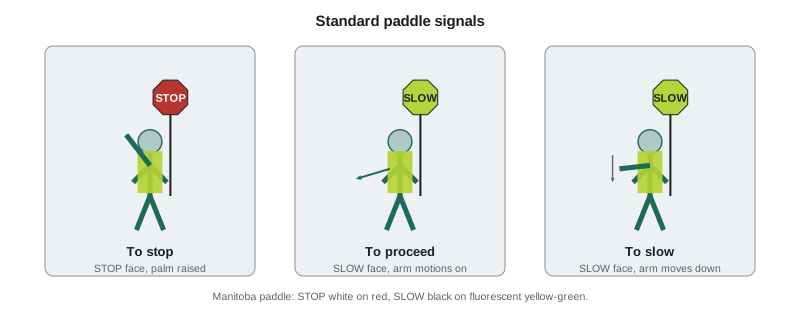
Manitoba flagpersons are trained in the same signals using the provincial paddle, with SLOW in black on fluorescent yellow-green. At night, the signals are repeated with a flashlight and red wand. Flags are not the normal signalling device; in an emergency, before a paddle is available, a red flag can be used to stop traffic.
Methods for alternating one-lane traffic
Traffic control manuals describe several ways of making sure only one direction uses the single lane at a time.
- Flagpersons at each end with radios. The most common method. One flagperson stops their direction, and when the last released vehicle from the other end has passed, the flagpersons confirm by radio before releasing the next group. The flagpersons must agree on a clear way to identify the last vehicle, such as describing it on the radio.
- Flag transfer. On short zones, the driver of the last vehicle in each group is handed a token, such as a flag or a numbered card, to give to the flagperson at the other end, who then knows it is safe to release traffic. It works only where the zone is short and drivers can be trusted to cooperate.
- Pilot car. On long zones, a marked pilot vehicle leads each group through the work area and then turns around to lead the next group the other way. A flagperson at each end controls the queue, and the pilot car tells them when its group is through. Side roads and driveways within the zone also need control, or drivers may join the lane behind the pilot car going the wrong way.
- Temporary traffic signals. Portable signals at each end, timed so that each direction has enough time to clear the single lane before the other gets a green. They need an all-red clearance interval long enough for the slowest vehicle to get through.
- STOP or YIELD control. On very low-volume roads with short closures and good visibility, a STOP or YIELD sign facing one direction can work, with the other direction given priority.
- Automated flagger assistance devices, covered below.
Getting the timing right
Whatever the method, the single lane must be clear before the other direction is released. The time a group needs to clear the zone depends on its length and speed. Owen asked Nadia to check the timing for the Birch Street closure.
# Clearance time and queue length for an alternating one-lane closure (illustrative).
zone_length_m = 120          # from one control station to the other
speed_kmh = 25               # speed through the narrowed lane
arrivals_per_hour = 240      # vehicles per hour in each direction
green_s = 45                 # time each direction is released
v = speed_kmh / 3.6
clear_s = zone_length_m / v
cycle_s = 2 * (green_s + clear_s)
stopped_s = cycle_s - green_s
queue = arrivals_per_hour / 3600 * stopped_s
print(f"Clearance time through the zone: {clear_s:.0f} s")
print(f"Full cycle: {cycle_s:.0f} s; each direction waits about {stopped_s:.0f} s")
print(f"Queue at the end of the red: about {queue:.0f} vehicles, roughly {queue * 7:.0f} m long")Clearance time through the zone: 17 s Full cycle: 125 s; each direction waits about 80 s Queue at the end of the red: about 5 vehicles, roughly 37 m long
With a 120 m zone at 25 km/h, each group takes about 17 seconds to clear, and each direction waits about 80 seconds, with a queue of about five vehicles at Birch Street's traffic volume. The queue is short enough that it does not reach back to the intersection with Larch Avenue, so the advance warning signs on Birch Street were enough. On a busier road, a queue that reached past the first warning sign would mean extending the advance warning area, as lesson 3 explained.
Automated flagger assistance devices
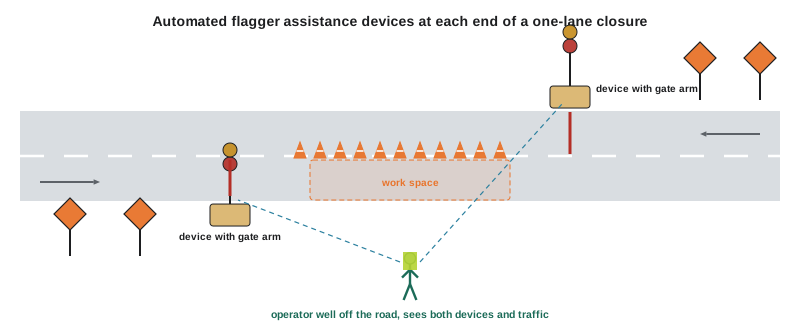
An automated flagger assistance device (AFAD) is a portable unit, usually on a trailer, that displays the stop and go messages that a flagperson would otherwise give with a paddle. The flagperson controls it remotely from a safe position off the road, often with a clear view of both ends of the zone. Manitoba's regulation lists automatic or remote-controlled traffic control systems among the protective measures employers may use where traffic creates a risk, and the provincial manual and road authorities set out how they may be used. The idea is simple and powerful: the device stands beside the traffic so the person does not have to.
AFADs are not a way to save on staffing at the expense of safety. They still need advance warning signs, a flagperson ahead or similar sign, a stop line or stop position, a trained operator who stays alert and can see the traffic, and a plan for emergencies and device failure. If the device fails, the operator must be ready to take over with a paddle from a safe position.
Emergency vehicles
Ambulances, fire trucks and police cars must get through work zones quickly. Flagpersons at both ends must agree in advance how they will handle them: the flagperson who first sees or hears the emergency vehicle radios the other end, both ends stop all other traffic, and the emergency vehicle is let through the single lane. Work stops if equipment is blocking the lane. Emergency services should be told in advance about the closure, and the plan should note how long it takes to clear the lane of equipment if they need it.
Talking on the radio
Radio discipline matters. The Birch Street flagpersons used a short script: the flagperson releasing traffic says how many vehicles are coming and describes the last one ('five coming, last is a white van'), the other flagperson confirms when the white van has passed ('white van clear'), and only then releases their own direction. If the radio goes quiet, both ends hold their traffic until contact is restored. Nobody guesses.
Worked problem
The missing last car
Show solution
- At Birch Street, Dev releases six westbound vehicles and radios: 'Six coming, last is a red pickup.'
- At the other end, Ana Reyes, the second flagperson from Red River Traffic Control Ltd., counts five vehicles past her and waits. No red pickup appears.
- Ana radios Dev, who confirms a red pickup went in. Both keep their directions stopped.
- Marco walks up the work space and finds that the pickup has turned into a driveway halfway along the zone to make a delivery and is about to pull back out.
- He holds the pickup until Ana's direction is clear, then lets it out behind the next westbound group. The flagpersons add a line to their briefing: watch for vehicles turning in or out of driveways inside the zone.
Answer: Release the other direction only when the last vehicle has been positively confirmed through. Driveways and side streets inside the zone can hide vehicles.
Temporary signals in more detail
Portable temporary traffic signals are often a good choice for alternating one-lane closures that last several days, such as the Birch Street sewer crossing, because they work day and night without a person standing beside the road. They need careful setup. The signal heads must be clearly visible to approaching drivers, with a stop line or a STOP HERE ON RED sign at each end. The timing must give each direction enough green time for the expected traffic and an all-red clearance interval long enough for the slowest vehicle to get through the single lane; the clearance time worked out above is the minimum. Many portable signals can detect waiting vehicles and adjust the timing. Someone must check them regularly, because a signal that fails, or that is knocked out of alignment, can send both directions into the lane at once. The plan must say who checks them, how often, and what happens if one fails, which is usually that flagpersons take over immediately.
Choosing a method
Owen's notes for choosing a method were short. For a closure of a few hours on a quiet street, flagpersons with radios are simple and flexible. For a closure of several days, temporary signals or AFADs keep people out of the road and work at night. For a long closure on a rural road with driveways, a pilot car keeps groups together. On a busy street, the first question is whether the closure can be avoided altogether with a full block closure and detour, because alternating one-lane traffic on a busy road creates long queues that drivers become impatient with.
Briefing the flagpersons
Before the Birch Street closure opened each morning, Marco and the traffic control supervisor briefed both flagpersons together on the day's plan: when trucks would cross the lane, where the driveways were, the radio channel and script, who to call for an emergency vehicle and what to do if the radio failed. A five-minute briefing turned two people at opposite ends of a work zone into one team.
Common mistakes
MistakeWaving traffic on with improvised gestures.
InsteadUse the standard paddle signals so every driver understands them.
MistakeReleasing traffic because the other end has probably cleared.
InsteadConfirm by radio that the last vehicle has passed before releasing the other direction.
MistakeUsing an arrow board in arrow mode on an alternating one-lane closure.
InsteadUse caution mode only on two-lane, two-way roads.
MistakeTreating an AFAD as unattended equipment.
InsteadA trained operator must control it and watch the traffic throughout.
MistakeLeaving emergency vehicle handling to chance.
InsteadAgree in advance how both ends will stop traffic and clear the lane for emergency vehicles.
Summary and key terms
- Standard paddle signals: STOP face and raised palm to stop, SLOW face and arm motion to proceed, SLOW face and lowering arm to slow.
- Manitoba flagpersons use the provincial paddle and a flashlight with a red wand at night; red flags are for emergencies.
- Alternating one-lane traffic can be controlled by flagpersons with radios, flag transfer, a pilot car, temporary signals, STOP or YIELD control, or AFADs.
- The single lane must be clear before the other direction is released; clearance time is the zone length divided by speed.
- AFADs let a trained operator control traffic from a safe position off the road, but still need warning signs and an alert operator.
- Plan radio scripts and emergency vehicle handling in advance, and never release traffic on a guess.
- Alternating one-lane two-way traffic
- A closure where traffic in both directions takes turns using a single open lane.
- Flag transfer
- A method where the last driver in a group carries a token to the flagperson at the other end.
- Pilot car
- A marked vehicle that leads a group of vehicles through a long one-lane work zone.
- Automated flagger assistance device (AFAD)
- A remotely operated device that displays stop and go messages so a flagperson can stay off the road.
- Clearance time
- The time needed for the last vehicle in a group to pass through the single-lane section.
- All-red interval
- The period on temporary signals when both directions see red, letting the lane clear.
Practice problems
Work each problem on paper first, then reveal the answer to check.
Describe the signal to stop traffic.
Show answer
Turn the STOP face toward traffic, hold the paddle still, and raise the free arm with the palm toward traffic.
Name four methods of controlling alternating one-lane traffic.
Show answer
Any four of flagpersons with radios, flag transfer, pilot car, temporary traffic signals, STOP or YIELD control, and AFADs.
A zone is 150 m long and traffic moves at 30 km/h. About how long does a group take to clear it?
Show answer
30 km/h is about 8.3 m/s, so about 150 / 8.3 ≈ 18 seconds.
What must an AFAD operator be able to do?
Show answer
See the devices and approaching traffic, control the devices from a safe position, and take over with a paddle if a device fails.
What should both flagpersons do if the radio goes quiet?
Show answer
Hold their traffic stopped until contact is restored.
Lesson quiz · 5 questions
Score 60% or more to complete this lesson.
Create a free account to save your progress, take quizzes and earn a certificate.