
HSE-373 · Lesson 3 of 12 · 20 min
Parts of a temporary traffic control zone
Every temporary traffic control zone, from a two-hour curb lane closure on a city street to a months-long highway project, is built from the same four parts. Drivers meet them in order: first they are warned, then they are guided out of their normal path, then they pass the work, and finally they are returned to normal driving. When Red River Traffic Control Ltd.'s traffic control supervisor, Nadia Kozak, trains new crew members, she starts by walking them along Larch Avenue in the direction of traffic, naming each part as they reach it. This lesson follows the same walk.
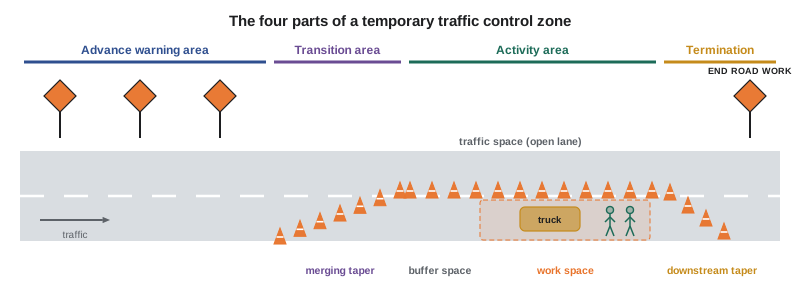
1. The advance warning area
The advance warning area tells drivers what is ahead before they reach it. It usually starts with a sign such as ROAD WORK AHEAD and continues with signs that explain what drivers will have to do: a lane closed ahead, a lane ending, a flagperson ahead, a reduced speed or a detour. Drivers need time to read each sign, understand it, decide what to do and do it. That time translates into distance, which is why the advance warning area gets longer as speeds rise.
On a slow city street such as Larch Avenue, posted at 50 km/h, the advance warning area might be only a block long, with signs a few dozen metres apart. On a provincial highway posted at 100 km/h, it may stretch for well over a kilometre, with signs hundreds of metres apart, and it may start with a portable changeable message sign several kilometres upstream warning of delays. The spacing comes from the manual's tables, which lesson 5 covers.
The advance warning area must account for the queue. If traffic is expected to back up past the first sign, drivers at the back of the queue get no warning at all and may run into stopped vehicles at full speed. Where queues are likely, the warning area is extended, signs are added further upstream, and on high-speed roads queue warning systems or a protection vehicle at the back of the queue may be used.
2. The transition area
The transition area is where drivers are moved out of their normal path. It is made with a taper: a line of channelizing devices, such as cones, tubular markers or drums, set at an angle to guide traffic out of the closed lane or shoulder and into the open lane. Different tapers do different jobs.
- Merging taper. Closes a lane on a multilane road, so drivers must merge into the adjacent lane. It is the longest taper because drivers must find a gap in moving traffic.
- Shifting taper. Moves traffic sideways into a new path without reducing the number of lanes, as when lanes are shifted onto a shoulder or temporary pavement. It can be about half as long as a merging taper.
- Shoulder taper. Closes a shoulder that drivers might otherwise use. It can be about a third as long as a merging taper.
- One-lane, two-way taper. Used with flagpersons or temporary signals when one lane of a two-lane road is closed and traffic in both directions takes turns using the open lane. It is short, because drivers are stopped or slowed before they reach it.
- Downstream taper. Returns traffic to its normal path at the end of the work. It is short and is covered under the termination area.
Lesson 7 shows how to calculate taper lengths. The key point here is that the transition area is where drivers make their biggest change, so it must be long enough, clearly marked and free of surprises such as workers, parked trucks or materials.
3. The activity area
The activity area is where the work happens and where traffic passes it. It has three parts.
- Buffer space. An empty area between the transition area and the work space, or between the traffic and the work space at the side, that gives a driver who misjudges the taper room to stop or recover before reaching workers. A longitudinal buffer runs along the lane, upstream of the work; a lateral buffer runs between the traffic lane and the work space. Nothing should be stored or parked in a buffer, and workers should not stand in it. On high-speed roads, a protection vehicle with a truck-mounted attenuator is often parked at the upstream end of the work space, inside or just past the buffer, to absorb the impact of a vehicle that gets through.
- Work space. The area closed to traffic and set aside for workers, equipment and materials. It may be fixed, as for the water service connection on Larch Avenue, or it may move along the road, as for line painting or sweeping. It should be clearly marked with channelizing devices along its edge, and its own internal traffic, trucks backing in and out, is controlled by the internal traffic control plan.
- Traffic space. The part of the road where traffic passes the activity area. It must be wide enough for the vehicles that use the road, including buses and trucks, and free of drop-offs, debris and equipment that could catch a vehicle.
The edge between the traffic space and the work space is the most important line in the whole zone. Every worker should know where it is and stay on the work side of it. When the work requires someone to cross it, for example to adjust a sign or move a cone, the move should be planned and quick, made facing traffic, and ideally made when traffic has been stopped.
4. The termination area
The termination area returns drivers to normal. It often has a short downstream taper to let traffic move back into the closed lane, and an END ROAD WORK sign or similar to tell drivers the zone is over. Without a termination area, drivers may not know when they can return to normal speed or lane use, and some will stay slow and confused while others speed up early, right beside the end of the work space.
Lengths add up
The total length of a work zone is the sum of its parts, and on a short city block the parts may not fit. Nadia uses a simple program to check whether a planned closure fits between intersections before she draws it.
# Does a curb-lane closure fit on one block of Larch Avenue? (illustrative lengths in m)
block_length = 260          # distance between intersections
advance_warning = 0         # signs placed on the approach block, not on this block
merging_taper = 60          # from the taper formula in lesson 7
longitudinal_buffer = 65    # stopping sight distance at 50 km/h
work_space = 75             # gate apron and pump truck footprint
downstream_taper = 15
needed = merging_taper + longitudinal_buffer + work_space + downstream_taper
print(f"Closure needs {needed} m of the {block_length} m block")
spare = block_length - needed
print("Fits" if spare >= 0 else "Does not fit", f"(spare {spare} m)")
# A driveway inside the taper would need its own treatment
driveways = [("cafe parking lot", 90), ("office loading dock", 230)]
for name, x in driveways:
    zone = "taper" if x < merging_taper else "buffer" if x < merging_taper + longitudinal_buffer else \
           "work space" if x < merging_taper + longitudinal_buffer + work_space else "after work space"
print(f" {name} at {x} m falls in the {zone}")Closure needs 215 m of the 260 m block Fits (spare 45 m) cafe parking lot at 90 m falls in the buffer office loading dock at 230 m falls in the after work space
The check showed that the closure fitted, with 45 m to spare, but also that the café's parking lot entrance fell in the buffer space. Drivers turning into or out of the lot would cross the buffer. Red River Traffic Control Ltd. adjusted the layout so the driveway stayed open with a gap in the cones and a sign for drivers leaving the lot, and the gate crew knew to watch for cars turning across the buffer.
The advance warning signs for the closure were placed on the approach block, west of the intersection, so drivers would see them before turning onto the closure block. Where intersections and side streets feed traffic into the middle of a work zone, drivers entering from the side street also need warning, usually a ROAD WORK AHEAD sign or its equivalent on the side street.
The principles behind every zone
Traffic control manuals in both countries rest on the same basic principles, and Nadia makes new crew members repeat them until they can say them without thinking.
- Safety for workers and road users comes first, and the zone must be planned before the work starts.
- Inhibit traffic as little as practical. Close the fewest lanes for the shortest time, and do noisy or disruptive work outside peak hours where possible.
- Guide drivers clearly. Use standard signs and devices, give enough warning, and avoid sudden changes.
- Inspect routinely. Check the zone at set-up, during the shift and at night, and fix anything missing, damaged or moved.
- Pay attention to roadside safety. Keep drop-offs, equipment, materials and parked vehicles out of the clear zone where errant vehicles could hit them.
- Train everyone. Everyone who works in or plans the zone should be trained for their role.
- Keep the public informed. Tell residents, businesses, transit and emergency services about closures and detours.
Worked problem
The cone that moved
Show solution
- Two hours into a curb lane closure, Nadia drives through the zone on her routine check and notices that the third cone in the taper has been knocked over and dragged into the open lane.
- Without it, the taper has a gap, and two drivers have cut through it into the buffer before swerving back out.
- She stops in the protected work space, walks back along the shoulder facing traffic, waits for a gap, and resets the cone, then adds a weighted base to it because the wind from passing buses keeps moving it.
- She logs the problem and the fix on the inspection sheet, and asks the gate crew to radio her if cones move again.
- On the next shift, Red River Traffic Control Ltd. replaces the lightweight cones in the taper with taller weighted ones.
Answer: A zone is only as good as its last inspection. Devices get hit, blown over and moved, and someone must be responsible for checking and fixing them throughout the shift.
Side streets, driveways and businesses
Real streets are full of entry points. Every driveway, side street and alley inside a work zone is a place where a driver can enter the zone without passing the advance warning signs, or turn across the buffer or work space. The plan should show each one and say how it is handled: kept open with a gap in the devices and a sign for drivers leaving, closed with the owner's agreement and an alternative access, or controlled by a flagperson during truck movements. Business owners care a great deal about access, and a short conversation before the closure, explaining when and how their entrance will be affected, prevents most complaints.
Common mistakes
MistakePlacing the first warning sign right at the start of the taper.
InsteadAdvance warning comes well before the transition area, far enough for drivers to read, decide and act.
MistakeParking a pickup or storing materials in the buffer space.
InsteadThe buffer stays empty so an errant vehicle has room to stop before reaching workers.
MistakeLeaving out the termination area to save cones and signs.
InsteadDrivers need a downstream taper and END ROAD WORK sign to know the zone is over.
MistakeIgnoring the queue that will form during peak traffic.
InsteadExtend the advance warning area upstream of the expected queue.
MistakeAssuming side streets and driveways inside the zone will sort themselves out.
InsteadPlan warning and access for every entry point within the zone.
Summary and key terms
- Every temporary traffic control zone has four parts: advance warning, transition, activity and termination.
- The advance warning area tells drivers what is ahead and must extend beyond the expected queue.
- The transition area uses tapers: merging, shifting, shoulder, one-lane two-way and downstream, each with a different length.
- The activity area contains the buffer space, the work space and the traffic space; the buffer stays empty.
- The termination area returns traffic to normal with a downstream taper and an END ROAD WORK sign.
- Zones are planned before work starts, guide drivers clearly, are inspected throughout the shift and keep the public informed.
- Advance warning area
- The part of a work zone where drivers are told what is ahead.
- Transition area
- The part of a work zone where traffic is moved out of its normal path, usually with a taper.
- Taper
- A line of channelizing devices set at an angle to move traffic out of or back into a lane.
- Buffer space
- An empty area that separates traffic from the work space and gives an errant vehicle room to stop.
- Work space
- The part of a work zone closed to traffic and used by workers, equipment and materials.
- Termination area
- The part of a work zone where traffic returns to its normal path.
Practice problems
Work each problem on paper first, then reveal the answer to check.
List the four parts of a temporary traffic control zone in the order a driver meets them.
Show answer
Advance warning area, transition area, activity area and termination area.
What are the three parts of the activity area?
Show answer
The buffer space, the work space and the traffic space.
Why must the advance warning area account for the queue?
Show answer
If the queue backs up past the first sign, drivers at the back get no warning and may hit stopped traffic.
Which taper is longest, and why?
Show answer
The merging taper, because drivers must find a gap and merge into moving traffic in the adjacent lane.
What problem did the length check on Larch Avenue reveal?
Show answer
A café driveway fell in the buffer space, so the layout had to keep it open with a gap and a sign.
Lesson quiz · 5 questions
Score 60% or more to complete this lesson.
Create a free account to save your progress, take quizzes and earn a certificate.