
HSE-373 · Lesson 2 of 12 · 20 min
The rules: Manitoba's regulation, traffic manuals and the road authority
Before Tallgrass could close a lane of Larch Avenue for the first delivery, Owen Hartley had to answer three questions. Which workplace safety rules apply to people working near traffic? Which traffic control manual sets the standard for the signs, devices and layouts? And who owns the street and has to give permission? The answers come from three different places, and a contractor who knows only one of them will get something wrong.
Layer 1: workplace safety law
Part 20 (Vehicular and Pedestrian Traffic) of the Workplace Safety and Health Regulation applies wherever vehicle traffic creates a risk to the safety or health of a worker. It requires the employer to develop and implement safe work procedures for that work, train workers in them and make sure they are followed. Section 20.5(2) lists the protective measures the employer must choose from where traffic creates a risk: warning signs, barriers, lane control devices, flashing lights, flares, conspicuously identified pilot vehicles, automatic or remote-controlled traffic control systems, speed restrictions and designated flagpersons. One or more must be used, and in practice a city lane closure uses several of them together.
Section 20.6 adds specific rules for flagpersons. A flagperson must hold a valid training certificate from a provider approved by the director, must have shown that they can apply that training at the particular workplace, and must carry the certificate. The employer must provide a reflective STOP/SLOW paddle, high-visibility apparel meeting CSA Z96 Class 3, Level 2 in fluorescent yellow-green, fluorescent headwear with retroreflective material for night work, and a way to communicate with other flagpersons when they cannot see each other. At night, the flagperson also needs a flashlight with a red signalling wand. Personal electronic devices, such as phones and music players, are not allowed while flagging, other than the approved communication device. Lesson 8 goes through these rules in detail.
Layer 2: the traffic control manual
Workplace safety law says what the employer must do; a traffic control manual says how. In Canada, the Transportation Association of Canada's Manual of Uniform Traffic Control Devices for Canada (MUTCDC) is the national reference. Its sixth edition was published in 2021, and it includes a part on temporary conditions such as work zones. Provinces and large cities adapt it into their own manuals. Manitoba's highway department publishes Manitoba's Work Zone Traffic Control Manual for work on provincial highways, with standard layouts, sign sizes, spacing tables, taper lengths and policies such as the use of the MAXIMUM 60 WHEN PASSING WORKERS sign. The City of Winnipeg sets its own requirements and permits for work on city streets, which draw on the same national and provincial guidance. For Larch Avenue, a city street, the City's requirements govern, and for the sister job's driveway tie-in on a provincial highway posted at 100 km/h, the provincial manual governs.
Traffic manuals use a deliberate vocabulary. A shall statement (a standard) is mandatory. A should statement (guidance) is the recommended practice unless engineering judgment or a study shows a good reason to do otherwise. A may statement (an option) is allowed but not required. Supervisors who write or review traffic control plans need to know which kind of statement they are relying on, because departing from guidance without a documented reason is hard to defend after a crash.
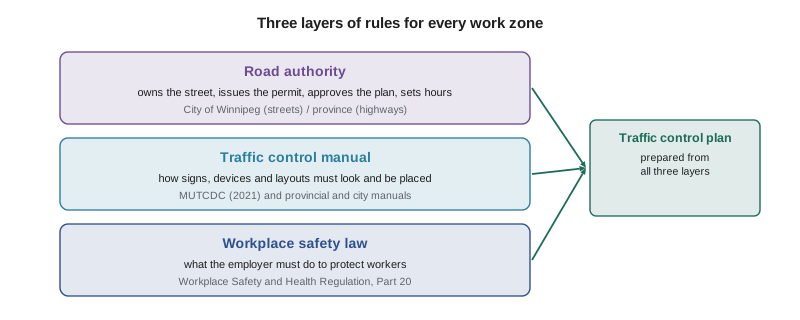
Layer 3: the road authority
The road authority owns the road and decides who may work on it. For Larch Avenue, that is the City of Winnipeg, which issues a permit to occupy or obstruct the street, may require a traffic control plan stamped or prepared by a qualified person, may restrict closures to certain hours to avoid rush hour, and can inspect the setup or revoke the permit. Transit, emergency services and nearby businesses have to be told when bus stops are moved or access changes. For a provincial highway posted at 100 km/h, the road authority is Manitoba Transportation and Infrastructure, which sets its own requirements for permits, layouts and approved traffic control contractors.
A permit is not a substitute for the safety rules, and the safety rules are not a substitute for a permit. On the Cottonwood Place job, the City's permit set the hours (closures only between 9:00 and 15:30 on weekdays, except under a separate night permit), the City approved the standard layout for the curb lane closure, and the workplace safety rules governed how Tallgrass and Red River Traffic Control Ltd. protected their workers inside that layout.
Traffic law and enforcement
Drivers are bound by traffic law, not by the workplace safety regulation. Manitoba's Highway Traffic Act requires drivers to obey flagpersons and traffic control devices, and speeding fines double in a designated construction zone, marked by signs at the start and end of the zone. Police enforcement, photo enforcement where it is authorized and paid police presence on major projects all support the plan, but none of them replaces good layout and worker protection.
Who does what on Cottonwood Place
Owen wrote a short responsibility list for the traffic control on the project and put it in the site safety plan.
- The prime contractor (Tallgrass Construction Ltd.) coordinates all work near traffic on the site, gets the City permit, makes sure every subcontractor working near traffic follows the plan, and controls deliveries so trucks do not arrive before a closure is set up.
- Red River Traffic Control Ltd. prepares the traffic control plans for the City, supplies and maintains signs and devices, provides certified flagpersons for the larger closures, and employs the traffic control supervisor who sets up, inspects and removes each closure.
- Each employer whose workers are exposed to traffic, such as Silva Earthworks and the concrete pumping subcontractor, has its own duty under Part 20 to assess the hazard, choose protective measures and train its workers, even when it works inside Red River Traffic Control Ltd.'s setup.
- Workers follow the plan, stay inside the protected area, report missing or damaged devices and refuse work that puts them in danger.
- The City approves the plan and permit and inspects.
A compliance check before the first closure
Owen built a small checklist program for each closure request. It checks that the three layers are covered before a closure goes on the schedule.
# Pre-closure compliance check (invented data for one closure request).
request = {
    "permit number on file": True,
    "permit hours cover the work": True,
    "traffic control plan approved by road authority": True,
    "plan uses current manual layouts": True,
    "flaggers trained, proof of training on site": True,
    "high-visibility apparel to required class": True,
    "advance warning signs and taper in plan": True,
    "pedestrian route in plan": False,
    "deliveries held until setup confirmed": True,
}
missing = [k for k, ok in request.items() if not ok]
print(f"{len(request) - len(missing)} of {len(request)} items in place")
for k in missing:
    print("  missing:", k)
print("Closure may go on the schedule:", "yes" if not missing else "no")8 of 9 items in place missing: pedestrian route in plan Closure may go on the schedule: no
On the first run, the pedestrian route was missing: the standard layout closed the curb lane but said nothing about the sidewalk beside the gate, where people waited for the bus. Red River Traffic Control Ltd. added a protected sidewalk route and moved the bus stop marker with the transit agency's agreement before the closure was approved.
Worked problem
Which rule decides the flagperson's vest?
Show solution
- A new flagperson from a staffing agency arrives at the Larch Avenue gate wearing an orange vest with narrow reflective strips and no sleeves.
- Owen checks Part 20: a flagperson in Manitoba must wear CSA Z96 Class 3, Level 2 apparel in fluorescent yellow-green. A sleeveless vest cannot meet Class 3, which needs sleeves or trousers with retroreflective bands.
- The flagperson is given a compliant jacket from Red River Traffic Control Ltd.'s truck before starting work.
- Owen adds a line to the gate checklist: apparel class checked before every shift.
Answer: The workplace safety rule sets the minimum for worker protection; the traffic manual and the site plan may add to it. Check both.
When the rules disagree
Sometimes the layers seem to pull in different directions. The road authority's permit may allow a closure only from 9:00 to 15:30, while the concrete supplier wants to start the pour at 6:00. The manual's layout may call for a taper longer than the block allows. A subcontractor's own safety program may require a barrier where the City's standard drawing shows only cones. Owen's rule on the Cottonwood Place job was simple: follow the most protective requirement, and where two requirements genuinely cannot both be met, stop and resolve it with the people who wrote them before the work starts.
In practice that meant three conversations. The pour start was moved to fit the permit, or a separate early-start permit was requested from the City with a plan to match. The taper problem was solved by moving the advance warning signs and the start of the taper to the approach block, which the City approved. And where a subcontractor's program asked for more protection than the standard drawing, Tallgrass provided it, because nothing in the permit or the manual forbids a contractor from protecting workers better than the minimum.
Keeping records
Records show that the rules were followed, and they matter when something goes wrong. For every closure, Tallgrass kept the permit, the approved traffic control plan and any revisions, the flagpersons' training certificates and the record of each flagperson's workplace competency check, the inspection sheets filled in by the traffic control supervisor at set-up and during the shift, and notes of any incidents, near misses or complaints. A safety and health officer from the Branch, the City's inspector or a lawyer after a crash will ask for exactly these documents.
Good records also help the next job. When a closure works well, its plan and inspection notes become the starting point for the next similar closure. When something goes wrong, the records show what was in place and what needs to change, so the same mistake is not repeated on the next block or the next project.
Questions to ask before any work near traffic
Before any crew works near traffic on the job, the foreman can answer five questions in a minute. Who owns this road, and do we have their permit for today and this time? Which plan covers this work, and is it the current revision? Which layout in the manual does it follow, and has anything on site changed since it was drawn? Who is the traffic control supervisor, and how do I reach them? Are the people directing traffic trained, equipped and carrying proof? If the foreman cannot answer one of these, the work waits until they can.
Common mistakes
MistakeAssuming the road authority's permit covers worker safety.
InsteadThe permit controls use of the road; the workplace safety rules still govern how workers are protected.
MistakeUsing an old edition of the traffic manual because the layouts are familiar.
InsteadUse the edition the road authority currently requires, and check for revisions.
MistakeTreating should statements as optional.
InsteadGuidance is the expected practice unless a documented engineering reason supports something else.
MistakeLeaving traffic control entirely to the traffic control subcontractor.
InsteadEvery employer whose workers are exposed must protect them, and the prime contractor coordinates the whole site.
MistakeRelying on police or doubled fines to protect workers.
InsteadEnforcement supports a good plan but does not replace separation, warning and safe worker positions.
Summary and key terms
- Part 20 (Vehicular and Pedestrian Traffic) of the Workplace Safety and Health Regulation requires safe work procedures and one or more protective measures, from signs and barriers to flagpersons, wherever traffic creates a risk; section 20.6 sets flagperson training, apparel and equipment rules.
- The MUTCDC (sixth edition, 2021) is the national reference; Manitoba's Work Zone Traffic Control Manual covers provincial highways and the City of Winnipeg sets requirements for city streets.
- Manuals use shall (mandatory), should (recommended) and may (optional) statements.
- The road authority owns the road, issues permits, approves the plan and sets hours.
- Traffic law binds drivers: they must obey flagpersons, and speeding fines double in a designated construction zone.
- The prime contractor, the traffic control contractor, each exposing employer and each worker have their own duties.
- Road authority
- The government body that owns and controls a road, issues permits for work on it and approves traffic control plans.
- Standard (shall)
- A mandatory requirement in a traffic control manual.
- Guidance (should)
- The recommended practice in a traffic control manual, departed from only with a documented reason.
- Option (may)
- A practice that a traffic control manual allows but does not require.
- Substantial conformance
- The requirement that a state or provincial manual meet the intent and key requirements of the national manual.
- Right-of-way permit
- Permission from the road authority to occupy or obstruct a road or sidewalk for work.
Practice problems
Work each problem on paper first, then reveal the answer to check.
Name five protective measures listed in section 20.5(2) of the Manitoba regulation.
Show answer
Any five of warning signs, barriers, lane control devices, flashing lights, flares, pilot vehicles, automatic or remote-controlled traffic control systems, speed restrictions and designated flagpersons.
Which manual governs the curb lane closure on Larch Avenue?
Show answer
The City of Winnipeg's requirements for city streets, which draw on the MUTCDC and the provincial manual.
What is the difference between a shall and a should statement?
Show answer
A shall statement is mandatory; a should statement is recommended practice that may be departed from only with a documented engineering reason.
What three things did the City's permit control on the Cottonwood Place job?
Show answer
The hours of closures, approval of the layout, and the right to inspect and revoke the permit.
Why was the first closure request held back?
Show answer
The plan had no protected pedestrian route past the gate and bus stop.
Lesson quiz · 5 questions
Score 60% or more to complete this lesson.
Create a free account to save your progress, take quizzes and earn a certificate.