
HSE-373 · Lesson 1 of 12 · 22 min
Work zone deaths and who is at risk
At 6:40 on a Tuesday morning in May, a dump truck heading for the Cottonwood Place site turned onto Larch Avenue, the busy street on the north side of the job. Dev Sandhu, who had finished his flagperson course two weeks earlier, was standing in the curb lane beside the gate in his high-visibility vest and hard hat, holding his STOP/SLOW paddle and waiting for the truck so he could stop traffic and let it back in. A pickup coming the other way drifted across the centre line while the driver looked at a phone. It missed Dev by less than a metre, clipped a cone and kept going. Nobody was hurt. By eight o'clock, the workplace safety and health committee was looking at why a new worker had been standing in a live lane at all.
This course is about that line between the work and the traffic. It covers how temporary traffic control zones are laid out, how signs, cones, barriers and arrow boards are chosen and spaced, how flagpersons are trained and positioned, how night work and short-duration work are protected, and how traffic inside a site, especially backing trucks and machines, is planned so that workers on foot are not run over by their own equipment. This first lesson looks at the numbers: who gets hurt, how and why.
Two kinds of traffic hazard
Workers near traffic face two separate groups of vehicles, and a good plan treats them differently.
- Passing traffic. Members of the public driving past or through the work zone. They do not work for anyone on the site, they may be tired, distracted, speeding or impaired, and they have no idea where workers are standing. The controls for them are separation, warning, speed reduction and guidance: signs, cones and barriers, tapers, flagpersons, arrow boards, police presence and, on high-speed roads, truck-mounted attenuators and concrete barriers.
- Construction traffic. The dump trucks, ready-mix trucks, excavators, loaders, rollers, telehandlers, pickups and delivery vehicles that belong to the work. Their drivers are part of the job, but they often cannot see workers on foot, especially behind them. The controls are an internal traffic control plan, separation of people from machines, spotters, cameras and alarms, and rules about where people may walk.
Both kill workers. On highway projects, passing traffic causes many of the deaths. Inside work zones and on building sites, construction vehicles and equipment, especially when backing, cause a large share as well. Lesson 12 deals with construction traffic in detail. Lessons 2 to 11 deal mostly with passing traffic, but always with an eye on the trucks that have to get in and out of the zone.
What the numbers show
Canada does not publish a single national count of work zone deaths, and provincial workers' compensation boards record fatalities by industry and cause rather than by whether a road was involved. What the data do show is consistent. Being struck by a vehicle or mobile equipment is one of the leading causes of death in Canadian construction, road builders and flagpersons are among the most exposed workers, and drivers are injured and killed in work zones every year. In 2013 Manitoba responded to injuries and close calls by doubling speeding fines in designated construction zones, and its workplace safety regulation sets specific training and equipment requirements for flagpersons. Other provinces have taken similar steps. Because Canadian data are scattered, Canadian safety associations often use the larger US data set to show the size of the problem, and so does this lesson.
The FHWA's fact sheet for National Work Zone Awareness Week 2026 reported 905 people killed in US work zones in 2023 and 850 in 2024, a drop of about 6 percent, which still works out to more than two deaths a day. Most of the people killed were drivers and passengers: 709 in 2023 and 673 in 2024. People on foot or on bicycles, a group that includes construction, maintenance and utility workers, made up 187 of the deaths in 2023 and 169 in 2024.
| Factor in fatal work zone crashes (US) | 2023 | 2024 |
|---|---|---|
| People killed in work zones | 905 | 850 |
| Drivers and passengers killed | 709 | 673 |
| Pedestrians and cyclists killed, including workers | 187 | 169 |
| Share of fatal crashes involving a rear-end collision | 21 % (173) | 22 % (169) |
| Share of fatal crashes involving a large truck or bus | 31 % (257) | 31 % (236) |
| Share of fatal crashes where speeding was a factor | 29 % (242) | 34 % (262) |
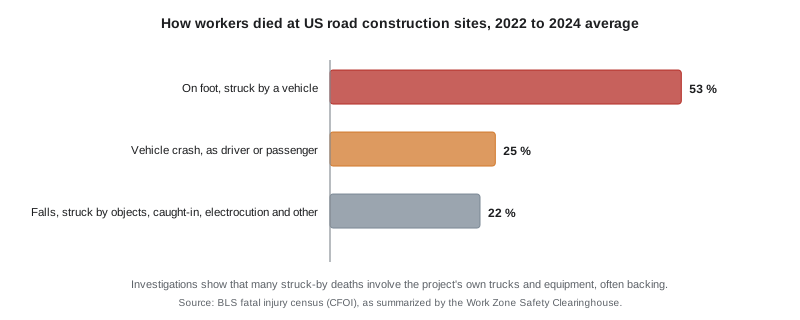
Worker deaths are counted separately. According to the Clearinghouse's summary of CFOI data, between 82 and 143 workers were killed each year at US road construction sites from 2015 to 2024, between 1.6 and 2.8 percent of all US worker deaths, and the number rose in 2024 after several years of decline. Over 2022 to 2024, more than half of these workers (about 53 percent) were on foot and struck by a vehicle, about a quarter died in crashes while driving or riding in a vehicle, and the rest died from falls, being struck by objects, being caught in equipment, electrocution and other causes. The data do not always separate passing motorists from construction vehicles, but investigations by the National Institute for Occupational Safety and Health (NIOSH) have shown for decades that a large share of the struck-by deaths involve the project's own trucks and equipment, often backing.
Why work zones are so dangerous
A work zone breaks almost every expectation a driver has about a road. Lanes end, shift or narrow. The pavement may be rough or have a drop-off at the edge. Signs, cones and machines crowd the edge of the lane. Traffic slows and queues suddenly, and drivers at the back of a queue may not expect it. Workers on foot, who are rare on most roads, are suddenly within arm's reach of the traffic. The research and crash investigations point to a short list of recurring problems.
- Speed. Drivers often keep their normal speed through work zones, especially when no workers are visible. Speeding was a factor in about a third of fatal US work zone crashes in 2024. Speed lengthens stopping distance and makes every mistake worse.
- Inattention and distraction. Phones, navigation screens and fatigue mean drivers miss signs and react late to stopped traffic or a flagperson.
- Rear-end crashes at queues. About one fatal work zone crash in five in the US involves a rear-end collision, often a truck hitting stopped or slowing traffic at the back of a queue that has formed upstream of the work.
- Large trucks. About three fatal work zone crashes in ten involve a large truck or bus. Heavy vehicles need longer to stop and do far more damage.
- Night work. More than half of fatal US work zone crashes in 2024 happened at night, when drivers see less, are more likely to be impaired or tired and are less likely to expect workers.
- Poor layouts. Tapers that are too short, signs that are too close together or hidden, missing advance warning, cones too far apart and confusing lane shifts all leave drivers with too little time to understand what they need to do.
- Workers in the wrong place. Flagpersons standing in the lane, workers stepping out from behind equipment, crews working outside the protected area, and people walking behind backing trucks.
Who is at risk
On the Cottonwood Place project, Owen Hartley, the Tallgrass Construction Ltd. safety coordinator, listed every group that would work near traffic over the life of the job. The list was longer than most people expected.
- Flagpersons, who stand closest to moving traffic and whose job is to stop it.
- Traffic control crews from Red River Traffic Control Ltd., who set out and remove signs, cones and arrow boards, often while traffic is still moving at full speed.
- Excavation and utility crews, such as Marco Silva's crew from Silva Earthworks connecting the new water service in Larch Avenue.
- Concrete pump operators and finishers working beside the pump truck parked in the curb lane for big pours.
- Crane crews and riggers receiving deliveries in the street, and the signal persons who guide trucks.
- Labourers sweeping the street, cleaning up mud tracked onto it and placing and checking cones.
- Surveyors setting out points in the road and sidewalk.
- Truck drivers getting out of their cabs to tarp loads, check tickets or talk to the gate.
- Inspectors, engineers and visitors who walk around the site perimeter.
- The public: pedestrians, people using wheelchairs and scooters, cyclists, bus passengers waiting at the stop near the gate, and drivers.
Each of these groups needs something different. A flagperson needs a station off the lane, advance warning, an escape route and good visibility. A pump operator needs a protected work area around the outriggers and the controls. A labourer sweeping the street needs either a closed lane or a short-duration plan with a shadow vehicle. Pedestrians need an accessible, protected route past the site. The rest of this course works through these needs one at a time.
A quick risk ranking
Owen uses a simple scoring method to decide which traffic activities need the most attention: likelihood of contact with traffic, from 1 to 5, times the severity, also from 1 to 5, adjusted upward for speed, night work and heavy truck volume.
# Traffic exposure ranking for Cottonwood Place activities (invented scores).
activities = [
    # name, likelihood 1-5, severity 1-5, speed_factor, night
    ("Flagging trucks in at the Larch Avenue gate", 4, 5, 1.0, False),
    ("Setting out cones for a curb-lane closure", 4, 5, 1.0, False),
    ("Water service connection in the street", 3, 5, 1.0, False),
    ("Concrete pump in the curb lane", 3, 4, 1.0, False),
    ("Night crane delivery with street closure", 3, 5, 1.0, True),
    ("Sweeping mud off the street", 3, 4, 1.0, False),
    ("Highway driveway tie-in at a sister job", 3, 5, 1.6, False),
]
rows = []
for name, like, sev, speed, night in activities:
    score = like * sev * speed * (1.3 if night else 1.0)
    rows.append((round(score, 1), name))
for score, name in sorted(rows, reverse=True):
    level = "high" if score >= 18 else "medium" if score >= 12 else "low"
print(f"{score:5.1f} {level:6} {name}")24.0 high Highway driveway tie-in at a sister job 20.0 high Setting out cones for a curb-lane closure 20.0 high Flagging trucks in at the Larch Avenue gate 19.5 high Night crane delivery with street closure 15.0 medium Water service connection in the street 12.0 medium Sweeping mud off the street 12.0 medium Concrete pump in the curb lane
The scores are only a guide, but the order matched the crew's experience. The high-speed highway tie-in at a sister job ranked first, followed by the night delivery, the flagging at the gate and the cone setting. Those activities got written traffic control plans, the most experienced crews and a supervisor's sign-off before each shift.
Worked problem
The near miss at the gate
Show solution
- Dev was standing in the curb lane with no cones or signs set up, waiting for a truck that had not yet arrived.
- Under the site's plan, the gate needed a closed curb lane with advance warning signs and a taper, and Dev's station was supposed to be on the sidewalk side of the cones, not in a live lane. On the morning of the near miss, the traffic control crew from Red River Traffic Control Ltd. had not yet set up the closure, and Dev started early to help a truck that arrived ahead of schedule.
- The investigation found three causes: a truck dispatched before the closure was in place, no rule that flagging could not start until the traffic control supervisor confirmed the setup, and a new worker who did not feel able to refuse.
- Tallgrass changed its delivery rules so that no truck could be dispatched to the Larch Avenue gate before 7:00, when the closure was confirmed, and added a hold point: the traffic control supervisor radios the gate when the setup is complete, and flagging starts only then.
- Carla Mendes, the superintendent, also reminded the whole site at the next toolbox talk that anyone can refuse to stand in a live lane, and that she would back them.
Answer: Most traffic near misses have causes upstream of the person who nearly got hit: scheduling, missing hold points and pressure to get trucks moving. Fix those, and the person at the gate is protected.
Common mistakes
MistakeThinking work zone deaths are mostly the fault of reckless drivers that a site cannot control.
InsteadSpeeding and distraction matter, but layouts, worker positions, scheduling and internal traffic plans are all within the contractor's control.
MistakePlanning only for passing traffic.
InsteadConstruction vehicles, especially backing trucks and equipment, kill many workers inside work zones and need their own plan.
MistakeTreating a short job in the street as too quick to need traffic control.
InsteadShort jobs still put workers next to traffic; they need a short-duration plan with the right signs, devices and vehicles.
MistakeAssuming a vest makes a worker safe in a live lane.
InsteadHigh-visibility apparel helps drivers see workers, but it does not stop a vehicle; separation and position matter more.
MistakeLeaving pedestrians and cyclists out of the plan.
InsteadThe public walking and cycling past the site must have a safe, accessible route.
Summary and key terms
- Workers near roads face two hazards: passing public traffic and the project's own construction vehicles, each with different controls.
- The FHWA reported 905 people killed in US work zones in 2023 and 850 in 2024; most were drivers and passengers, and 169 to 187 a year were people on foot or bicycles, including workers.
- Between 82 and 143 US workers were killed each year at road construction sites from 2015 to 2024, more than half of them on foot and struck by a vehicle.
- Speed, distraction, rear-end crashes at queues, large trucks, night work, poor layouts and workers in the wrong place are the recurring causes.
- Canadian data are scattered, but struck-by deaths are a leading cause in construction, and Manitoba doubled speeding fines in designated construction zones in 2013 and sets specific requirements for flagpersons in its regulation.
- Many groups work near traffic, from flagpersons and traffic control crews to pump operators, surveyors and truck drivers, and the public must be protected too.
- Work zone
- An area of a road or street where construction, maintenance or utility work is going on, marked by signs, devices and other traffic controls.
- Temporary traffic control
- The signs, devices, people and plans used to move traffic safely past or through a work zone for the duration of the work.
- Passing traffic
- Public vehicles travelling past or through a work zone that are not part of the work.
- Construction traffic
- Trucks, machines and other vehicles belonging to the project that move within or into the work zone.
- Struck-by incident
- An incident in which a worker is hit by a moving vehicle, machine or object.
- Queue
- A line of slowed or stopped traffic that forms upstream of a work zone or a flagperson.
Practice problems
Work each problem on paper first, then reveal the answer to check.
Name the two kinds of traffic that put workers at risk, and one control for each.
Show answer
Passing public traffic, controlled by separation, warning signs, tapers, flagpersons and barriers; construction traffic, controlled by an internal traffic control plan, spotters, alarms and keeping people on foot away from machines.
About how many people were killed in US work zones in 2024, and who were most of them?
Show answer
About 850, most of them drivers and passengers.
What share of US worker deaths at road construction sites in 2022 to 2024 involved a worker on foot struck by a vehicle?
Show answer
About 53 percent, more than half.
Give four recurring causes of work zone crashes.
Show answer
Any four of speed, distraction, rear-end crashes at queues, large trucks, night work, poor layouts and workers in the wrong place.
What three upstream causes did the investigation of Dev's near miss find?
Show answer
A truck dispatched before the closure was set up, no hold point stopping flagging until the setup was confirmed, and a new worker who did not feel able to refuse.
Lesson quiz · 5 questions
Score 60% or more to complete this lesson.
Create a free account to save your progress, take quizzes and earn a certificate.