
HSE-373 · Lesson 6 of 12 · 20 min
Channelizing devices, barriers and arrow boards
Signs tell drivers what is coming. Channelizing devices show them, physically, where to go. A line of cones, drums or barricades draws a path through the work zone that a driver can follow without reading anything, even in rain or at night. Barriers go a step further: they do not just show the path, they physically stop a vehicle from leaving it. Arrow boards add a bright, flashing signal that a lane is closed and which way to merge. This lesson covers each of these devices, what it does and does not do, and where it belongs.
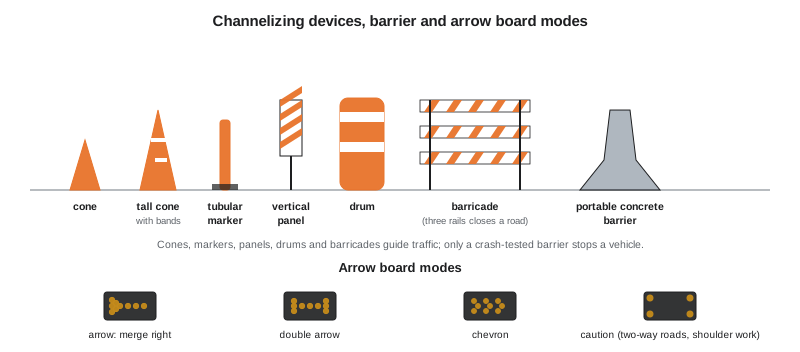
Channelizing devices
Channelizing devices guide traffic. They are designed to be seen and, when hit, to fall over or bend without causing serious damage to the vehicle or its occupants. They do not stop vehicles. That distinction matters: a line of cones beside a trench marks the edge of the work space, but it will not keep a car out of the trench.
- Cones. The most common device, easy to place and remove. Cones about 450 mm tall are used in daylight on low-speed streets; taller cones, about 700 mm or more, with retroreflective bands, are used on higher-speed roads and at night. Cones blow over in wind and from the draft of passing trucks, so they may need weighted bases or added ballast rings.
- Tubular markers. Narrow upright posts, often mounted on a weighted base or glued to the pavement. They take up less room than cones and are useful where space is tight, but they are less visible.
- Vertical panels. Flat panels with diagonal orange and white retroreflective stripes on a post or base. They are visible from far away and useful where space is narrow.
- Drums. Large barrel-shaped devices, about 900 mm tall, with alternating orange and white retroreflective bands. Drums are highly visible, look substantial to drivers and do not blow over easily, so they are the usual choice on highways and for longer-term closures.
- Barricades. Frames with one, two or three striped horizontal rails. A barricade with three rails is used to close a road or ramp completely; barricades with fewer rails mark the edge of an excavation or work area.
- Longitudinal channelizing devices. Lightweight, water-filled or interlocking plastic units that form a continuous wall. They guide traffic and pedestrians and are easy to move, but unless they are tested and accepted as barriers, they do not stop vehicles.
Spacing of channelizing devices
Devices must be close enough together that drivers see a continuous line, especially at night. Manitoba's Work Zone Traffic Control Manual and the City's standard drawings give the spacing for each speed. In the taper, where drivers are changing lanes, devices are closer together; along the work space, where drivers are going straight, they can be spaced further apart. A rough check used by many supervisors, borrowed from the US manual, is that the spacing in a taper in metres should be no more than about a fifth of the speed in km/h, and about twice that along the work space.
Barriers
Where the consequences of a vehicle entering the work space are severe, channelizing devices are not enough. Deep excavations, workers in a long-term work space beside high-speed traffic, a drop-off of more than a few centimetres at the pavement edge, and bridge decks with open edges all need positive protection: a barrier that can stop or redirect a vehicle.
- Portable concrete barriers are the most common. They are heavy precast sections connected end to end. When hit, they deflect a little and redirect the vehicle, so the work space behind them must be set back far enough from the barrier to allow for that deflection. Workers must not stand in the deflection zone behind the barrier.
- Water-filled and steel barriers that have been crash-tested and accepted for the speed can be used where concrete is too heavy or where barriers must be moved often. Many water-filled devices are channelizing devices only, so the supervisor must check the approval.
- End treatments. The blunt end of a barrier facing traffic is a severe hazard. It must be flared away from traffic, buried, or fitted with a crash cushion, or the end must be outside the clear zone.
- Truck-mounted and trailer-mounted attenuators are energy-absorbing cushions on the back of a heavy truck or trailer parked or moving upstream of the work. They protect workers in mobile and short-term work, and lesson 11 covers how they are used.
Barrier systems used on Canadian highways are generally those tested and accepted by the road authority, often using test criteria developed in the United States. The supervisor uses the road authority's list of accepted products and follows the manufacturer's installation instructions, including the required set-back for deflection.
Arrow boards
An arrow board, sometimes called a flashing arrow panel, is a large panel of lights mounted on a trailer or truck. It is the most visible signal in a work zone and is used mainly on multilane roads to tell drivers that a lane is closed and which way to merge. It has four display modes.
- Flashing or sequential arrow: a lane is closed; merge in the direction of the arrow.
- Double arrow: traffic may pass on either side.
- Sequential chevron: a lane is closed; merge in the direction shown.
- Caution mode: four corner lights or a horizontal bar, used when there is work on or near the shoulder but no lane is closed, or on two-lane two-way roads.
Two rules prevent dangerous misuse. First, an arrow pointing to the left or right is used only on multilane roads where drivers can actually merge into another lane going the same way. Second, on a two-lane, two-way road, where one lane is closed and traffic takes turns with flagpersons, an arrow board must be in caution mode only, because an arrow could send drivers into the oncoming lane. Arrow boards are placed at the start of the taper, on the shoulder or in the closed lane, and are sized for the speed: small boards for low-speed city streets, large boards for highways.
Flashing and steady-burn lights
Flashing warning lights on barricades and drums draw attention to a single hazard, such as the start of a closure. Steady-burn lights mounted in a line on channelizing devices at night help define the path drivers should follow. Flashing lights should not be used in a line along a taper, because a row of flashing lights is confusing and makes it hard to see the path.
Pedestrian devices
Where a sidewalk is closed or narrowed, pedestrian channelizing devices must be detectable to people who are blind or have low vision. That usually means a continuous bottom rail or edge close to the ground that a white cane can find, and a top rail at a height people can use for guidance, with no gaps between units. Cones and barricades with open bottoms are not detectable and should not be used alone to define a pedestrian route. Lesson 12 returns to pedestrian protection.
Choosing devices
Nadia uses a short decision program when she drafts a plan, to suggest a starting device type from the speed, the duration and whether workers will be exposed to a severe hazard.
# Suggest a starting device type for the edge of a work space (simplified, illustrative rules).
def suggest(speed_kmh, days, severe_hazard, night):
    if severe_hazard and speed_kmh >= 60:
        return "crash-tested barrier with end treatment and set-back for deflection"
    if severe_hazard:
        return "barrier or protected work space; at minimum drums with close spacing"
    if speed_kmh >= 70 or days > 3:
        return "drums or tall cones with retroreflective bands"
    if night:
        return "tall retroreflective cones with steady-burn lights"
    return "standard cones"
cases = [
    ("Larch Ave gate closure, day", 50, 1, False, False),
    ("Water service trench in street", 50, 4, True, False),
    ("Night crane erection", 50, 1, False, True),
    ("Highway driveway tie-in", 100, 6, True, False),
]
for name, s, d, sev, n in cases:
print(f"{name:32} -> {suggest(s, d, sev, n)}")Larch Ave gate closure, day -> standard cones Water service trench in street -> barrier or protected work space; at minimum drums with close spacing Night crane erection -> tall retroreflective cones with steady-burn lights Highway driveway tie-in -> crash-tested barrier with end treatment and set-back for deflection
The water service trench on Larch Avenue was 2.4 m deep, beside an open lane at 50 km/h, for four days. The program suggested a barrier or protected work space. Red River Traffic Control Ltd. closed both lanes on that block for the deep work, which removed traffic from beside the trench completely, rather than relying on cones a metre from the edge.
Worked problem
The arrow board on Larch Avenue
Show solution
- For the first curb lane closure, Red River Traffic Control Ltd. brought a small arrow board on a trailer and set it at the start of the taper showing a flashing arrow to the left.
- Larch Avenue is a two-lane one-way street, so drivers in the closed right lane could merge left into a lane going the same way: the arrow was correct.
- A week later, the same crew set up a closure on a two-lane, two-way side street for a utility crossing, with flagpersons at each end, and the arrow board was set to a flashing arrow again.
- Owen spotted it during his inspection: an arrow on a two-way road could send drivers into the oncoming lane. The board was switched to caution mode immediately.
- The crew's set-up checklist now asks: is this a two-lane, two-way road? If yes, arrow board in caution mode only.
Answer: Arrow boards are powerful signals. Use arrows only where drivers can merge into another lane going the same way; otherwise use caution mode.
Device condition
Devices wear out. Cones get crushed, their retroreflective bands peel, drums get dented and dirty, and barricade rails crack. A device that is damaged or dirty may not be visible at night and makes the zone look neglected, which encourages drivers to take it less seriously. Many road authorities use a simple rating system: acceptable, marginal (replace soon) or unacceptable (replace now). Red River Traffic Control Ltd.'s crews checked devices when loading the truck each morning and pulled damaged ones out of service, and the traffic control supervisor swapped out any that got damaged during the shift. Clean, upright, complete devices are part of the message that the work zone is real and the rules apply.
Storing devices on site
Devices not in use should be stored off the road and out of the clear zone, not stacked on the shoulder or the sidewalk, where they can be hit, blown into traffic or block pedestrians. Barriers and drums left lying beside an open lane become hazards themselves.
Common mistakes
MistakeUsing a line of cones as protection beside a deep trench next to traffic.
InsteadCones guide drivers but do not stop vehicles; use a barrier, a buffer or close the lane.
MistakeLeaving the blunt end of a concrete barrier facing traffic.
InsteadFlare it away, bury it, fit a crash cushion or keep the end out of the clear zone.
MistakeLetting workers stand right behind a concrete barrier.
InsteadKeep workers out of the deflection zone behind the barrier.
MistakeShowing a flashing arrow on a two-lane, two-way road.
InsteadUse caution mode only on two-lane, two-way roads.
MistakeDefining a pedestrian detour with cones only.
InsteadUse detectable pedestrian channelizing devices with a continuous bottom edge.
Summary and key terms
- Channelizing devices, from cones and tubular markers to vertical panels, drums and barricades, guide traffic but do not stop vehicles.
- Device spacing comes from the road authority's tables, closer in tapers than along the work space.
- Barriers provide positive protection where a vehicle entering the work space would be catastrophic; they need end treatments and set-back for deflection.
- Arrow boards have arrow, double arrow, chevron and caution modes; arrows are used only on multilane roads, and only caution mode on two-lane, two-way roads.
- Steady-burn lights define a path at night; flashing lights mark a single hazard.
- Pedestrian channelizing devices must be detectable by white cane, with a continuous bottom edge.
- Channelizing device
- A device such as a cone, drum or barricade that guides traffic along a path.
- Positive protection
- A device, such as a barrier, that physically prevents vehicles from entering the work space.
- Deflection
- The distance a barrier moves sideways when struck by a vehicle.
- End treatment
- A way of protecting the exposed end of a barrier, such as flaring, burying or a crash cushion.
- Arrow board
- A trailer- or truck-mounted panel of lights that shows arrows, chevrons or a caution display.
- Detectable edge
- A continuous edge at the bottom of a pedestrian device that a white cane can find.
Practice problems
Work each problem on paper first, then reveal the answer to check.
What is the key difference between a channelizing device and a barrier?
Show answer
A channelizing device guides traffic but does not stop vehicles; a barrier physically stops or redirects them.
Name the four arrow board modes.
Show answer
Flashing or sequential arrow, double arrow, sequential chevron and caution mode.
Why must workers stay out of the area just behind a concrete barrier?
Show answer
The barrier deflects sideways when struck, and workers in the deflection zone could be hit.
Why are cones alone not suitable for a pedestrian detour?
Show answer
They have open bottoms and gaps, so a person using a white cane cannot detect the route.
Why did Tallgrass close both lanes beside the 2.4 m trench?
Show answer
Because a vehicle entering the work space would be catastrophic, and cones would not stop it; closing the lanes removed the traffic.
Lesson quiz · 5 questions
Score 60% or more to complete this lesson.
Create a free account to save your progress, take quizzes and earn a certificate.