
HSE-373 · Lesson 5 of 12 · 20 min
Signs: types, sizes, placement and spacing
Signs are a driver's first contact with a work zone, and often the only information a driver gets before meeting a taper, a flagperson or a stopped queue. A good sign is the right sign, big enough, placed where drivers will see it, far enough ahead to act on, and clean, upright and working. A bad sign, or a sign that says something that is no longer true, is worse than none, because it teaches drivers to ignore signs. This lesson covers the signs used in temporary traffic control and how they are chosen, sized, placed and spaced.
Three kinds of sign
- Regulatory signs tell drivers what the law requires: speed limits, lane use, no passing, stop, do not enter, road closed. They are usually rectangular, with black on white, and disobeying them is an offence. A reduced work zone speed limit is a regulatory sign and normally needs the road authority's approval.
- Signs that warn tell drivers about conditions ahead that they might not expect: road work, a lane closed, a flagperson, a lane shift, an uneven pavement edge, trucks entering. In work zones they are normally diamond-shaped with black symbols or words on a fluorescent orange background, which sets them apart from permanent yellow warning signs.
- Guide signs help drivers find their way, for example through a detour, and in work zones they are often orange with black text.
the Transportation Association of Canada's Manual of Uniform Traffic Control Devices for Canada (MUTCDC) uses a TC (temporary condition) series for work zone signs, such as the construction ahead sign, lane closure symbol signs and the flagperson ahead sign, many of which use symbols rather than words so they can be understood in English and French and by drivers who read neither. Manitoba's Work Zone Traffic Control Manual uses the same national signs and adds policies, such as the MAXIMUM 60 WHEN PASSING WORKERS sign for provincial highways where the posted limit is 60 km/h or more. Manitoba also uses signs marking the start and end of designated construction zones, where speeding fines are doubled.
Size and visibility
Sign size grows with speed, because drivers need to read signs from further away and in less time. Work zone warning signs on urban streets are commonly 600 to 750 mm across, and on rural highways and freeways 900 mm to 1,200 mm across, with the exact sizes set out in the manual's tables for each sign and speed. Signs must be retroreflective, so they shine back in vehicle headlights at night. Fluorescent orange sheeting is the norm for temporary warning signs because it stands out in daylight, at dusk and in poor weather.
Placement
- On the right side of the road, where drivers expect signs. On multilane roads with a closure on the left, on one-way streets with two or more lanes, and on divided highways, signs are commonly placed on both sides, so drivers in every lane can see one.
- Clear of obstructions. Parked vehicles, trees, other signs, utility poles and the work itself can hide a sign. The traffic control supervisor drives the approach at the posted speed to check that each sign can be seen.
- At the right height. Portable signs on stands are mounted at least about 300 mm (1 ft) above the road surface so they can be seen over low vehicles; signs mounted on posts are higher, typically around 2 m (7 ft) to the bottom of the sign in urban areas where pedestrians and parked cars could block them, and lower in rural areas.
- Stable and crashworthy. Sign stands must be weighted with low-mounted sandbags, never with rocks, concrete blocks or other objects that become missiles when a vehicle hits them. Stands and supports should be the crashworthy types accepted by the road authority.
- Not in the pedestrian route. Signs on stands placed on a sidewalk must leave enough clear width for wheelchairs and must be detectable by people using white canes.
Spacing
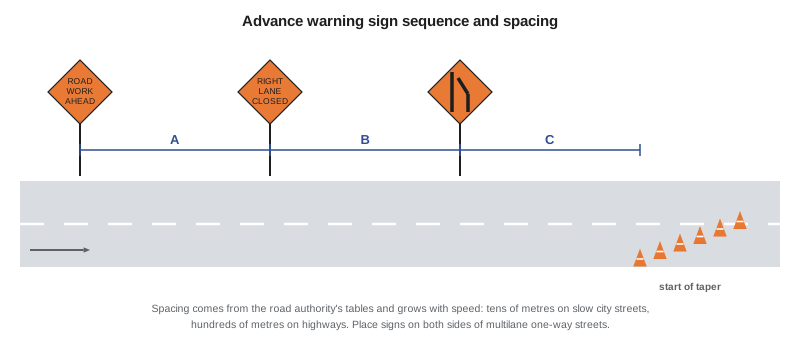
Spacing between signs gives drivers time to read each sign, understand it and act before reaching the next one or the taper. Higher speeds need longer spacing because drivers cover more ground per second.
Manitoba's Work Zone Traffic Control Manual and the City's standard drawings give spacing distances by speed. On low-speed city streets, signs may be a few dozen metres apart; on a provincial highway posted at 100 km/h, spacing is measured in hundreds of metres, and the first sign may be more than a kilometre before the taper. The supervisor uses the table for the road authority that owns the road, not a rule of thumb.
A useful way to understand spacing is to think in seconds. A driver needs roughly two to three seconds to read and understand a simple sign, and more for a complex one or for a decision such as changing lanes. At a given speed, those seconds become a distance.
# How far does a driver travel while reading and acting on a sign?
def m_per_s(kmh):
    return kmh / 3.6
def feet_per_second(mph):
    return mph * 5280 / 3600
for kmh in (50, 60, 80, 100):
    d = m_per_s(kmh) * 6       # 6 s to read, decide and begin a lane change
    print(f"{kmh:>3} km/h: {d:5.0f} m covered in 6 s")
for mph in (30, 35, 45, 65):
    d = feet_per_second(mph) * 6
print(f"{mph:>3} mph: {d:5.0f} ft covered in 6 s")50 km/h: 83 m covered in 6 s 60 km/h: 100 m covered in 6 s 80 km/h: 133 m covered in 6 s 100 km/h: 167 m covered in 6 s 30 mph: 264 ft covered in 6 s 35 mph: 308 ft covered in 6 s 45 mph: 396 ft covered in 6 s 65 mph: 572 ft covered in 6 s
At 50 km/h, a driver covers about 83 m in six seconds; at 100 km/h, about 167 m. That is why the spacing in the manual roughly doubles or triples as speed rises, and why the advance warning area on a highway is so long.
Portable changeable message signs
Portable changeable message signs, the trailer-mounted electronic signs often seen before major work zones, are useful for warning of delays, closures, detours and dates of future work. They are not a substitute for the standard static signs required by the plan. Messages should be short, with no more than two phases (screens) and a few words per line, so drivers can read them at speed. A common failure is a long message that scrolls through several screens: drivers can read only part of it before they pass the sign.
Keeping signs honest
Signs must match what drivers will actually find. A ROAD WORK AHEAD sign left out over the weekend when no work is happening, or a lane closed sign standing beside an open lane, teaches drivers to ignore signs. The rules of thumb on the Cottonwood Place job were simple.
- Cover or remove signs as soon as the condition they describe ends, including overnight when a daytime closure is lifted.
- Use proper covers that block the whole sign face. Do not turn signs sideways or lay them flat in the ditch, where they can still be seen or blown back up.
- Inspect signs at set-up, at least once during each shift and at night, for visibility, position, damage and dirt.
- Clean signs that get splashed with mud or concrete.
- Replace damaged, faded or bent signs, which lose retroreflectivity and look neglected.
Worked problem
The sign behind the bus
Show solution
- On the first morning of the curb lane closure, the second advance warning sign is placed on the sidewalk side of the approach block, according to the plan.
- At 8:15 a city bus stops at the stop beside it, completely hiding the sign from drivers in both lanes for about a minute every few minutes.
- Nadia drives the approach, sees the problem and moves the sign 30 m upstream, past the bus stop, and adds a matching sign on the left side of the one-way street.
- She records the change on the plan revision log and sends it to the City for approval, which comes back the same day.
- On later closures, the standard plan for that block shows signs on both sides and the second sign upstream of the bus stop.
Answer: Drive the approach at the posted speed after set-up. A sign that cannot be seen does not exist for the driver.
Signs for special situations
A few situations need extra signs beyond the standard sequence. Where trucks enter and leave a site across traffic, a truck entrance or trucks entering warning sign upstream of the gate tells drivers to expect slow, heavy vehicles. Where the pavement edge has a drop-off or the surface is rough, signs warning of an uneven lane or a low shoulder are used. Where a sidewalk is closed, a SIDEWALK CLOSED sign with an arrow to the alternative route is placed at the previous intersection so pedestrians can choose their route before reaching the closure, not halfway along the block. Where a bike lane is closed, a sign tells cyclists whether to merge into traffic or use another route. Where workers will be present at night or the closure stays overnight, signs must be retroreflective and the arrangement must make sense in the dark.
Common sign problems found in inspections
When Owen reviewed inspection sheets from the first two months of the Cottonwood Place job, the same few problems came up again and again: signs blown over in wind because the sandbags were too small, signs turned sideways by passing trucks, signs hidden by parked vehicles or by the bus at the stop, signs left out after the closure was lifted, and a sign on the wrong side of the street after a crew set it up in a hurry. Each problem had a simple fix: bigger sandbags and wind-rated stands, a check of every sign at mid-shift, parking restrictions on the approach block, a sign removal step in the take-down sequence and a printed copy of the plan in every truck. None of the fixes cost much, and together they made the zone noticeably clearer for drivers.
Who may place a sign
Placing and removing signs is itself one of the most exposed jobs in traffic control. On the Cottonwood Place job, only Red River Traffic Control Ltd.'s trained crew placed signs on Larch Avenue and Birch Street, working from the protected side of their truck where possible, facing traffic and wearing Class 3 apparel. Other workers who noticed a fallen or misplaced sign reported it by radio rather than walking out to fix it, which kept untrained people out of the road and made sure every change was recorded on the plan.
Common mistakes
MistakeWeighting sign stands with concrete blocks or rocks.
InsteadUse low-mounted sandbags or the manufacturer's ballast so nothing becomes a missile when hit.
MistakePlacing signs only on the right side of a one-way street with several lanes.
InsteadPlace signs on both sides where drivers in other lanes might not see the right side.
MistakeUsing small signs on a high-speed road because they are easier to carry.
InsteadUse the size the manual requires for the speed.
MistakeLeaving work zone signs up when no work is happening.
InsteadCover or remove them so drivers keep trusting signs.
MistakeWriting long, multi-screen messages on changeable message signs.
InsteadKeep messages to two phases and a few words per line.
Summary and key terms
- Regulatory signs state legal requirements, warning signs alert drivers to conditions, and guide signs help them find their way.
- Temporary warning signs are fluorescent orange, retroreflective and sized for the speed of the road.
- Place signs where drivers expect them, on both sides where needed, clear of obstructions, at the right height and on crashworthy, properly ballasted supports.
- Spacing comes from the road authority's tables and grows with speed; on highways the first sign may be more than a kilometre before the taper.
- Portable changeable message signs supplement, not replace, the static signs, and messages should be short.
- Signs must always match what drivers will find: cover or remove them when the condition ends, and inspect them every shift.
- Regulatory sign
- A sign that tells drivers what the law requires, such as a speed limit or lane restriction.
- Temporary warning sign
- A sign that alerts drivers to a condition ahead; in work zones usually a fluorescent orange diamond.
- Retroreflective
- Able to reflect light back toward its source, so a sign shines in headlights at night.
- Sign spacing
- The distance between successive advance warning signs and between the last sign and the taper.
- Portable changeable message sign
- A trailer-mounted electronic sign that can display changing text messages.
- Crashworthy
- Designed and tested to break away or yield safely when struck by a vehicle.
Practice problems
Work each problem on paper first, then reveal the answer to check.
What colour and shape are temporary warning signs in work zones?
Show answer
Diamond-shaped with black symbols or text on a fluorescent orange background.
Why are signs placed on both sides of a one-way street with several lanes?
Show answer
Drivers in lanes away from the right side may not see a sign on the right, especially if traffic or buses block it.
How should sign stands be weighted?
Show answer
With low-mounted sandbags or approved ballast, never with rocks or concrete blocks.
About how far does a driver travel in six seconds at 100 km/h (about 62 mph)?
Show answer
About 167 m (about 550 ft).
What should happen to signs when a daytime closure is lifted overnight?
Show answer
They should be fully covered or removed.
Lesson quiz · 5 questions
Score 60% or more to complete this lesson.
Create a free account to save your progress, take quizzes and earn a certificate.