
HSE-373 · Lesson 12 of 12 · 20 min
Internal traffic control: backing, spotters, blind spots, pedestrians and the public
Most of this course has been about protecting workers from public traffic. This last lesson turns inward, to the trucks and machines that belong to the job. Investigations of road construction deaths keep finding the same story: a worker on foot, often the person directing traffic or checking grade, is run over by a dump truck, roller or loader from their own project, very often while it is backing. On a building site the story is the same: a labourer walking behind a reversing telehandler, a spotter who stepped into a blind spot, a delivery driver who got out of the cab and walked behind another truck. This lesson covers internal traffic control plans and the protection of pedestrians and the public around the site.
The internal traffic control plan
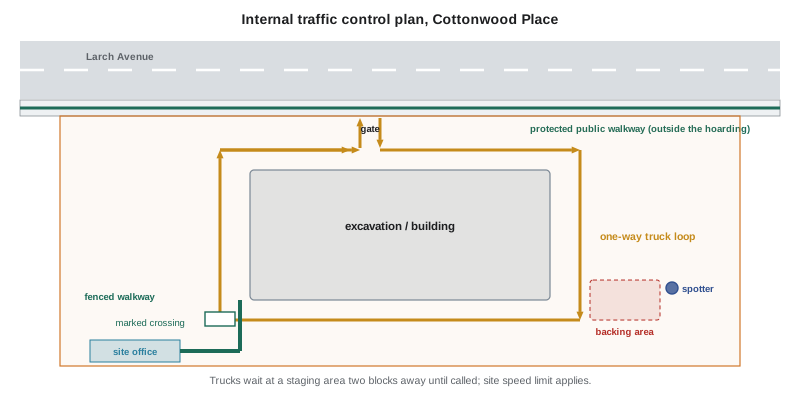
An internal traffic control plan (ITCP) is a plan for how vehicles, equipment and people move inside the work space. It is the counterpart of the traffic control plan for public traffic. The idea, developed by road builders and safety researchers in the United States in the early 2000s, is simple: decide in advance where trucks and machines will travel, where people on foot may go, and how the two are kept apart, rather than letting it happen by habit.
A good ITCP for the Cottonwood Place site covered:
- Haul routes for trucks entering, moving through and leaving the site, preferably one-way loops so trucks drive forward and rarely reverse.
- Backing areas, kept to a minimum, each with a designated spotter position and a no-walk zone.
- Pedestrian routes for workers on foot, separated from haul routes by barriers, fencing or at least clear markings, with marked crossing points.
- Equipment work areas, where excavators, loaders and rollers operate, with exclusion zones around their swing and travel paths.
- Delivery and staging areas, where trucks wait and unload, away from foot traffic.
- Parking for workers' vehicles, outside the work area.
- Speed limits on site, such as 10 km/h.
- Communication, including radio channels, horn signals and the rules for spotters.
- Who is in charge of each area and when the plan is reviewed, because the site layout changes as the building rises.
Why backing is so dangerous
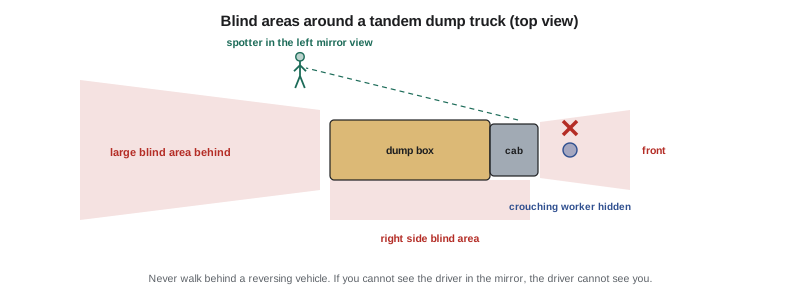
A driver reversing a large truck or machine relies on mirrors and, increasingly, cameras, but large areas around the vehicle cannot be seen. Behind a dump truck there is a blind area that can extend many metres, and beside and in front of tall machines there are areas where a person, especially a short person or someone crouching, disappears below the driver's line of sight. NIOSH has published diagrams of these blind areas for dozens of common machines, and the results surprise most workers: an adult can be completely invisible to the driver while standing only a few metres from the vehicle.
The geometry is easy to see in front of a machine. A driver looks out over the hood or the front edge of the machine, which is lower than their eyes and some distance ahead of them. Anything shorter than that edge is hidden for a certain distance beyond it, along the line from the driver's eyes over the edge to the ground. The program below works out how far.
# How far beyond the hood edge is a person hidden from the driver? (simple sight-line geometry)
def hidden_beyond_edge(eye_h, edge_h, edge_dist, person_h):
    if person_h >= edge_h:
        return 0.0
    return edge_dist * (edge_h - person_h) / (eye_h - edge_h)
machines = [
    # name, driver eye height (m), hood/edge height (m), horizontal distance eye to edge (m)
    ("Pickup truck", 1.4, 1.1, 1.8),
    ("Tandem dump truck", 2.5, 1.9, 2.4),
    ("Loader with bucket raised low", 2.9, 2.2, 3.5),
]
for name, eye, edge, dist in machines:
    adult = hidden_beyond_edge(eye, edge, dist, 1.0)     # a crouching adult or a child
print(f"{name:30} crouching worker hidden for {adult:4.1f} m beyond the front edge")Pickup truck crouching worker hidden for 0.6 m beyond the front edge Tandem dump truck crouching worker hidden for 3.6 m beyond the front edge Loader with bucket raised low crouching worker hidden for 6.0 m beyond the front edge
A crouching worker, such as someone setting grade stakes or picking up a cone, can be hidden for about 3.6 to 6 m (12 to 20 ft) in front of a dump truck or loader. Behind the vehicle, where the driver relies on mirrors, the blind area is usually much larger. That is why the first rule of the ITCP is to plan so that vehicles back up as little as possible, and the second is that nobody walks behind a reversing vehicle.
Controls for backing
Manitoba's regulation requires precautions where the operator of a vehicle or mobile equipment does not have a clear view of the path of travel, such as a signaller to guide the operator, along with requirements for warning devices. Tallgrass's site rules went further.
- Design out backing. One-way loops, drive-through loading positions and turnaround areas mean most trucks never reverse on site.
- Use a spotter wherever backing is needed, trained and dedicated to that task while the truck is moving, not doing other work at the same time.
- Backup alarms, cameras and proximity sensors on all trucks and machines, checked daily. Alarms help, but people get used to them, and on a noisy site many alarms sound at once, so they are never relied on alone.
- No-walk zones marked behind backing areas and around equipment swing paths.
- Drivers stay in the cab in the work space unless they are in a designated safe area, and drivers who get out wear high-visibility apparel.
- Eye contact before approaching. Workers on foot do not approach any machine until the operator has seen them, acknowledged them and stopped or grounded the equipment.
- Speed limits and separation on haul routes.
Rules for spotters
A spotter is a worker whose job is to guide a reversing or manoeuvring vehicle and keep people out of its path. The job looks simple, but spotters themselves are often the people who are hit. On the Cottonwood Place job, every spotter followed the same rules.
- Agree on hand signals and radio words with the driver before the move: start, stop, slow, left, right, distance remaining.
- Stand where the driver can see you, usually to the driver's side rear, in the mirror. If you cannot see the driver's face in the mirror, the driver cannot see you.
- Never stand or walk directly behind the vehicle, and never walk backward while guiding.
- Keep everyone else out of the backing path.
- Give one clear signal at a time, and only one spotter gives signals to a driver.
- The driver stops immediately if they lose sight of the spotter, and stays stopped until they see the spotter again.
- Do not do any other task, such as talking on the phone or checking tickets, while spotting.
Protecting pedestrians and cyclists
The public walking or cycling past a site is part of the traffic control plan. People cannot be expected to step into the road to get around a closed sidewalk, and a detour that is not accessible is no detour at all for someone using a wheelchair, a walker, a stroller or a white cane.
- Keep the sidewalk open if possible, protected by hoarding and, where materials are lifted overhead, a covered walkway.
- If the sidewalk must close, provide an alternative route that is continuous, accessible and protected, such as a temporary walkway in the curb lane separated from traffic by barriers, rather than a sign telling people to cross the street. Where people must cross, the closure should be signed at the previous intersection, not halfway along the block.
- Make the route detectable for people with low vision, with continuous pedestrian channelizing devices that have a detectable bottom edge, and no protruding objects at head height.
- Keep it smooth and wide enough for a wheelchair, with ramps instead of steps, and keep it clear of mud, materials, signs and equipment.
- Protect cyclists. Where a bike lane is closed, sign it in advance and give cyclists a protected route or a clear shared lane.
- Manitoba's accessibility legislation and the City's requirements for work on public streets both expect routes that people with disabilities can use.
Bringing it all together
By the end of the job, Owen had a single page that he used to review every new traffic activity on the site. It asked six questions, drawn from the twelve lessons of this course.
- Who is exposed, to which traffic: public, construction or both? (Lessons 1 and 12)
- Which rules apply, and does the road authority's permit cover this? (Lesson 2)
- Is there a plan, with all four parts of the zone, correct signs, devices, tapers and buffers? (Lessons 3 to 7)
- If people are directing traffic, are they trained, equipped and positioned safely, and is there a safer option such as an automated device? (Lessons 8 and 9)
- Is it night or short-duration work, and is the lighting, apparel and vehicle protection right? (Lessons 10 and 11)
- Inside the site, can trucks avoid backing, are walkways separated, and are spotters trained? Is the public protected? (Lesson 12)
Worked problem
The spotter who stepped back
Show solution
- A ready-mix truck has to back up the last 20 m to the pump hopper because the pump is set up at the end of a dead-end ramp.
- The assigned spotter, a labourer from the concrete crew, starts guiding from the left rear, then walks backward toward the hopper to keep the truck in sight as it turns, stepping into the space between the truck and the pump.
- Owen, watching from the ramp, sounds his air horn. The driver stops immediately, as the site rules require, because the spotter has disappeared from his mirror.
- The move is restarted with the spotter in a fixed position beside the hopper, visible in the mirror, and a second worker keeping the crew clear of the ramp.
- For the next pour, the pump is set up so trucks can drive forward to it, and the backing move is gone.
Answer: Spotters are often the people who are hit. Fixed positions, the driver's stop rule and, best of all, a layout that removes the backing move protect them.
Reviewing the plan as the site changes
The internal traffic control plan at Cottonwood Place changed five times: when excavation started, when the tower crane went up, when the building rose above the hoarding, when the hoist was installed and when landscaping began. Each change moved haul routes, walkways or backing areas, and each time the plan was redrawn, posted at the gate and explained at a toolbox talk before the new layout was used.
Everyone can stop the work
Finally, the plan only works if everyone on site feels able to stop a dangerous movement. On the Cottonwood Place job, any worker who saw a person in a blind area or behind a reversing vehicle could sound an air horn or call stop on the radio, and drivers stopped immediately. Nobody was criticized for a false alarm.
Common mistakes
MistakeRelying on backup alarms alone.
InsteadAlarms help, but use one-way routes, spotters, cameras and no-walk zones as well.
MistakeSpotting while walking backward behind the vehicle.
InsteadStand in a fixed position to the driver's side rear, visible in the mirror.
MistakeApproaching a machine before the operator has seen you.
InsteadMake eye contact and wait for the operator to stop or ground the equipment.
MistakeClosing a sidewalk with a sign telling pedestrians to use the road.
InsteadProvide a continuous, accessible, protected route, or sign the closure at the previous intersection.
MistakeLeaving the internal traffic plan unchanged as the site changes.
InsteadReview the plan whenever haul routes, work areas or the building change.
Summary and key terms
- Many road and building site workers are killed by their own project's trucks and machines, often while backing.
- An internal traffic control plan sets haul routes, backing areas, walkways, equipment zones, staging, parking, speeds and communication.
- Blind areas around large vehicles can hide a worker a few metres away; design layouts to minimize backing.
- Manitoba's regulation requires precautions such as a signaller where the operator's view is obstructed; site rules add alarms, cameras, no-walk zones and eye contact.
- Spotters stand in fixed positions visible in the driver's mirror, never behind the vehicle, and the driver stops if they lose sight of the spotter.
- Pedestrian and cyclist routes must be continuous, accessible, detectable and protected.
- Internal traffic control plan (ITCP)
- A plan for how vehicles, equipment and people move inside the work space.
- Blind area
- An area around a vehicle or machine that the operator cannot see directly or in mirrors.
- Spotter
- A worker who guides a reversing or manoeuvring vehicle and keeps people out of its path.
- No-walk zone
- A marked area, such as behind a backing area, where people on foot may not go.
- Haul route
- The planned path for trucks and equipment moving through a site.
- Accessible route
- A pedestrian route that people using wheelchairs, walkers or white canes can use safely.
Practice problems
Work each problem on paper first, then reveal the answer to check.
Name six things an internal traffic control plan should cover.
Show answer
Any six of haul routes, backing areas, pedestrian routes, equipment work areas, delivery and staging areas, parking, speed limits, communication and who is in charge.
What is the best way to protect workers from backing vehicles?
Show answer
Design the layout so vehicles rarely need to back, for example with one-way loops and drive-through positions.
Where should a spotter stand?
Show answer
In a fixed position to the driver's side rear, where the driver can see them in the mirror, never directly behind the vehicle.
What must a driver do if they lose sight of the spotter?
Show answer
Stop immediately and stay stopped until they can see the spotter again.
What makes a temporary pedestrian route acceptable?
Show answer
It is continuous, accessible to people with disabilities, detectable by white cane, protected from traffic, smooth, wide enough and kept clear.
Lesson quiz · 5 questions
Score 60% or more to complete this lesson.
Create a free account to save your progress, take quizzes and earn a certificate.