
HSE-373 · Lesson 11 of 12 · 20 min
Mobile and short-duration operations, and work in the street beside the site
Not every job in the road lasts long enough to justify a full set of signs, a taper and a buffer. A labourer sweeping mud off Larch Avenue, a surveyor checking a point in the curb lane, a utility locator painting marks, a line painter, a crew patching a pothole: these jobs last minutes, not days, and some of them move along the road as they go. They are some of the most dangerous jobs in temporary traffic control, because the workers are exposed for a short time with less protection, and because the time spent setting up a full zone can be longer than the job itself. This lesson covers how short and moving work is protected, and the everyday work in the street beside a building site: crane deliveries, concrete pumps, bins and cleaning.
How long is the work?
Traffic control manuals sort work by how long it occupies a location, because duration drives the kind of protection that is practical. the Transportation Association of Canada's Manual of Uniform Traffic Control Devices for Canada (MUTCDC) and provincial manuals use categories close to those in the US manual: long-term stationary work that stays for several days or more; intermediate-term work that stays overnight or for a few days; short-term stationary work done within a single daylight period; short-duration work of up to about an hour; and mobile work that moves along the road, stopping briefly or not at all. The road authority's manual gives the exact definitions and the layouts allowed for each.
The longer the work, the more elaborate the protection: long-term zones get fixed signs, drums or barriers, pavement markings for lane shifts and sometimes temporary lighting. Short-duration and mobile work get simpler setups, often built around vehicles with signs, lights and arrow boards. The manuals allow those simplifications because the setup would otherwise expose workers for longer than the work. They do not mean the hazard is lower. Fewer devices must be offset by other protection: vehicles, lights, a spotter and a strict plan.
Protecting short-duration work
On the Cottonwood Place job, the short-duration plan prepared by Red River Traffic Control Ltd. covered sweeping and cleaning the street, minor sign and device repairs, quick surveys and utility locates in the curb lane. It set out a few firm rules.
- Use a work vehicle as protection. A truck with a high-mounted flashing or rotating amber light, an arrow board in caution or arrow mode as appropriate, and a sign on the back such as a lane closed or road work symbol, parked upstream of the workers in the same lane.
- Add a few devices. Even for a 20-minute job, a ROAD WORK AHEAD sign or its equivalent upstream and a short taper of cones in front of the truck guide drivers out of the lane.
- Keep the job truly short. If the work will take more than about an hour, or will continue into rush hour, set up the full plan instead.
- Use a spotter. One worker watches traffic and warns the others with an air horn or radio if a vehicle enters the closed lane.
- Avoid peak hours and work in daylight where possible.
- Never work in a live lane with no protection, not even to pick up a single cone or piece of debris. Wait for a gap and a protected moment, or close the lane.
Mobile operations
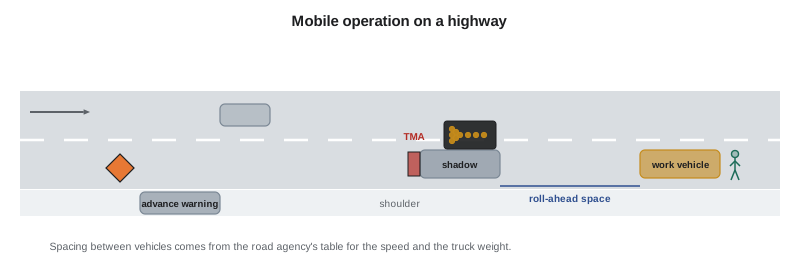
Mobile operations, such as line painting, crack sealing, sweeping, pothole patching and mowing on highways, move along the road. On high-speed roads they are usually protected by a convoy.
- Work vehicle doing the job, with lights and a sign.
- Shadow vehicle, a heavy truck following the work vehicle in the same lane at a set distance, fitted with a truck-mounted attenuator (TMA) and an arrow board. If a vehicle hits the convoy from behind, it hits the cushion on the shadow vehicle instead of the workers.
- Advance warning vehicle, further back, sometimes on the shoulder, with a sign warning of the mobile operation ahead.
The distance between the shadow vehicle and the work vehicle matters. Too close, and a heavy impact pushes the shadow vehicle into the workers. Too far, and drivers cut in between them. Many road agencies publish spacing tables based on speed and the weight of the shadow vehicle. The idea behind them is momentum: when a car hits a parked truck, the truck rolls forward, and the distance it rolls depends on how heavy and fast the car is, how heavy the truck is and how hard the truck's brakes hold.
# Illustrative roll-ahead estimate for a shadow vehicle struck from behind.
# Assumes a fully plastic impact (the two vehicles move together) and the truck braked at friction mu.
def roll_ahead_m(car_kg, car_kmh, truck_kg, mu=0.3):
    v1 = car_kmh / 3.6
    v_after = car_kg * v1 / (car_kg + truck_kg)       # conservation of momentum
    return v_after ** 2 / (2 * mu * 9.81)
for car_kg, kmh in ((1600, 80), (2500, 100), (12000, 90)):
    for truck_kg in (9000, 11000):
        d = roll_ahead_m(car_kg, kmh, truck_kg)
print(f"{car_kg:>6} kg vehicle at {kmh} km/h into {truck_kg} kg truck: rolls about {d:4.1f} m")1600 kg vehicle at 80 km/h into 9000 kg truck: rolls about 1.9 m 1600 kg vehicle at 80 km/h into 11000 kg truck: rolls about 1.4 m 2500 kg vehicle at 100 km/h into 9000 kg truck: rolls about 6.2 m 2500 kg vehicle at 100 km/h into 11000 kg truck: rolls about 4.5 m 12000 kg vehicle at 90 km/h into 9000 kg truck: rolls about 34.7 m 12000 kg vehicle at 90 km/h into 11000 kg truck: rolls about 28.9 m
The estimate shows why a heavy shadow vehicle with its parking brake set and wheels turned away from the work is used, and why the gap between the shadow vehicle and the workers is several times the expected roll-ahead. A car at 80 km/h might push an 11,000 kg truck a metre or more; a loaded truck at highway speed could push it tens of metres. Road agencies' spacing tables are based on crash testing and include a margin. The program is only an illustration, and the agency's table governs.
Work in the street beside the site
Building sites in cities do a surprising amount of work in the street. On the Cottonwood Place job, Owen counted five regular activities, each with its own plan.
- Crane deliveries. Trucks carrying steel, precast and the crane itself parked in the curb lane while the tower crane or a mobile crane lifted the loads. The lift zone under the load must be kept clear of people, which means the sidewalk below may need to be closed or protected and pedestrians held during lifts. A signal person guides the truck into position, and a flagperson may stop traffic briefly while the truck reverses.
- Concrete pumps. A boom pump parked in the curb lane with outriggers extended. The outriggers and pads must stay inside the closed work space, with a buffer to the open lane, and the operator's control position must be protected from traffic. Ready-mix trucks queue to feed the pump and must not queue in the open lane. The boom must never be swung over the open lane or near overhead lines.
- Bins and deliveries. Waste bins and material drops placed in the street need a permit, lights or reflective markings at night and a place that does not block sight lines or the bike lane.
- Cleaning the street. Mud and debris tracked onto the street make it slippery and are a hazard for cyclists. Sweeping is done under the short-duration plan, ideally from inside a closed lane, and a wheel wash or rumble pad at the gate reduces the amount tracked out.
- Sidewalk protection. Where the building is next to the sidewalk, overhead protection (a covered way) and hoarding protect pedestrians from falling objects, and any closure of the sidewalk needs an accessible alternative route, as lesson 12 explains.
The gate
The site gate on Larch Avenue was the busiest and most hazardous point on the job, where construction traffic met public traffic and pedestrians. The plan for the gate brought together everything in this course: a curb lane closure with advance warning and a taper, a flagperson stationed off the lane who stopped traffic briefly for trucks reversing in, a spotter inside the gate for the reversing trucks, a protected pedestrian route across the gate opening with a gate attendant holding pedestrians while trucks crossed, a wheel wash, and signs warning drivers of trucks entering and leaving. Trucks were scheduled so they did not queue in the open lane, and drivers who arrived early waited at a staging area two blocks away, not on Larch Avenue.
Worked problem
Picking up a cone
Show solution
- Late in the afternoon, a wind gust blows a cone from the taper into the middle of the open lane of Larch Avenue.
- A labourer starts to step off the sidewalk to grab it while traffic is moving.
- Dev, at the flagperson station, shouts to stop him and radios the traffic control supervisor.
- The traffic control supervisor waits for the next truck movement, when Dev has stopped traffic, then walks out facing traffic, retrieves the cone and resets it with a weighted base.
- At the next toolbox talk, Carla repeats the rule: nobody enters a live lane for any reason without traffic stopped or the lane closed.
Answer: Short moments in a live lane are where many traffic control workers are hit. Wait for stopped traffic or protection, every time, even for a single cone.
Working at the gate in winter and summer
Weather changes the short-duration plan. In a Winnipeg winter, snowbanks narrow the street, hide signs and bury cones, and early darkness turns afternoon work into night work, so the crew needs drums, lights and cleared sign locations. In a San Antonio summer, heat makes long shifts beside hot pavement exhausting, so tasks are shortened and rotated, water and shade are provided, and the most demanding work is done in the morning. In both places, rain and wet leaves lengthen stopping distances and reduce visibility, which is another reason to extend the advance warning and keep devices clean.
Telling the public
Short jobs still affect the public. Before regular street sweeping and short closures began, Tallgrass told the businesses on the block when they would happen and posted the schedule at the site office, so delivery drivers and customers were not surprised by a closed curb lane.
Common mistakes
MistakeWorking in the road for a few minutes with no protection because the job is quick.
InsteadUse a short-duration plan with a protective vehicle, a sign, a short taper and a spotter.
MistakeLetting a short job run into hours and rush hour under the short-duration setup.
InsteadSet up the full plan if the work will take longer than planned.
MistakeFollowing the work vehicle too closely with the shadow vehicle.
InsteadUse the agency's spacing table so the shadow vehicle has room to roll ahead without hitting workers.
MistakeLetting ready-mix trucks queue in the open lane beside the pump.
InsteadPlan a staging area and a queue inside the closure or off the street.
MistakeSwinging the pump boom over the open lane.
InsteadKeep the boom over the work space and clear of traffic and overhead lines.
Summary and key terms
- Manuals classify work as long-term, intermediate-term, short-term, short-duration or mobile, with layouts for each.
- Simpler setups for short and mobile work must be offset by protective vehicles, lights, a spotter and strict rules.
- Mobile operations on high-speed roads use a work vehicle, a shadow vehicle with a truck-mounted attenuator and arrow board, and an advance warning vehicle.
- Shadow vehicle spacing comes from agency tables based on speed and weight, allowing for roll-ahead.
- Street work beside a building site, including crane deliveries, pumps, bins, cleaning and sidewalk protection, needs its own plans.
- Never enter a live lane, even for a single cone, without traffic stopped or the lane closed.
- Short-duration work
- Work that occupies a location for up to about an hour.
- Mobile operation
- Work that moves along the road, stopping briefly or not at all.
- Shadow vehicle
- A vehicle that follows or parks upstream of workers to protect them from traffic.
- Truck-mounted attenuator (TMA)
- An energy-absorbing cushion mounted on the back of a shadow vehicle.
- Roll-ahead distance
- How far a shadow vehicle is pushed forward when struck from behind.
- Staging area
- A place away from the work zone where trucks wait until they are called in.
Practice problems
Work each problem on paper first, then reveal the answer to check.
List the duration categories used in traffic control manuals.
Show answer
Long-term stationary, intermediate-term stationary, short-term stationary, short-duration and mobile.
What protection should a short-duration job in the curb lane have?
Show answer
A protective vehicle with lights, an arrow board and a sign, an advance sign, a short taper and a spotter.
What three vehicles make up a typical mobile operation convoy on a highway?
Show answer
The work vehicle, a shadow vehicle with a truck-mounted attenuator and arrow board, and an advance warning vehicle.
Why must there be a gap between the shadow vehicle and the work vehicle?
Show answer
Because the shadow vehicle rolls forward when struck, and it must not be pushed into the workers.
Give two controls for a concrete pump in the curb lane.
Show answer
Keep outriggers and pads inside the closed work space with a buffer, protect the operator's position, stage ready-mix trucks off the open lane, and keep the boom away from traffic and overhead lines (any two).
Lesson quiz · 5 questions
Score 60% or more to complete this lesson.
Create a free account to save your progress, take quizzes and earn a certificate.