
HSE-373 · Lesson 10 of 12 · 20 min
Night work, visibility and high-visibility apparel
The tower crane for Cottonwood Place arrived on eleven trucks and was erected over two nights with Larch Avenue fully closed between 21:00 and 05:30. The City would not allow a full daytime closure of a major street, and night was the only option. Night work cuts delays and the number of drivers exposed to the work zone, but it brings its own hazards. Drivers see less and react later. More of them are tired or impaired. Workers are harder to see and more tired themselves. And lights that help the crew can blind passing drivers. This lesson covers how to make night work zones visible and how high-visibility apparel works, day and night.
Why night is different
The FHWA reported that more than half of fatal US work zone crashes in 2024 happened at night, even though far less traffic uses the roads at night. Several things combine.
- Drivers see less. Low-beam headlights light the road for only about 50 to 60 m (roughly 160 to 200 ft) ahead. At highway speeds, that is less than the distance needed to stop, so drivers are effectively driving faster than they can see.
- More drivers are impaired or tired. Alcohol- and drug-impaired driving and drowsy driving are more common late at night.
- Drivers do not expect workers. Most drivers have never seen people working in the road at 2 a.m.
- Workers are harder to see, especially against a dark background or when dazzled by headlights or work lights.
- Workers are tired, especially on the first nights of a night shift, when the body clock is still set for daytime sleep.
Seeing and being seen: the headlight problem
Owen used a short program at the night shift briefing to show the crew why the advance warning area and retroreflective devices matter so much at night.
# How far does a driver travel before stopping, compared with low-beam headlight reach?
def stop_m(kmh, t=2.5, a=3.4):
    v = kmh / 3.6
    return v * t + v * v / (2 * a)
headlight_m = 55        # typical useful reach of low beams on a dark road
for kmh in (50, 70, 90, 100):
    d = stop_m(kmh)
    verdict = "can stop within headlight reach" if d <= headlight_m else "cannot stop within headlight reach"
print(f"{kmh:>3} km/h: needs {d:4.0f} m to stop -> {verdict}")50 km/h: needs 63 m to stop -> cannot stop within headlight reach 70 km/h: needs 104 m to stop -> cannot stop within headlight reach 90 km/h: needs 154 m to stop -> cannot stop within headlight reach 100 km/h: needs 183 m to stop -> cannot stop within headlight reach
At about 50 km/h and above, a driver relying on low beams cannot stop for something that appears at the edge of the light. Retroreflective signs, cones and apparel shine back much further in headlights, often hundreds of metres, which is what gives drivers time to react at night. That is why night closures use larger retroreflective devices, tall cones with bands, drums, steady-burn lights along the channelizing line and longer advance warning.
Lighting the work, not the drivers
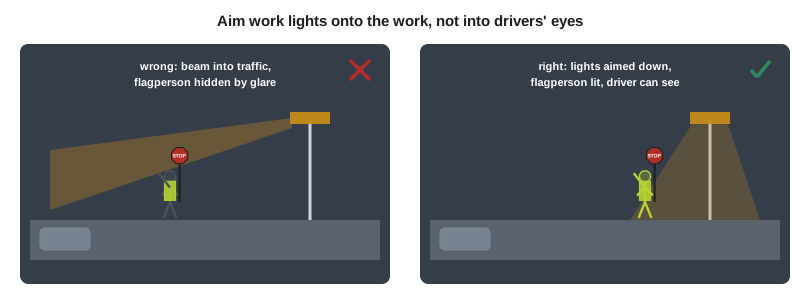
Night work needs light so the crew can see what they are doing and drivers can see the flagpersons. But lights pointed the wrong way blind drivers, who then cannot see the taper, the flagperson or the workers.
- Light levels. Research guidance used by many road agencies in the United States sets three rough levels: about 50 lux (5 foot-candles) for general activity areas and flagperson stations, about 100 lux (10 foot-candles) around equipment and for general construction tasks, and about 200 lux (20 foot-candles) for detailed tasks such as crack sealing or electrical work. The road authority's specifications govern where they exist.
- Flagperson stations must be lit so drivers can see the flagperson, the paddle and the apparel. A flagperson standing just outside a pool of light is nearly invisible.
- Aim lights down and away from traffic. Light towers should be aimed so the bright part of the beam falls on the work, not into drivers' eyes. Balloon lights, which spread light evenly with little glare, are useful near traffic.
- Check from the driver's seat. After the lights are set up, the traffic control supervisor drives through the zone in both directions to check for glare and dark spots, and adjusts the lights before work starts.
- Vehicle lights. Work vehicles' headlights and strobes can also dazzle drivers. Headlights should be off or dipped when vehicles are parked in the work space, and warning lights should be enough to mark the vehicle without blinding.
High-visibility apparel
High-visibility apparel makes workers conspicuous in two ways. Fluorescent material, in fluorescent yellow-green, orange-red or red, glows brightly in daylight and at dusk, because it converts ultraviolet light into visible light. Retroreflective material, the silver bands, sends light from headlights straight back toward the driver, so a worker shines at night. Good apparel uses both, arranged around the body so the human shape is recognizable from any direction. People recognize a human form, especially moving arms and legs, faster than a patch of colour.
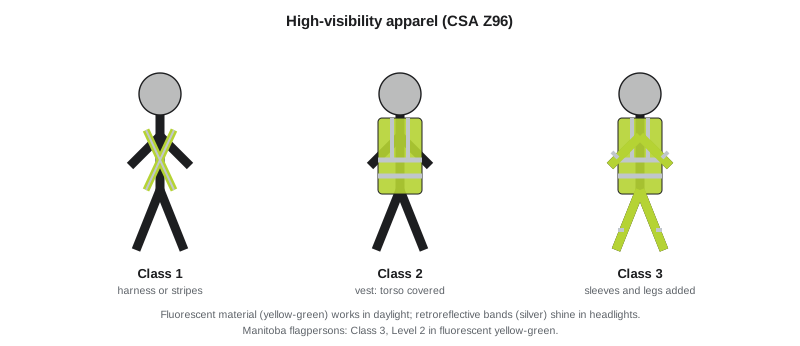
CSA Z96, the Canadian standard for high-visibility safety apparel, groups garments into classes by how much of the body they cover. Class 1 is a harness or stripes; Class 2 covers the torso, like a vest; Class 3 adds bands on the arms and, often, the legs, and gives the most visibility. The standard also sets retroreflective performance levels, with Level 2 the higher. Manitoba requires flagpersons to wear Class 3, Level 2 apparel in fluorescent yellow-green. For other workers exposed to traffic on the Cottonwood Place job, Tallgrass required at least Class 2, with Class 3 at night and for anyone working in the road.
Choosing and caring for apparel
- Choose the colour for the background. Fluorescent yellow-green stands out against most backgrounds, but against autumn leaves, yellow construction equipment or yellow-green signs, orange-red may stand out better; in snow, orange or red may be better than yellow-green. Manitoba requires fluorescent yellow-green for flagpersons.
- Wear it properly. A vest must be fastened, not open and flapping, and must not be covered by a backpack, a tool belt or a winter coat. Winter jackets and rain gear should themselves be high-visibility garments of the right class.
- Keep it clean. Dirt, concrete and grease reduce both fluorescence and retroreflectivity. Wash apparel as the label says; harsh washing destroys retroreflective bands.
- Replace it. Fluorescent colours fade in sunlight, and retroreflective bands crack and peel. Faded, torn or heavily soiled apparel should be replaced. Many contractors replace vests at least yearly, and sooner when they look worn.
- Label check. The garment label shows the standard, class and level or type. Apparel without a label cannot be relied on.
Night shift health and fatigue
The first nights of a night shift are the most dangerous for workers, because the body clock still expects sleep. On the crane erection, Tallgrass and the crane company planned the shift around fatigue: a briefing at the start of each night with the plan, the hazards and the radio channels; a break every two hours with food and hot drinks; flagpersons rotated every hour and a half; no worker on a night shift after a full day shift; and a supervisor watching for signs of fatigue, such as slow reactions, nodding and mistakes. Workers driving home after the shift were encouraged to nap first or share rides.
Worked problem
The flagperson nobody could see
Show solution
- On the first night of the crane erection, the flagperson at the east end of the closure stands just beyond the edge of a light tower's beam, in front of a dark-coloured building.
- During her drive-through at 21:30, Nadia sees the paddle only at the last moment, and the flagperson's jacket only when her headlights reach it.
- She moves a small balloon light to the flagperson station, so the flagperson stands in an evenly lit area, and turns the tower head away from westbound drivers, who were getting glare in their eyes.
- She also replaces the flagperson's faded jacket with a new Class 3 jacket from the truck.
- On her second drive-through, the flagperson is visible from well before the flagperson ahead sign.
Answer: At night, check the zone from the driver's seat. Light the flagperson, not the drivers, and make sure apparel is bright enough to work.
Planning a night closure
The crane erection plan included a separate section for night work that went beyond the daytime layout. It set the hours and the City's night permit conditions; added portable changeable message signs on the main approaches a week ahead, warning of the closure dates; specified drums with steady-burn lights instead of cones along the closure; set out light tower positions, aiming and the drive-through glare check; named a traffic control supervisor who stayed on site all night and inspected the zone every hour; listed the detour route, which was also signed and lit; arranged for police to be on site at the busiest points; and set rules for noise near the apartments on the next block, such as no tailgate banging and backup alarms that adjust their volume to the surroundings. Residents and businesses on the block received a notice with the dates and a phone number for complaints.
Night work also changes what workers need. Cold, dew and darkness make every task slower. The crew had warm high-visibility outer layers, hand warmers, headlamps for close work, and a heated trailer for breaks. Supervisors checked on every worker at each break and watched especially closely in the early morning hours, between about 3:00 and 5:00, when alertness is lowest.
Apparel for other people on site
High-visibility apparel is not only for flagpersons. On the Cottonwood Place job, everyone who worked within reach of traffic or moving equipment, including surveyors, inspectors, engineers, delivery drivers out of their cabs and visitors, wore at least Class 2 apparel, and anyone in the road at night wore Class 3. The site kept a box of clean vests at the gate for visitors, so nobody had an excuse to walk in without one. Truck drivers who stepped out of their cabs at the gate were required to put on a vest first, because the gate was where the most vehicles and people met.
Apparel also helps equipment operators. A worker on foot in a bright jacket with reflective bands is easier for a loader or truck driver to spot in a mirror or camera, especially in dust, rain or the low sun of early morning and late afternoon. Visibility is never a substitute for separation and spotters, but it gives everyone a better chance.
Common mistakes
MistakeAiming light towers along the road toward oncoming traffic.
InsteadAim lights down onto the work and away from drivers, then check for glare.
MistakeLeaving flagperson stations in the dark beyond the work lights.
InsteadLight each flagperson station so drivers can see the flagperson and paddle.
MistakeWearing a vest open or under a dark winter coat.
InsteadFasten apparel and wear it as the outer layer, or wear high-visibility winter gear.
MistakeKeeping faded, dirty vests because they still look orange.
InsteadReplace apparel when fluorescence fades or bands crack.
MistakeScheduling the same crew for a day shift and the following night shift.
InsteadPlan rest and rotation to manage night shift fatigue.
Summary and key terms
- More than half of fatal US work zone crashes in 2024 happened at night, because of poor visibility, impaired and tired drivers and unexpected workers.
- Low beams reach only about 50 to 60 m, less than stopping distance at higher speeds, so retroreflective devices and longer warning are essential.
- Light the work and flagperson stations, aim lights away from traffic and check glare from the driver's seat.
- High-visibility apparel uses fluorescent material for daylight and retroreflective bands for night, arranged to show the human shape.
- CSA Z96 classes range from Class 1 to Class 3, with Level 2 the higher retroreflective level; Manitoba flagpersons wear Class 3, Level 2 fluorescent yellow-green.
- Choose colours for the background, wear apparel properly, keep it clean, replace it when worn, and plan night shifts for fatigue.
- Fluorescent material
- Material that converts ultraviolet light to visible light and appears very bright in daylight and at dusk.
- Retroreflective material
- Material that returns light from headlights back toward the driver, making a worker shine at night.
- High-visibility apparel class
- A rating of how much of the body a garment covers with high-visibility material.
- Glare
- Excessive brightness, such as from badly aimed work lights, that reduces a driver's ability to see.
- Balloon light
- A diffused work light that spreads light evenly with little glare.
- Foot-candle
- A unit of illuminance equal to about 10.8 lux.
Practice problems
Work each problem on paper first, then reveal the answer to check.
Give three reasons why night work zones are more dangerous.
Show answer
Any three of reduced driver visibility, more impaired or tired drivers, drivers not expecting workers, workers harder to see, and worker fatigue.
What two kinds of material make high-visibility apparel work, and when does each work best?
Show answer
Fluorescent material, best in daylight and at dusk, and retroreflective material, which shines in headlights at night.
How should light towers be aimed?
Show answer
Down onto the work area and away from approaching traffic, then checked for glare from the driver's seat.
What apparel must a Manitoba flagperson wear?
Show answer
CSA Z96 Class 3, Level 2 apparel in fluorescent yellow-green.
When should high-visibility apparel be replaced?
Show answer
When the fluorescent colour has faded, the retroreflective bands are cracked or peeling, or it is torn or heavily soiled.
Lesson quiz · 5 questions
Score 60% or more to complete this lesson.
Create a free account to save your progress, take quizzes and earn a certificate.