
HSE-351 · Lesson 9 of 12 · 23 min
Reporting spills
Some spills must be reported to the government, and reporting them quickly and accurately is a legal duty. A report brings help and oversight: the regulator can advise on cleanup, warn people downstream, and make sure the job is done properly. Failing to report a spill that should have been reported, or reporting it late, can bring charges and fines that are much bigger than the cost of the cleanup, and it destroys trust with the regulator for years.
This lesson covers who must be told inside the company, which spills must be reported to the regulator, how quickly, what the report must say and what happens next. The details depend on where the station is; this lesson uses Northfield's rules. Every station's spill binder should have the same information for its own location.
Inside the company first
At Northfield, every spill is reported to the manager, however small. The worker on shift does not decide alone whether a spill must be reported to the government. The worker's job is to tell the manager quickly, with the facts: what spilled, about how much, where it went, what was done and whether it reached a drain, soil or water. The manager then decides, with the company's environmental coordinator, whether the regulator must be told, and makes the call or makes sure it is made.
If the manager cannot be reached quickly and the spill is clearly reportable, for example fuel in a creek or a large spill reaching the storm drain, the senior person on shift makes the report. The procedure says so, and no one at Northfield will be criticized for reporting a spill that turns out not to need it. Delaying a report while waiting for permission is the real mistake.
Which spills must be reported
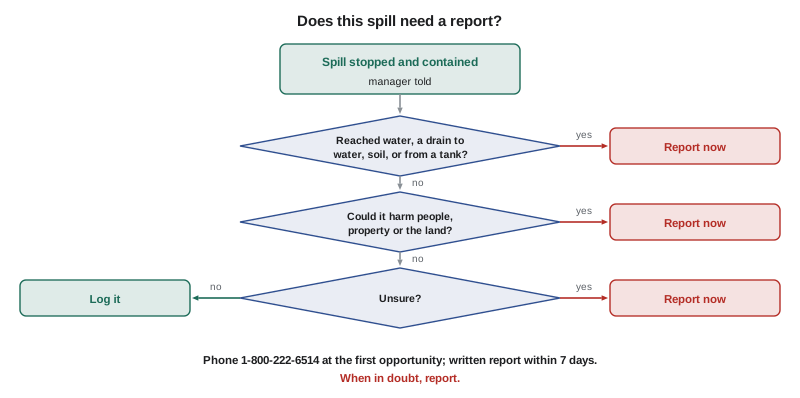
In Alberta, the Environmental Protection and Enhancement Act and its Release Reporting Regulation require the person responsible to report a release of a substance into the environment that has caused, is causing or may cause an adverse effect, meaning harm to the environment, human health or safety, or property. Alberta's guidance also says to report releases that exceed the quantities set out in legislation, an approval or a code of practice, and any release into groundwater or surface water. If unsure, the guidance says to report (all checked in 2026). For a fuel station, that means a release should be reported to Alberta Environment and Protected Areas when it:
- Reaches a creek, river, lake, ditch with water, wetland or groundwater, or a storm drain that leads to one.
- Soaks into soil or gravel, or leaks from an underground tank or piping.
- Is large enough, or spreads far enough, that it may harm people, property or the environment.
- Causes an evacuation or a fire department response.
- Is one the worker or manager is unsure about.
A delivery spill from the tanker has another layer. The carrier also has reporting duties under the federal and Alberta rules for transporting dangerous goods, and the driver will call their dispatcher. The station and the carrier should agree on the spot who is calling which regulator; the station should still make sure the environmental report is made.
How fast
Alberta's rule is to report "at the first available opportunity" as soon as the person responsible knows or should know about the release. That means by phone, once the source is stopped and people are safe, not at the end of the shift. The number is Alberta's 24-hour Environment and Protected Areas response line, 1-800-222-6514 (checked in 2026). A written report must follow within seven days of the phone report. Emergencies such as a fire still go to 911 first.
What the report says
Whoever makes the call should have the facts ready. The spill report form in the binder follows the questions the regulator usually asks:
- Who is calling: name, role, company, phone number.
- Where: the station's name and street address, and the exact location on the site.
- When: the date and time the spill started or was found.
- What: the product (regular gasoline, diesel), and how it was released.
- How much: the best estimate of the volume released and recovered, and how it was estimated.
- Where it went: onto pavement, into soil, into a drain, into water; whether it has left the site.
- What has been done: source stopped, drains protected, containment, contractor called.
- Effects: injuries, evacuation, fire department response, any sheen or dead fish seen.
Estimates are fine, as long as they are honest and the basis is explained; Lesson 1 showed how to estimate volume. If new information comes in, for example the contractor finds more fuel in the soil, the station calls back with an update. The person who took the call will usually give a reference number. Write it on the form.
A reporting decision in code
The program below turns Northfield's reporting rules into a simple decision for a few example spills. It is a teaching aid, not a replacement for the regulator's rules or the manager's judgement, and it deliberately reports whenever the facts are uncertain.
# Northfield (Alberta) reporting decision.
def must_report(spill):
    reasons = []
    if spill["to_water"] or spill["to_drain_to_water"]:
        reasons.append("reached water or a drain to water")
    if spill["to_soil"] or spill["from_tank_or_piping"]:
        reasons.append("in soil or from the tank system")
    if spill["may_harm"] or spill["fire_dept"]:
        reasons.append("may cause an adverse effect")
    if spill["unsure"]:
        reasons.append("unsure: report")
    return reasons

spills = [
    dict(name="topping-off drips, pump 2", litres=0.5, to_water=False, to_drain_to_water=False,
         to_soil=False, from_tank_or_piping=False, may_harm=False, fire_dept=False, unsure=False),
    dict(name="nozzle failure, drain covered", litres=15, to_water=False, to_drain_to_water=False,
         to_soil=False, from_tank_or_piping=False, may_harm=False, fire_dept=False, unsure=False),
    dict(name="diesel onto gravel strip", litres=60, to_water=False, to_drain_to_water=False,
         to_soil=True, from_tank_or_piping=False, may_harm=False, fire_dept=False, unsure=False),
    dict(name="delivery spill, some into storm drain", litres=40, to_water=False, to_drain_to_water=True,
         to_soil=False, from_tank_or_piping=False, may_harm=True, fire_dept=False, unsure=False),
    dict(name="sump fuel alarm, cause unknown", litres=0, to_water=False, to_drain_to_water=False,
         to_soil=False, from_tank_or_piping=False, may_harm=False, fire_dept=False, unsure=True),
]
for s in spills:
    r = must_report(s)
    verdict = "REPORT to 1-800-222-6514, written report in 7 days" if r else "log only"
    print(f"{s['name']:38} {s['litres']:>5} L: {verdict}")
    for reason in r:
print(f"{'':44}- {reason}")topping-off drips, pump 2 0.5 L: log only
nozzle failure, drain covered 15 L: log only
diesel onto gravel strip 60 L: REPORT to 1-800-222-6514, written report in 7 days
- in soil or from the tank system
delivery spill, some into storm drain 40 L: REPORT to 1-800-222-6514, written report in 7 days
- reached water or a drain to water
- may cause an adverse effect
sump fuel alarm, cause unknown 0 L: REPORT to 1-800-222-6514, written report in 7 days
- unsure: reportThe first two spills are handled and logged, the gravel spill is reported because fuel is in the soil, the delivery spill because it reached a drain that leads to the creek, and the sump alarm because no one yet knows whether fuel has left the tank system. In real life, the manager would also think about things the program does not know, such as how close the nearest well or creek is.
After the report
The regulator may give advice over the phone, send an inspector, or ask for a written report, sampling or a cleanup plan. The station must follow any orders it is given and keep all the records: the spill report, the reference number, notes of calls, contractor reports, sample results and waste paperwork. If the spill came from the tank system, the tank registry or tank program will also be involved, and the system may need to be tested or repaired before it is used again.
Neighbours sometimes call the station about a smell or a sheen. Workers should be polite, take their name and number, tell the manager, and not argue about whether the spill is serious or speculate about cause. The manager or company decides what to say publicly.
For supervisors: a reporting culture
Workers will only report spills honestly if they are sure they will not be blamed for doing so. Thank people for reporting spills, even their own. Never ask anyone to downplay a volume, leave something out or wait until after the weekend. Review every report afterwards for what could be learned, not who to blame. A station where every spill reaches the manager quickly is a station where reportable spills reach the regulator on time.
Worked problem
Saturday night, fuel in the ditch
At 10:30 on a Saturday night, a neighbour walks into the store and tells Ben there is a fuel smell and a rainbow sheen in the ditch behind the station, where the storm drain outlet is. Ben finds a sheen on the water and a smell. There is no spill visible on the forecourt. Leah Morin is not answering her phone. What should Ben do?
Show solution
- Thank the neighbour and take their contact details.
- Check for a source: look at the forecourt, the drains, the fill area and the tank gauge console for alarms. Ben finds none, but the separator could be overflowing or there could be a leak.
- Protect what he can: lay socks across the ditch below the outlet if it is safe to reach it from the bank, without stepping into the water.
- Fuel is in water, so this must be reported. The procedure says the senior person on shift reports if the manager cannot be reached. Ben calls 1-800-222-6514, gives the facts from the form and gets a reference number.
- He keeps calling Leah and leaves a message, then calls Raj Patel, the backup in the binder. Everything goes on the spill report.
Answer: Fuel in water is reportable: check for a source, protect what he safely can, make the report himself because the manager is unreachable, and keep trying the manager and backup.
Practising the call
Phoning a government spill line for the first time is stressful. The person who answers will ask questions quickly, and it is easy to forget the street address or the product name in the moment. Northfield practises the call in its spill drills (Lesson 12): one person plays the regulator, reading the usual questions, and the worker answers from the spill report form. It takes five minutes, and it means that a worker like Ben, alone on a Saturday night, has done it before.
A few habits make the real call go better. Fill in the form before calling, at least the who, where, what and how much. Call from a quiet place, away from the forecourt noise but where the spill can still be watched. Speak slowly and spell the station's name and street. Give estimates as estimates ("about 40, maybe up to 60") rather than guessing a precise number. Ask what the regulator wants the station to do next, write down the answer, and read the reference number back to make sure it is right.
Keeping the reporting record
Every report creates a file. At Northfield it goes in a folder labelled with the date and the reference number, and holds the spill report form, notes of every call (who, when, what was said), photographs, the contractor's report, sample results, waste receipts and the copy of the written report. Months later, when the regulator closes the file or asks a question, the station can answer from the folder instead of from memory.
Common mistakes
MistakeWaiting until Monday to report a weekend spill.
InsteadReport as soon as the source is stopped and people are safe.
MistakeNot reporting because the volume is only an estimate.
InsteadGive an honest estimate, explain the basis and update it later.
MistakeLeaving a voicemail and considering the spill reported.
InsteadSpeak to a person and record the reference number.
MistakeAssuming the hauler has reported a delivery spill.
InsteadAgree who calls whom, and confirm the report was made.
MistakeAsking staff to play down a spill.
InsteadReport accurately and thank people for reporting.
Summary and key terms
- Every spill goes to the manager; the manager decides on reporting with the environmental coordinator.
- In Alberta, report releases that may cause an adverse effect, that reach water or exceed set quantities, and report if unsure, at the first available opportunity to 1-800-222-6514; a written report follows within 7 days.
- If the manager cannot be reached and the spill is reportable, the senior person on shift reports it.
- Have the facts ready: who, where, when, what, how much, where it went, what was done and effects.
- Keep every record and follow up with updates and any orders.
- Thank people for reporting; never ask anyone to downplay a spill.
- Release
- A spill, leak or discharge of a substance into the environment.
- Adverse effect
- Harm to the environment, human health or safety, or property.
- First available opportunity
- As soon as practical once the release is known; not the end of the shift.
- Written report
- The follow-up report due within seven days of the phone report in Alberta.
- Reference number
- The number given by the regulator for a phone report.
- Environmental coordinator
- The company person who advises on reporting and cleanup.
Practice problems
Work each problem on paper first, then reveal the answer to check.
Who decides whether a spill is reported to the regulator?
Show answer
The manager, with the environmental coordinator; the senior person on shift reports if the manager cannot be reached.
Name three kinds of spill Northfield reports in Alberta.
Show answer
For example, spills into water or a drain to water, into soil or from the tank system, that may cause harm, that needed the fire department, or when unsure.
How fast must a reportable spill be reported?
Show answer
At the first available opportunity, by phone, with a written report within 7 days.
What facts does the report need?
Show answer
Who, where, when, what product, how much, where it went, what was done and any effects.
What should be done if new information comes in after the report?
Show answer
Call back with an update.
How should a worker respond to a neighbour who reports a smell?
Show answer
Be polite, take their details, tell the manager and not argue or speculate.
Why must reporting be blame-free?
Show answer
So that workers report every spill honestly and quickly.
Lesson quiz · 5 questions
Score 60% or more to complete this lesson.
Create a free account to save your progress, take quizzes and earn a certificate.