
HSE-351 · Lesson 11 of 12 · 22 min
Preventing spills
Every lesson so far has ended with the same point: the cheapest spill is the one that never happens. This lesson pulls together the ways stations prevent spills, from the design of the tanks to the habits of the people on shift. Prevention is not one big decision but many small ones, made every day: checking the space in the tank before a delivery, replacing a cracked hose before it splits, refilling the spill kit, and talking to the customer who always tops off.
HSE-103 introduced the hierarchy of controls for any hazard. Applied to spills, it gives a useful order for thinking about prevention: first remove the chance of a spill where possible, then design the equipment to prevent or catch spills, then use procedures and training, and finally be ready to respond.
The hierarchy of controls for spills
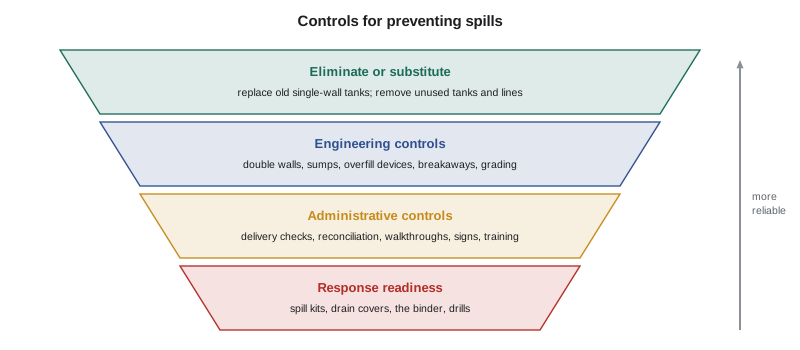
- Eliminate or substitute: replacing old single-walled steel tanks and piping with double-walled systems, removing tanks and lines that are no longer used, and storing fewer separate products where possible. These are big, expensive decisions made by the company, but they remove the most likely sources of large leaks.
- Engineering controls: equipment that prevents spills or catches them without anyone having to act, such as double walls and sumps, overfill prevention, breakaway couplings and shear valves, spill buckets, automatic nozzle shut-offs, forecourt grading that keeps spills away from drains, curbs around the fill area and oil-water separators.
- Administrative controls: the procedures, checks and training that depend on people, such as the delivery procedure, daily reconciliation, walkthroughs, the maintenance schedule, signs and rules for customers, and drills.
- Response readiness: spill kits, drain covers, the spill binder and trained staff. They do not prevent spills, but they keep a small spill small.
The controls near the top are the most reliable because they work every time, whoever is on shift. The controls near the bottom depend on someone remembering and doing the right thing, every time. A good station has all four layers, so that when one fails another catches the problem.
Preventing delivery spills
Deliveries move the most fuel in the shortest time, and an overfill can release a large volume in seconds. Most delivery spills are prevented by a few steps that the driver and station take every time:
- Before the truck arrives, the station checks the tank gauge for the volume in each tank and the space available (ullage), and confirms the order fits. HSE-350, Lesson 9 showed how to calculate it. Many stations plan to fill tanks to no more than about 90% of capacity.
- The driver checks the ullage again on the gauge, confirms which fill pipe is which product, and checks that the spill bucket is clean and dry.
- Fill caps and pipes are colour-coded by product, so the right compartment goes into the right tank.
- The driver stays with the truck and watches the delivery the whole time; the station keeps the area clear.
- Overfill prevention equipment is in place and working: typically a valve that shuts off flow at about 95% full, or an alarm at about 90%.
- At the end, the hose is drained completely before it is disconnected, and any drips in the spill bucket are cleaned up properly.
Many delivery spills happen because one of these steps was skipped on a busy day: the order was not checked against the space, the driver walked away from the truck, or the hose was pulled before it drained. Drivers and station staff should treat a delivery as a team job, with both checking.
Preventing dispensing spills
Customers cause most small spills, and a few simple measures reduce them:
- Signs at each pump asking customers not to top off, and to stay with the vehicle while fuelling.
- Rules for portable containers: approved containers only, placed on the ground, filled slowly, and not more than about 95% full (HSE-350, Lesson 6).
- Working automatic shut-offs and hold-open latches, and nozzles and hoses replaced at the first sign of wear.
- Breakaways and nozzle boots inspected, and broken breakaways replaced before the dispenser is used again.
- Watching the forecourt, and stopping a pump quickly if a customer is having trouble.
- A friendly word with regular customers who top off or fill containers in the truck bed.
Maintenance and inspection
Equipment that is maintained does not leak as often. The station's maintenance schedule should cover the dispensers (hoses, nozzles, filters, internal leaks), the tank system (walkthroughs and contractor tests from Lesson 7), the separators and drains (Lesson 6) and the spill kits (Lesson 4). Each item should have a frequency, a person responsible and a place to record that it was done. A dispenser with a recurring drip, a spill bucket that fills with water every time it rains, or a drain cover that no longer seals are all small fixes that prevent bigger problems.
Is prevention worth the cost?
Prevention costs money every year: equipment, contractor tests, spill kit stock, training time. Spills cost money only when they happen, but some of them cost a great deal. A simple way to compare is to estimate the expected cost of spills each year, by multiplying how likely each kind of spill is by what it would cost, with and without a prevention program. The program below does this with made-up figures for a station like Northfield; the point is the method, not the numbers.
# Expected yearly cost of spills, with and without prevention (made-up figures).
# each: (name, chance per year without, chance per year with, cost if it happens $)
spills = [
    ("small forecourt spills (x20)", 1.00, 1.00,      800),
    ("delivery overfill to drain",   0.10, 0.02,   40_000),
    ("dispenser leak into soil",     0.05, 0.01,   60_000),
    ("undetected tank leak, 1 year", 0.02, 0.002, 900_000),
]
prevention_per_year = 9_000   # tests, kits, training, maintenance
without = sum(p0 * cost for _, p0, _, cost in spills)
with_prog = sum(p1 * cost for _, _, p1, cost in spills) + prevention_per_year
for name, p0, p1, cost in spills:
    print(f"{name:30} ${p0 * cost:>8,.0f} -> ${p1 * cost:>8,.0f}")
print(f"{'prevention program':30} {'':>9} -> ${prevention_per_year:>8,.0f}")
print(f"Expected cost per year: without ${without:,.0f}, with ${with_prog:,.0f}")
print(f"Saving per year: ${without - with_prog:,.0f}")small forecourt spills (x20) $ 800 -> $ 800 delivery overfill to drain $ 4,000 -> $ 800 dispenser leak into soil $ 3,000 -> $ 600 undetected tank leak, 1 year $ 18,000 -> $ 1,800 prevention program -> $ 9,000 Expected cost per year: without $25,800, with $13,000 Saving per year: $12,800
With these figures, the prevention program costs less each year than the spills it prevents, mostly because it makes the rare but very expensive events, such as an undetected tank leak, much less likely. The small forecourt spills do not change much; they are prevented by habits, not equipment. Real figures would come from the company's own records, its insurer and its consultants. The comparison also leaves out costs that are hard to put a number on: harm to the creek, to neighbours' health and to the station's reputation.
Housekeeping and the forecourt
A clean forecourt makes spills easier to see and keeps everyday drips out of the stormwater. Sweep up stains with absorbent rather than washing them down. Keep drains clear of litter and leaves so that drain covers seal. Keep the fill area tidy and the spill bucket lids closed. Do not store drums, used oil or waste outside where they can be knocked over or rained on. Report damaged curbs, cracked concrete and potholes near the dispensers, because they collect fuel and let it soak in.
For supervisors: make prevention a routine
Prevention works when it is routine, not when it is remembered. Build it into the checklists the station already uses: the opening walk, the delivery checklist, the weekly kit and walkthrough checks, the monthly review of the spill log and reconciliation records, and the annual contractor tests. Track whether each one is done. When a spill happens, ask which layer of the hierarchy failed, and fix that layer, not just the spill. Lesson 12 shows how drills and reviews keep the routine alive.
Worked problem
An overfill that did not happen
Mike arrives with a load of 18,000 L of regular for Northfield. The order was placed three days ago, but sales have been slow. Raj Patel checks the tank gauge before Mike connects: the 50,000 L regular tank holds 30,500 L. What should they do?
Show solution
- Work out the safe space: filling to 90% of 50,000 L means no more than 45,000 L in the tank.
- Space available: 45,000 − 30,500 = 14,500 L. The load of 18,000 L will not fit.
- Raj tells Mike, who confirms the reading on the gauge himself. Delivering the full load would overfill the tank and trip the overfill valve, or worse, spill at the fill pipe.
- They agree to drop only one compartment that fits within 14,500 L, and Mike's dispatcher reroutes the rest to another station.
- Raj records the delivery and the decision, and tells Leah Morin so the next order is based on current sales.
Answer: The tank has room for only 14,500 L at 90%, so they deliver only what fits and reroute the rest.
When things change
Many spills happen just after something changes: a new hauler whose drivers do not know the site, a new attendant on their first night shift, a dispenser replaced with a different model, construction work near the tanks, or a new product added to the forecourt. Each change can quietly undo a prevention habit. A new driver may not know which fill pipe is diesel; a construction crew may park a loader on a monitoring well or dig near the piping without a locate; a new dispenser may have its shear valve installed wrongly.
HSE-103 covered management of change in general. At a station it can be as simple as a short checklist used whenever something changes: who needs to know, which procedures, signs, site plans or drain maps must be updated, which staff need a briefing, and whether the spill kits and drain covers still match the site. The manager signs it off before the change goes live, and checks again a week later that the new routine is actually being followed.
Talking to customers
Customers do not usually think of themselves as part of a station's spill prevention, but they are. Most respond well to a friendly, specific request: "Could you put the can on the ground to fill it? It's safer for both of us" works better than a lecture. Attendants should never argue with a customer at the pump; if a customer insists on doing something unsafe, such as filling an unapproved container or fuelling with the engine running, the attendant can stop that pump from the console and explain why. Regular customers who see the same rules every visit soon follow them without being asked.
Common mistakes
MistakeRelying only on spill kits and response.
InsteadUse every layer of the hierarchy, starting with equipment that prevents spills.
MistakeStarting a delivery without checking the space in the tank.
InsteadCheck the ullage before every delivery, station and driver both.
MistakeLeaving a cracked hose or dripping nozzle in service.
InsteadTake it out of service and have it replaced.
MistakeWashing the forecourt down with a hose.
InsteadDry sweep with absorbent.
MistakeFixing the spill but not the cause.
InsteadAsk which layer failed and fix it.
Summary and key terms
- The hierarchy of controls for spills runs from eliminating sources, through engineering and administrative controls, to response readiness.
- Controls near the top are more reliable because they do not depend on people remembering.
- Most delivery spills are prevented by checking the ullage, the right product and fill pipe, attending the delivery, working overfill prevention and draining the hose.
- Signs, container rules, maintained nozzles and an alert attendant prevent most dispensing spills.
- Comparing expected spill costs with prevention costs shows that prevention usually pays, mainly by avoiding rare, expensive leaks.
- Build prevention into routine checklists and fix the cause of every spill.
- Hierarchy of controls
- An order of preference for controls, from eliminating the hazard to response readiness.
- Engineering control
- Equipment that prevents or catches a spill without anyone having to act.
- Administrative control
- A procedure, check or training that depends on people.
- Overfill prevention
- Equipment that stops, restricts or alarms a delivery before a tank is too full.
- Ullage
- The space available in a tank to receive fuel.
- Expected cost
- The chance of an event multiplied by its cost, added up over all events.
Practice problems
Work each problem on paper first, then reveal the answer to check.
Name the four levels of the hierarchy of controls for spills.
Show answer
Eliminate or substitute, engineering controls, administrative controls and response readiness.
Why are engineering controls more reliable than procedures?
Show answer
They work every time without anyone having to remember them.
What should be checked before every delivery?
Show answer
The space in the tank (ullage), the right product and fill pipe, and a clean, dry spill bucket.
A 25,000 L tank holds 18,000 L. How much can be delivered if the station fills to 90%?
Show answer
90% of 25,000 L is 22,500 L, so 22,500 − 18,000 = 4,500 L.
Name three ways to reduce customer spills.
Show answer
For example, signs against topping off, portable container rules, working shut-offs, replacing worn nozzles and hoses, and watching the forecourt.
Why does prevention usually pay for itself?
Show answer
It makes rare but very expensive events, such as undetected tank leaks, much less likely.
After a spill, what question should a supervisor ask?
Show answer
Which layer of the hierarchy failed, so that layer can be fixed.
Lesson quiz · 5 questions
Score 60% or more to complete this lesson.
Create a free account to save your progress, take quizzes and earn a certificate.