
HSE-351 · Lesson 12 of 12 · 22 min
Drills, reviews and keeping the plan alive
A spill procedure that sits in a binder and is never practised will not work on the day it is needed. People forget where the drain covers are, the phone numbers go out of date, new staff have never opened a spill kit, and the procedure itself may no longer match the site. This final lesson is about keeping the spill plan alive: practising it in drills, reviewing real spills to learn from them, and checking the whole system once a year.
It also brings the course together. Each lesson has added a piece: knowing the pathways (Lesson 1), the rules (Lesson 2), the spill families (Lesson 3), the five steps (Lesson 4), cleanup and waste (Lesson 5), the drains (Lesson 6), the tanks (Lesson 7), the inventory records (Lesson 8), reporting (Lesson 9), what happens underground (Lesson 10) and prevention (Lesson 11). A drill tests how well those pieces fit together in practice.
Why drills work
In a real spill, people do what they have practised. Under stress, there is no time to read a procedure; the hands go to the emergency stop, the drain cover and the socks because they have done it before. Drills also find problems before a spill does: an empty kit, a drain cover that does not fit the new grate, a backup manager whose number has changed, a new worker who did not know where the kits are. Every problem a drill finds is one that a real spill will not.
Types of drills
Northfield uses three kinds of drill, from quick to thorough:
| Drill | What happens | How often | Time |
|---|---|---|---|
| Talk-through | The manager describes a spill and asks each person what they would do, step by step, at the spot where it would happen | Monthly, at a shift change | 5 to 10 minutes |
| Hands-on drill | A worker responds to a mock spill (water or a marked area) with a real kit: emergency stop (simulated), cones, drain cover, socks and pads, and a practice call | Every quarter, and for every new worker | 15 to 20 minutes |
| Full exercise | A larger scenario, such as a delivery spill reaching a drain, with the driver, the whole shift and a practice report; sometimes with the fire department | Once a year | About an hour, plus a review |
Drills never use real fuel. A mock spill can be marked with chalk or cones, or made with water, so that people can practise laying socks and covers. The emergency stop is not actually pressed during busy hours unless the drill has been planned for it; the worker shows they can reach it and says what they would do. The practice call is made to a colleague playing the regulator, never to the real spill line.
Timing a drill
Timing a drill shows where the response is slow. An observer with a phone and a checklist notes when each step is done: when the spill was noticed, when the source was stopped, when the drain was covered, when the spill was contained and when the manager was told. Comparing those times with targets shows which step needs practice. The targets below are Northfield's own, set for its layout; they are illustrative, not legal requirements.
# Spill drill timing: seconds from "spill noticed" to each step (illustrative).
targets = {"source stopped": 30, "area made safe": 90, "drain covered": 120,
           "spill contained": 300, "manager told": 420}
drills = {
    "Sofia (new, Mar)": {"source stopped": 25, "area made safe": 110, "drain covered": 210,
                         "spill contained": 390, "manager told": 450},
    "Sofia (Jun)":      {"source stopped": 20, "area made safe": 80, "drain covered": 115,
                         "spill contained": 280, "manager told": 330},
    "Tyler (Jun)":      {"source stopped": 35, "area made safe": 75, "drain covered": 100,
                         "spill contained": 260, "manager told": 600},
}
for who, times in drills.items():
    late = [f"{s} +{times[s] - t}s" for s, t in targets.items() if times[s] > t]
print(f"{who:18} {'all steps on target' if not late else 'late: ' + ', '.join(late)}")Sofia (new, Mar) late: area made safe +20s, drain covered +90s, spill contained +90s, manager told +30s Sofia (Jun) all steps on target Tyler (Jun) late: source stopped +5s, manager told +180s
The results tell a story. Sofia's first drill was slow at making the area safe and covering the drain: she had to look for the cones and the cover, which delayed every step after it. Three months later, after practice, she met every target. Tyler stopped the source a little late, perhaps because the emergency stop was behind something at the counter, and told the manager very late, which suggests he finished the cleanup before calling. Each of these is a specific thing to fix, which is far more useful than a general reminder to be quick.
Reviewing real spills
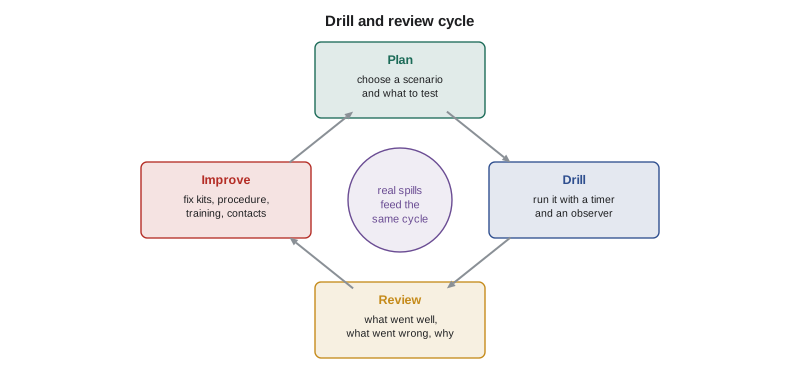
Every real spill, however small, is a free drill. The spill log records the facts; a short review afterwards turns them into lessons. For small spills, the review can be a two-minute conversation at the next shift change. For larger spills, reportable spills and near misses, Leah Morin holds a proper review within a week with the people involved. The questions are always the same:
- What happened, in order, with times?
- What went well?
- What went wrong or was slow, and why?
- Which layer of the hierarchy of controls failed (Lesson 11)?
- What will we change: equipment, kits, procedure, training, signs, contacts?
- Who will do it, and by when?
A good review looks for causes in the system, not someone to blame. "Ben was slow to cover the drain" is a fact; "the drain cover was kept in the store room, 40 seconds away" is a cause that can be fixed. The actions from each review go on a list that the manager follows up, and the list is checked at the next review to see that they were done.
The annual check
Once a year, Northfield checks the whole spill system against a list. It is a good time to involve the safety representative (Raj Patel) and the company's environmental coordinator.
- The spill procedure: does it still match the site, the equipment and the law? Have any rules changed, such as reporting numbers or waste requirements?
- The spill binder and contact list: every phone number tested.
- The site plan and drain map: every drain, separator, monitoring well and kit shown correctly.
- The spill kits: complete, in the right places, with stock for the largest spill the station handles.
- Training records: every worker trained and drilled, including new and part-time staff.
- Tank and leak detection records: walkthroughs, reconciliation, gauge tests and contractor tests all done and filed.
- Separator and drain maintenance: cleanings done and recorded.
- Waste records: shipping documents and receipts for every collection.
- The spill log and reviews: patterns, and actions completed.
The annual check ends with a short written summary for head office: what was checked, what was found and what will be done. It is also a chance to thank the staff whose habits keep the station's spills small.
Training new workers
Every new worker at Northfield gets spill training before they work a shift alone. It covers the site walk (drains, kits, emergency stops and the fill area), the five steps, the reporting chain, PPE and a hands-on drill. It is short, practical and done on the forecourt, not in the back office. Grace, at 17, did hers in her first week, and Sofia did hers before her first evening shift. The training record is signed by the worker and the trainer and kept on file.
Workers who will do more, such as handling deliveries, doing reconciliation or walkthroughs, get extra training for those jobs, and the manager checks their first few by doing them together.
Where this course leads
This course has focused on spills and the environment. Other courses cover the rest of station life. HSE-350 covered fire, vapour, the emergency stop and the delivery from the safety side. HSE-352 covers working alone and late-night safety, which matters because many spills, like Ben's Saturday night sheen, happen when only one person is on shift. HSE-353 covers propane cylinder exchange and refilling, with its own hazards and leak response. HSE-251 covers spill response more generally for any workplace, and HSE-330 and HSE-332 cover the larger tanks, pipelines and facilities upstream of the station.
For supervisors: keep it small and regular
The best spill programs are not elaborate. They are a one-page procedure, full kits in the right places, a binder that is current, a monthly five-minute talk-through, a quarterly hands-on drill, a review after every spill and an annual check. Each takes a few minutes. Together they mean that when a nozzle fails on a busy Friday, the person on shift stops it, covers the drain and calls the manager without having to think about it.
Worked problem
Reviewing the delivery spill exercise
For its annual exercise, Northfield runs a scenario with Mike's hauling company: a hose coupling leaks during a delivery, and "fuel" (water with a little dye) heads for the storm drain. Mike stops the flow in 20 seconds. Ben brings the fill-area kit, but the drain cover in it is the wrong size for the new grate installed in the spring, and the water reaches the drain. The practice call to the "regulator" takes 15 minutes because nobody can find the station's legal address. What comes out of the review?
Show solution
- What went well: Mike stopped the source fast, and Ben went straight to the right kit.
- What went wrong: the drain cover did not fit, so the drain was not protected. The cause was a change (the new grate) that was not followed by a check of the kit, a management of change gap (Lesson 11).
- What was slow: the report, because the station's address and details were not on the form. The cause was a form that had not been filled in ahead of time.
- Actions: Leah orders the right drain cover the same day and has every cover test-fitted to its drain; she adds the station's legal name, address and tank registration numbers to the top of the spill report form; she adds "check kits and drain map" to the change checklist.
- Follow-up: at the next quarterly drill, the drain cover is test-fitted and the practice call is timed again. It takes four minutes.
Answer: The drill found a drain cover that no longer fitted and a report form missing the station details; both were fixed, checked at the next drill, and a change-checklist gap was closed.
Drilling with partners
Some of the people who matter most in a spill do not work for the station: the fuel hauler and its drivers, the spill contractor, the separator cleaning company and the local fire department. Inviting them to the annual exercise, or at least walking them around the site once a year, pays off. Drivers learn where the drains and kits are; the contractor learns the site layout and how to get a vacuum truck in; firefighters learn where the emergency stops, tanks and vents are. Many fire departments are glad to do a pre-incident site visit at a fuel station, and it is much better for them to see the site on a quiet morning than for the first time in the dark with a fire burning.
After each partner drill, share the review with them, and ask for their view. A driver who has seen a hundred stations may notice something at Northfield that no one on staff would.
Common mistakes
MistakeWriting a spill procedure and never practising it.
InsteadRun talk-throughs, hands-on drills and an annual exercise.
MistakeUsing real fuel in a drill.
InsteadUse water, chalk or cones, and simulate the emergency stop.
MistakeMaking a practice call to the real spill line.
InsteadHave a colleague play the regulator.
MistakeReviewing spills to find someone to blame.
InsteadLook for causes in the system and fix them.
MistakeLetting new workers work alone before spill training.
InsteadTrain and drill every worker before their first solo shift.
Summary and key terms
- People do in a real spill what they have practised, so drills are essential.
- Use talk-throughs monthly, hands-on drills quarterly and for new workers, and a full exercise once a year.
- Time drills against targets to find the slow steps.
- Review every real spill and near miss for causes and actions, not blame.
- Check the whole spill system once a year: procedure, binder, maps, kits, training, tank and waste records.
- Train every new worker on the forecourt before they work alone.
- Talk-through
- A short drill where people describe what they would do in a spill.
- Hands-on drill
- A drill where workers respond to a mock spill with real equipment.
- Full exercise
- A larger, timed scenario involving the whole shift and partners.
- Spill review
- A meeting after a spill or drill to find causes and agree actions.
- Annual check
- A yearly review of the whole spill system against a checklist.
- Management of change
- Checking procedures, equipment and training whenever something changes.
Practice problems
Work each problem on paper first, then reveal the answer to check.
Why do drills improve real spill response?
Show answer
People do what they have practised, and drills find problems before a real spill does.
Name the three kinds of drill used at Northfield.
Show answer
Talk-throughs, hands-on drills and a full annual exercise.
What should be used instead of fuel in a drill?
Show answer
Water, chalk marks or cones.
What does timing a drill show?
Show answer
Which steps are slow compared with the targets, so they can be practised or fixed.
What questions does a spill review ask?
Show answer
What happened, what went well, what went wrong and why, which control failed, what will change, who will do it and by when.
Name four things checked in the annual check.
Show answer
For example, the procedure, binder and contacts, site plan and drain map, kits, training records, tank and leak detection records, separator maintenance, waste records and the spill log.
When should a new worker get spill training?
Show answer
Before they work a shift alone.
Lesson quiz · 5 questions
Score 60% or more to complete this lesson.
Create a free account to save your progress, take quizzes and earn a certificate.