
HSE-333 · Lesson 3 of 12 · 26 min
The permit team on oil and gas sites
A permit system is only as good as the people who run it. HSE-221 described the standard roles in any permit system: the person who asks for the work, the person who issues the permit, the person who receives it and does the work, the people who isolate and test, and the people who watch. This lesson looks at how those roles are filled on oil and gas sites, where the issuer may be a lease operator responsible for twenty wells, the receiver may work for a contractor that arrived this morning, the control room may be a hundred kilometres away, and a drilling rig and a producing battery may share the same pad.
The roles on an oil and gas site
Names vary from company to company, but most oil and gas permit systems use the roles in the table below. One person can hold more than one role on a small job, but some combinations should never be allowed, such as the person who will do the work also verifying their own isolation on a high-hazard job.
| Role | Usually filled by | Key duties on an oil and gas site |
|---|---|---|
| Area authority | Operations: lease operator, plant shift supervisor or facility foreman | Owns the site or unit; knows what else is happening; agrees the work can go ahead in that area at that time |
| Permit issuer | Operations staff authorized by name | Confirms hazards, isolations and gas tests; visits the worksite with the receiver; signs the permit; suspends or closes it |
| Permit receiver | Contractor or maintenance supervisor | Accepts the permit for the crew; briefs the crew at the worksite; keeps the work within scope; hands back at the end |
| Isolating authority | Operations for process isolations; qualified electrician for electrical | Plans, applies, locks and verifies isolations; keeps the isolation certificate; removes isolations at the end |
| Gas tester | Trained operator, safety advisor or competent crew member | Tests with a calibrated, bump-tested detector at the right points and intervals; records results |
| Safety watch or standby | Trained crew member with no other task | Watches entrants, hot work or line opening; keeps communication; starts rescue or alarm |
| Control room operator | Plant or regional control centre staff | Knows which equipment is under permit; avoids remote actions that would affect it; raises alarms |
| Wellsite supervisor | Operator's representative on drilling, completions or servicing | Coordinates the operator's permit system with the contractor's under the bridging document |
Remote and unstaffed sites
The biggest difference between oil and gas permits and plant permits is distance. A battery or well pad may be unstaffed most of the day, with a lease operator visiting on a route that covers many sites. The permit issuer is therefore often not present while work is done. Companies use several approaches, and the choice should depend on the hazard of the work.
- Issue in person, stay for the critical step. The issuer meets the crew, walks the isolations, witnesses the gas test and stays for the first break or the start of hot work, then leaves with agreed check-in times.
- Issue in person, check back. For lower-hazard work, the issuer issues on site and returns at agreed times or at shift end to inspect and close.
- Remote authorization. For low-hazard routine work only, the issuer authorizes by phone or radio after the receiver reports conditions, sometimes backed by photographs or readings sent from the site. This saves driving but removes the joint site visit, so many companies forbid it for line opening, hot work in classified areas, confined space entry and sour service.
- Dedicated permit coordinator. On large jobs such as a battery rebuild or a pad turnaround, the operator assigns a permit coordinator who stays on site and issues all permits for the job.
Whatever approach is used, the permit must say who can be contacted, how the crew will report that conditions have changed, and what the crew does if contact is lost. Many companies link permit work at unstaffed sites to their working-alone and journey-management systems, covered in HSE-330, so that a missed check-in triggers a call.
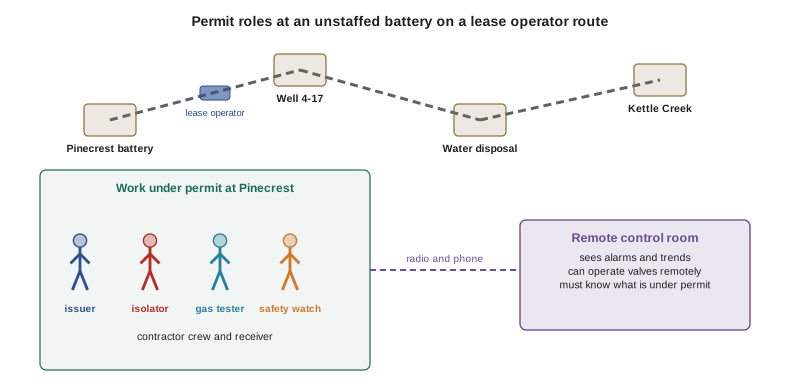
Can one issuer cover the work?
Issuer workload is a real safety issue on routes. A lease operator who must issue permits at four sites in a morning, while also doing production checks and responding to alarms, may be tempted to shorten the site visit, skip a gas test witness or authorize by phone. The program below checks whether a lease operator's planned day leaves enough time for the permit tasks at each site, using invented drive and task times.
# Can one lease operator issue and verify today's permits on the route? (invented times)
route = [  # site, drive minutes from previous stop, permit tasks (name, minutes)
    ("Pinecrest battery", 35, [("issue line-break permit, walk isolations", 40),
                               ("witness first break", 25)]),
    ("Well 4-17", 20, [("issue cold work permit", 15)]),
    ("Water disposal", 25, [("issue hot work permit, witness gas test", 35)]),
    ("Kettle Creek", 30, [("issue entry permit, witness entry test", 45)]),
]
routine_min = 150        # production checks and paperwork that must still be done
shift_min = 12 * 60
t = 0
for site, drive, tasks in route:
    t += drive
    for name, m in tasks:
        t += m
        print(f"{t // 60:>2}h{t % 60:02d}  {site:<17} {name}")
total = t + routine_min + sum(d for _, d, _ in route[:1])   # include drive home
print(f"Permit work and driving: {t} min; with routine work and drive home: {total} min")
print("Fits in a 12-hour shift" if total <= shift_min else "Does not fit; split the work or add an issuer")
spare = shift_min - total
print(f"Spare time for alarms and delays: {spare} min")1h15 Pinecrest battery issue line-break permit, walk isolations 1h40 Pinecrest battery witness first break 2h15 Well 4-17 issue cold work permit 3h15 Water disposal issue hot work permit, witness gas test 4h30 Kettle Creek issue entry permit, witness entry test Permit work and driving: 270 min; with routine work and drive home: 455 min Fits in a 12-hour shift Spare time for alarms and delays: 265 min
On paper the day fits with about four and a half hours to spare, but that spare time is what absorbs alarms, flat tires, late contractors and permits that need revalidation. If a well goes down or the hot work crew finds a problem, the operator may suddenly be needed in two places at once. Planning issuer workload before the work starts, and adding a second issuer or a permit coordinator when several high-hazard jobs coincide, is part of the permit system, not an afterthought.
Competence and authorization
Every role in the permit system should be filled by someone who has been trained, assessed and authorized by name for that role at that kind of site. Authorization is usually recorded in a register that lists each person's roles, the sites or units where they may act, the permit types they may issue and the date of their last assessment. On oil and gas sites, typical requirements include:
- Issuers: experience operating the specific facility, permit system training, isolation training, gas testing competence and a formal assessment by a senior operator or permit system owner.
- Isolating authorities: training on the site's isolation standard and drawings, and for electrical isolation, the appropriate electrical qualification.
- Gas testers: training on the detectors used, bump testing and calibration, sampling technique and interpretation of results, usually with H2S Alive or equivalent training for sour sites.
- Receivers: knowledge of the permit system and the hazards of the work, usually confirmed through the operator's orientation and the contractor's own training records.
- Safety watches: confined space, hot work or H2S training as relevant, rescue and alarm procedures, and the authority to stop the work.
Contractors often bring their own permit systems. The operator must decide whose system governs each activity and record the decision in a bridging document, as HSE-331 described for drilling and completions. A common arrangement is that the operator's permit system governs all work on producing equipment, while the drilling or service contractor's system governs work on its own rig equipment, with the operator's wellsite supervisor coordinating the two.
Signatures mean accountability
A signature on a permit is a statement that the signer has personally checked something. The issuer's signature says the hazards have been assessed, the isolations are in place and verified, the gas test is acceptable and the worksite has been visited. The receiver's signature says the crew understands the hazards and controls and will stay within the scope. The isolating authority's signature says each listed point is in the stated position and locked. When signatures become a formality, such as signing in the truck without looking, the permit system quietly stops working. Good practice is to ask each signer what they checked, and auditors do exactly that.
The control room's part
Many oil and gas facilities are monitored and partly operated from a control room that may be on site or in a regional centre far away. Control room operators can start pumps, open shutdown valves, change setpoints and reset trips remotely. If they do not know that a vessel is open or a crew is working beside a compressor, a routine remote action can put workers in danger. Permit systems therefore notify the control room of every permit that affects equipment it can operate, and the control room marks that equipment on its screens, often with a software inhibit, so that it cannot be operated by mistake. Removing those marks is part of closing the permit.
Independence and challenge
The permit system relies on people checking each other. An issuer under pressure from a contractor who is paid by the day, or a receiver who does not want to look slow in front of the operator, may let a doubtful condition pass. Companies build in challenge by giving every role clear authority to stop work, by rotating issuers on long jobs, by having a second person verify isolations on high-hazard work, and by rewarding people who stop jobs for good reasons. HSE-221 discusses this in general; on oil and gas sites, the mix of employers makes it even more important that a contractor's worker can challenge the operator's issuer, and the other way round, without fear.
Worked problem
Assigning roles for a separator repair at Pinecrest
A contractor will replace a corroded nozzle on the Pinecrest test separator, which is in sour service. The lease operator covers six sites. The contractor crew has a welder, a helper and a supervisor. Who should fill each role, and what arrangement suits the remote site?
Show solution
- Area authority and issuer: the lease operator, who knows the battery and is authorized for line-break and hot work permits on it.
- Isolating authority: the lease operator for the process isolation, with a second operator or the foreman verifying it because the service is sour and the job involves hot work after the vessel is opened.
- Receiver: the contractor's supervisor, who has completed Larchwood's orientation and holds training for the work.
- Gas tester and safety watch: the issuer witnesses the first gas test; the contractor's helper, trained and with no other task, acts as safety watch during the first break and as fire watch during welding.
- Arrangement: issue in person and stay for the first break and the start of hot work, notify the control centre so the separator's controls are inhibited, and set check-in times for the rest of the day.
Answer: Because the work involves sour service, line opening and hot work, the issuer should not authorize it remotely. The issuer stays for the critical steps, a second person verifies the isolation and the control centre is told.
Common mistakes
MistakeAuthorizing a line break in sour service by phone.
InsteadReserve remote authorization for low-hazard work; high-hazard work needs a joint site visit and the issuer present for the critical step.
MistakeLetting the person who will do the work verify their own high-hazard isolation.
InsteadHave a second competent person verify isolations on high-hazard jobs.
MistakeTreating an issuer's route as unlimited.
InsteadPlan issuer workload and add an issuer or permit coordinator when high-hazard jobs coincide.
MistakeForgetting to tell the control room about equipment under permit.
InsteadNotify the control room and inhibit remote operation of affected equipment until the permit closes.
MistakeSigning a permit without checking what the signature claims.
InsteadSign only for what you have personally checked, and expect to be asked what that was.
Summary and key terms
- Oil and gas permit systems use the standard roles of area authority, issuer, receiver, isolating authority, gas tester and safety watch, plus the control room and wellsite supervisor.
- Remote and unstaffed sites mean the issuer is often absent; the arrangement must match the hazard, and high-hazard work needs the issuer present for critical steps.
- Issuer workload on a route must be planned so that site visits, isolation walks and gas test witnessing are not squeezed out.
- Every role should be filled by people trained, assessed and authorized by name for that site and permit type.
- Bridging documents decide whose permit system governs each activity when contractors bring their own.
- Signatures mean personal verification, and the control room must know which equipment is under permit.
- People in every role need the authority and support to challenge doubtful conditions across employer boundaries.
- Area authority
- The person who controls the site or unit and agrees that work can proceed there.
- Permit issuer
- The authorized person who confirms conditions and issues a permit.
- Permit receiver
- The person who accepts a permit on behalf of the crew doing the work.
- Isolating authority
- The person who plans, applies, locks and verifies isolations.
- Safety watch
- A trained person assigned to watch workers during high-risk work and raise the alarm.
- Remote authorization
- Authorizing work by phone or radio without the issuer at the worksite.
- Authorization register
- A record of who may hold each permit role, where and for which permit types.
- Software inhibit
- A control system setting that prevents remote operation of equipment under permit.
Practice problems
Work each problem on paper first, then reveal the answer to check.
Who usually acts as area authority at a battery?
Show answer
Operations, such as the lease operator or facility foreman.
Name two duties of a permit receiver.
Show answer
Any two of: accept the permit for the crew, brief the crew at the worksite, keep the work within scope, hand back at the end.
Why do many companies forbid remote authorization for line opening in sour service?
Show answer
It removes the joint site visit and the issuer's check of isolations and gas tests on high-hazard work.
In the program, how much spare time was left in the lease operator's shift?
Show answer
265 minutes, about four and a half hours.
What should happen when several high-hazard jobs coincide on a route?
Show answer
Add a second issuer or assign a permit coordinator.
What does an authorization register record?
Show answer
Each person's permit roles, sites, permit types and last assessment.
What document decides whose permit system governs work on a rig on a producing pad?
Show answer
The bridging document.
What does the issuer's signature claim?
Show answer
That hazards were assessed, isolations are in place and verified, the gas test is acceptable and the worksite was visited.
Why must the control room know about permits?
Show answer
So it does not remotely operate equipment that is open or being worked on.
Give one way to build challenge into a permit system.
Show answer
Any one of: clear stop-work authority, rotating issuers, second-person verification, rewarding justified stops.
Lesson quiz · 5 questions
Score 60% or more to complete this lesson.
Create a free account to save your progress, take quizzes and earn a certificate.