
HSE-323 · Lesson 8 of 12 · 28 min
Working safely around suppression systems
Most injuries and accidental discharges involving suppression systems do not happen during fires. They happen during inspection, testing, maintenance, construction and ordinary work in protected spaces, when someone disturbs a detector, a release circuit, an actuator or a cylinder without the right precautions. This lesson brings together the practical rules for working safely on and around gaseous suppression systems: putting systems into manual or lockout, handling high-pressure cylinders, inspecting agent quantity and pressure, controlling hot work and dusty work in protected areas, and restoring systems afterwards. Water-based impairments were covered in Lesson 7; this lesson applies the same ideas to clean agent and carbon dioxide systems.
HSE-210, Lockout and Hazardous Energy Control, covers the principles of controlling hazardous energy, which apply here because a charged cylinder is stored energy and a release circuit is a control system that can start it. HSE-250, Transportation of Dangerous Goods Awareness, covers moving cylinders on public roads. HSE-216, Hot Work Safety, covers hot work in general.
Who may work on suppression systems
Inspection, testing, maintenance and repair of suppression systems are specialist work. The fire protection contractor's technicians, trained on the specific system and manufacturer, handle actuators, cylinders, valves, releasing panels and agent. Site staff may be trained to carry out a limited set of tasks under a written procedure, such as checking gauges, recording panel status, placing a system in manual using a keyed switch, and acting as a fire watch. Everyone else, including electricians, cablers, mechanical contractors and customers, must know enough to avoid disturbing the system and to recognize when work needs an impairment permit.
Automatic, manual and lockout
A clean agent or carbon dioxide system can usually be placed in one of several states, and the names vary between manufacturers and sites. The states that matter to people are these.
| State | What it means | Discharge possible by | Typical use |
|---|---|---|---|
| Automatic | Normal operation | Detection, manual release station | Normal occupancy |
| Manual only (automatic disabled) | Detection gives alarms but does not release | Manual release station only | Dusty or hot work; work in positions with slow egress; some occupancy policies |
| Disabled or isolated at the panel | Release circuits isolated electrically | Mechanical manual release at the cylinders, on some systems | Testing of detection and alarm functions |
| Locked out (mechanical) | A supervised lockout valve is closed or actuators are removed from cylinders | Not possible into the protected space | Work on the system itself; work inside carbon dioxide protected spaces |
The key distinction is between electrical isolation and mechanical lockout. Disabling release circuits at the panel prevents the panel from firing the actuators, but it does not prevent a discharge caused by a mechanical manual release at the cylinders, by an actuator fired by stray voltage while wiring is being disturbed, or by a technician working on the wrong circuit. For work on the system itself, and for any work inside a carbon dioxide protected space, a mechanical means of preventing discharge into the space is needed: a supervised lockout valve in the discharge piping, as NFPA 12 requires for carbon dioxide systems, or physical removal of the actuators from the cylinder valves as specified by the manufacturer. NFPA 2001 likewise requires means to prevent discharge of clean agent systems during maintenance.
Every change of state is an impairment. It must be authorized, recorded, communicated to the monitoring station and the people in the area, and reversed afterwards with a check that the system is back in its normal state. One of the most common findings after fires in protected rooms is that the system was left in manual or disabled after earlier work and did not discharge.
The release circuit is a live control system
Electric actuators on clean agent cylinders are fired by a pulse of current from the releasing panel. They are designed to be reliable, which means they fire readily when current flows. A technician who disconnects or reconnects actuator wiring while the panel is armed, tests continuity with the wrong instrument, or shorts a release circuit can fire the actuator and discharge the system. Manufacturers therefore specify a strict order for work: disable the release at the panel, then remove the actuators from the cylinder valves and place them in a safe position or fit them with test devices, before any work on the release circuits or the cylinders; and on restoration, reconnect and test the circuits with the actuators off the cylinders, confirm the panel is normal, and refit the actuators last.
High-pressure cylinders
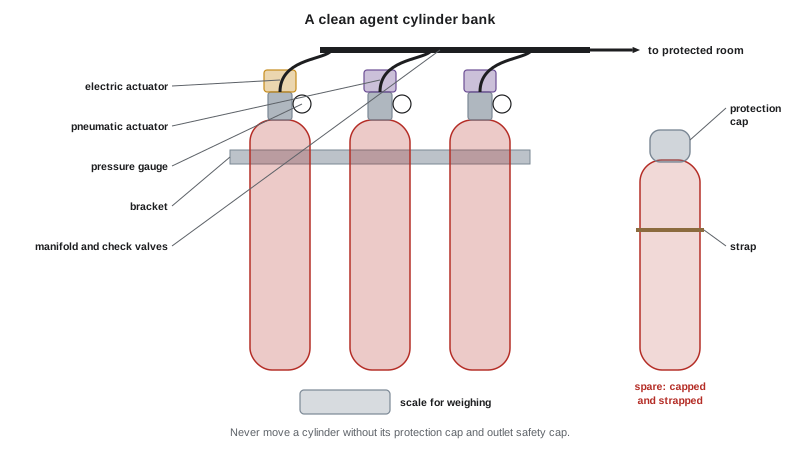
A suppression cylinder stores energy in compressed gas. An inert gas cylinder at 200 to 300 bar (about 2,900 to 4,400 psi) holds enough energy to turn the cylinder into a projectile if its valve is knocked off, and halocarbon cylinders, though at lower pressure, are heavy and still dangerous. Discharge through an unrestricted valve outlet produces a strong reaction force. Safe handling follows the general rules for compressed gas cylinders, with some additions for suppression systems.
- Keep cylinders secured in their brackets at all times when installed, and secure spare or removed cylinders upright and chained or strapped.
- Fit the valve protection cap and the outlet safety device, often called an anti-recoil or safety cap, whenever a cylinder is disconnected from its discharge hose. The device diverts the gas so that an accidental discharge does not produce a strong thrust.
- Never move a cylinder with its discharge hose or actuator attached, and never move one without its protection cap. Use a suitable cylinder cart; do not roll heavy cylinders by hand or drag them.
- Keep cylinders within their rated temperature range and away from heat sources, because pressure rises with temperature.
- Do not attempt to open, repair or refill a cylinder on site unless you are a qualified technician following the manufacturer's procedure.
- Treat a cylinder that has been dropped, damaged, exposed to fire or found with a damaged valve as hazardous; keep people away and call the fire protection contractor.
Inspecting agent quantity and pressure
NFPA 2001 and NFPA 12 require periodic checks that the cylinders still contain enough agent and pressure, commonly at six-month intervals, in addition to monthly visual inspections. Halocarbon cylinders are checked by weighing them or by using a liquid level indicator, and their pressure is checked against the manufacturer's chart for the cylinder temperature. Inert gas cylinders are checked by pressure, adjusted for temperature. A common rule in NFPA 2001 is that a halocarbon container must be refilled or replaced if it has lost more than 5 percent of its agent or more than 10 percent of its pressure after temperature correction, and an inert gas container if it has lost more than 5 percent of its pressure after correction. Carbon dioxide cylinders are weighed, and a loss of more than 10 percent of agent weight requires action. These are summaries; the edition in force and the manufacturer's instructions govern.
Temperature correction matters because cylinders in a cold or warm room show pressures that differ from the reference value even when no agent has been lost. The program below corrects inert gas cylinder pressures to a reference temperature using the ideal gas law and flags cylinders below the illustrative 5 percent criterion. The readings are invented.
# Teaching check of inert gas cylinder pressures, corrected to 15 degC.
REF_C, NOMINAL_BAR, LIMIT = 15.0, 300.0, 0.05   # illustrative values
def corrected(p_bar, t_c):
    # ideal gas: P/T constant for fixed gas quantity (absolute temperatures)
    return p_bar * (REF_C + 273.15) / (t_c + 273.15)

readings = [  # cylinder, gauge bar, room degC
    ("IG-01", 304.0, 18.0), ("IG-02", 296.0, 18.0), ("IG-03", 282.0, 18.0),
    ("IG-04", 286.0, 8.0), ("IG-05", 311.0, 24.0),
]
for cyl, p, t in readings:
    pc = corrected(p, t)
    loss = (NOMINAL_BAR - pc) / NOMINAL_BAR
    status = "REFILL OR REPLACE" if loss > LIMIT else "ok"
    print(f"{cyl}: gauge {p:5.1f} bar at {t:4.1f} C -> {pc:5.1f} bar at 15 C, "
f"loss {100*loss:4.1f}% {status}")IG-01: gauge 304.0 bar at 18.0 C -> 300.9 bar at 15 C, loss -0.3% ok IG-02: gauge 296.0 bar at 18.0 C -> 293.0 bar at 15 C, loss 2.3% ok IG-03: gauge 282.0 bar at 18.0 C -> 279.1 bar at 15 C, loss 7.0% REFILL OR REPLACE IG-04: gauge 286.0 bar at 8.0 C -> 293.1 bar at 15 C, loss 2.3% ok IG-05: gauge 311.0 bar at 24.0 C -> 301.6 bar at 15 C, loss -0.5% ok
Cylinder IG-03 has lost more than 5 percent after correction and must be refilled or replaced. Cylinder IG-04 reads low on the gauge, but only because its room is cold; after correction it is within limits. Cylinder IG-05 reads high for the same reason in reverse. Real inspections use the manufacturer's correction chart, especially for halocarbon agents, whose pressure depends on both the nitrogen and the vapour pressure of the liquid and does not follow the simple gas law.
Cylinders must also be requalified periodically under transport rules, which means they are emptied and tested, typically by a hydrostatic test, at intervals set by Transport Canada or the US Department of Transportation and the cylinder specification. A cylinder removed for retest leaves the system without part of its agent, so cylinder replacement programs are planned as impairments with spare cylinders or alternative protection.
Hot work and dusty work in protected areas
Hot work, such as welding, cutting, grinding and soldering with a torch, in or near a protected room creates two problems. The heat, smoke and dust can trigger the detection system and cause an unwanted discharge. And if a halocarbon agent is present, perhaps from a leak or a recent discharge, hot surfaces and flames can decompose it to hydrogen fluoride. Hot work in protected areas therefore needs a hot work permit, a planned impairment that places the release in manual or lockout and isolates only the detectors that the work would affect, a fire watch during the work and for a period afterwards, and confirmation that no agent is present. Dusty work, such as core drilling, cutting gypsum board and sanding, needs the same impairment and dust control, as Lesson 3 described.
Working in carbon dioxide protected spaces
Where carbon dioxide total flooding systems remain, entry into the protected space is controlled more strictly than for clean agents. Before anyone enters, the system must be locked out mechanically using the supervised lockout valve or another means specified by the manufacturer, the lockout must be verified, and the person entering must hold the key or lock. The space should be checked for residual carbon dioxide and oxygen deficiency, particularly in low areas, before entry, and signs must be in place. Adjacent low spaces into which gas could flow, such as pits and basements, should be checked too. These requirements apply to every entry, however brief, and they are commonly built into the site's lockout and confined space procedures.
Restoring systems
Restoration is where many incidents begin. A system left in manual, an actuator left off its cylinder, a lockout valve left closed or a detector left covered will leave a room unprotected, often without anyone noticing until a fire. A good restoration procedure includes a physical check of every item changed during the work, a check of the panel for normal status with no supervisory or trouble signals, notification of the monitoring station and the people told of the impairment, and a second person's verification for critical systems. Shift handovers should review all open impairments.
Worked problem
Replacing a cylinder at Cedar Ridge
During the six-month inspection, the fire protection contractor finds that one of the FK-5-1-12 cylinders protecting the Cedar Ridge meet-me room has lost about 7 percent of its agent weight. It must be replaced. Outline a safe sequence.
Show solution
- Raise an impairment permit; the impairment coordinator authorizes it, and the monitoring station, insurer and, where required, the fire department are notified. Customers with equipment in the room are told.
- Decide on alternative protection during the work, such as keeping the remaining cylinders available if the manufacturer allows partial operation, extra clean agent extinguishers and a fire watch in the room.
- Disable the release at the panel, then remove the actuator from the affected cylinder and place it in its safe position; disconnect the discharge hose and fit the valve protection cap and outlet safety cap.
- Unstrap the cylinder from its bracket and move it on a cylinder cart to the loading dock, upright and secured; record its serial number for return to the supplier.
- Install the replacement cylinder in the bracket, connect the discharge hose, confirm the cylinder's weight and pressure, and record them.
- With all actuators still off the cylinders, test the release circuits, confirm a normal panel display, then refit the actuators, return the system to automatic, and have a second person verify the system state before closing the permit and notifying everyone.
Answer: Plan the work as an impairment, protect the room in the meantime, make the release circuit and cylinder safe before disconnecting anything, handle the cylinder with caps fitted, and restore the system in the manufacturer's order with independent verification.
Common mistakes
MistakeRelying on disabling the release at the panel as a lockout for work on cylinders.
InsteadUse mechanical lockout, such as removing actuators or closing a supervised lockout valve, as the manufacturer specifies.
MistakeMoving a cylinder without its protection cap and outlet safety cap.
InsteadFit both caps before disconnecting or moving any cylinder, and use a cylinder cart.
MistakeJudging cylinder contents by the gauge reading alone in a cold room.
InsteadCorrect pressure for temperature using the manufacturer’s chart, and weigh halocarbon cylinders.
MistakeEntering a carbon dioxide protected space for a quick check without lockout.
InsteadLock out mechanically and verify before every entry, however brief.
MistakeClosing an impairment as soon as the work is finished.
InsteadClose it only after the system is physically checked, the panel is normal and notifications are made.
Summary and key terms
- Most suppression incidents happen during maintenance and work in protected spaces, not fires.
- Systems may be automatic, manual only, disabled at the panel or mechanically locked out; electrical isolation is not a lockout.
- Release circuits can fire actuators if disturbed; manufacturers specify removing actuators before work and refitting them last.
- High-pressure cylinders must be secured, capped and moved on carts; damaged cylinders are hazardous.
- Agent quantity and pressure are checked periodically, with temperature correction; common NFPA 2001 criteria are 5 percent agent or 10 percent pressure loss for halocarbons.
- Hot work and dusty work in protected areas need permits, planned impairments and fire watches.
- Restoration needs physical checks, a normal panel, notifications and independent verification.
- Actuator
- A device fitted to a cylinder valve that opens it when signalled electrically or pneumatically.
- Anti-recoil device
- An outlet cap that diverts gas from an accidentally opened cylinder valve to prevent thrust.
- Hydrostatic test
- A pressure test with water used to requalify gas cylinders.
- Mechanical lockout
- Physically preventing discharge into a space, for example by closing a supervised lockout valve or removing actuators.
- Releasing panel
- The control panel that processes detection signals and fires suppression actuators.
- Temperature correction
- Adjusting a cylinder pressure reading to a reference temperature before comparing it with the nominal value.
- Valve protection cap
- A cap that protects a cylinder valve from damage during handling and storage.
Practice problems
Work each problem on paper first, then reveal the answer to check.
Why is electrical isolation at the panel not a lockout?
Show answer
A mechanical manual release, stray voltage or wiring errors can still fire the actuators and discharge agent.
What order do manufacturers specify for actuators during work on release circuits?
Show answer
Disable the release, remove the actuators from the cylinders before work, and refit them last after testing.
What two caps should a disconnected cylinder have?
Show answer
A valve protection cap and an outlet safety or anti-recoil cap.
How often are agent quantity and pressure commonly checked?
Show answer
At six-month intervals, with monthly visual inspections.
What loss criteria does NFPA 2001 commonly use for halocarbon containers?
Show answer
More than 5 percent of agent or more than 10 percent of temperature-corrected pressure.
Why must cylinder pressure be corrected for temperature?
Show answer
Pressure changes with temperature even when no agent is lost.
Why must hot work near a halocarbon system be controlled?
Show answer
It can trigger detection and discharge, and heat can decompose agent to hydrogen fluoride.
What is required before every entry into a carbon dioxide protected space?
Show answer
Mechanical lockout verified, the key or lock held by the entrant, signs, and atmosphere checks including low areas.
What is a common finding after fires in protected rooms?
Show answer
The system had been left in manual or disabled after earlier work.
What should a restoration include?
Show answer
A physical check of every item changed, a normal panel, notifications and independent verification.
Lesson quiz · 5 questions
Score 60% or more to complete this lesson.
Create a free account to save your progress, take quizzes and earn a certificate.