
HSE-323 · Lesson 6 of 12 · 29 min
Enclosure integrity, pressure and acoustic effects
A total flooding system treats the room as part of the system. The walls, floor, ceiling and doors must hold the agent long enough to put out the fire, must withstand the pressure of the discharge, and must not be changed in ways that defeat either purpose. The discharge also makes a great deal of noise, enough in some cases to damage hard disk drives and take a data centre offline. This lesson explains these three effects of the enclosure, pressure and noise, and why everyday work such as pulling cable, lifting ceiling tiles and wedging doors open is a fire protection matter in a clean agent room.
DCE-440 covers the engineering of enclosure integrity testing and pressure relief design. The calculations in this lesson are simplified teaching models intended to show which factors matter, not methods for checking a real room.
Why rooms leak agent
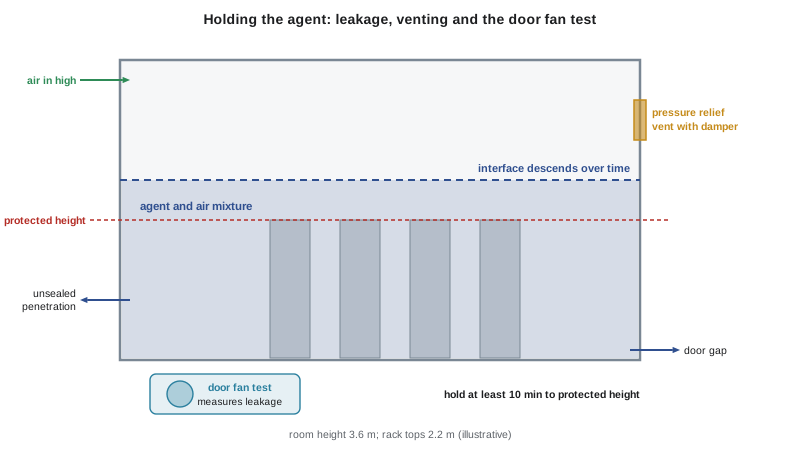
After discharge, a halocarbon agent mixed with air is denser than the air outside the room. The agent-air mixture presses on the lower parts of the room more than the outside air does, so it leaks out through openings low in the room, such as gaps under doors, unsealed cable penetrations, gaps around raised floor edges and floor drains, while fresh air leaks in through openings high in the room. As this happens, a boundary forms between the agent mixture below and clean air above, and it descends over time. Inert gas mixtures are close to the density of air, so they leak in a more mixed way, but they still leak through every opening.
The agent must remain above a minimum concentration up to the height of the equipment being protected for a minimum hold time. NFPA 2001 calls for the concentration to be maintained for a period sufficient for the fire to be extinguished and for trained responders to arrive, commonly at least 10 minutes. If the room leaks too much, the concentration falls before the fire is fully out, especially in deep-seated fires in cable bundles or equipment, and the fire can reignite once the agent has gone. A leaky room can also send agent into adjacent spaces, such as offices or corridors, where people do not expect it.
Enclosure integrity testing
Because it is impractical to discharge agent every time a room is checked, enclosure integrity is tested with a door fan test. A temporary panel with a calibrated fan is fitted into a doorway. The fan pressurizes and depressurizes the room by a small amount, typically a few tens of pascals, and the airflow needed to hold each pressure is measured. From these measurements, the total leakage area of the room can be calculated, and software based on the method in NFPA 2001 predicts how long the room would hold the agent at its design concentration. If the predicted hold time is too short, the leaks are found, often with smoke pencils or thermal cameras, and sealed, and the test is repeated.
NFPA 2001 requires enclosure integrity to be confirmed when a system is commissioned and checked at regular intervals, commonly annually, and after any change that could affect it. For people on site, the most important part of that requirement is the last one. Most rooms that fail a door fan test were tight when the system was installed and have been made leaky by later work.
| Common change | Effect on the enclosure | Better practice |
|---|---|---|
| New cable or conduit through a wall, floor or ceiling | Unsealed penetration leaks agent and fire rating | Seal and fire-stop every penetration at once; record it |
| Ceiling tiles lifted or removed and not replaced | Opens the room to the ceiling space; agent escapes upward or interface forms in wrong place | Replace and clip tiles after work; report damaged tiles |
| Raised floor tiles left out or replaced with perforated tiles | Changes the protected volume and leakage paths | Restore tiles to the design layout; check with fire protection before changing |
| Door wedged open or door closer removed | Agent pours out through the door; room cannot reach concentration | Keep doors closed; use hold-opens released by the panel |
| New air handling unit, duct or transfer grille | Creates leakage path; may not shut down on alarm | Treat as a design change; interlock with the releasing panel |
| New wall or cage partition inside the room | Changes volume and agent distribution; may raise concentration | Engineering review before construction |
The program below is a simplified model of how leakage area affects hold time for a halocarbon agent. It treats the room as a box with equal leakage areas at the top and bottom, calculates the leakage flow driven by the extra weight of the agent mixture, and estimates how long the descending interface takes to fall from the ceiling to the protected height. Real hold time calculations follow the method in NFPA 2001 and use measured leakage; this model only shows the trend.
import math
# SIMPLIFIED teaching model of halocarbon hold time (not the NFPA 2001 method).
g = 9.81
rho_air = 1.20                # kg/m3
rho_mix = 1.20 * 1.45         # about 5% FK-5-1-12 makes the mix ~45% denser
H_room, H_protect = 3.6, 2.2  # ceiling height and top of tallest rack, m
floor_area = 14 * 10          # meet-me room, m2
Cd = 0.61                     # discharge coefficient for sharp-edged openings

def hold_time_min(leak_area_m2):
    """Interface falls from ceiling to protected height; half the leakage area
    is low (mixture out), half is high (air in)."""
    A = leak_area_m2 / 2
    t, h, dt = 0.0, H_room, 1.0
    while h > H_protect:
        dP = g * h * (rho_mix - rho_air)           # driving pressure at low leaks
        q = Cd * A * math.sqrt(2 * dP / rho_mix)   # m3/s of mixture leaving
        h -= q * dt / floor_area                   # interface descends
        t += dt
    return t / 60

for leak_cm2 in (1000, 2000, 4000, 8000):
    print(f"total leakage {leak_cm2:5} cm2 -> interface reaches rack tops in about "
f"{hold_time_min(leak_cm2 / 1e4):5.1f} min")total leakage 1000 cm2 -> interface reaches rack tops in about 25.7 min total leakage 2000 cm2 -> interface reaches rack tops in about 12.8 min total leakage 4000 cm2 -> interface reaches rack tops in about 6.4 min total leakage 8000 cm2 -> interface reaches rack tops in about 3.2 min
Doubling the leakage area roughly halves the hold time in this model. A room that just met a 10-minute hold time at commissioning can fall well below it after a few unsealed penetrations and a missing ceiling tile. In the illustrative numbers above, a room with 2,000 cm² of total leakage holds the agent for about 13 minutes, comfortably above 10. Adding another 2,000 cm² of openings, roughly the area of one missing ceiling tile's gaps plus a few unsealed cable holes, cuts the hold time to about 6 minutes, and at 8,000 cm² it is about 3 minutes, by which time a deep-seated fire in a cable bundle may not be out. The heavier the agent mixture, the faster it drains, which is why halocarbon rooms are especially sensitive to low-level leaks.
Discharge pressure
Discharging a gas into a closed room changes the pressure in it. When an inert gas system discharges, it adds a volume of gas equal to roughly a third to a half of the room volume within about a minute or two. That gas must push an equal volume of air out of the room, or the pressure inside rises. Without an opening for the air to escape, the pressure would rise far beyond what ordinary walls, ceilings and doors can withstand. Inert gas rooms therefore have pressure relief vents: openings in a wall, usually high up, fitted with dampers that open at a set pressure and close again afterwards.
Halocarbon discharges behave differently. As the liquid agent flashes to vapour it absorbs heat and cools the air, so the room pressure first drops, creating a negative pressure, and then rises as the agent warms and expands. Depending on the agent, the room and its leakage, either the negative or the positive peak may govern, and some halocarbon rooms also need pressure relief. The manufacturers of both kinds of agent publish methods for calculating the peak pressure and the vent area, and the designer must check them against the strength of the room.
The strength of the room is the weak point. Concrete and masonry walls can withstand much more than lightweight partitions of steel studs and gypsum board, suspended ceilings and doors with ordinary hardware. A discharge into a room without adequate venting can push out partitions, lift ceilings, blow doors open, crack glazing and damage equipment, and the flying debris can injure anyone nearby. Rooms are commonly designed so that the pressure stays below a limit chosen for the weakest element, often a few hundred pascals for lightweight construction.
The program below estimates the free vent area needed to relieve the air pushed out of the invented Hall 2 network room during an IG-541 discharge, using the simple orifice equation. It uses the agent volume from Lesson 4 and an illustrative allowable room pressure. Real vent sizing uses the manufacturer's method, which accounts for the changing flow during the discharge and other factors.
import math
# SIMPLIFIED vent sizing for an inert gas discharge (teaching only).
agent_m3 = 133.0        # IG-541 for the 260 m3 network room (Lesson 4 estimate)
discharge_s = 60.0      # time to discharge most of the agent
rho = 1.20              # density of air leaving the room, kg/m3
Cd = 0.6                # vent discharge coefficient
peak_factor = 1.6       # flow early in the discharge is higher than the average

avg_flow = agent_m3 / discharge_s
peak_flow = avg_flow * peak_factor
for allow_pa in (150, 250, 500):
    v = math.sqrt(2 * allow_pa / rho)            # orifice velocity
    area = peak_flow / (Cd * v)
    print(f"allowable {allow_pa:3} Pa: peak outflow {peak_flow:.2f} m3/s -> "
f"free vent area about {area*1e4:5.0f} cm2 ({area*10.764:.2f} ft2)")allowable 150 Pa: peak outflow 3.55 m3/s -> free vent area about 3739 cm2 (4.02 ft2) allowable 250 Pa: peak outflow 3.55 m3/s -> free vent area about 2896 cm2 (3.12 ft2) allowable 500 Pa: peak outflow 3.55 m3/s -> free vent area about 2048 cm2 (2.20 ft2)
Weaker rooms need larger vents, and the vent must discharge to a space that can safely receive the displaced air, usually a corridor or the outdoors, never a space where people could be trapped by the agent. Vents must not be blocked by stored materials, painted shut, covered during renovation, or rendered ineffective by changes to the adjoining space. If you see a pressure relief vent in a protected room, it is a safety device, not a ventilation grille.
Noise and hard disk drives
A gaseous discharge is loud. The gas leaves the nozzles at very high velocity, and the sound level near a nozzle can exceed 120 to 130 decibels. For people, this is one more reason to be out of the room before discharge; very loud short impulses can damage hearing, and the noise makes it impossible to hear instructions. For equipment, the noise can be destructive. Hard disk drives read and write data with heads flying a few nanometres above platters spinning thousands of times per minute, and they are sensitive to vibration, including vibration carried by sound. Testing has shown that high sound pressure levels at certain frequencies can cause drives to slow down, report errors or fail.
The best-known incident occurred at ING Bank's data centre in Romania in September 2016. During a planned test of an inert gas fire suppression system, the noise of the discharge, which a source said was over 130 decibels, damaged dozens of hard drives in storage systems. The bank's ATM network, card processing and online banking were unavailable for about 10 hours until services were moved to a backup site. Similar events have been reported elsewhere, including during real and accidental discharges.
The industry responded in several ways. Manufacturers developed nozzles with lower noise, often called silent or acoustic nozzles, and published guidance on placing nozzles away from storage arrays and on limiting nozzle pressure. Some operators shut down or protect sensitive storage before planned discharge tests, and many now avoid full discharge tests in live rooms, relying instead on door fan tests and component testing. Solid-state drives, which have no moving parts, are much less sensitive than hard drives, so the risk has fallen as storage has moved to flash, but large quantities of hard drives remain in archive and bulk storage systems.
For the people on site, the lessons of the ING incident are about planning and impairment management. A planned discharge test is a hazardous operation that needs a method of procedure, involvement of the customers and storage owners affected, and a clear decision about what equipment is protected or shut down. And an accidental discharge caused by careless testing or a mistaken manual release can take down services as surely as a fire.
Worked problem
After the cable contractors leave
Over two weeks, a contractor at Cedar Ridge installs new overhead cable trays in the meet-me room, which is protected by the FK-5-1-12 system. The work involved cutting four new openings in the wall to the corridor, removing ceiling tiles along two rows and propping the door open to bring in materials. The room passed its door fan test six months ago. What should happen before the work is accepted as complete?
Show solution
- Inspect all four new wall openings and confirm that they are sealed and fire-stopped with a listed system, around every cable and tray.
- Confirm that all ceiling tiles are back in place, undamaged and clipped, and that no tiles have been replaced with perforated or different tiles.
- Check that the door closer works, that the door latches, and that nothing has been left to hold it open.
- Confirm that the pressure relief vent, if any, is unobstructed and its damper moves freely.
- Ask the fire protection contractor to repeat the door fan test, because the changes may have increased leakage, and correct any failures.
- Return the clean agent system from manual or lockout to automatic only after these checks, and close the impairment permit.
Answer: Seal every new penetration, restore and clip the ceiling, make the door self-closing again, check the vent, retest enclosure integrity and only then return the system to automatic. A passed test from before the work no longer proves the room will hold the agent.
Common mistakes
MistakeLeaving cable penetrations unsealed until a later visit.
InsteadSeal and fire-stop every penetration as soon as the cables are installed.
MistakeWedging the door of a clean agent room open during long jobs.
InsteadKeep it closed or use panel-released hold-open devices, and plan an impairment if the door must stay open.
MistakeTreating the pressure relief vent as a ventilation grille that can be covered.
InsteadKeep vents clear and functional; they protect the room structure during discharge.
MistakeRunning a full discharge test in a live room without considering hard drives.
InsteadPlan discharge tests with a method of procedure, protect sensitive storage, and prefer integrity and component tests.
MistakeRelying on the last door fan test after major work in the room.
InsteadRetest enclosure integrity after any change that could affect leakage.
Summary and key terms
- A total flooding room must hold the agent above minimum concentration to the protected height, commonly for at least 10 minutes.
- Halocarbon mixtures leak out low and air leaks in high, so a descending interface forms; doubling leakage roughly halves hold time.
- Door fan tests measure leakage and predict hold time; retesting is needed after any change that could increase leakage.
- Unsealed penetrations, missing ceiling tiles, open doors and new ducts are common causes of failed integrity.
- Inert gas discharges push large volumes of air out; pressure relief vents protect the room from damaging overpressure.
- Halocarbon discharges can cause negative then positive pressure peaks.
- Discharge noise above 120 to 130 dB can damage hard drives, as in the 2016 ING Bank Romania outage.
- Door fan test
- A test that uses a calibrated fan in a doorway to measure a room’s leakage area and predict hold time.
- Enclosure integrity
- The ability of a protected room to hold the agent at the required concentration for the required time.
- Hold time
- The time a protected room maintains the agent above a minimum concentration up to the protected height.
- Interface
- The boundary between the agent-air mixture and clean air in a room after discharge.
- Pressure relief vent
- An opening with a damper that relieves room pressure during a gaseous discharge.
- Protected height
- The height up to which the agent concentration must be maintained, usually the top of the tallest equipment.
- Acoustic nozzle
- A discharge nozzle designed to reduce noise and protect hard disk drives.
Practice problems
Work each problem on paper first, then reveal the answer to check.
Why does a halocarbon agent leak out low in a room?
Show answer
The agent-air mixture is denser than outside air, so it presses harder on the lower openings.
What is a common minimum hold time for clean agent rooms?
Show answer
At least 10 minutes.
How does a door fan test work?
Show answer
A calibrated fan pressurizes and depressurizes the room slightly; the airflow needed gives the leakage area, used to predict hold time.
Name three everyday changes that degrade enclosure integrity.
Show answer
Any three of: unsealed penetrations, missing ceiling tiles, changed floor tiles, doors wedged open, new ducts or grilles, new partitions.
In the simplified model, what happens to hold time if leakage area doubles?
Show answer
It roughly halves.
Why do inert gas rooms need pressure relief vents?
Show answer
The discharge adds a large volume of gas, which must push air out or the pressure would damage the room.
How can a halocarbon discharge cause negative pressure?
Show answer
The liquid agent absorbs heat as it vaporizes, cooling the air before it warms and expands.
What happened at ING Bank in Romania in 2016?
Show answer
Noise from an inert gas system test damaged hard drives, taking banking services offline for about 10 hours.
Why are solid-state drives less affected by discharge noise?
Show answer
They have no moving parts, unlike hard disk drives with spinning platters and flying heads.
When should the clean agent system be returned to automatic after work affecting the room?
Show answer
After penetrations are sealed, tiles and doors restored, the vent checked and enclosure integrity retested as needed.
Lesson quiz · 5 questions
Score 60% or more to complete this lesson.
Create a free account to save your progress, take quizzes and earn a certificate.