
HSE-250 · Lesson 8 of 12 · 27 min
Shipping documents and emergency response assistance plans
Labels and placards tell people the class of dangerous goods at a glance. The shipping document tells them exactly what is on board, how much, who sent it and who to call. Under Part 3 of the TDG Regulations, a shipping document must accompany almost every shipment of dangerous goods that is not covered by an exemption. It travels with the carrier, is kept in a set place in the vehicle and is the first thing responders ask for at an incident. For the most hazardous goods, the document also carries the reference number of an emergency response assistance plan (ERAP), which brings specialist help to the scene.
What the document must contain
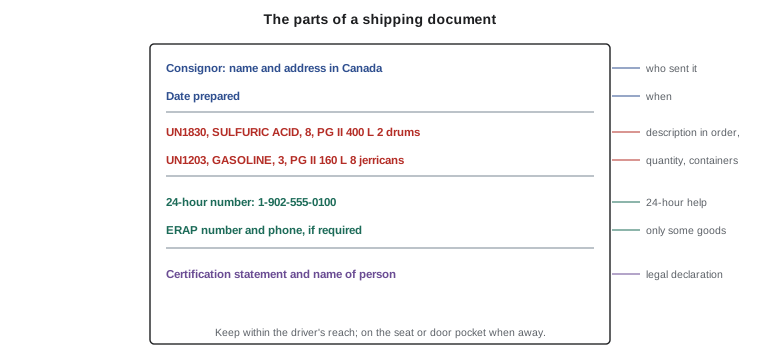
The TDG Regulations set out the required information but not a fixed form, so shipping documents can be bills of lading, waybills, manifests or electronic records, as long as they contain everything required and are legible. For each dangerous good, the document must show the following:
| Item | Example |
|---|---|
| Consignor's name and address in Canada | Northshore Supply Ltd., 12 Harbour Rd., Halifax NS |
| Date the document was prepared or given to the carrier | 2026-10-19 |
| Description in order: UN number, shipping name, primary class, subsidiary classes in brackets, packing group | UN1830, SULFURIC ACID, 8, PG II |
| Quantity for each shipping name, in SI units (mass or volume) | 400 L |
| Number of means of containment for each shipping name | 2 drums |
| 24-hour telephone number of a person who can give technical information | 1-902-555-0100 |
| ERAP reference number and telephone number, if an ERAP is required | ERAP 2-0123-456, 1-800-555-0199 |
| Consignor's certification statement and the name of the person who made it | Signed or named by the person preparing the shipment |
| Extra information where required: technical names, control and emergency temperatures, marine pollutant, toxic by inhalation, special provisions | FLAMMABLE LIQUID, N.O.S. (xylene) |
The certification statement confirms that the person preparing the shipment has classified, packaged and marked it properly. Its wording is set out in the regulations: I hereby declare that the contents of this consignment are fully and accurately described above by the proper shipping name, are properly classified and packaged, have dangerous goods safety marks properly affixed or displayed on them, and are in all respects in proper condition for transport according to the Transportation of Dangerous Goods Regulations. Signing it is a legal declaration, not a formality.
Where the document goes
For road transport, the shipping document must be kept in the cab, within reach of the driver while the driver is at the controls, or in a pocket on the driver's door. When the driver leaves the vehicle, the document must be left on the driver's seat or in the door pocket, or in a location clearly visible to anyone entering the cab. This lets a responder find it quickly even if the driver is hurt or away. For rail, a crew member must have it; for marine and air, it goes with the vessel's or aircraft's documents. Consignors and carriers must keep a copy, paper or electronic, for at least two years.
The emergency telephone number
Every shipping document must give a 24-hour telephone number at which someone with technical knowledge of the dangerous goods can be reached, normally the consignor's own number. Some consignors arrange this through a contracted service, and CANUTEC itself can be listed in some cases if the consignor has registered the required information with it. If an ERAP is required, the ERAP telephone number must be given, and that line must be answered immediately by someone who can activate the plan.
Emergency response information
Carriers are expected to have emergency information available, and Transport Canada distributes the Emergency Response Guidebook (ERG) for that purpose. The current 2024 edition, published jointly by Canada, the United States and Mexico, helps first responders in the first 30 minutes of an incident. Lesson 11 explains how to use it. Many carriers also keep safety data sheets or company emergency procedures in their vehicles.
Emergency response assistance plans
Part 7 of the TDG Regulations requires an emergency response assistance plan for dangerous goods that could cause a catastrophic incident, in quantities above the ERAP index in column 7 of Schedule 1. Examples include large quantities of liquefied petroleum gases (Schedule 1 sets an ERAP index of 3,000 L for UN1075, so a propane tank truck needs one), chlorine and other toxic gases, many explosives, some highly toxic or flammable liquids in tank cars, and certain radioactive materials. An ERAP describes how the plan holder will respond anywhere along the route, with trained teams, specialized equipment such as transfer pumps and patching kits, and arrangements with local responders. Transport Canada reviews and approves each ERAP and assigns it a reference number, which must appear on the shipping document. The importer or consignor holds the plan, but may join an industry plan, such as those run by chemical and propane associations, rather than create its own.
# Check a draft shipping document entry for required elements (simplified).
REQUIRED = ["un", "name", "class", "pg", "quantity", "containers"]
entries = [
    {"un": "UN1203", "name": "GASOLINE", "class": "3", "pg": "II", "quantity": "160 L", "containers": "8 jerricans"},
    {"un": "UN1075", "name": "PETROLEUM GASES, LIQUEFIED", "class": "2.1", "quantity": "", "containers": "4 cylinders"},
    {"un": "UN3480", "name": "Li-ion batteries", "class": "9", "quantity": "60 kg", "containers": "3 boxes"},
]
NO_PG = {"2.1", "2.2", "2.3", "7", "6.2"}
OFFICIAL = {"UN1203": "GASOLINE", "UN1075": "PETROLEUM GASES, LIQUEFIED", "UN3480": "LITHIUM ION BATTERIES"}
for e in entries:
    problems = [f for f in REQUIRED if not e.get(f) and not (f == "pg" and e["class"] in NO_PG)]
    if e.get("pg") is None and e["class"] in NO_PG:
        problems = [p for p in problems if p != "pg"]
    if e["name"].upper() != OFFICIAL[e["un"]]:
        problems.append("shipping name not as listed")
    if e["class"] == "9" and "pg" in problems:
        problems.remove("pg")  # many class 9 battery entries have no packing group
print(e["un"], "OK" if not problems else "missing or wrong: " + ", ".join(problems))UN1203 OK UN1075 missing or wrong: quantity UN3480 missing or wrong: shipping name not as listed
The checker finds two errors that inspectors often see: a quantity left blank and an abbreviated shipping name. Real documents are checked line by line against the dangerous goods list, and many companies use software that fills in the description from the list to avoid typing errors.
Worked problem
Writing a shipping document entry
A shipper sends 3 drums containing a total of 600 L of a flammable liquid mixture of xylene and toluene, class 3, packing group II, under FLAMMABLE LIQUID, N.O.S. Write the description line and the quantity information.
Show solution
- Start with the UN number for the generic entry: UN1993.
- Add the shipping name with technical names in brackets: FLAMMABLE LIQUID, N.O.S. (xylene, toluene).
- Add the class and packing group: 3, PG II.
- Add the quantity in SI units and the number of means of containment: 600 L, 3 drums.
Answer: UN1993, FLAMMABLE LIQUID, N.O.S. (xylene, toluene), 3, PG II, 600 L, 3 drums, plus the consignor's details, date, 24-hour number and certification.
Worked problem
Where to leave the document
A driver stops for lunch and leaves the truck in a parking lot. The shipping documents are on the dashboard under a clipboard. Is this correct?
Show solution
- When the driver leaves the vehicle, the documents must be on the driver's seat or in the holder or pocket on the driver's door.
- Documents hidden under a clipboard on the dashboard may not be found quickly by a responder looking through the window or opening the door.
- If the truck were struck or caught fire, responders would lose valuable time.
Answer: No. The driver should leave the documents on the seat or in the door pocket every time they leave the cab.
Errors inspectors find most often
Roadside and facility inspections turn up the same document errors again and again. Knowing them makes them easy to avoid:
- A blank or estimated quantity, or a quantity without a unit.
- Shipping names that are abbreviated, misspelled or replaced with trade names.
- Generic N.O.S. entries without the required technical names.
- Packing groups missing, or written with Arabic numerals instead of Roman numerals in a way that causes confusion.
- An emergency telephone number that is not answered at all hours, or belongs to someone who knows nothing about the product.
- A missing or unsigned certification statement.
- Documents kept in the sleeper berth, a toolbox or the trailer instead of within the driver's reach.
Electronic shipping documents are attractive to carriers, but on the road the regulations still expect a document that responders can read immediately, even if the driver is injured and the truck has no power. Transport Canada has allowed electronic shipping documents in some trials and under specific permits, and companies should check the current rules before relying on them. Many consignors use software that fills in descriptions from the list automatically, which removes typing errors as long as the product data behind it are correct.
Treat the document as safety equipment. A responder who reads a correct document can choose the right guide, the right isolation distance and the right extinguishing method in seconds; one who reads a wrong document may choose all three wrongly.
Documents for multi-stop routes
Delivery routes with several stops add a complication: the document must always match what is on the vehicle. As goods come off at each stop, the driver should mark the document or use a separate document for each consignee, and the placards must be updated when a class leaves the vehicle or when the total drops below a placarding threshold. A responder who arrives at a crash at the fifth stop needs to know what is still on board, not what was loaded in the morning. Many carriers give drivers a stop-by-stop list showing the remaining dangerous goods after each delivery, which also helps the driver keep the placards correct.
Documents for returns need the same care. When a customer sends back partly used cylinders, damaged packages or unwanted products, the driver becomes the carrier of a new shipment, and the customer becomes its consignor. A document must be prepared for the return trip unless an exemption applies, and damaged packages may need special handling or salvage packaging.
Common mistakes
MistakeListing the description elements out of order.
InsteadUse the fixed order: UN number, shipping name, class, subsidiary classes, packing group.
MistakeUsing an office number that is not answered at night.
InsteadGive a 24-hour number answered by someone with technical knowledge of the goods.
MistakeKeeping the document in a locked glove box or sleeper berth.
InsteadKeep it within the driver's reach, and on the seat or in the door pocket when the driver leaves.
MistakeSigning the certification without checking the shipment.
InsteadThe certification is a legal declaration that the shipment is fully compliant.
MistakeShipping goods above the ERAP index without an ERAP number on the document.
InsteadGoods above the ERAP index need an approved ERAP and its number and telephone number on the document.
Summary and key terms
- A shipping document must accompany dangerous goods unless an exemption applies.
- It shows the basic description in a fixed order, the quantity, the number of containers and an emergency telephone number.
- The person preparing the shipment signs or names a certification statement, a legal declaration of compliance.
- On the road, the document stays within the driver's reach, and on the seat or in the door pocket when the driver leaves.
- Consignors and carriers keep copies for two years.
- Emergency response information, usually the 2024 ERG, should travel with the shipment.
- Goods above the ERAP index need an approved emergency response assistance plan.
- Shipping document (shipping paper)
- The document that describes dangerous goods in a shipment and travels with the carrier.
- Certification statement
- The signed or named declaration that a shipment is properly classified, packaged, marked and described.
- 24-hour number
- The emergency telephone number on the document, answered at all times by someone who knows the goods.
- ERAP
- In Canada, an emergency response assistance plan approved by Transport Canada for the most hazardous goods.
- Emergency Response Guidebook (ERG)
- A guide for first responders, published by Canada, the United States and Mexico.
- CANUTEC
- The Canadian Transport Emergency Centre, which gives 24-hour advice to responders.
- CHEMTREC
- A US emergency call centre that provides emergency response information for registered shippers.
- HM column
- A column on a US shipping paper marked with an X beside hazardous materials entries.
- Bill of lading
- A common commercial document that can serve as a shipping document if it contains the required information.
- Record retention
- Keeping copies of shipping documents for the required period after the shipment.
Practice problems
Work each problem on paper first, then reveal the answer to check.
List the five elements of the basic description in order.
Show answer
UN number, shipping name, class, subsidiary classes and packing group.
What quantity information is required?
Show answer
The quantity in SI units and the number of means of containment for each shipping name.
What must the emergency telephone number provide?
Show answer
A 24-hour answer from someone with technical knowledge of the goods.
Where must the document be when the driver is at the controls?
Show answer
Within the driver's reach, or in the door pocket or holder.
Where must the document be when the driver leaves the cab?
Show answer
On the driver's seat or in the door pocket or holder.
How long must consignors keep copies?
Show answer
Two years.
What does the certification statement declare?
Show answer
That the shipment is properly classified, described, packaged and marked and in proper condition for transport.
When is an ERAP required?
Show answer
When the quantity of certain goods exceeds the ERAP index in column 7 of Schedule 1.
Which edition of the Emergency Response Guidebook is current?
Show answer
The 2024 edition.
Why are abbreviated shipping names a problem?
Show answer
They are not allowed and can mislead responders looking up the product.
Lesson quiz · 5 questions
Score 60% or more to complete this lesson.
Create a free account to save your progress, take quizzes and earn a certificate.