
HSE-250 · Lesson 3 of 12 · 27 min
The nine classes and their divisions
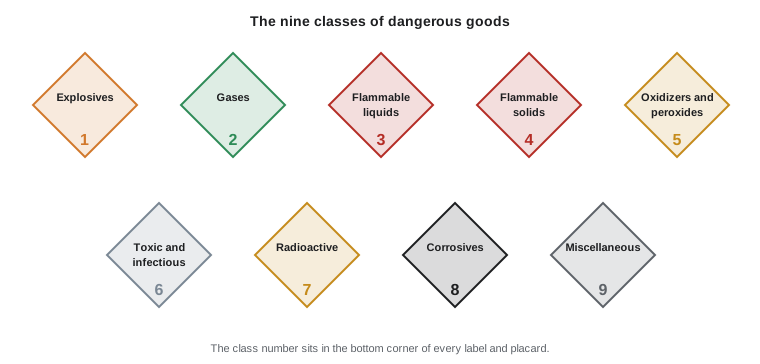
Every dangerous good belongs to one of nine classes, numbered 1 to 9. The class describes the main way the product can cause harm in transport: by exploding, by being a gas under pressure, by burning, by reacting, by poisoning or infecting, by emitting radiation, by corroding, or in some other way. Several classes are split into divisions, written with a decimal point, such as 2.3 for toxic gases or 6.2 for infectious substances. The class number is printed at the bottom corner of every label and placard, so learning the nine classes is the first step in reading any shipment.
The class numbers do not rank danger. Class 9 is not safer than class 1 in every situation, and some class 9 products, such as large lithium batteries, have caused serious fires. Within several classes, the packing group (lesson 4) does rank danger from great (I) to minor (III).
Class 1: Explosives
Class 1 covers substances and articles that can explode, burn rapidly or produce a pyrotechnic effect, from blasting explosives and ammunition to fireworks, airbag inflators and flares. It has six divisions based on the type of hazard: 1.1 mass explosion hazard, 1.2 projection hazard, 1.3 fire hazard with minor blast or projection, 1.4 minor hazard confined mostly to the package, 1.5 very insensitive substances with a mass explosion hazard, and 1.6 extremely insensitive articles. Each explosive also has a compatibility group letter, from A to S, that controls which explosives can travel together. Division 1.4S, the lowest-hazard group, includes many small arms cartridges and some safety devices.
Explosives are also regulated under the Explosives Act, administered by Natural Resources Canada, which authorizes explosive products and licenses their manufacture and storage. Most of the exemptions for small quantities in the TDG Regulations do not apply to class 1, apart from a short list of low-hazard items.
Class 2: Gases
Class 2 covers gases that are compressed, liquefied, dissolved under pressure or refrigerated to very low temperatures, and aerosols. Its three divisions describe the hazard of the gas itself:
- Division 2.1, flammable gases, such as propane, butane, acetylene, hydrogen and natural gas.
- Division 2.2, non-flammable, non-toxic gases, such as nitrogen, carbon dioxide, argon, compressed air and refrigerated liquid nitrogen. Oxygen and other oxidizing gases are also in 2.2, with a subsidiary class 5.1.
- Division 2.3, toxic gases, such as chlorine, ammonia (anhydrous), hydrogen sulfide and sulfur dioxide. These are among the most dangerous products in transport because a release can spread a lethal cloud downwind.
Even a non-flammable, non-toxic gas can kill. Nitrogen and carbon dioxide displace oxygen in an enclosed space such as a van cargo area, and a cylinder whose valve is knocked off becomes a projectile. Refrigerated liquids cause cold burns and expand enormously as they warm. Lesson 12 deals with carrying cylinders safely.
Class 3: Flammable liquids
Class 3 covers liquids with a flash point of not more than 60 °C, the temperature at which they give off enough vapour to ignite. Gasoline, diesel fuel (whose flash point is usually just above 52 °C), ethanol, acetone, paint thinners, many adhesives and crude oil are all class 3. Liquids with a flash point above 60 °C are not regulated as class 3 in Canada unless they are transported hot, at or above their flash point. Flammable liquids are by far the largest group of dangerous goods moved by road and rail.
Class 4: Flammable solids and related substances
Class 4 has three divisions that describe different ways a solid can start a fire:
- Division 4.1, flammable solids, such as matches, sulfur, magnesium powder and some metal powders, plus self-reactive substances that can decompose violently with heat, and desensitized explosives that are kept wet to suppress their explosive properties.
- Division 4.2, substances liable to spontaneous combustion, such as white phosphorus, oily rags and some activated carbon, which can heat up and ignite in air without an ignition source.
- Division 4.3, substances that are dangerous when wet, such as sodium, calcium carbide and some metal hydrides, which give off flammable gas when they contact water. Responders must know about 4.3 goods because water, their usual tool, makes the fire worse.
Class 5: Oxidizers and organic peroxides
Division 5.1, oxidizing substances, are products that are not necessarily combustible themselves but give off oxygen and make other materials burn more fiercely. Examples include ammonium nitrate, calcium hypochlorite (pool chlorine), hydrogen peroxide solutions and sodium chlorate. Division 5.2, organic peroxides, combine fuel and oxidizer in one molecule and can decompose explosively when heated or contaminated. Some organic peroxides must be kept below a control temperature during transport, with a higher emergency temperature at which emergency action begins.
Class 6: Toxic and infectious substances
Division 6.1, toxic substances, are liquids and solids that can kill or seriously harm people if swallowed, inhaled or absorbed through the skin, such as many pesticides, arsenic compounds, cyanides and phenol. Division 6.2, infectious substances, are materials known or reasonably expected to contain pathogens. Category A infectious substances (UN2814 affecting humans and UN2900 affecting only animals) can cause permanent disability or life-threatening disease; Category B substances, such as most diagnostic specimens, travel as UN3373 Biological Substance, Category B, with simpler packaging rules. Laboratory and medical shippers need specific training for class 6.2; the Human Pathogens and Toxins Act also applies to many of these materials.
Class 7: Radioactive materials
Class 7 covers materials that emit ionizing radiation above set activity limits, such as medical isotopes, industrial radiography sources, moisture density gauges used on construction sites and uranium ore concentrate. Radioactive packages carry one of three labels, Category I-White, II-Yellow and III-Yellow, depending on the radiation level at the surface and at one metre, which is expressed as the transport index. The Packaging and Transport of Nuclear Substances Regulations, 2015, administered by the Canadian Nuclear Safety Commission, add requirements to the TDG Regulations.
Class 8: Corrosives
Class 8 covers substances that destroy skin or corrode metal. A product is corrosive in transport if it causes full-thickness destruction of skin within set exposure times, or if it corrodes steel or aluminum faster than 6.25 mm (about 0.25 inch) a year at 55 °C. Sulfuric acid, hydrochloric acid, sodium hydroxide, battery fluid, many cleaners and some amines are class 8. Corrosives are common in industry and are frequent causes of package leaks.
Class 9: Miscellaneous products
Class 9 holds products that present a hazard in transport but do not meet the criteria of any other class. It includes lithium batteries, environmentally hazardous substances (products toxic to aquatic life), dry ice (UN1845), elevated temperature substances such as molten sulfur and hot asphalt above set temperatures, certain asbestos, genetically modified organisms, life-saving appliances such as inflatable rafts, and vehicles and engines powered by flammable fuel or batteries. Lithium batteries now generate a large share of incidents across all modes because damaged or poorly packed cells can overheat and catch fire.
The older consumer commodity designation ORM-D, still sometimes seen on old packaging, belongs to the US system and was phased out there at the end of 2020. In Canada, consumer products are handled through limited quantities and the small-quantity exemptions in lesson 10.
| Class or division | Main hazard | Everyday examples |
|---|---|---|
| 1.1 to 1.6 | Explosion, projection or fire | Blasting explosives, ammunition, fireworks, airbag inflators |
| 2.1 | Flammable gas | Propane, acetylene, aerosol lubricants |
| 2.2 | Gas under pressure, asphyxiation, cold | Nitrogen, carbon dioxide, compressed air, oxygen |
| 2.3 | Toxic gas | Chlorine, hydrogen sulfide |
| 3 | Flammable liquid | Gasoline, ethanol, paint thinner |
| 4.1, 4.2, 4.3 | Flammable solid, spontaneous combustion, dangerous when wet | Matches, oily rags, sodium, calcium carbide |
| 5.1, 5.2 | Oxidizer, organic peroxide | Pool chlorine, ammonium nitrate, hardeners for resins |
| 6.1, 6.2 | Toxic, infectious | Pesticides, cyanides, laboratory cultures, specimens |
| 7 | Radiation | Medical isotopes, density gauges |
| 8 | Corrosive | Sulfuric acid, sodium hydroxide, battery fluid |
| 9 | Other hazards | Lithium batteries, dry ice, environmentally hazardous substances |
Primary and subsidiary hazards
Many products have more than one hazard. Methanol is flammable and toxic. Hydrofluoric acid is corrosive and toxic. A substance gets one primary class, the most important hazard in transport, and one or more subsidiary classes. The primary class is chosen using a precedence table in the regulations; for many combinations, the class with the more severe packing group wins. Subsidiary classes are shown in brackets after the primary class on the shipping document, for example 3 (6.1), and often require an additional label. Some subsidiary hazards also require a subsidiary placard on the vehicle.
# Simplified precedence between class 3 and class 8 for a flammable, corrosive liquid,
# following the pattern of the UN precedence table (illustrative; always check the regulations).
TABLE = {  # (class 3 PG, class 8 PG) -> primary class
    ("I", "I"): "3", ("I", "II"): "3", ("I", "III"): "3",
    ("II", "I"): "8", ("II", "II"): "3", ("II", "III"): "3",
    ("III", "I"): "8", ("III", "II"): "8", ("III", "III"): "3",
}
def primary(pg3, pg8):
    p = TABLE[(pg3, pg8)]
    sub = "8" if p == "3" else "3"
    pg = min(pg3, pg8, key=["I", "II", "III"].index)   # most severe packing group applies
    return f"Class {p} ({sub}), PG {pg}"

for case in [("II", "I"), ("II", "II"), ("III", "II"), ("I", "III")]:
print(f"flammable PG {case[0]:<3} corrosive PG {case[1]:<3} -> {primary(*case)}")flammable PG II corrosive PG I -> Class 8 (3), PG I flammable PG II corrosive PG II -> Class 3 (8), PG II flammable PG III corrosive PG II -> Class 8 (3), PG II flammable PG I corrosive PG III -> Class 3 (8), PG I
The result always carries the most severe packing group of the hazards involved, even when the class with the less severe group is chosen as primary. The table is illustrative; real classification follows the exact table in the regulations and, where a product is listed by name, the class shown in the list overrides your own reasoning.
Worked problem
Classifying products in a maintenance shop
A maintenance shop is shipping back unused stock: a cylinder of acetylene, a drum of sodium hydroxide solution, a carton of aerosol paint, a jug of pool shock (calcium hypochlorite) and a carton of matches. Which class is each?
Show solution
- Acetylene is a flammable gas: division 2.1.
- Sodium hydroxide solution destroys skin: class 8.
- Aerosol paint is a flammable aerosol: class 2 (division 2.1).
- Calcium hypochlorite is an oxidizer: division 5.1.
- Matches are a flammable solid: division 4.1.
Answer: 2.1, 8, 2.1, 5.1 and 4.1. The oxidizer and the flammable products must also be kept apart under the segregation rules in lesson 7, because an oxidizer feeds a fire.
Worked problem
A hazard that is easy to overlook
A courier depot finds a carton marked only with a lithium battery mark and a carton of dry ice packed with frozen samples. Are these dangerous goods, and why does it matter?
Show solution
- Lithium batteries are class 9. Damaged cells can short-circuit, overheat and ignite neighbouring packages, especially in aircraft holds.
- Dry ice (solid carbon dioxide) is class 9. It turns to gas, which can build pressure in a sealed container and displace oxygen in a closed vehicle or aircraft compartment.
- Both are low on the class numbering but both have caused real incidents.
- If the samples are infectious, they also carry division 6.2 requirements.
Answer: Yes, both are dangerous goods (class 9), and the samples may add division 6.2. Packages must allow carbon dioxide gas to escape, and battery packages must protect against short circuits and damage.
Common mistakes
MistakeReading the class number as a ranking of danger.
InsteadThe class describes the type of hazard; packing group ranks danger within a class.
MistakeTreating non-flammable gases as harmless.
InsteadDivision 2.2 gases can asphyxiate, cause cold burns and turn cylinders into projectiles.
MistakeUsing water on a fire involving division 4.3 goods.
InsteadDangerous-when-wet goods release flammable gas with water; responders need to know they are present.
MistakeIgnoring the subsidiary hazard.
InsteadSubsidiary hazards appear on documents and labels and can change packing group, placards and segregation.
MistakeOverriding a named list entry with your own classification.
InsteadIf a product is listed by name, use the class and packing group shown in the list unless the rules allow otherwise.
Summary and key terms
- All dangerous goods fall into one of nine classes, several of which are split into divisions.
- The class number appears at the bottom of every label and placard.
- Class numbers describe the type of hazard, not how dangerous a product is.
- Gases (class 2) and flammable liquids (class 3) are the most common goods moved by road.
- Division 4.3 goods react dangerously with water, and division 5.1 oxidizers make fires burn harder.
- Lithium batteries and dry ice are class 9 but have caused serious incidents.
- Products with more than one hazard get a primary class from a precedence table and subsidiary classes shown in brackets.
- Division
- A subgroup within a class, written with a decimal point, such as 2.3.
- Compatibility group
- A letter from A to S that controls which explosives can travel together.
- Flash point
- The lowest temperature at which a liquid gives off enough vapour to ignite.
- Toxic gas
- A division 2.3 gas that can kill or seriously harm by inhalation.
- Dangerous when wet
- A division 4.3 substance that releases flammable gas on contact with water.
- Oxidizer
- A division 5.1 substance that gives off oxygen and intensifies fires.
- Organic peroxide
- A division 5.2 substance that contains both fuel and oxidizer and can decompose violently.
- Category A infectious substance
- An infectious substance able to cause permanent disability or life-threatening disease in exposed people or animals.
- Transport index
- A number based on the radiation level one metre from a radioactive package, used to control stowage.
- Subsidiary class
- An additional hazard of a product, shown in brackets after the primary class.
Practice problems
Work each problem on paper first, then reveal the answer to check.
What do the divisions of class 1 describe?
Show answer
The type of explosive hazard, from mass explosion (1.1) to extremely insensitive articles (1.6).
Give one example each of divisions 2.1, 2.2 and 2.3.
Show answer
For example propane (2.1), nitrogen (2.2) and chlorine (2.3).
What flash point limit defines a class 3 flammable liquid?
Show answer
Not more than 60 °C.
Why must responders know about division 4.3 goods?
Show answer
Water releases flammable gas from them, so the usual firefighting approach makes things worse.
Which division includes pool chlorine, and why is it hazardous?
Show answer
Division 5.1; it is an oxidizer that makes other materials burn more fiercely.
What is the UN number for Biological Substance, Category B?
Show answer
UN3373.
What metal corrosion rate makes a product class 8?
Show answer
More than 6.25 mm a year on steel or aluminum at 55 °C.
Name three class 9 products.
Show answer
Any three of lithium batteries, dry ice, environmentally hazardous substances, elevated temperature substances, asbestos and life-saving appliances.
How is a subsidiary class shown on a shipping document?
Show answer
In brackets after the primary class, for example 3 (6.1).
A flammable liquid in packing group II is also corrosive in packing group I. Which packing group applies to the shipment?
Show answer
Packing group I, the most severe.
Lesson quiz · 5 questions
Score 60% or more to complete this lesson.
Create a free account to save your progress, take quizzes and earn a certificate.