
HSE-250 · Lesson 6 of 12 · 28 min
Means of containment and UN specification marks
The best protection against a dangerous goods release is a container that does not leak. The TDG Regulations call any container used for dangerous goods a means of containment: a can, bottle, drum, box, bag, cylinder, intermediate bulk container, highway tank, portable tank or rail tank car. Part 5 of the regulations, together with safety standards incorporated by reference, sets out which means of containment can be used for which dangerous goods and how they must be designed, tested, marked, filled and closed.
The general rule
Whatever the container, the same general requirement applies: it must be designed, constructed, filled, closed, secured and maintained so that under normal conditions of transport, including handling, there is no accidental release of the dangerous goods that could endanger public safety. That sentence appears again and again in the regulations, including in the conditions of the small-quantity exemptions. It means more than choosing a strong container. The container must be compatible with the product (some plastics soften with solvents, and some metals corrode with acids), the closure must be tight and secured, there must be enough empty space (ullage) to allow liquids to expand with heat, and the container must be in good condition, without dents, rust or cracks that weaken it.
Normal conditions of transport include vibration, stacking, temperature changes from below freezing to the inside of a sunlit trailer, and the drops and bumps of loading and unloading. For air transport they also include pressure changes: a closure that is tight at ground level can leak at altitude unless the packaging is designed for the pressure difference.
Types of packaging
Small packagings fall into two broad types. A single packaging, such as a steel drum or plastic jerrican, holds the product directly. A combination packaging consists of inner packagings, such as glass bottles or metal cans, placed inside an outer packaging, such as a fibreboard box, often with cushioning and absorbent material. Combination packagings are common for laboratory chemicals, paints and consumer products. A composite packaging, such as a plastic receptacle in a steel drum, behaves as a single unit.
Larger containers come in several forms. Intermediate bulk containers (IBCs), often called totes, hold up to 3,000 litres and are common for liquids such as cleaning chemicals. Bulk containers include highway cargo tanks, portable tanks, tank cars, bulk bags and rail hopper cars. Cylinders and tubes hold gases under pressure. Each type has its own design standard and inspection schedule.
| Container | Typical capacity | Typical use |
|---|---|---|
| Inner packaging in a box | Up to a few litres each | Lab chemicals, paint, aerosols |
| Drum (steel, plastic, fibre) | Up to 450 L | Solvents, acids, powders |
| Jerrican | Up to 60 L | Fuels, cleaners |
| Intermediate bulk container | Up to 3,000 L | Industrial liquids and powders |
| Cylinder | Up to about 150 L water capacity | Compressed and liquefied gases |
| Cargo tank or highway tank | Tens of thousands of litres | Fuels, chemicals, liquefied gases |
| Rail tank car | Around 100,000 L or more | Crude oil, chemicals, liquefied gases |
Performance-tested packagings
Most small packagings used for dangerous goods must be UN standardized packagings. That means the design has been tested to show it can survive drops, stacking, leakage tests and, for liquids, internal pressure, at a performance level matched to the packing group. Packing group I products need the toughest tests, marked X. Packing group II needs Y, and packing group III needs Z. A packaging tested to X may be used for products of any packing group; one tested to Y may be used for packing groups II and III; one tested to Z may be used only for packing group III.
Manufacturers of UN standardized packagings in Canada must be registered with Transport Canada and must test their designs at set intervals. The standard CAN/CGSB-43.150, incorporated into the regulations in 2026, sets out how small packagings and intermediate bulk containers are selected and used for different classes.
Reading the UN specification mark
A UN standardized packaging carries a permanent mark, usually embossed or printed, that tells you exactly what it was tested for. The mark begins with the UN packaging symbol, a small u over n in a circle, or the letters UN, followed by a series of codes separated by slashes.
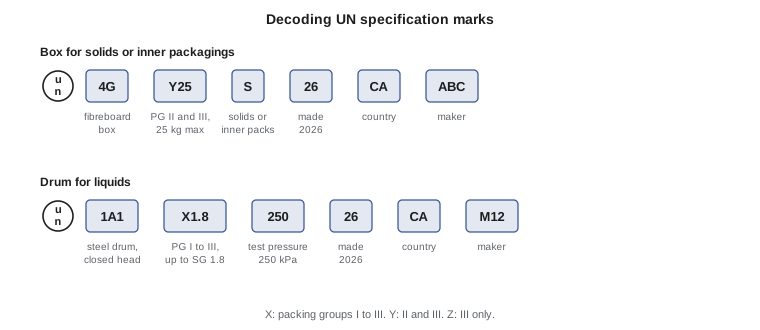
The first code identifies the type of packaging. A number gives the kind (1 drum, 3 jerrican, 4 box, 5 bag, 6 composite). A letter gives the material (A steel, B aluminum, C natural wood, D plywood, G fibreboard, H plastic, L textile, M paper, N other metal). A second number, where used, gives the category, such as 1 for a closed head and 2 for an open (removable) head. So 1A1 is a closed-head steel drum, 1H2 an open-head plastic drum, 3H1 a closed-head plastic jerrican and 4G a fibreboard box.
Next comes the performance level letter (X, Y or Z). For packagings meant for solids or inner packagings, the letter is followed by the maximum gross mass in kilograms, and then the letter S. For packagings meant for liquids, the letter is followed by the maximum specific gravity (relative density) of liquid the design was tested for, and then the hydraulic test pressure in kilopascals. The mark ends with the last two digits of the year of manufacture, the country that authorized the mark (CA for Canada, USA for the United States) and a code identifying the manufacturer or the testing agency. Plastic drums and jerricans also show the month of manufacture, because plastic degrades with age and is allowed only a limited service life for dangerous goods.
# Decode a UN specification mark and check it against a product (simplified).
KIND = {"1": "drum", "3": "jerrican", "4": "box", "5": "bag", "6": "composite"}
MATERIAL = {"A": "steel", "B": "aluminum", "G": "paperboard", "H": "plastic", "C": "wood", "D": "plywood"}
LEVEL = {"X": {"I", "II", "III"}, "Y": {"II", "III"}, "Z": {"III"}}

def decode(mark):
    code, perf, third, year, country, maker = mark.split("/")[:6]
    kind = KIND[code[0]] + " of " + MATERIAL[code[1]]
    if len(code) > 2:
        kind += ", closed head" if code[2] == "1" else ", open head"
    groups = LEVEL[perf[0]]
    if third == "S":
        detail = f"solids or inner packagings, max gross mass {perf[1:]} kg"
    else:
        detail = f"liquids up to specific gravity {perf[1:]}, test pressure {third} kPa"
    return kind, "PG " + "/".join(sorted(groups, key=["I", "II", "III"].index)), detail, "20" + year, country

def suitable(mark, pg, sg=None):
    kind, groups, detail, year, country = decode(mark)
    ok = pg in groups.replace("PG ", "").split("/")
    if sg is not None and "specific gravity" in detail:
        ok = ok and sg <= float(mark.split("/")[1][1:])
    return ok

for mark in ["4G/Y25/S/26/CA/ABC", "1A1/X1.8/250/26/USA/M12", "3H1/Y1.2/100/25/CA/XYZ"]:
    print(mark, "->", decode(mark))
print("sulfuric acid, PG II, SG 1.84 in 1A1/X1.8:", suitable("1A1/X1.8/250/26/USA/M12", "II", 1.84))
print("solvent, PG II, SG 0.87 in 3H1/Y1.2:     ", suitable("3H1/Y1.2/100/25/CA/XYZ", "II", 0.87))
print("PG I solid in 4G/Y25: ", suitable("4G/Y25/S/26/CA/ABC", "I"))4G/Y25/S/26/CA/ABC -> ('box of paperboard', 'PG II/III', 'solids or inner packagings, max gross mass 25 kg', '2026', 'CA')
1A1/X1.8/250/26/USA/M12 -> ('drum of steel, closed head', 'PG I/II/III', 'liquids up to specific gravity 1.8, test pressure 250 kPa', '2026', 'USA')
3H1/Y1.2/100/25/CA/XYZ -> ('jerrican of plastic, closed head', 'PG II/III', 'liquids up to specific gravity 1.2, test pressure 100 kPa', '2025', 'CA')
sulfuric acid, PG II, SG 1.84 in 1A1/X1.8: False
solvent, PG II, SG 0.87 in 3H1/Y1.2: True
PG I solid in 4G/Y25: FalseThe check shows why the numbers matter. Concentrated sulfuric acid has a specific gravity of about 1.84, slightly above the 1.8 the drum was tested for, so that drum design is not suitable even though its performance letter allows packing group II. A packing group I solid cannot go in a box tested only to Y. These are common errors in real inspections.
Gas cylinders
Cylinders for gases must meet a specification and be requalified at set intervals, usually by a hydrostatic or ultrasonic test every five or ten years depending on the type, with the date stamped on the cylinder. In Canada cylinders must meet the TC specifications in CSA B339, or DOT or UN specifications where the regulations accept them, and selection and use are covered by CSA B340. Never transport a cylinder that is out of date for requalification, has a damaged valve or shows bulging, deep dents, fire damage or corrosion. Valves must be closed and, where the cylinder is designed for one, protected by a cap or guard.
Bulk containers
Highway tanks are built to TC specifications such as TC 406 for low-pressure flammable liquids like gasoline, TC 407 for chemicals and TC 331 for liquefied gases like propane, under standards such as CSA B620 and B621. They must be inspected and tested periodically by registered facilities, and the test dates must be marked on the tank. Rail tank cars carrying flammable liquids in trains must now be TC-117 cars or retrofitted equivalents, a requirement that resulted from the Lac-Mégantic disaster.
Handling and loading
Even the best container fails if it is mishandled. Packages must be loaded so they cannot shift, roll or fall during transport, using blocking, bracing, straps or load bars. Orientation arrows on combination packagings must point up, because the inner packagings may have been designed to stay upright. Packages must not be dropped, dragged or stacked higher than they were designed for, and leaking or damaged packages must not be transported. Lesson 7 covers segregation, which keeps incompatible goods apart, and lesson 12 covers securing cylinders in a vehicle.
Worked problem
Checking a drum before reuse
A worker wants to reuse an empty plastic drum marked 1H1/Y1.4/150/19/CA/ABC to ship a corrosive liquid, packing group II, with a specific gravity of 1.3. The current year is 2026. Is the drum suitable?
Show solution
- 1H1 is a closed-head plastic drum, a suitable type for many liquids.
- Y allows packing groups II and III, so packing group II is covered.
- The specific gravity limit is 1.4, and the product is 1.3, so that is acceptable.
- The drum was made in 2019, so it is seven years old. Plastic drums for dangerous goods have a limited service life, commonly five years from manufacture unless the product or the regulations allow otherwise.
- The drum must also be compatible with the product and in good condition, and it must have been cleaned or must contain only the same product.
Answer: The marks would allow it, but the drum's age means it is probably beyond its permitted service life for dangerous goods. Use a newer drum.
Worked problem
A combination packaging for paint
A shop sends twelve 1 L cans of solvent-based paint (class 3, packing group II) in a fibreboard box. What should the box be?
Show solution
- This is a combination packaging: cans inside a box.
- Unless the shipment qualifies as a limited quantity (lesson 10), the box must be a UN standardized packaging tested to at least Y, because the paint is packing group II.
- The box must be marked with a gross mass at least equal to the packed weight, and the cans must be closed and cushioned as the box's test report specifies.
- Orientation arrows must show which way is up.
Answer: A UN-marked fibreboard box such as 4G/Y with a suitable gross mass, packed as tested, or a strong outer box under the limited quantity rules if all their conditions are met.
Common mistakes
MistakeUsing any strong container that seems suitable.
InsteadUse a container permitted for the product, compatible with it and, where required, UN standardized at the right performance level.
MistakeIgnoring the specific gravity limit in a liquid packaging mark.
InsteadCheck that the product's specific gravity does not exceed the number after X, Y or Z.
MistakeOverfilling a container of liquid.
InsteadLeave the required empty space so the liquid can expand with heat.
MistakeShipping a cylinder past its requalification date or with a damaged valve.
InsteadCheck the requalification date and condition before every shipment.
MistakeReusing old plastic drums indefinitely.
InsteadPlastic drums and jerricans have a limited service life for dangerous goods; check the date in the mark.
Summary and key terms
- The general rule: containers must be designed, filled, closed, secured and maintained so there is no release under normal transport conditions.
- Compatibility, closures, ullage and condition matter as much as strength.
- Single, combination and composite packagings, IBCs, bulk tanks and cylinders each have their own standards.
- UN standardized packagings are tested to X (packing groups I to III), Y (II and III) or Z (III only).
- The UN mark gives the packaging type, performance level, mass or specific gravity, test pressure, year, country and maker.
- Cylinders and bulk tanks must be requalified or inspected at set intervals, with dates marked.
- Packages must be loaded so they cannot shift, kept upright where marked and never shipped if leaking or damaged.
- Means of containment (packaging)
- Any container used for dangerous goods, from a can or drum to a rail tank car.
- Combination packaging
- Inner packagings placed in an outer packaging, such as bottles in a fibreboard box.
- Single packaging
- A packaging that holds the product directly, such as a drum or jerrican.
- Intermediate bulk container (IBC)
- A rigid or flexible container of up to 3,000 litres, often called a tote.
- UN standardized packaging
- A packaging design that has passed the UN performance tests and carries a UN specification mark.
- Performance level
- The letter X, Y or Z showing which packing groups a packaging design was tested for.
- Specific gravity
- The density of a liquid compared with water, which liquid packaging marks limit.
- Ullage (outage)
- The empty space left in a container so that liquid can expand with heat.
- Requalification
- Periodic testing of a cylinder or tank to confirm it is still safe to use.
- Closure instructions
- The manufacturer's instructions for closing a packaging so it performs as tested.
Practice problems
Work each problem on paper first, then reveal the answer to check.
State the general rule for containers of dangerous goods.
Show answer
They must be designed, constructed, filled, closed, secured and maintained so there is no accidental release under normal conditions of transport.
What is the difference between a single and a combination packaging?
Show answer
A single packaging holds the product directly; a combination packaging has inner packagings inside an outer packaging.
Which packing groups may use a packaging marked Y?
Show answer
Packing groups II and III.
Decode 4G/Y25/S.
Show answer
Fibreboard box, packing groups II and III, maximum gross mass 25 kg, for solids or inner packagings.
Decode 1A1/X1.8/250.
Show answer
Closed-head steel drum, packing groups I to III, liquids up to specific gravity 1.8, test pressure 250 kPa.
Why can a closure that is tight on the ground leak in an aircraft?
Show answer
Pressure drops at altitude, increasing the pressure difference across the closure.
What should you check on a gas cylinder before shipping it?
Show answer
Its requalification date, valve condition and protection, and signs of damage such as dents, bulging, fire damage or corrosion.
Why must liquids not be filled to the brim?
Show answer
They expand when heated and could burst or leak the container.
What do orientation arrows on a box mean?
Show answer
The box must be kept upright because the inner packagings are designed to stay upright.
Which tank car standard became required for flammable liquid trains after Lac-Mégantic?
Show answer
TC-117 (or retrofitted equivalents).
Lesson quiz · 5 questions
Score 60% or more to complete this lesson.
Create a free account to save your progress, take quizzes and earn a certificate.