
GAS-320 · Lesson 6 of 12 · 24 min
Unit heaters and infrared heaters
▶ Video coming soon A video version of this lesson is on the way.
On Thursday, October 8, Grant and Ayesha did the fall start-up at the truck yard of Ridgeline Paving, a road-building contractor in Glanbrook, south of Hamilton. The yard's main building had three repair bays heated by four low-intensity infrared tube heaters of 44 kW (150,000 Btu/h) each, a parts warehouse with two propeller unit heaters of 29.3 kW (100,000 Btu/h), and a wash bay with a third unit heater of 22 kW (75,000 Btu/h). The shop foreman, Rick Halloran, walked them through. "Tube heater number two hasn't run right since last winter, the wash bay heater rattles, and the guys say the warehouse is cold at the floor and hot at the ceiling," he said. "Other than that, it's perfect." Grant grinned. "That's a typical shop. Three heaters, three different problems, and I'd guess none of them is the gas valve."
This lesson covers the heaters that warm large open spaces: unit heaters, which heat and blow air, and infrared heaters, which heat people and objects directly by radiation. It describes the kinds of each, how they are mounted, vented and connected, the clearances that keep them from starting fires, and how to check that a space has enough heater for its heat loss.
Heating tall, open spaces
Warehouses, garages, factories, arenas and loading docks share two problems. They are tall, so warm air rises to the ceiling, where it does no good and leaks out through the roof, while the people work on a cold floor. And they have large doors that open often, so their air is replaced every time a truck comes in. Heating such a space with a central system and ducts would be expensive and slow. Instead, they are usually heated by individual gas appliances hung from the structure: unit heaters, which blow heated air down into the working zone, and infrared heaters, which radiate heat down onto the floor, the equipment and the people without having to warm all the air first.
Unit heaters
A unit heater is a compact heater with its own burner, heat exchanger and fan, hung from the building structure. The most common is the propeller type, with a fan blowing air horizontally across the heat exchanger and out through adjustable louvres. Blower types have a centrifugal blower and can push air through short ducts or across a long distance. They are vented in several ways:
- Gravity-vented units have a draft hood and vent like any Category I appliance, into a vertical vent.
- Power-vented units have an inducer fan and can vent horizontally through a wall, often through a positive-pressure vent.
- Separated-combustion units take their combustion air from outdoors through a pipe and vent outdoors through another, so they do not use the building's air at all. They are the right choice where the air in the space is dusty, humid or corrosive.
- Condensing unit heaters use a second heat exchanger to recover latent heat and need a condensate drain.
A unit heater's throw, the distance its warm air carries, and the direction of its louvres determine whether the heat reaches the floor. Unit heaters are mounted at the height the maker recommends for their size, often 2.4 to 4.5 m (8 to 15 ft) above the floor, and aimed so that their air sweeps across the working area and toward the outside walls and doors, where the heat loss is greatest. A heater hung too high, or with its louvres pointed straight out at the ceiling, stratifies the space: hot at the top and cold at the floor. That was the warehouse complaint at Ridgeline.
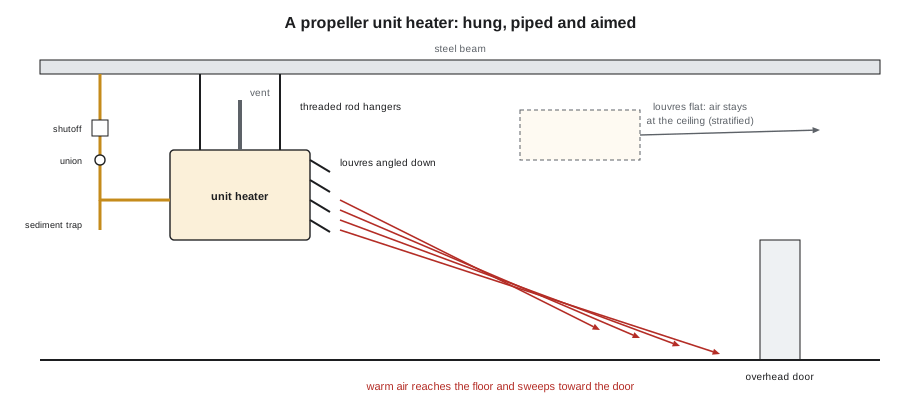
Unit heaters must be hung from structure that can carry them, using the hangers the maker supplies or specifies, usually threaded rod from beams or purlins, never from the roof deck or from the gas piping. The gas connection must allow the heater to be removed and serviced: a manual shutoff valve, a union and a sediment trap ahead of the heater's own controls, all reachable from a ladder or lift. Because hung heaters can swing or vibrate, the connection must be rigid or made with a connector that the codes and the maker allow for that use.
Infrared heaters
An infrared heater heats the way the sun does. Its hot surface radiates energy that passes through the air without warming it much and is absorbed by the floor, the vehicles, the equipment and the people below, which then warm the air near the floor. Because the air at the ceiling stays cooler, less heat escapes through the roof, and because people feel radiant heat directly, the space can feel comfortable at a lower air temperature. Infrared heating is common in repair garages, warehouses, loading docks, arenas and patios.
- Low-intensity tube heaters, certified in both countries to ANSI Z83.20/CSA 2.34, burn gas at one end of a long steel tube. The hot flue gas flows along the tube, heating it to a dull, invisible glow, and a reflector above the tube directs the radiation downward. A fan, either pushing at the burner end or pulling at the exhaust end, moves the gas through the tube and out through a vent. Tube heaters are vented and can usually take their combustion air from outdoors.
- High-intensity heaters, certified to ANSI Z83.19/CSA 2.35, burn gas across the face of a ceramic tile or a metal screen that glows bright orange. Many are unvented, releasing their combustion products into the space, so the space must have the ventilation that the code and the maker require for them.
Clearances to combustibles
Infrared heaters can ignite anything in front of them that absorbs enough radiation for long enough: wood, cardboard, plastic, tarps, vehicle tires, even a pickup's paint. Every infrared heater carries a label giving its clearances to combustibles, the minimum distances below, beside, behind and above the heater, and these distances are large below the tube, where the radiation is aimed. The label's clearances are not suggestions. They apply to anything that can be placed under or beside the heater, including vehicles and stored goods, and the installer must check them against how the space is actually used, not only against the empty building on installation day. Unit heaters have clearances too, smaller ones, on their own labels.
Garages add their own requirements. Repair garages have vehicles with fuel in them and sometimes open fuel, and the codes set minimum heights above the floor for heaters in such spaces and require that they be mounted above the reach of vehicles. In parking garages and repair bays, heaters must also be protected from damage by vehicles. Where vehicles are lifted on hoists or have tall bodies, the clearance must be checked against the highest position they can reach.
Worked problem
Checking a tube heater clearance
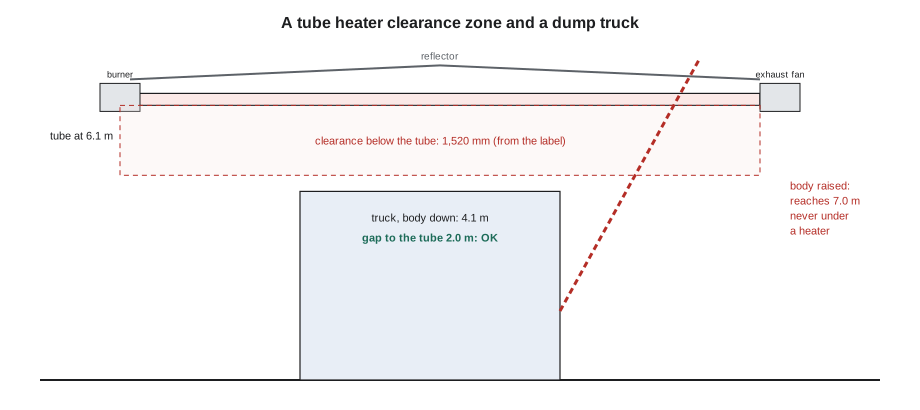
At Ridgeline, tube heater 2 is mounted with its tube 6.1 m above the floor. Its label requires 1,520 mm clearance below the tube to combustibles. The tallest vehicle in the bay, a tandem dump truck, is 4.1 m high with its body down; with its body raised for a hoist repair, it reaches 7.0 m. Check the clearance in each position.
Show solution
- Body down:
- \[6.1 - 4.1 = 2.0 \text{ m} = 2{,}000 \text{ mm} > 1{,}520 \text{ mm}\]
- Body raised:
- \[7.0 > 6.1 \text{ m}\]
Answer: With the body down the truck clears the tube by more than the label requires. With the body raised it would hit the tube itself. The shop must never raise a dump body under a heater, and the safe way to manage that is to mark the floor zones under each heater and to do dump-body repairs in the bay without one, or to move the heaters.
That was exactly the issue with tube heater 2. Its reflector was dented and twisted, and two of its hangers were bent. Rick admitted that the previous winter a mechanic had raised a dump body in bay two, and the body had struck the tube. Since then the heater had run hot and shut down on its own safety switch: the twisted reflector was radiating heat up toward the roof deck instead of down, and the bent tube sagged so that a joint had opened slightly and the tube's exhaust fan could not hold the negative pressure the heater's pressure switch needed. Grant isolated the heater, and he and Ayesha replaced the damaged tube section, the coupling, the reflector and the hangers with the maker's parts. After the repair the pressure switch proved, the burner lit and held, and the tube ran at an even heat along its length. Ayesha used chalk paint to mark the clearance zone on the floor of each bay, and Rick wrote a shop rule on the board: no raised dump bodies in bays one to three.
The wash bay
The rattling wash bay heater was a standard propeller unit heater taking its combustion air from the bay. A wash bay's air is warm, wet and, in winter, full of road salt and chlorides from the trucks' undercarriages. Burned with gas, those chlorides form acids that attack steel. When Ayesha removed the heater's access panel, the heat exchanger tubes were scaled with rust, and one had a hole through which the flame could be seen from the air side. The rattle was a loose, corroded baffle. A heat exchanger with a hole in it, in a space where people work, is an unsafe condition. Grant shut the heater off, tagged it, and recommended its replacement with a separated-combustion unit heater with a stainless steel heat exchanger, which takes clean outdoor air for combustion and keeps the bay's corrosive air out of its burner.
| Space | Usual heater choice | Why |
|---|---|---|
| Repair garage | Low-intensity tube heaters, mounted high | Warm floor and vehicles; heaters clear of vehicles |
| Warehouse | Unit heaters or tube heaters | Unit heaters are cheap and simple; tubes reduce stratification |
| Wash bay | Separated-combustion heater with a corrosion-resistant heat exchanger | Bay air is humid and corrosive |
| Loading dock | Tube or high-intensity heaters | Heat people and goods despite open doors |
| Dusty or lint-laden shop | Separated-combustion units | Keep dust out of the burner and combustion air |
| Space with flammable vapours | Equipment suitable for the hazard, often located outside the area | Open flames must not ignite vapours |
Do the heaters match the heat loss?
A space is comfortable only if its heaters can replace the heat it loses on a design day: through the walls, roof and doors, and by the cold outdoor air that comes in whenever the doors open. Calculating a building's heat loss is a designer's job, but a technician who is asked to add or replace heaters should be able to check that the proposed equipment matches the designer's figure.
Worked problem
Checking the repair bays
The designer's heat loss for Ridgeline's three repair bays, including an allowance for the doors opening, is 120 kW. The four tube heaters are rated 44 kW input each, and the maker gives a thermal efficiency of 80 in 100. Do the heaters cover the loss, and with what margin?
Show solution
- Total input:
- \[4 \times 44 = 176 \text{ kW}\]
- Total output:
- \[176 \times 0.80 = 140.8 \text{ kW}\]
- Margin over the loss:
- \[\frac{140.8}{120} = 1.17\]
Answer: The four heaters deliver about 17 parts in 100 more than the design loss. That is a sensible margin for a garage whose doors open often. With one heater out of service, as heater 2 had been all last winter, the three remaining deliver three-quarters of that, about 88 in 100 of the loss, which is why bay two had been cold.
The warehouse
In the warehouse, both unit heaters were hung close under the roof, about 6 m (20 ft) up, with their louvres set horizontal. Grant measured 29 °C near the roof and 12 °C at the floor. The heaters were working perfectly; their air simply never came down. With Rick's agreement, Ayesha angled the louvres downward toward the floor and the overhead doors, and Grant recommended lowering the heaters to the maker's recommended mounting height on the next shutdown, or adding destratification fans. An hour after the louvres were adjusted, the floor temperature had risen to 16 °C and the roof temperature had fallen. "Same gas, same heat," Grant said. "Just put where the people are."
Ventilation for unvented heaters
Unvented infrared heaters release carbon dioxide, water vapour and small amounts of carbon monoxide into the space, so the space must be ventilated to carry them away. The codes set a minimum ventilation rate tied to the heaters' input and require that the heaters be interlocked with the ventilation, or that the ventilation run whenever they do. Unvented heaters are not permitted in some occupancies at all, and in a tight modern building the moisture they release can cause condensation. Where unvented heaters are found, check that the ventilation the code and the maker require exists and works.
Common mistakes
MistakeChecking clearances against the empty building only.
InsteadCheck against how the space is used: vehicles, raised bodies, hoists and stored goods.
MistakeHanging a unit heater from the roof deck or the gas piping.
InsteadHang it from structure with the maker's hangers.
MistakePointing unit heater louvres horizontally under a high roof.
InsteadAim the air down to the working zone and toward doors and outside walls.
MistakeUsing a standard unit heater in a wash bay or corrosive shop.
InsteadUse separated combustion and a corrosion-resistant heat exchanger.
MistakeRunning an unvented infrared heater without the required ventilation.
InsteadConfirm the ventilation exists, is interlocked and runs.
Summary and key terms
- Tall, open spaces are heated by hung unit heaters, which blow warm air down, and infrared heaters, which radiate heat to the floor, objects and people.
- Unit heaters may be gravity-vented, power-vented, separated-combustion or condensing; they must be hung from structure, connected with an accessible shutoff, union and sediment trap, and aimed so that their air reaches the working zone.
- Low-intensity tube heaters are vented and use a reflector; high-intensity heaters are often unvented and need ventilation.
- Every heater's label gives clearances to combustibles, which must be checked against vehicles, raised bodies and stored goods.
- Corrosive or dusty spaces need separated-combustion heaters.
- The heaters' total output should cover the designer's heat loss with a sensible margin.
- Unit heater
- A compact hung heater with its own burner, heat exchanger and fan.
- Separated combustion
- An arrangement in which combustion air comes from outdoors through a pipe and the flue gas is vented outdoors.
- Infrared heater
- A heater whose hot surface radiates heat directly to objects and people.
- Tube heater
- A low-intensity infrared heater that burns gas into a long steel tube under a reflector.
- Clearance to combustibles
- The minimum distance from a heater to combustible material, given on its label.
- Stratification
- Layering of warm air at the ceiling and cold air at the floor.
- Throw
- The distance a unit heater's warm air carries.
Practice problems
Work each problem on paper first, then reveal the answer to check.
Why does infrared heating suit tall spaces with large doors?
Show answer
It warms people, floors and objects directly, so less heat goes into the air at the ceiling and out through the roof.
What did a raised dump body do to tube heater 2?
Show answer
It struck the tube, bending the tube, hangers and reflector, so the heater ran hot and lost its draft.
Why was the wash bay unit heater's heat exchanger rusted through?
Show answer
It burned the bay's humid, salty air, whose chlorides formed acids that attacked the steel.
Five heaters of 30 kW input at 80 in 100 efficiency serve a space with a 110 kW loss. What is the margin?
Show answer
5 × 30 × 0.80 = 120 kW; 120 ÷ 110 = 1.09.
What made the warehouse cold at the floor?
Show answer
Heaters hung high with horizontal louvres, so the warm air stayed at the ceiling.
Lesson quiz · 5 questions
Score 60% or more to complete this lesson.
Create a free account to save your progress, take quizzes and earn a certificate.