
GAS-320 · Lesson 1 of 12 · 27 min
Commercial heating systems overview
▶ Video coming soon A video version of this lesson is on the way.
On Monday, September 14, Maureen Fitch took Grant Whitlock on a walk-through of Ferguson Place, a 1974 eight-storey office building on King Street East in downtown Hamilton. Bayline had just won the building's mechanical service contract, and the property manager, Wendy Szabo, wanted a list of every gas appliance in the building before the heating season started. Grant had spent eleven years servicing rooftop units for a refrigeration contractor before joining Bayline's commercial team in the spring, and he knew air-side equipment well. "Rooftops I can do in my sleep," he said as they took the freight elevator to the penthouse. "Boiler plants, not so much." Maureen handed him a clipboard. "Then today we write down everything that burns gas in this building, what it heats, and how it's controlled. By the end you'll see that a building like this is one system, not a pile of appliances."
This lesson is the map for the rest of the course. It describes the main kinds of commercial heating systems, how commercial appliances are rated, how to add up a building's gas load and its heat output, how to work out the water flow a boiler plant must move, and who is allowed to work on which equipment. The lessons that follow take each kind of equipment in turn: boilers and their controls, rooftop units, makeup air units and kitchen ventilation, unit and infrared heaters, water heaters, cooking equipment, common venting, mechanical rooms, seasonal maintenance and, finally, a complete restaurant installation.
What makes commercial work different
A house usually has one furnace, one water heater and perhaps a range and a dryer, each with its own instructions and each serving one family. A commercial building has many appliances serving many people, often from a central plant, and they interact. The boilers in the penthouse heat water that flows to coils in air handlers on another floor; a makeup air unit replaces the air that a kitchen hood removes, and if it stops, the whole ground floor goes negative and every atmospheric appliance on that floor may spill; a garage unit heater may run all night while the boilers idle. When one part changes, other parts are affected. A commercial technician has to understand the building as well as the appliance.
Commercial appliances are also larger, and size changes the work. Inputs run from a few tens of kilowatts for a unit heater to several megawatts for a large boiler. Gas is often delivered at elevated pressure and reduced by line and appliance regulators. Many appliances have power burners, gas trains with two safety shutoff valves and flame safeguards, and the larger ones fall under rules for burner management that do not apply to a furnace. Boilers are pressure vessels as well as gas appliances, so they are also governed by boiler and pressure vessel rules and inspected by a boiler inspector. Many commercial appliances are serviced under contract on a schedule, by technicians who did not install them, from records that may be incomplete. And the people who depend on the building, office workers, residents, students, diners, are not the people who own the equipment.
The main kinds of system
Most commercial buildings heat with one or more of five arrangements, and many use several at once.
- Central hydronic plant. One or more hot water boilers heat water that pumps carry to radiators, fin-tube baseboard, fan coils, radiant floors and the heating coils of air handlers. The boilers can be atmospheric, power-burner or condensing. Ferguson Place is heated this way.
- Low-pressure steam plant. Older buildings, especially those built before about 1950, often heat with steam, which rises through the piping to radiators and returns to the boiler as condensate. Steam needs no circulating pump for the heating loop but needs traps, vents and careful water treatment.
- Rooftop units and gas-fired air handlers. Packaged units on the roof heat, cool and ventilate the space directly below. Each has its own gas heat section, so a single-storey store may have a dozen small gas appliances instead of one plant.
- Makeup air and ventilation heating. Kitchens, laboratories, garages and factories exhaust large volumes of air, and a makeup air unit heats the replacement air, often with a direct-fired burner in the airstream.
- Space heaters. Unit heaters and infrared heaters heat warehouses, garages, workshops and loading docks, where heating the air of a tall space would be wasteful.
Alongside the heating, almost every commercial building has domestic hot water heaters, and many have commercial cooking equipment, pool heaters, laundry dryers or process equipment. Each of these is a gas appliance with its own code requirements, and each adds to the gas load.
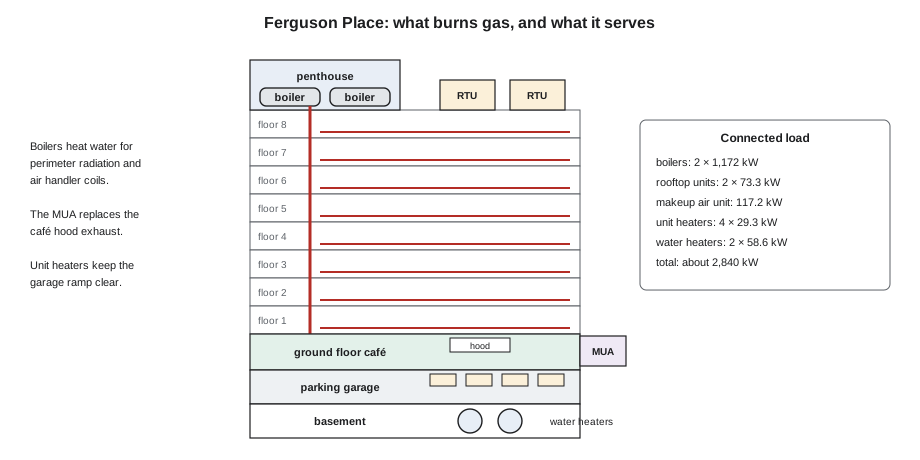
The Ferguson Place inventory
By lunchtime Grant's clipboard held the list. In the penthouse were two fire-tube hot water boilers installed in 1999, each with a modulating power burner rated 1,172 kW (4,000,000 Btu/h). They supplied water at up to 82 °C to perimeter fin-tube radiation on every floor and to the heating coils of two air handlers on the mechanical floor. Beside the penthouse, two rooftop units added in 2012 for the eighth-floor tenant each had a gas heat section of 73.3 kW (250,000 Btu/h). On the ground floor, the café had a kitchen hood and a direct-fired makeup air unit of 117.2 kW (400,000 Btu/h). In the parking garage, four unit heaters of 29.3 kW (100,000 Btu/h) each kept the ramp and the entrance from icing. In the basement, two commercial storage water heaters of 58.6 kW (199,900 Btu/h) supplied the washrooms and the café.
For each appliance Grant wrote down the make, model, serial number, rated input, gas type, the date of the last service if a tag showed one, the type of venting, what controlled it and what it served. He also noted the things that were not on any nameplate: a combustion air louvre in the penthouse that had been partly covered with plywood, a garage unit heater with a crushed vent cap, and a makeup air unit whose filter rack was empty. "That's the real value of an inventory," Maureen said. "The nameplates tell you what was installed. Your eyes tell you what's happened since."
Rating commercial appliances
Every gas appliance is rated by its input, the rate at which it burns gas, given on the rating plate in kilowatts or Btu per hour. Commercial equipment is also often described in MBH, thousands of Btu per hour, so a 117 kW heater is a 400 MBH heater. Some boilers are rated in boiler horsepower, an old unit equal to about 9.81 kW of output; in steam terms, one boiler horsepower evaporates about 15.6 kg of water per hour at atmospheric pressure. You will meet boiler horsepower on older nameplates and in boiler room conversations, so it is worth knowing the conversion.
The output is the heat the appliance delivers to the water or air, and the ratio of output to input is its efficiency. Commercial equipment is rated in different ways, and they are not interchangeable. Combustion efficiency is calculated from a flue gas analysis and counts only the heat lost up the stack. Thermal efficiency is measured at the outlet under test conditions and also counts losses through the jacket. Seasonal ratings such as AFUE, used for furnaces and smaller boilers, include cycling and standby losses over a typical season. A large commercial boiler is usually rated by thermal or combustion efficiency, which is why its efficiency figure cannot be compared directly with a house furnace's AFUE.
A boiler's gross output is the heat it can deliver at its outlet. Its net rating is a lower figure that allows for heat lost from the piping and for the extra heat needed to warm a cold system in the morning; it is the figure to compare with the building's heat loss. Hydronic and steam boilers often show both on the plate or in the maker's tables.
Worked problem
Total connected load at Ferguson Place
Add up the connected gas load of Ferguson Place: two boilers at 1,172 kW, two rooftop units at 73.3 kW, one makeup air unit at 117.2 kW, four unit heaters at 29.3 kW and two water heaters at 58.6 kW. Then find the gas flow if every appliance ran at full input, using a heating value of 37.5 MJ/m³.
Show solution
- Boilers:
- \[2 \times 1{,}172 = 2{,}344 \text{ kW}\]
- Rooftop units:
- \[2 \times 73.3 = 146.6 \text{ kW}\]
- Makeup air, unit heaters and water heaters:
- \[117.2 + 4 \times 29.3 + 2 \times 58.6 = 117.2 + 117.2 + 117.2 = 351.6 \text{ kW}\]
- Total:
- \[2{,}344 + 146.6 + 351.6 = 2{,}842.2 \text{ kW}\]
- Gas flow (1 kW for one hour is 3.6 MJ):
- \[\frac{2{,}842.2 \times 3.6}{37.5} = 272.8 \text{ m}^3/\text{h}\]
Answer: The building's connected load is about 2,840 kW, which would burn about 273 m³ of gas an hour if everything fired at once. That rarely happens, but the utility's meter and the main gas piping must be able to carry it, so the connected load is the starting point for any change to the gas system.
Worked problem
Boiler output and boiler horsepower
Each Ferguson Place boiler has an input of 1,172 kW and a thermal efficiency of 82 in 100. Find its output in kilowatts and in boiler horsepower, using 1 boiler horsepower = 9.81 kW.
Show solution
- Output:
- \[1{,}172 \times 0.82 = 961 \text{ kW}\]
- Boiler horsepower:
- \[\frac{961}{9.81} = 98.0 \text{ BHP}\]
Answer: Each boiler is about a 100 horsepower boiler, the way an older stationary engineer would describe it. Two of them give the building about twice that, and the building's heat loss on the coldest day should be well within the output of one boiler plus part of the second, so that the plant has a spare.
Moving the heat: water flow
A hydronic boiler's output only reaches the building if enough water flows through it. The heat carried by a flow of water depends on how much water moves and how much its temperature drops as it gives up heat in the building. Boiler makers give a design temperature difference between supply and return, often about 11 °C for conventional boilers and larger for condensing boilers designed for low return temperatures, and a minimum flow below which the boiler may overheat or flash to steam locally. If the pumps move too little water, the temperature rise across the boiler climbs, the high limit trips, and in the worst case the boiler is damaged; if they move too much in a condensing system, the return water stays too warm for the boiler to condense.
Worked problem
Water flow for one boiler
One Ferguson Place boiler delivers 961 kW. The design temperature difference is 11 °C. Using heat = 4.19 × flow in L/s × temperature difference in °C (in kW), find the water flow.
Show solution
- Rearrange for flow:
- \[\text{flow} = \frac{\text{heat}}{4.19 \times \Delta T}\]
- Substitute:
- \[\frac{961}{4.19 \times 11} = \frac{961}{46.09} = 20.9 \text{ L/s}\]
Answer: Each boiler needs about 21 litres of water every second at full fire. If the pump serving it delivers much less, the temperature rise across the boiler will be larger than 11 °C, and the high limit will start to trip on cold mornings. Checking flow, or at least the temperature rise at full fire, is part of every boiler start-up.
The constants come from the properties of water: 4.19 kJ to warm one kilogram, or one litre, by one degree Celsius. For water with glycol antifreeze, which carries less heat, the maker's correction must be used.
| System | Typical gas equipment | What the gas technician checks most |
|---|---|---|
| Hydronic plant | Hot water boilers, atmospheric, power-burner or condensing | Burner, controls and limits, water flow, venting, combustion air |
| Steam plant | Low-pressure steam boilers | Water level controls, pressure control, burner, venting |
| Rooftop units | Packaged gas heat sections | Heat exchanger, temperature rise, gas pressure, roof piping |
| Makeup air | Direct- or indirect-fired makeup air units | Air proving, burner profile, discharge temperature, interlocks |
| Space heating | Unit heaters, infrared tube and high-intensity heaters | Clearances, venting, mounting, gas connection |
| Water heating | Commercial storage, tankless and booster heaters | Recovery, temperatures, relief valves, venting |
| Cooking | Ranges, fryers, broilers, ovens | Connectors, restraints, interlocks with exhaust, pressure |
Who may work on what
In Ontario, gas technicians are certified under the regulation for gas technicians and fitters. A G.2 technician may work on appliances up to 117 kW (400,000 Btu/h); larger appliances, including both Ferguson Place boilers, need a G.1. Grant holds a G.2 and is logging commercial hours under Maureen toward his G.1, so on the boilers he works under her direction. An apprentice works under the direct supervision of a certificate holder for the class of work. The contractor must also be registered with TSSA. Because boilers are pressure vessels, the boiler and pressure vessel regulation also applies to them: heating boilers above a small size are registered, inspected by an authorized inspector, usually from the owner's insurer, and operated under a certificate of inspection.
Whatever the jurisdiction, the rule on the job is the same: before you touch a commercial appliance, know whether your certificate or your company's rules allow you to, and if not, work only under the person who is allowed.
Reading the building before the appliance
Maureen ended the walk-through in the property manager's office with three questions that she asks at every new building. First, what has changed recently: new tenants, renovations, new exhaust fans, new equipment? Changes to the building are the most common cause of new problems with old appliances. Second, where are the records: start-up reports, service reports, boiler inspection certificates, drawings? A building with good records can be serviced properly; a building without them has to be surveyed first. Third, who operates the building day to day, and what are they allowed to adjust? At Ferguson Place the answer to the third question was a building operator, Stan, who reset the boilers when they locked out and had adjusted the boiler temperature dial "to keep the tenants happy". "That's not a criticism," Maureen told Grant afterward. "Stan keeps the building running. But we need to know what he does, and he needs to know when to call us instead."
Common mistakes
MistakeTreating each appliance in a commercial building as if it stood alone.
InsteadAsk what each appliance serves and what else in the building can affect it, especially exhaust fans and other burners.
MistakeComparing a commercial boiler's thermal efficiency directly with a furnace's AFUE.
InsteadKnow which rating a figure is: combustion, thermal or seasonal efficiency.
MistakeAdding a new appliance without adding up the existing connected load.
InsteadTotal the connected load first; the meter, regulators and piping must carry the new total.
MistakeChecking a boiler's burner and ignoring the water side.
InsteadCheck flow, or the temperature rise at full fire, as well as the gas side.
MistakeWorking on a large appliance outside your certificate or company rules.
InsteadConfirm who is allowed to do the work before starting, and work under that person if it is not you.
Summary and key terms
- Commercial buildings combine central hydronic or steam plants, rooftop units, makeup air units, space heaters, water heaters and cooking equipment, and these appliances affect one another through the building's air and piping.
- Appliances are rated by input in kilowatts, Btu/h or MBH, sometimes by boiler horsepower (about 9.81 kW of output), and efficiency figures may be combustion, thermal or seasonal, which are not interchangeable.
- The connected load is the sum of all inputs and sets the size of the meter and piping.
- A hydronic boiler needs enough water flow to carry its output: heat in kW = 4.19 × L/s × ΔT.
- In Ontario, appliances over 117 kW need a G.1, and boilers are also registered and inspected under the boiler and pressure vessel regulation. Every new building starts with an inventory, the records and a conversation about recent changes.
- Connected load
- The total of the rated inputs of all gas appliances served by a meter or piping system.
- MBH
- Thousands of Btu per hour.
- Boiler horsepower
- An old unit of boiler output, about 33,475 Btu/h or 9.81 kW.
- Thermal efficiency
- The ratio of heat delivered at the outlet to heat input, measured under test conditions.
- Gross output
- The heat a boiler delivers at its outlet.
- Net rating
- A boiler rating that allows for piping losses and pick-up, for comparison with building heat loss.
- Central plant
- Boilers or other equipment in one place serving a whole building through piping.
Practice problems
Work each problem on paper first, then reveal the answer to check.
What are the five common arrangements for heating commercial buildings?
Show answer
Central hydronic plants, low-pressure steam plants, rooftop units and gas-fired air handlers, makeup air units, and space heaters such as unit and infrared heaters.
What is 400 MBH in Btu/h?
Show answer
400,000 Btu/h.
A boiler delivers 500 kW. How many boiler horsepower is that?
Show answer
500 ÷ 9.81 = 51.0 BHP.
Why is a boiler's net rating, not its gross output, compared with the building's heat loss?
Show answer
Because the net rating allows for heat lost from the piping and the extra heat needed to warm a cold system.
What three questions does Maureen ask at every new building?
Show answer
What has changed recently, where the records are, and who operates the building and what they adjust.
Lesson quiz · 5 questions
Score 60% or more to complete this lesson.
Create a free account to save your progress, take quizzes and earn a certificate.