
GAS-320 · Lesson 11 of 12 · 26 min
Seasonal start-up and maintenance
▶ Video coming soon A video version of this lesson is on the way.
On Tuesday morning, November 3, Maureen sat down with Ayesha and Priya Nair, Bayline's dispatch and safety coordinator, to look at the commercial service contracts. Bayline now looked after more than forty commercial buildings, and the fall start-ups that had begun in September were nearly finished. "Every one of these buildings has a story," Maureen said, pointing at the list. "Ferguson Place had a jumpered switch. Rymal had a broken sensor. Lakeshore had a heater nobody knew was off. None of those were breakdowns. They were things a good maintenance program finds before they become breakdowns." That afternoon she took Ayesha to the last start-up on the list, the Riverdale Community Centre in Hamilton's east end, a building with a little of everything: two hot water boilers of 293 kW (1,000,000 Btu/h), two rooftop units over the gym, a commercial water heater and a hall kitchen with a range under a small hood.
This lesson pulls together the service work of this course into a maintenance program: what is done at start-up in the fall, what is checked through the season, what is done at spring shutdown, how safety controls are tested on a schedule, how records are kept, and how findings are reported to the owner. It also shows how trends in readings warn of problems before they cause a failure.
Why commercial equipment needs a program
A house furnace that is serviced once a year usually runs safely in between, and its owner hears it if it misbehaves. Commercial equipment runs longer hours, often unattended, in rooms nobody visits, serving people who cannot see it. The codes and standards recognize this. Automatically fired boilers without a full-time attendant are allowed only because their controls are tested regularly; ASME CSD-1, which applies to many commercial boilers in the United States and is often specified in Canada, while Ontario's boiler and gas requirements cover the same ground in their own way, sets out which controls must be tested and expects the owner to have a maintenance and testing program. Burner and appliance makers publish maintenance schedules in their manuals. Insurers and boiler inspectors look for records. And building owners, under occupational safety and building maintenance laws, have a duty to keep their equipment safe. A maintenance program turns all of that into a calendar and a checklist for each building.
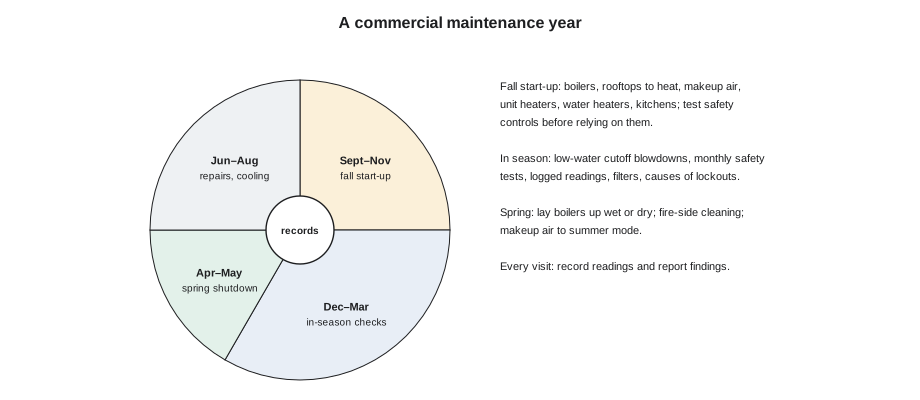
Fall start-up
The fall start-up is the most important visit of the year, because it is the moment when equipment that has sat idle for months is asked to work hard. For each appliance it follows a set order, which at Riverdale went like this.
- Before firing. Read the log and last spring's shutdown notes. Check that the boilers are full of water at the right pressure, that air has been vented, that the valves are in their running positions, that the pumps turn, that nothing has been stored against the equipment, that combustion air openings and vents are clear, and that the vent terminals outdoors have not collected nests, leaves or debris over the summer.
- Safety controls. Test the low-water cutoffs, flow switches, high limits and other safety controls by the makers' procedures before relying on them, and test the relief valves as the maker and the inspector require.
- Firing and combustion. Light each burner and watch the sequence; measure the gas pressures, the flue gas oxygen and carbon monoxide, the stack temperature and the draft; adjust only as the maker allows; and compare the readings with last year's.
- Air side and water side. On rooftop units, change filters, check belts and measure the temperature rise; on boilers, confirm water flow or the temperature rise across each boiler; on water heaters, check temperatures and the relief valve.
- Building conditions. Test spillage and room pressure with exhaust fans running, test kitchen interlocks, and look at what has changed in the building since last year.
- Report. Record everything, tag anything unsafe, and tell the owner in writing what was found and what is recommended.
What Ayesha found at Riverdale
Most of the start-up was routine, which is what a good maintenance program aims for. The boilers lit cleanly and their low-water cutoffs, flow switches and high limits all tested correctly. The gym rooftop units' filters were changed and their rises were within range. The kitchen's hood interlock shut off the range's gas when the exhaust fan was switched off. Two findings were not routine.
The first was a relief valve. Boiler 2's safety relief valve was newer than the boiler's; the spring report from the previous contractor mentioned that it had been replaced after it began to weep. Ayesha read its nameplate, as Maureen had taught her to do with every relief valve, and compared its rated capacity with the boiler's output.
Worked problem
Is the replacement relief valve big enough?
Boiler 2 has an input of 293 kW and a gross efficiency of 82 in 100. The original relief valve was rated 264 kW of relieving capacity. The replacement valve fitted last year is rated 147 kW. The relief valve's capacity must be at least the boiler's output. Check both valves.
Show solution
- Boiler output:
- \[293 \times 0.82 = 240 \text{ kW}\]
- Original valve:
- \[264 \ge 240\]
- Replacement valve:
- \[147 < 240\]
Answer: The replacement valve had the right pressure setting and the right pipe size, which is probably why it was chosen, but only about 60 in 100 of the capacity needed. If the boiler's controls failed and the burner kept firing, the valve could not release enough to stop the pressure rising. Maureen tagged the boiler out of service until a correctly rated valve was fitted, which the supplier delivered the next morning.
The second finding was a trend. Boiler 1's stack temperature at high fire was 210 °C, where the readings in the log for the two previous falls were 177 °C and 190 °C. Its oxygen and carbon monoxide were normal, so the burner was set correctly. A rising stack temperature with a normal burner means the heat is not being transferred into the water: either the fire side of the heat exchanger is fouled with soot or scale, or the water side is scaled.
Worked problem
What the rising stack temperature costs
Boiler 1's stack temperature has risen from 177 °C to 210 °C over two years. Using the rule of thumb that, at the same oxygen, each 22 °C rise in stack temperature costs about one point of efficiency, estimate the loss.
Show solution
- Rise in stack temperature:
- \[210 - 177 = 33 \text{ °C}\]
- Estimated efficiency loss:
- \[\frac{33}{22} \times 1 = 1.5 \text{ points}\]
Answer: The boiler is wasting about one and a half points of efficiency, a typical figure for this rule of thumb, which is only an estimate. More important, the trend shows the heat exchanger is getting dirtier every year, and a heavily fouled heat exchanger runs hotter, wastes fuel and, on the fire side, can eventually restrict the flue passages enough to affect combustion. It is a finding for the spring shutdown, when the boiler can be opened and cleaned.
A single reading of 210 °C would not have meant much. It was the log, with its readings from previous years, that showed the trend. "That's why we write down the numbers even when everything's fine," Maureen said. "Fine this year is the baseline for next year."
In-season checks
During the heating season, the building's operator and the service contractor share the routine checks. The makers' manuals and, where it applies, CSD-1 set the intervals, which depend on the equipment and on whether the plant is attended. Typical in-season tasks include blowing down float-type low-water cutoffs on steam boilers at the frequency the maker requires, which may be daily or weekly; testing low-water cutoffs, high limits and flame safeguards monthly or as specified; reading and logging pressures, temperatures and stack temperatures; checking that combustion air openings and vent terminals are clear of snow and ice; changing filters on air handlers, rooftop units and makeup air units; and responding to lockouts by finding the cause, not just resetting. Bayline's contracts at larger buildings included a monthly visit for the safety control tests and a review of the operator's log.
| Equipment | Typical fall start-up tasks | Typical spring tasks |
|---|---|---|
| Hot water and steam boilers | Water level and pressure, safety control tests, combustion analysis, venting, relief valves | Lay-up wet or dry, fire-side cleaning and inspection, repairs |
| Rooftop units | Changeover to heat, filters, belts, heat exchanger inspection, rise, gas pressure | Changeover to cooling, filters |
| Makeup air units | Airflow switches, burner profile, discharge temperature, interlocks | Switch to summer mode; filters |
| Unit and infrared heaters | Clean burners and fans, check clearances, vents and hangers | Shut off; note any damage |
| Water heaters and boosters | Temperatures, relief valves, condensate and neutralizer, combustion | Flush tanks; check anodes |
| Kitchen equipment | Connectors, restraints, pilots, pressures, interlocks | Same, often on a separate schedule |
Spring shutdown
In spring, equipment that will sit idle all summer is shut down in a way that protects it. A boiler can be laid up wet, completely full of treated water so that no air reaches its surfaces, or dry, drained, cleaned, dried and kept dry with a desiccant, depending on the maker's advice and how long it will be idle. Spring is also the time to open boilers for fire-side cleaning and inspection, as Riverdale's boiler 1 needed, and to make the repairs that were deferred through the winter. Makeup air units go to summer mode, unit heaters are switched off, and the shutdown notes, recording what was done and what must be checked before next fall, go in the log.
Planning the time
A maintenance program is only real if someone has budgeted the time to do it. Bayline estimated hours for each building from the equipment list and the tasks, and Priya scheduled them.
Worked problem
Estimating the yearly maintenance hours
Riverdale's equipment is two boilers, two rooftop units, one water heater and one kitchen line. Bayline's estimates are: each boiler, 3 hours at fall start-up and 2 hours at spring shutdown; each rooftop unit, 1.5 hours in fall and 1 hour in spring; the water heater, 1 hour in fall and 0.5 hour in spring; the kitchen line, 1.5 hours once a year; and four in-season visits of 1 hour each. Find the total yearly hours, excluding travel.
Show solution
- Boilers:
- \[2 \times (3 + 2) = 10 \text{ h}\]
- Rooftop units:
- \[2 \times (1.5 + 1) = 5 \text{ h}\]
- Water heater and kitchen:
- \[(1 + 0.5) + 1.5 = 3 \text{ h}\]
- In-season visits:
- \[4 \times 1 = 4 \text{ h}\]
- Total:
- \[10 + 5 + 3 + 4 = 22 \text{ h}\]
Answer: About 22 hours a year, plus travel, keeps this building's equipment safe and efficient. That is the number Bayline prices the contract on and schedules around. If a contract does not budget enough time to do the tasks properly, the tasks get skipped, and skipped tasks are where problems hide.
Records and reporting
Every visit ends with a record and a report. The record, in the building's log and in Bayline's own files, lists the equipment, the tests performed and their results, the readings, the adjustments and repairs made, and the parts used, with the date and the technician's name. The report to the owner explains, in plain language, what was found, what was done, what is unsafe and has been shut off, and what is recommended, with priorities and, where possible, costs. An unsafe condition is reported in writing at the time it is found, not at the end of the month, and the equipment is tagged as the company's procedure and the jurisdiction require. Recommendations that the owner declines should be recorded as declined.
Ayesha wrote the Riverdale report before they left: all controls tested and working; boiler 2 out of service with an undersized relief valve, replacement ordered for the next morning; boiler 1's rising stack temperature, recommending fire-side cleaning at spring shutdown; rooftop and kitchen equipment in good order. The centre's manager signed the tag for boiler 2. The next morning Ayesha went back with Grant, fitted the new valve, checked its rating against the boiler's output, and returned the boiler to service.
Working with the building operator
In most commercial buildings someone on site looks after the plant day to day: a building operator like Stan at Ferguson Place, a caretaker, a maintenance person or a property manager. A maintenance program works only if that person knows what is expected of them and when to call. At each fall start-up, Bayline's technicians spend a few minutes with the operator going over the plant: how to read the boiler controllers' displays and fault histories, which routine checks the operator is responsible for and how to record them, which settings the operator may change and which they must not, and what to do after a lockout. The rule Maureen gives every operator is short. "You may reset a lockout once," she says. "If it locks out again, or if you smell gas, see water on the floor, hear something new or find a tag that isn't ours, you call us. And you write it in the log."
Operators also see things a technician visiting twice a year never will: the boiler that short-cycles only on windy nights, the rooftop unit that rattles when the store's doors are propped open, the makeup air unit that someone switches off when the kitchen gets cold. Asking the operator what they have noticed since the last visit is one of the most useful questions on any start-up checklist, and writing down the answer gives the next technician a head start.
Common mistakes
MistakeResetting lockouts in season without finding their cause.
InsteadTreat every lockout as a symptom and record its cause.
MistakeReplacing a relief valve by pressure setting and pipe size only.
InsteadCheck its relieving capacity against the boiler's output.
MistakeRecording readings only when something is wrong.
InsteadRecord every reading; normal readings are next year's baseline.
MistakeStarting a boiler in the fall without testing its safety controls first.
InsteadTest the safety controls before relying on them.
MistakeLeaving a boiler idle all summer half-full and open to air.
InsteadLay it up wet or dry as the maker advises.
Summary and key terms
- Commercial equipment runs long hours, often unattended, so it needs a maintenance program built from the makers' schedules, the codes and, for many boilers, ASME CSD-1.
- The fall start-up follows a set order: check before firing, test safety controls, fire and analyze combustion, check the air and water sides and building conditions, and report.
- In-season checks include low-water cutoff blowdowns, safety control tests, logged readings, filters and finding the cause of every lockout.
- Spring shutdown lays boilers up wet or dry and schedules cleaning and repairs.
- Relief valves must have capacity at least equal to the boiler's output.
- Trends in readings, such as a rising stack temperature at normal oxygen, reveal fouling before it causes failure.
- Every visit ends with a record and a written report, and unsafe conditions are tagged and reported at once.
- Maintenance program
- A planned calendar of inspections, tests and services for a building's equipment.
- Fall start-up
- The visit that prepares heating equipment for the heating season.
- Lay-up
- The method of protecting an idle boiler, wet or dry.
- Relieving capacity
- The rate of heat or steam a relief valve can discharge, stamped on its nameplate.
- Baseline
- Earlier readings against which later readings are compared.
- Stack temperature
- The temperature of the flue gas leaving an appliance.
- ASME CSD-1
- A standard for the controls and safety devices on automatically fired boilers.
Practice problems
Work each problem on paper first, then reveal the answer to check.
Why is the fall start-up the most important visit of the year?
Show answer
Equipment that has sat idle for months is asked to work hard, and summer changes, nests and debris must be found first.
A boiler delivers 400 kW. Is a relief valve rated 350 kW acceptable?
Show answer
No: its capacity must be at least 400 kW.
What does a rising stack temperature with normal oxygen and CO suggest?
Show answer
The heat exchanger is fouled on the fire side or scaled on the water side.
What are the two ways to lay up a boiler for the summer?
Show answer
Wet, full of treated water, or dry, drained, cleaned and kept dry.
What must happen when an unsafe condition is found during a start-up?
Show answer
The equipment is shut off and tagged, and the owner is told in writing at once.
Lesson quiz · 5 questions
Score 60% or more to complete this lesson.
Create a free account to save your progress, take quizzes and earn a certificate.