
FILM-430 · Lesson 7 of 12 · 27 min
Semiotics and structuralism
How does a film mean anything at all? A shot of a rose is a picture of a rose, but in context it can signify love, death, beauty, England or a brand of perfume. Semiotics, the study of signs, and structuralism, the search for underlying patterns in cultural forms, gave film theory its most systematic tools for answering such questions. This lesson introduces the linguistic foundations, the attempt to describe film as a language, the analysis of narrative structures and myths, and the post-structuralist turn that unsettled those systems.
These ideas underpin much of the theory in Lessons 6, 8 and 9. Auteur-structuralism, introduced in Lesson 4, is one application. Here we look at the methods themselves.
Saussure and the sign
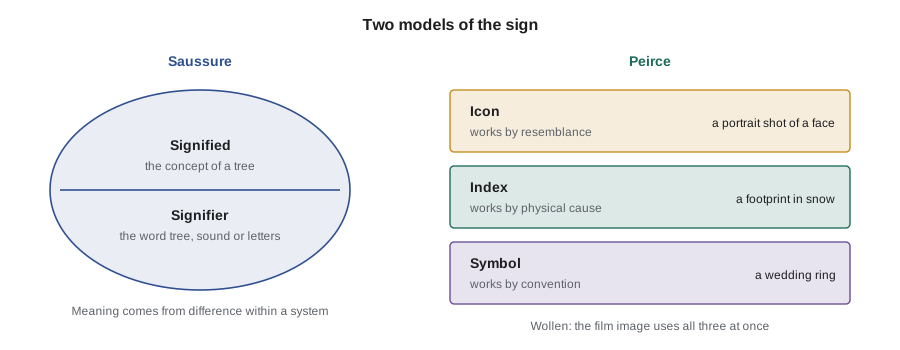
The Swiss linguist Ferdinand de Saussure, whose lectures were published after his death in 1916, argued that language is a system of signs. Each sign joins a signifier, the sound or written form, to a signified, the concept it calls up. The relationship is arbitrary: nothing about the sound of the word tree resembles a tree, and other languages use different sounds for the same concept. Signs gain meaning not from their connection to things but from their differences from other signs in the system. Tree means what it means partly because it is not bush, branch or free.
Saussure distinguished langue, the underlying system of rules shared by speakers, from parole, individual acts of speaking. He also distinguished two kinds of relationship among signs. Syntagmatic relationships connect signs in a sequence, such as words in a sentence. Paradigmatic relationships connect signs that could replace one another in the same position, such as the different nouns that could fill a sentence's subject slot. These distinctions would become central to film analysis.
Peirce's three kinds of sign
The American philosopher Charles Sanders Peirce developed a different classification. An icon signifies by resemblance, as a portrait resembles its sitter. An index signifies by a physical or causal connection, as smoke indicates fire or a footprint indicates a foot. A symbol signifies by convention, as words or traffic colours do. Peter Wollen argued in 1969 that cinema is unusual because it uses all three at once: a film image resembles its object, is physically caused by it, and is organized by cultural conventions. Different theorists emphasize different aspects: Bazin the index, as Lesson 3 showed, Eisenstein the symbol and conceptual montage, and many directors the icon.
Barthes: denotation, connotation and myth
The French critic Roland Barthes applied semiotics to popular culture, from wrestling to advertising, in Mythologies (1957). He distinguished denotation, the literal meaning of a sign, from connotation, the additional cultural meanings it carries. A photograph of a soldier saluting a flag denotes a soldier and a flag; it may connote patriotism, loyalty or empire. Barthes called the second-order system of connotations myth: the way a culture turns its particular values into something that seems natural and obvious. This is close to the idea of ideology in Lesson 6, and Barthes's method became a standard tool of ideological criticism.
Worked problem
Denotation and connotation in an opening shot
An invented film opens with a slow aerial shot over a misty pine forest at dawn, followed by a cut to a small cabin with smoke rising from the chimney, accompanied by a solo piano. Distinguish denotation from connotation and suggest the myth the opening may draw on.
Show solution
- Denotation: a forest of pine trees, mist, early light, a wooden cabin, smoke, piano music.
- Connotations: wilderness, purity, solitude, quiet, a refuge from modern life; the smoke connotes human presence and warmth; the piano suggests introspection and melancholy.
- Possible myth: the northern wilderness as an unspoiled space of authenticity, a recurring idea in Canadian and American culture that can hide histories of Indigenous presence and dispossession.
- Critical use: an essay might ask whether the film confirms this myth or complicates it later, for example by revealing the land's history.
Answer: The shot denotes a forest and cabin but connotes solitude, purity and refuge, drawing on a cultural myth of wilderness that a critic can then examine.
Metz and the question of film language
The most ambitious attempt to build a semiotics of film came from the French theorist Christian Metz in the 1960s. He asked whether cinema is a language in Saussure's sense. His answer was nuanced: cinema is a language without a langue. It lacks a fixed vocabulary of units like words, since every shot is new and contains an indefinite amount of information, and it has no strict grammar. Yet films do use conventions of combination that viewers learn, and these can be described.
Metz proposed a classification of the ways films combine shots into larger units, which he called the grande syntagmatique. It distinguished an autonomous shot, such as a single long take forming a whole episode, from various kinds of syntagma made of several shots. The table summarizes his categories in simplified form.
| Type of segment | What it does | Example |
|---|---|---|
| Autonomous shot | A single shot forms a complete episode | A long take of a conversation |
| Parallel syntagma | Alternates motifs without time or space relation | Rich and poor lives intercut to make a point |
| Bracket syntagma | Brief images grouped as examples of one idea | A quick series of shots summing up city life |
| Descriptive syntagma | Shows things coexisting in one space at one time | Shots of a landscape establishing a setting |
| Alternating syntagma | Intercuts actions happening at the same time | A chase cutting between pursuer and pursued |
| Scene | Continuous action in one time and place, edited | A dinner conversation in shot and reverse shot |
| Episodic sequence | Brief scenes summarizing development over time | A montage of a relationship over years |
| Ordinary sequence | Action with time skips that are not significant | A character driving across town in several shots |
The grande syntagmatique was designed for classical narrative cinema, and critics found many segments that resisted classification. But it showed how viewers understand time and space through learned conventions, and it encouraged precise segmentation of films, which remains useful. Metz later turned to psychoanalysis, as Lesson 8 shows.
from collections import Counter
segments = ["scene", "scene", "ordinary sequence", "alternating syntagma", "scene",
            "descriptive syntagma", "episodic sequence", "scene", "autonomous shot",
            "scene", "alternating syntagma", "scene", "ordinary sequence", "scene"]
c = Counter(segments)
for kind, n in c.most_common():
print(f"{kind:22s} {n:2d} ({n / len(segments):.0%})")scene 7 (50%) ordinary sequence 2 (14%) alternating syntagma 2 (14%) descriptive syntagma 1 (7%) episodic sequence 1 (7%) autonomous shot 1 (7%)
In classical films, scenes usually dominate, as in this invented example. A film built mostly of autonomous shots or parallel syntagmas would immediately look modernist or experimental, which shows how segmentation can support stylistic claims.
Structuralism: myth and narrative
Structuralism extended Saussure's method beyond language to cultural systems. The anthropologist Claude Lévi-Strauss analysed myths as structures of binary oppositions, such as nature and culture, raw and cooked or life and death, which myths try to mediate. Film critics adapted the method to genres and auteurs: the western, for example, can be read as a structure of oppositions between wilderness and civilization, individual and community, East and West. Will Wright's study of westerns, mentioned in Lesson 5, combined Lévi-Strauss with the work of the Russian folklorist Vladimir Propp.
Propp's Morphology of the Folktale (1928) found that Russian fairy tales, despite surface variety, share a fixed sequence of up to thirty-one functions, such as a lack or villainy, the hero's departure, a test, receipt of a magical agent, struggle, victory and return, distributed among a small set of character roles: hero, villain, donor, helper, princess, dispatcher and false hero. Critics have applied Propp's scheme to popular films, showing how closely many adventure stories follow folk patterns.
Worked problem
Propp's roles in a space adventure
Apply Propp's character roles to Star Wars (1977), in which a young farmhand joins a mission to rescue a captured princess and destroy an imperial battle station.
Show solution
- Hero: Luke Skywalker, who leaves home after a villainy, the destruction of his family's farm.
- Villain: Darth Vader and the Empire; dispatcher: Princess Leia's message, which sends the hero on his quest.
- Donor: Obi-Wan Kenobi, who tests the hero and gives him a magical agent, the lightsaber, and knowledge of the Force.
- Helpers: Han Solo, Chewbacca and the droids; princess: Leia, the sought-for person; the reward ceremony echoes the folktale's ending.
Answer: The film maps closely onto Propp's roles, which helps explain its mythic familiarity and supports readings of it as a modern folktale.
Barthes's five codes and the reader
In S/Z (1970), Barthes analysed a short story by Balzac sentence by sentence and identified five codes through which readers make sense of narrative. The hermeneutic code poses and delays answers to enigmas; the proairetic code organizes actions into sequences; the semic code builds characters through connotations; the symbolic code organizes oppositions such as male and female; and the cultural code draws on shared knowledge. Film critics adapted these codes to analyse suspense, character and cultural reference in films. The hermeneutic code, for example, describes the way a mystery or thriller withholds information to keep viewers engaged.
Post-structuralism and intertextuality
By the late 1960s, thinkers such as Jacques Derrida, Julia Kristeva and the later Barthes questioned whether stable structures underlie meaning at all. Derrida argued that meaning is always deferred, produced by endless chains of difference, never fully present. Kristeva introduced intertextuality, the idea that every text is a mosaic of quotations and transformations of other texts. Barthes's Death of the Author, discussed in Lesson 4, belongs to this turn.
For film criticism, post-structuralism encouraged readings that emphasize ambiguity, contradiction and the play of references. Intertextuality is especially useful for contemporary cinema, which constantly quotes, remakes, parodies and builds franchises. A film may mean differently to a viewer who recognizes its references to earlier films than to one who does not.
Using semiotics today
Semiotic tools remain valuable for precise analysis. Denotation and connotation help separate what is shown from what it suggests. Syntagmatic and paradigmatic thinking helps analyse editing and choices: why this shot rather than another possible one. Segmentation helps describe structure. Structural analysis reveals deep patterns in genres and stories. The main danger is mechanical application, treating categories as boxes to fill rather than tools for interpretation. Cognitive theorists (Lesson 11) also argue that viewers understand images through ordinary perception, not by decoding them like words, so the language analogy should be used carefully.
Common mistakes
MistakeTreating every film image as an arbitrary sign
InsteadFilm images are also iconic and indexical; Wollen argued cinema uses all three kinds of sign.
MistakeConfusing denotation and connotation
InsteadDenotation is the literal meaning; connotation is the additional cultural meaning.
MistakeCalling cinema a language exactly like speech
InsteadMetz described cinema as a language without a langue, with conventions but no fixed vocabulary.
MistakeForcing every film into Propp's functions
InsteadUse structural models where they illuminate a story and note where the film departs from them.
MistakeUsing semiotic terms as labels without interpretation
InsteadUse the terms to support an argument about meaning, not as an end in themselves.
Summary and key terms
- Saussure defined the sign as signifier plus signified, arbitrary and defined by difference within a system.
- Syntagmatic relations link signs in sequence; paradigmatic relations link signs that could substitute for one another.
- Peirce classified signs as icon, index and symbol, and Wollen argued film uses all three.
- Barthes distinguished denotation from connotation and analysed myth as culture made to seem natural.
- Metz called cinema a language without a langue and classified segments in the grande syntagmatique.
- Structuralists such as Lévi-Strauss and Propp found binary oppositions and narrative functions beneath stories.
- Post-structuralism emphasized deferred meaning, the reader and intertextuality.
- Semiotics
- The study of signs and how they produce meaning.
- Signifier
- The perceptible form of a sign, such as a sound, word or image.
- Signified
- The concept that a signifier calls up.
- Paradigmatic
- Relationship among signs that could replace one another in the same position.
- Syntagmatic
- Relationship among signs combined in a sequence.
- Connotation
- Additional cultural meanings carried by a sign beyond its literal meaning.
- Myth (Barthes)
- A second-order system of meaning that makes cultural values seem natural.
- Grande syntagmatique
- Metz's classification of ways films combine shots into larger segments.
- Binary opposition
- A pair of contrasting terms, such as nature and culture, used to analyse structures.
- Intertextuality
- The idea that every text is shaped by quotations and transformations of other texts.
Practice problems
Work each problem on paper first, then reveal the answer to check.
Explain the arbitrariness of the sign.
Show answer
There is no natural connection between a signifier's form and its concept; it is set by convention.
Give a film example of a paradigmatic choice.
Show answer
Choosing a close-up instead of a wide shot, or one actor instead of another, for the same moment.
Classify a footprint, a portrait and a wedding ring using Peirce.
Show answer
Index, icon and symbol.
Distinguish denotation from connotation for a red rose in a film.
Show answer
It denotes a flower; it may connote love, passion or death.
What did Metz mean by a language without a langue?
Show answer
Film has learned conventions but no fixed vocabulary or strict grammar.
Which Metz segment intercuts actions happening at the same time?
Show answer
The alternating syntagma.
Name three of Propp's character roles.
Show answer
Hero, villain, donor, helper, princess, dispatcher, false hero.
What does the hermeneutic code describe?
Show answer
The posing and delaying of answers to narrative enigmas.
Define intertextuality and give a film example.
Show answer
Texts are made of references to other texts; a remake or parody quoting earlier films.
What caution do cognitive theorists raise about semiotics?
Show answer
Viewers understand images through ordinary perception, not by decoding them like words.
Lesson quiz · 5 questions
Score 60% or more to complete this lesson.
Create a free account to save your progress, take quizzes and earn a certificate.