
FILM-430 · Lesson 11 of 12 · 25 min
Cognitivism, phenomenology and cinema after film
From the 1980s, a new generation of theorists challenged psychoanalytic and ideological theory. Cognitive film theorists turned to psychology and philosophy of mind to explain how viewers actually perceive, follow and feel films. Phenomenologists emphasized the embodied, sensory experience of watching. At the same time, digital technology, streaming platforms and algorithms transformed what a film is and how it reaches viewers, raising the classical questions of Lesson 1 again. This lesson covers these new approaches and the theoretical problems of cinema after film.
The fabula and syuzhet distinction from Lesson 2 and the critique of Grand Theory from Lesson 1 return here. Lesson 8's psychoanalytic theory is the main target of the cognitivists' criticism.
The cognitive turn
Cognitive film theory starts from a simple claim: watching a film is an active mental process that can be studied with the tools of psychology. In Narration in the Fiction Film (1985), David Bordwell argued that viewers construct the story by forming hypotheses. Using the syuzhet, the information the film presents, they build the fabula, the story in chronological order. They rely on schemata: mental structures learned from life and from other films, such as knowledge of how people behave, how stories are structured and what genre conventions mean. Viewers make inferences, test them against new information, and revise them.
This model treats the spectator as a problem-solver rather than a subject positioned by the unconscious. It explains suspense as uncertainty about outcomes, surprise as a failed hypothesis and mystery as a gap in the fabula that the syuzhet withholds. It also explains differences between styles: classical Hollywood narration is redundant and clear, helping viewers form strong hypotheses, while art cinema narration leaves more gaps and ambiguities, encouraging viewers to interpret.
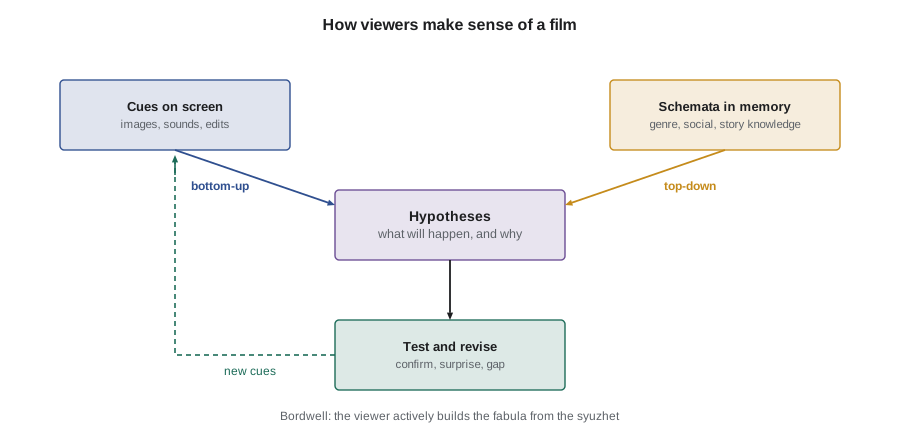
Noël Carroll added a theory of erotetic narration, from the Greek for question: most popular films proceed by raising questions and answering them, scene by scene, which explains why mainstream narrative is so absorbing and easy to follow. He and Bordwell edited Post-Theory (1996), a collection arguing for evidence-based, middle-level research against psychoanalytic and ideological Grand Theory.
Character engagement and emotion
Cognitive theorists also rethought identification. Murray Smith, in Engaging Characters (1995), argued that identification is too vague a term and replaced it with a structure of sympathy with three levels. Recognition is perceiving a character as a distinct individual. Alignment is the access the film gives us to a character's actions, knowledge and feelings, through what Smith calls spatial attachment and subjective access. Allegiance is our moral evaluation of the character, which leads to sympathy or antipathy. These levels can come apart: a film can align us closely with a character we do not approve of.
Worked problem
The structure of sympathy and the antihero
In Martin Scorsese's Taxi Driver (1976), the film follows a lonely, increasingly unstable taxi driver in New York, with his voice-over diary, until he commits violent acts that the press then celebrates. Apply Smith's structure of sympathy.
Show solution
- Recognition: the driver is clearly individuated from the first scenes by appearance, voice and routine.
- Alignment: the film attaches us to him spatially in almost every scene and gives subjective access through voice-over and point-of-view shots of the city.
- Allegiance: viewers may feel pity for his loneliness early on, but his racism, delusions and violence make allegiance increasingly difficult.
- Interpretation: the film's power comes from high alignment combined with unstable allegiance; the ironic ending, in which he is praised as a hero, forces viewers to examine their own responses.
Answer: Smith's model shows how the film aligns us closely with a character we cannot morally endorse, a precise account of the unease many viewers feel.
Other cognitive scholars, such as Ed Tan, Carl Plantinga and Torben Grodal, developed theories of film emotion, arguing that films elicit emotions much as real situations do, guided by structures such as suspense, empathy and the expectations set by genre. Empirical researchers now test such theories with eye tracking, which shows that viewers' gaze converges strongly on the same points during fast-cut mainstream sequences, and with brain imaging studies that show how films synchronize viewers' responses.
Phenomenology and the embodied viewer
Phenomenology, a philosophical tradition from Edmund Husserl and Maurice Merleau-Ponty, studies experience as it is lived. Vivian Sobchack's The Address of the Eye (1992) argued that film is not just an object we watch but an expression of perception: the film sees, moves and attends, and we perceive its perceiving with our whole bodies. In later essays, she described viewers as cinesthetic subjects whose senses blend, so that we may feel textures, temperatures and movements on screen in our own bodies.
Laura U. Marks, in The Skin of the Film (2000), proposed haptic visuality: a way of seeing that works like touch, attending to surfaces, textures and grain rather than to distant objects. She found it especially in intercultural and diasporic films that evoke memories carried by the senses. Steven Shaviro's The Cinematic Body (1993) argued that film works directly on the nervous system through affect, intensities of feeling that come before meaning. These approaches value the sensory power of cinema that semiotic and cognitive theories tend to neglect.
| Approach | The spectator is | Key concepts | Key theorists |
|---|---|---|---|
| Psychoanalytic | A subject positioned by unconscious desire | Identification, gaze, voyeurism | Metz, Mulvey |
| Cognitive | An active problem-solver using schemata | Hypotheses, alignment, allegiance | Bordwell, Carroll, Smith |
| Phenomenological | An embodied perceiver feeling with the film | Embodiment, haptic visuality, affect | Sobchack, Marks, Shaviro |
Deleuze and the time-image
The French philosopher Gilles Deleuze, in two books on cinema (1983 and 1985), offered a different kind of theory, a philosophy of images rather than of spectators. He distinguished the movement-image, typical of classical cinema, in which time is subordinated to action and situations lead to responses, from the time-image, which emerged after the Second World War in neorealism and modernist cinema, where characters become observers of situations they cannot act on and time itself becomes visible. Deleuze's concepts are demanding but influential, especially for writing about slow cinema, memory and modernist films.
Digital cinema and the index
Digital technology raised the classical question of the medium again. Bazin's realism (Lesson 3) rested on the photograph as an index of reality. Digital images, captured as data and freely manipulable, or generated entirely by software, need have no physical connection to any object. Lev Manovich argued in The Language of New Media (2001) that digital cinema becomes a branch of painting and animation, in which live-action footage is just one raw material among others. Others, such as Stephen Prince, argued that digital effects aim for perceptual realism: images that match how we perceive the world even when they show impossible things.
Generative artificial intelligence sharpens these questions. Video generated from text prompts may look photographic without any camera or subject. For criticism, the issue is not only technical but ethical and interpretive: what viewers believe they are seeing, how documentaries maintain trust, and how authorship is shared with software. PHOT-420 Lesson 11 covers provenance and content credentials; here the point is that the old debate between formalists and realists continues in new forms.
Intensified continuity and measuring style
Bordwell also used quantitative evidence to describe changes in Hollywood style. He argued in 2002 that from the 1960s mainstream films adopted intensified continuity: faster cutting, more extreme lens lengths, more close shots in dialogue and a constantly moving camera, while still preserving the basic rules of continuity editing. Barry Salt's measurements and Cinemetrics data support the overall trend toward shorter average shot lengths, although individual films vary widely.
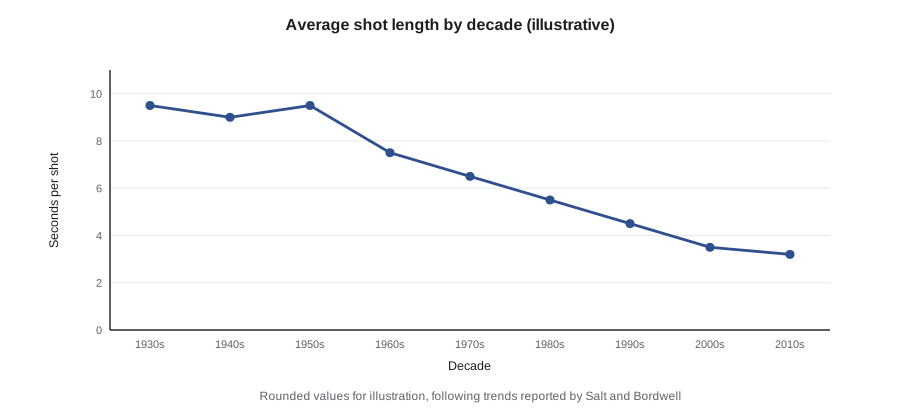
decades = [1930, 1940, 1950, 1960, 1970, 1980, 1990, 2000, 2010]
asl = [9.5, 9.0, 9.5, 7.5, 6.5, 5.5, 4.5, 3.5, 3.2]
n = len(decades)
mx, my = sum(decades) / n, sum(asl) / n
slope = sum((x - mx) * (y - my) for x, y in zip(decades, asl)) / sum((x - mx) ** 2 for x in decades)
print(f"Average change per decade: {slope * 10:+.2f} seconds")
print(f"Ratio of 1930s to 2010s ASL: {asl[0] / asl[-1]:.1f} to 1")Average change per decade: -0.90 seconds Ratio of 1930s to 2010s ASL: 3.0 to 1
The illustrative trend shows average shots shortening by roughly a second per decade, but measurement cannot say why. Explanations include television's influence, the training of directors in commercials and music video, digital editing, and changing audience expectations. Each explanation is a theoretical claim that requires further evidence.
Post-cinema, streaming and algorithmic culture
Theorists use the term post-cinema to describe moving images after the dominance of the projected film in a theatre: images watched on phones, laptops and televisions, made with digital cameras, distributed by platforms and mixed with games and social media. Shaviro's Post-Cinematic Affect (2010) argued that these media produce new kinds of feeling suited to networked, financialized capitalism.
Streaming services raise questions that echo earlier theory. Recommendation algorithms shape what viewers discover, creating feedback loops in which past choices determine future offerings. Platforms use viewing data to commission content, and critics have debated whether this favours familiar formulas, as the culture industry argument of Lesson 6 would predict, or allows niche work to find audiences, as Altman's pragmatic genre theory might suggest. Viewing habits such as watching on small screens, pausing, skipping and second-screening alter the conditions that apparatus theory and phenomenology assumed.
In Canada, these questions are also policy questions. The Online Streaming Act of 2023 brought streaming services under the Broadcasting Act, and the CRTC has required large services to contribute to Canadian and Indigenous content, raising debates about how discoverability and algorithms should be regulated.
Combining approaches
The approaches in this lesson are often presented as rivals to psychoanalytic and ideological theory, but critics frequently combine them. A cognitive account can explain how a film guides attention and builds suspense, while an ideological reading explains what values that suspense serves. A phenomenological account can describe the bodily intensity of a scene, while a feminist reading asks whose bodies are made to suffer or to be looked at. Quantitative measurement can test whether a pattern a critic claims is really present across a whole film.
When combining approaches, be clear about which claims rest on which evidence. Statements about what viewers infer or feel should be supported by the film's cues and, where possible, by research on audiences. Statements about ideology should be supported by patterns in the film and its context. Statements about style should be supported by precise description or measurement. Keeping these kinds of claims distinct makes an essay more rigorous and easier to evaluate.
Finally, remember that new technologies do not make older theories obsolete. Debates about artificial intelligence, streaming and immersive media keep returning to questions first asked by Münsterberg, Arnheim, Bazin and Kracauer: what the moving image is, what it shows and what it does to those who watch it.
Common mistakes
MistakeAssuming cognitivism ignores emotion
InsteadCognitive theorists such as Smith, Tan and Plantinga developed detailed theories of film emotion.
MistakeUsing identification as if it were one simple process
InsteadSeparate recognition, alignment and allegiance, as Smith proposed.
MistakeTreating phenomenology as personal impressions
InsteadPhenomenology describes embodied experience with philosophical concepts such as embodiment and haptic visuality.
MistakeClaiming digital images cannot be realist
InsteadDistinguish indexical realism from perceptual realism and ask what viewers believe they are seeing.
MistakeTreating shot-length trends as explanations
InsteadMeasurement describes change; explanations require further evidence and theory.
Summary and key terms
- Cognitive theory treats viewers as active problem-solvers who form and revise hypotheses using schemata.
- Bordwell's narration theory uses fabula and syuzhet, and Carroll described erotetic narration.
- Smith replaced identification with recognition, alignment and allegiance.
- Phenomenologists such as Sobchack and Marks emphasized embodied, sensory and haptic experience, and Shaviro emphasized affect.
- Deleuze distinguished the movement-image of classical cinema from the time-image of modern cinema.
- Digital and generative images challenge indexical realism, and perceptual realism offers an alternative account.
- Intensified continuity, post-cinema and streaming algorithms show classical questions returning in new forms.
- Cognitive film theory
- Theory explaining film viewing through perception, inference and emotion.
- Schema
- A mental structure of knowledge used to interpret information.
- Erotetic narration
- Carroll's account of narrative as a series of questions and answers.
- Structure of sympathy
- Smith's model of recognition, alignment and allegiance.
- Alignment
- The access a film gives to a character's actions, knowledge and feelings.
- Allegiance
- A viewer's moral evaluation of a character.
- Haptic visuality
- Marks's term for seeing that works like touch, attending to texture and surface.
- Time-image
- Deleuze's term for images in which time becomes directly visible rather than serving action.
- Perceptual realism
- Prince's term for digital images that match how we perceive the world.
- Intensified continuity
- Bordwell's term for faster, more intense styling within continuity rules.
Practice problems
Work each problem on paper first, then reveal the answer to check.
How does Bordwell describe a viewer following a film?
Show answer
As forming hypotheses from syuzhet cues using schemata to build the fabula.
What is erotetic narration?
Show answer
Narrative built from questions raised and answered scene by scene.
Distinguish alignment from allegiance.
Show answer
Alignment is access to a character; allegiance is moral evaluation of them.
Give an example of high alignment with low allegiance.
Show answer
Following a violent antihero closely, as in Taxi Driver.
What is haptic visuality?
Show answer
A way of seeing that works like touch, attending to textures and surfaces.
Distinguish Deleuze's movement-image and time-image.
Show answer
In the movement-image time serves action; in the time-image time itself becomes visible.
How does digital imaging challenge Bazin?
Show answer
Images need not be caused by real objects, weakening the index.
List two features of intensified continuity.
Show answer
Faster cutting, extreme lens lengths, more close shots, constantly moving camera.
In the illustrative data, about how much does ASL change per decade?
Show answer
About minus 0.9 seconds per decade.
Give one way streaming algorithms relate to earlier theory.
Show answer
They can be read through the culture industry critique or Altman's pragmatic genre theory.
Lesson quiz · 5 questions
Score 60% or more to complete this lesson.
Create a free account to save your progress, take quizzes and earn a certificate.