
FILM-430 · Lesson 5 of 12 · 25 min
Genre theory
Every viewer uses genre. Before a film begins, we usually know whether it is a horror film, a romantic comedy, a western or a superhero film, and that knowledge shapes what we expect and how we respond. Genre theory asks what genres are, how they form and change, why audiences enjoy repetition, and what genres reveal about the societies that make and consume them. This lesson covers the major approaches, from early essays on the western and gangster film to semantic and syntactic analysis, genre cycles and the algorithmic categories of streaming.
FILM-101 Lesson 9 introduced genre as a way of grouping films by shared conventions, and FILM-320 Lesson 10 discussed how directors control tone within genres. This lesson treats genre as a theoretical problem.
Early genre criticism
Some of the first serious writing about genre came from critics who wanted to take popular cinema seriously. In 1948, the American critic Robert Warshow argued that the gangster film expressed a tragic sense of modern life: the gangster rises through ambition and violence and must fall, dramatizing the dark side of the American dream of success. A few years later, Warshow and André Bazin each wrote essays on the western, treating it as a form that worked through myths of national origin, law and violence. These critics showed that genre films could be read as art and as cultural statements, not merely formula.
In the 1960s and 1970s, British critics such as Lawrence Alloway and Edward Buscombe emphasized iconography: the recurring visual elements, such as costumes, settings, objects and character types, that signal a genre at a glance. The western's horses, guns, saloons and open landscapes, or the gangster film's cars, suits and city streets, carry meaning built up across many films. When a new film uses them, it inherits that meaning and can confirm or play against it.
The problem of definition
Defining a genre is harder than it looks. If we define the western by its setting, the American West in the late nineteenth century, we must include films that share nothing else and exclude films such as contemporary or science-fiction westerns that share much of its spirit. If we define it by themes, such as civilization against wilderness, we find those themes in many other genres. The British film scholar Andrew Tudor called this the empiricist dilemma: to define a genre we need to know which films belong to it, but to know which films belong we need a definition.
Tudor's answer was that genres are what a culture collectively believes them to be. Genre is not a fixed essence but a shared understanding among producers, critics and audiences, which changes over time. This insight moved genre theory away from classification toward questions of use: how genres are produced, marketed, recognized and enjoyed.
Schatz and the life of genres
In Hollywood Genres (1981), Thomas Schatz described genres as a contract between filmmakers and audiences, a familiar set of conventions that allows efficient production and gives viewers the pleasure of variation within repetition. He divided Hollywood genres into two broad types. Genres of determinate space, such as the western, gangster and detective films, take place in contested spaces and resolve conflict through violence or the restoration of order. Genres of indeterminate space, such as the musical, screwball comedy and family melodrama, take place in civilized spaces and resolve conflict through integration, often a romantic couple or a reunited family.
| Feature | Genres of order (determinate space) | Genres of integration (indeterminate space) |
|---|---|---|
| Examples | Western, gangster, detective, war | Musical, screwball comedy, family melodrama |
| Setting | Contested territory such as the frontier or city streets | Civilized, domestic or social spaces |
| Hero | Individual, often a loner or outsider | A couple or community |
| Conflict | External threat to social order | Tension between individuals and social norms |
| Resolution | Violence, elimination of threat, restoration of order | Embrace, marriage, reconciliation |
Schatz and others also proposed that genres follow a life cycle. In the experimental stage, conventions are established; in the classic stage, they reach a stable, transparent form; in a stage of refinement, filmmakers elaborate them; and in a baroque or reflexive stage, films comment on the conventions themselves, through parody, self-consciousness or revision. The western's path from early silent shorts to John Ford's classics, then to revisionist westerns of the 1960s and 1970s that questioned frontier violence, is often given as an example. Critics have objected that the cycle is too neat: reflexive and parodic films appear early in many genres, and genres revive after apparent exhaustion.
Altman's semantic and syntactic approach
In a 1984 essay, the American scholar Rick Altman proposed a more flexible model. He distinguished a genre's semantic elements, its building blocks such as settings, character types, objects and shots, from its syntactic elements, the relationships and structures that organize those blocks into meaning. Two films may share semantic elements but use them in different syntax, or share a syntax while changing the semantic elements.
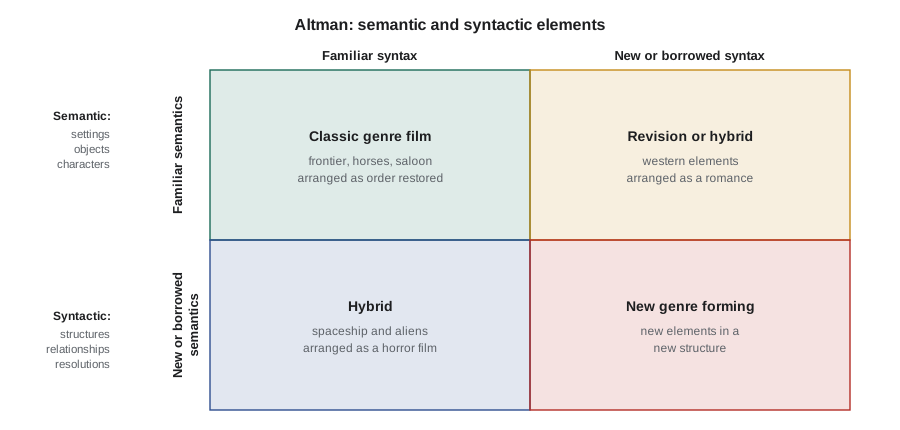
Altman later added a pragmatic dimension, recognizing that different groups use genre labels differently. Studios coin genres to market films, critics name genres after the fact, and fans build communities around categories that studios never intended. A genre, in this view, is a site of struggle among users rather than a fixed property of films.
Worked problem
A semantic and syntactic analysis
Ridley Scott's Alien (1979) is set on a commercial spaceship whose crew picks up a deadly creature. Analyse its genre using Altman's approach.
Show solution
- Semantic elements of science fiction: a spacecraft, distant planets, advanced technology, a corporation, an artificial human.
- Syntactic structure of horror: a group isolated in a confined space is picked off one by one by a monstrous intruder until a final survivor confronts it.
- Result: Alien combines science-fiction semantics with a horror syntax, which explains why audiences and critics place it in both genres and why it influenced later hybrids.
- Pragmatic note: the film's marketing emphasized terror over spectacle, and its later franchise shifted toward action, showing how users reframe a genre identity over time.
Answer: Alien uses science-fiction building blocks arranged in the structure of a horror film; Altman's distinction explains its hybrid identity precisely.
Genre as ritual and genre as ideology
Theorists disagree about what genres do socially. In the ritual view, associated with Schatz and with Will Wright's study of westerns, Sixguns and Society (1975), genres act like cultural myths: they dramatize contradictions in a society, such as individual freedom versus community obligation, and offer imaginary resolutions that audiences find satisfying. Audiences choose genres that speak to their concerns, so genres reflect collective values and anxieties.
In the ideological view, genres are tools through which industries and dominant groups reproduce particular values. Their resolutions make social arrangements seem natural and inevitable: the western naturalizes the conquest of Indigenous lands, the romantic comedy naturalizes heterosexual marriage, and the action film naturalizes violence as a solution. Lesson 6 develops ideological criticism in detail. Many critics combine the views, arguing that genres express real tensions but resolve them in ways that favour existing power.
The critic Robin Wood's influential essays on the American horror film of the 1970s show both sides. Drawing on psychoanalysis and politics, Wood argued that the monster represents what a society represses, such as sexuality, workers, women or racial others, and that horror films can either destroy the monster to reassert normality or sympathize with it to question normality. Lesson 8 returns to psychoanalytic ideas.
Cycles, hybrids and streaming genres
Film historians increasingly study genre cycles: short bursts of similar films produced while a formula is profitable, such as the slasher cycle around 1980, the disaster cycle of the 1970s or the superhero boom after 2008. Cycles respond to box office success, technology, censorship and current events, and they show how genres are produced industrially. Hybrids, such as the horror comedy or the science-fiction western, combine conventions to reach multiple audiences.
Canada has its own genre traditions. In the late 1970s and early 1980s, a federal capital cost allowance for certified Canadian films encouraged a wave of low-budget genre production, including horror films such as Black Christmas (1974) and Prom Night (1980) and David Cronenberg's early body horror. Quebec cinema has developed popular comedies and crime dramas for domestic audiences, and recent Canadian horror and science fiction circulate widely through streaming.
Streaming services have added another layer. Their recommendation systems tag films with fine-grained categories, combining mood, setting, subject and audience in combinations far more specific than traditional genres. These algorithmic micro-genres are pragmatic in Altman's sense: they are created by a platform to match films to viewers and may reshape how audiences understand and search for genre.
counts = {1976: 2, 1977: 3, 1978: 5, 1979: 9, 1980: 18, 1981: 26, 1982: 21, 1983: 14, 1984: 10, 1985: 7}
peak_year = max(counts, key=counts.get)
total = sum(counts.values())
print(f"Total films in cycle: {total}")
print(f"Peak year: {peak_year} with {counts[peak_year]} releases")
for y, n in counts.items():
print(y, "#" * n)Total films in cycle: 115 Peak year: 1981 with 26 releases 1976 ## 1977 ### 1978 ##### 1979 ######### 1980 ################## 1981 ########################## 1982 ##################### 1983 ############## 1984 ########## 1985 #######
Plotting release counts, even with invented figures like these, shows the typical shape of a cycle: a slow start, a rapid rise after early hits, a peak and a decline as audiences tire and studios move on. Real research uses databases of releases and box office figures to test such patterns.
Using genre theory in criticism
Genre theory is most useful when it helps explain a particular film's choices. Ask which genre conventions the film uses, where it follows or breaks them, and why. Ask what contradictions the genre dramatizes and how the film resolves them. Ask whether the film is classic, revisionist, parodic or hybrid, and how its marketing and audience frame it. A good genre essay places the film within a tradition and shows how it speaks to its moment.
Genre and the critic
When you write about a genre film, begin by naming the conventions the film inherits and the expectations they create, then ask where the film meets, delays or frustrates those expectations. A horror film that withholds its monster, a western that ends in defeat or a musical in which the songs express despair rather than joy are all making choices against a background of convention. Genre theory gives you the vocabulary to describe these choices precisely: iconography for the visual signals, semantic and syntactic elements for the building blocks and structures, cycles for the industrial moment, and ritual or ideological readings for what the resolution means socially.
It also helps to compare the film with two or three earlier examples of its genre. The comparison makes the film's innovations visible and protects you from praising as original a device the genre has used for decades.
Common mistakes
MistakeTreating a genre as a fixed list of rules
InsteadTreat genres as shared, changing understandings among producers, critics and audiences.
MistakeDefining a genre only by setting or plot
InsteadCombine iconography, structure, themes and how audiences and industries use the label.
MistakeAssuming the genre life cycle always runs in order
InsteadRecognize that reflexive films appear early and genres revive after decline.
MistakeCalling every hybrid a parody
InsteadUse Altman's semantic and syntactic distinction to describe what is borrowed and what is changed.
MistakeSeeing genres only as harmless formula
InsteadAsk what social contradictions the genre dramatizes and how its resolution favours certain values.
Summary and key terms
- Early critics such as Warshow and Bazin read the gangster film and western as cultural myths and art.
- Iconography describes the recurring visual elements that signal a genre and carry accumulated meaning.
- Tudor's empiricist dilemma shows that genres are shared cultural understandings rather than fixed essences.
- Schatz distinguished genres of order from genres of integration and proposed a life cycle from classic to reflexive.
- Altman distinguished semantic building blocks from syntactic structures and added a pragmatic dimension.
- Ritual and ideological views disagree about whether genres express shared values or reproduce dominant ones.
- Genre cycles, hybrids and streaming micro-genres show genre as an industrial and pragmatic process.
- Genre
- A category of films sharing conventions recognized by producers, critics and audiences.
- Iconography
- Recurring visual elements, such as costumes and settings, that signal a genre.
- Empiricist dilemma
- Tudor's problem that defining a genre and identifying its members presuppose each other.
- Genres of order
- Schatz's genres set in contested space that restore order through conflict.
- Genres of integration
- Schatz's genres set in civilized space that resolve conflict through union.
- Genre life cycle
- A proposed progression from experimental and classic to refined and reflexive stages.
- Semantic elements
- A genre's building blocks, such as settings, objects and character types.
- Syntactic elements
- The structures and relationships that organize a genre's building blocks.
- Genre cycle
- A short burst of similar films produced while a formula is profitable.
- Micro-genre
- A fine-grained category created by streaming platforms to match films to viewers.
Practice problems
Work each problem on paper first, then reveal the answer to check.
What is iconography in genre criticism?
Show answer
Recurring visual elements, such as horses and saloons in the western, that signal a genre.
Explain Tudor's empiricist dilemma.
Show answer
We need a definition to choose members of a genre, but need the members to form the definition.
Give one example each of Schatz's genres of order and integration.
Show answer
Western or gangster film; musical or screwball comedy.
What happens in the reflexive stage of a genre's life cycle?
Show answer
Films comment on the conventions through parody, self-consciousness or revision.
Distinguish semantic and syntactic elements.
Show answer
Semantic elements are building blocks; syntactic elements are the structures organizing them.
Analyse a western set in outer space using Altman's terms.
Show answer
Science-fiction semantics with western syntax, such as a lone hero restoring order on a frontier.
How does the ritual view differ from the ideological view of genre?
Show answer
Ritual sees genres expressing shared values; ideology sees them reproducing dominant values.
What did Robin Wood argue about the horror monster?
Show answer
It represents what a society represses, and films either destroy it or sympathize with it.
In the invented data, which year is the peak of the cycle?
Show answer
1981, with 26 releases.
Why are streaming micro-genres pragmatic in Altman's sense?
Show answer
They are created by a platform to match films to viewers, a use rather than an essence.
Lesson quiz · 5 questions
Score 60% or more to complete this lesson.
Create a free account to save your progress, take quizzes and earn a certificate.