
FILM-410 · Lesson 5 of 12 · 25 min
Budgeting I: structure and the top sheet
A film budget translates a screenplay into money. It lists every cost the production expects to incur, from the purchase of rights to the last hard drive delivered to a distributor, organized so that the producer, financiers and department heads can read it, question it and control spending against it. A good budget is both a plan and a promise: a plan for how the money will be used, and a promise to financiers that the film can be made for that amount.
Budgeting is iterative. A producer may prepare a rough estimate in development, a detailed budget for financing applications, a revised budget after casting and location decisions, and a locked budget at the start of prep that becomes the baseline for cost control. Each version is built from the script and schedule, and each must be internally consistent: the number of shooting days, the size of the crew, the locations and the cast must match across every account.
This lesson covers the structure of a feature budget and its summary page, the top sheet. Lesson 6 looks at the largest component of most budgets, labour, including union rates and fringe benefits. Lesson 7 covers the schedule that drives the budget, and lesson 9 covers controlling costs once spending begins.
The anatomy of a film budget
Feature budgets are organized into accounts, each covering a category of cost, such as story and rights, director, cast, camera, locations or editing. Each account is broken into line items, for example camera operator, first assistant camera, camera package rental and expendables, and each line item is calculated from units, rates and quantities: so many weeks at so much per week, so many days at so much per day.
Accounts are grouped into sections. The most important division is between above-the-line and below-the-line costs. Above-the-line costs cover the creative and rights elements negotiated individually before production: rights to the story, the screenplay, the producers, the director and the principal cast. Below-the-line costs cover everything needed to physically make the film: crew, equipment, locations, sets, wardrobe, transport, catering, post-production and so on. Budgets also include other costs, such as insurance, legal fees, financing costs, publicity, the completion bond and the contingency, which are often grouped separately.
The split matters because above-the-line costs vary enormously with the package, while below-the-line costs are driven by the schedule and the physical demands of the script. Financiers look at the ratio to judge whether the money is reaching the screen. A low-budget drama with a famous cast might have a high above-the-line share; a visual-effects-heavy film might have most of its money below the line.
Canadian productions applying to Telefilm, the CMF or provincial agencies usually submit budgets in the funders' required formats, which follow a standard chart of accounts with numbered accounts. Using the expected format from the start saves work and reduces errors when the same budget must be submitted to several funders and to CAVCO.
| Section | Typical accounts | What drives the cost |
|---|---|---|
| Above the line | Story and rights, writers, producers, director, principal cast | Negotiated deals, the package |
| Production (below the line) | Production staff, extras, camera, grip and electric, art department, set dressing, props, wardrobe, hair and makeup, sound, locations, transport, catering | Shooting days, crew size, script demands |
| Post-production | Picture editing, sound editing and mixing, music, visual effects, colour grading, deliverables | Post schedule, complexity, deliverables list |
| Other costs | Insurance, legal, publicity, financing costs, general expenses, audit | Financing structure and requirements |
| Contingency and bond | Contingency reserve, completion bond fee | Usually a percentage of other costs |
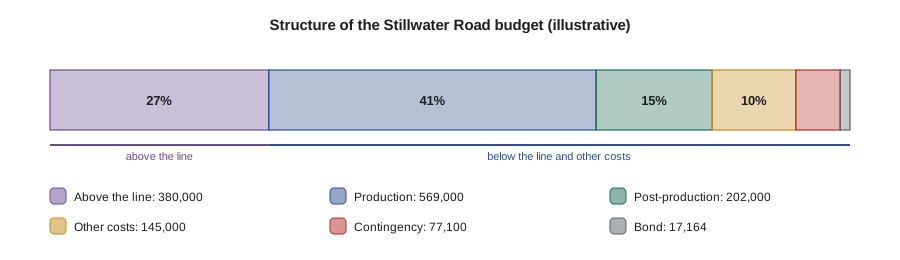
The top sheet
The top sheet is the first page of a budget. It summarizes each account and section on one page, shows the total, and often lists key assumptions such as the number of shooting days, the shooting locations and union status. Most people who read a budget read only the top sheet, so it must be accurate and easy to follow. Financiers compare top sheets across projects; an unusual number invites questions, and an unexplained one can undermine confidence in the whole budget.
A top sheet should be read from the bottom up as well as from the top down. From the top, a reader sees where the money goes. From the bottom, they see what has been added to protect the production: the contingency, the bond, insurance and financing costs. A budget with no contingency or with financing costs missing tells an experienced reader that the producer has not thought through the risks.
accounts = {
    "Above the line": {
        "Story and rights": 40000, "Screenplay": 45000, "Producers": 110000,
        "Director": 70000, "Principal cast": 115000,
    },
    "Production": {
        "Production staff": 98000, "Extras": 12000, "Camera": 64000,
        "Grip and electric": 58000, "Art and set dressing": 72000, "Wardrobe": 21000,
        "Hair and makeup": 14000, "Production sound": 22000, "Locations": 60000,
        "Transport": 38000, "Catering and craft": 30000, "Fringes": 80000,
    },
    "Post-production": {
        "Picture editing": 62000, "Sound editing and mix": 48000, "Music": 30000,
        "Visual effects": 14000, "Grading and finishing": 26000, "Deliverables": 22000,
    },
    "Other costs": {
        "Insurance": 31000, "Legal": 30000, "Publicity": 10000,
        "Financing costs": 41000, "Office and general": 21000, "Audit": 12000,
    },
}
section_totals = {s: sum(v.values()) for s, v in accounts.items()}
subtotal = sum(section_totals.values())
contingency = 0.10 * (section_totals["Production"] + section_totals["Post-production"])
bond = 0.0125 * (subtotal + contingency)   # some lenders require a completion bond
total = subtotal + contingency + bond
for s, t in section_totals.items():
    print(f"{s:<18}{t:>11,.0f}{t / total:>8.1%}")
print(f"{'Contingency 10%':<18}{contingency:>11,.0f}{contingency / total:>8.1%}")
print(f"{'Completion bond':<18}{bond:>11,.0f}{bond / total:>8.1%}")
print(f"{'Total':<18}{total:>11,.0f}")
atl = section_totals["Above the line"]
print(f"Above-the-line share: {atl / total:.1%}; below-the-line share: {(total - atl) / total:.1%}")Above the line 380,000 27.3% Production 569,000 40.9% Post-production 202,000 14.5% Other costs 145,000 10.4% Contingency 10% 77,100 5.5% Completion bond 17,164 1.2% Total 1,390,264 Above-the-line share: 27.3%; below-the-line share: 72.7%
The script prints a top sheet close to 1.4 million for Stillwater Road. Note how the contingency is calculated on production and post-production costs rather than on everything, a common convention because those are the costs most likely to overrun, and how the completion bond fee is calculated on the total including contingency. Conventions vary by funder and guarantor, so producers follow the requirements of the financiers actually involved.
The contingency
A contingency is a reserve for the unexpected: a lost day to weather, an equipment failure, a location that falls through, a necessary reshoot. Most independent budgets include a contingency of about 10 per cent of below-the-line costs, and completion guarantors and many funders require one. It is not a slush fund for creative wishes; spending it usually requires the producer's approval and, on bonded films, the guarantor's notice or consent.
Producers are sometimes tempted to cut the contingency to make a budget fit the available money. This is dangerous. A film without a contingency has no margin for the problems every production faces, and the first serious problem may force cuts that damage the film or push the production into crisis. A better approach is to reduce the scope of the film so that a proper contingency fits.
Fees, overhead and the producer's position
Producers are paid through fees and overhead in the budget. A producer fee compensates the producers for their work; a corporate overhead charge contributes to the production company's office and staff costs. Funders often limit these, for example to a percentage of the budget, and may require that some of the fee be deferred if the budget is tight. On a low-budget feature, producers frequently defer part of their fees to close the finance plan, as in the Stillwater Road plan in lesson 3.
Fees should be visible in the budget, not hidden in other accounts. Financiers and funders want to see that the producers are paid fairly but not excessively, and that any deferrals are recorded so they can be repaid in the agreed order.
Building a budget from the script
A budget starts with a script breakdown (lesson 7), which lists every element each scene needs: cast, extras, locations, props, wardrobe, vehicles, special effects and so on. The breakdown feeds a schedule, which sets the number of shooting days and where they occur. Only then can the budget be calculated, because most below-the-line costs depend on the schedule.
Budgeting is therefore a loop. The first schedule produces a first budget. If the budget is too high, the producer, director and first assistant director look for ways to reduce the schedule or the script's demands: combining locations, shooting a scene day-for-night, cutting a scene that adds little, or simplifying a stunt. Each change updates the schedule and then the budget. The loop continues until the film the director wants and the money the producer can raise meet.
Worked problem
Reducing a budget without hurting the film
The first full budget for Stillwater Road comes in at 1.55 million, but the finance plan can support only 1.4 million. Where should the producer look for 150,000 in savings?
Show solution
- Review the schedule: can two locations be combined, saving a company move and a day? A shooting day on this film costs roughly 35,000 to 45,000 in production costs alone.
- Review the script with the director: is there a scene that adds little but needs an expensive element such as a boat at night or a large crowd?
- Review post-production: can visual effects be reduced by solving problems in camera?
- Review fees and overheads: can some producer fees be deferred?
- Keep the contingency intact and do not cut safety, insurance or fair pay.
Answer: Combining two locations and losing a day saves about 40,000; replacing a night boat sequence with a dock scene saves about 55,000; reducing visual effects and simplifying deliverables saves 20,000; deferring 35,000 of producer fees closes the gap, with the contingency untouched.
Common budgeting pitfalls
Experienced line producers have seen the same problems many times. Budgets often underestimate post-production, especially deliverables and music licensing, which are discussed in lesson 10. They forget the cost of preparing for audits and the time it takes to receive credits. They leave out equipment loss and damage, overtime, meal penalties and turnaround violations. They assume locations will be free or cheap without confirming permits and fees. And they treat optimistic schedules as certain.
The remedy is discipline: build every line from units and rates, check every assumption against the schedule, ask department heads to review their sections, compare the budget with similar productions, and keep notes explaining unusual figures. A budget that can be explained line by line is a budget that can be defended to financiers and controlled during production.
| Check | Question to ask |
|---|---|
| Consistency | Do shooting days, crew size and locations match the schedule in every account? |
| Completeness | Are insurance, legal, financing, audit, publicity and deliverables included? |
| Rates | Are union and non-union rates current and correctly applied? |
| Fringes | Are fringes calculated on every wage line that requires them? |
| Contingency | Is there a contingency at the level financiers and the guarantor require? |
| Notes | Are unusual figures explained in footnotes? |
Common mistakes
MistakeBuilding costs as rough lump sums
InsteadBuild each line from units, rates and quantities linked to the schedule.
MistakeCutting the contingency to fit the money available
InsteadReduce scope so a proper contingency fits.
MistakeLeaving financing, insurance and audit costs out
InsteadInclude all other costs, which financiers check on the top sheet.
MistakeBudgeting before scheduling
InsteadBreak down and schedule the script first, then calculate the budget.
MistakeHiding producer fees in other accounts
InsteadShow fees and overhead openly and record any deferrals.
Summary and key terms
- A budget is both a plan for spending and a promise to financiers.
- Budgets are organized into accounts, line items and sections, with costs built from units and rates.
- Above-the-line costs cover rights and key creative deals; below-the-line costs cover physical production.
- The top sheet summarizes the budget on one page and is what most financiers read.
- A contingency of about 10 per cent of below-the-line costs protects against the unexpected.
- Budgets are built from the breakdown and schedule, and revised in a loop until script and money meet.
- Common pitfalls include underestimating post-production, leaving out other costs and trusting optimistic schedules.
- Top sheet
- The one-page summary of a budget's accounts, sections and total.
- Above the line
- Rights and key creative costs negotiated before production, such as director and principal cast.
- Below the line
- Costs of physically making the film, such as crew, equipment and locations.
- Account
- A category of cost in a budget, such as camera or locations.
- Line item
- A single cost within an account, calculated from units, rates and quantities.
- Contingency
- A reserve, often about 10 per cent of below-the-line costs, for unexpected problems.
- Completion bond
- A guarantee to financiers that the film will be completed and delivered.
- Corporate overhead
- A budget charge contributing to the production company's office and staff costs.
- Chart of accounts
- A standard numbered list of budget accounts.
- Locked budget
- The approved budget used as the baseline for cost control.
Practice problems
Work each problem on paper first, then reveal the answer to check.
What is the main difference between above-the-line and below-the-line costs?
Show answer
Above-the-line costs are rights and key creative deals; below-the-line costs are physical production.
Why do financiers look at the top sheet first?
Show answer
It summarizes the whole budget and reveals unusual or missing costs.
On what costs is a contingency usually calculated?
Show answer
Below-the-line costs, often production and post-production.
Why is cutting the contingency dangerous?
Show answer
The production has no margin when problems occur.
What comes before the budget in the planning process?
Show answer
The script breakdown and schedule.
Name two kinds of other costs that must appear in a budget.
Show answer
For example, insurance, legal, financing costs, audit or publicity.
How are producers usually paid in a budget?
Show answer
Through producer fees and corporate overhead.
Give one way to reduce a budget without hurting the film.
Show answer
For example, combine locations, cut a low-value scene or defer fees.
Why should unusual figures have notes?
Show answer
So financiers can understand and trust them.
What is a locked budget?
Show answer
The approved budget used as the baseline for cost control.
Lesson quiz · 5 questions
Score 60% or more to complete this lesson.
Create a free account to save your progress, take quizzes and earn a certificate.