
FILM-410 · Lesson 10 of 12 · 25 min
Post-production management and deliverables
When the shoot wraps, the producer's work is far from over. Post-production turns hundreds of hours of footage and sound into a finished film, and then into the long list of materials, files and documents that distributors, broadcasters, streamers and festivals require. These materials are the deliverables, and a film is not finished, in the business sense, until they are accepted. Delivery triggers many of the payments in the finance plan, such as minimum guarantees and pre-sale balances, so late or rejected deliverables can leave a production without the cash it was counting on.
FILM-220 covers editing and FILM-310 covers sound, including dialogue editing, music and mixing. CINE-430 covers colour grading and finishing. This lesson covers post-production from the producer's side: planning the post schedule and budget, managing the creative process to picture lock, controlling the costs of music, visual effects and finishing, and delivering everything the buyers need.
The post-production workflow
Post-production begins during the shoot, when the editor assembles scenes from the daily footage. After the shoot, the editor and director work through cuts: the assembly, the director's cut and successive versions until the picture is locked, meaning that no further changes will be made to the timing of shots. Picture lock is a critical milestone, because sound, music, visual effects and colour work all depend on the locked timing. Changes after lock are expensive, because they ripple through every department.
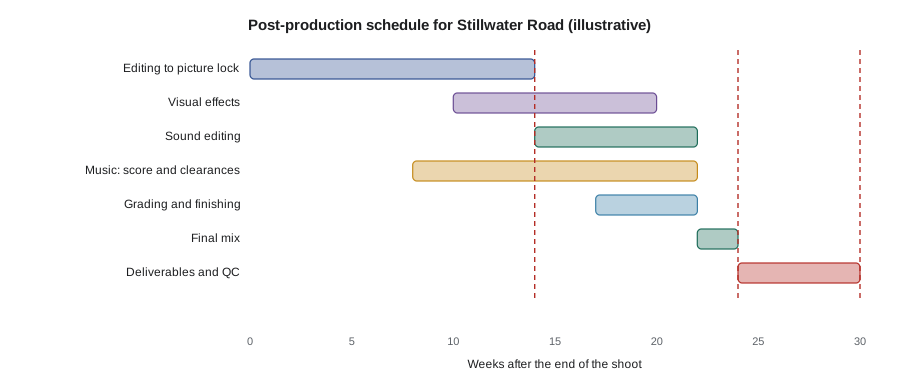
After lock, several processes run in parallel. Sound editors build dialogue, effects and ambience tracks; Foley and ADR are recorded; the composer writes and records the score; visual effects artists complete their shots; and the colourist grades the picture. The final mix combines all sound elements, and the final conform and grade produce the finished picture. Then the deliverables are created from the finished masters.
Planning the post schedule and budget
Post-production schedules for low-budget features commonly run four to eight months, and longer when the film goes to festivals with a cut that is later refined. The schedule depends on the amount of footage, the complexity of the edit, visual effects, music, and the delivery date in distribution agreements. Producers work backward from the delivery date, adding buffers for test screenings, notes from financiers and distributors, and the inevitable delays.
The post budget includes the editor and assistants, editing systems and storage, sound editing and mixing, music, visual effects, colour grading and finishing, titles, closed captions and audio description, deliverables, quality control and archiving. These costs are easy to underestimate in development, when the producer is focused on getting the film shot, and many productions arrive in post with too little money to finish properly. A common rule is to protect the post budget from being raided during production unless there is a clear plan to replace the money.
shoot_days = 20
hours_per_day = 4.5         # recorded camera footage per day across all cameras
camera_rate_mbps = 1300     # high-quality camera codec, megabits per second (illustrative)
proxy_rate_mbps = 45        # lightweight editing proxies
copies = 3                  # original plus two backups, kept in different places

def terabytes(hours, mbps):
    return hours * 3600 * mbps / 8 / 1_000_000   # megabits to terabytes

total_hours = shoot_days * hours_per_day
camera_tb = terabytes(total_hours, camera_rate_mbps)
proxy_tb = terabytes(total_hours, proxy_rate_mbps)
print(f"Recorded footage: {total_hours:.0f} hours")
print(f"Camera originals: {camera_tb:.1f} TB per copy, {camera_tb * copies:.1f} TB for {copies} copies")
print(f"Editing proxies: {proxy_tb:.1f} TB")
cost_per_tb = 25            # illustrative cost per TB for drives
print(f"Drive cost at {cost_per_tb} per TB: {(camera_tb * copies + proxy_tb) * cost_per_tb:,.0f}")Recorded footage: 90 hours Camera originals: 52.6 TB per copy, 157.9 TB for 3 copies Editing proxies: 1.8 TB Drive cost at 25 per TB: 3,994
Storage is only one post cost, but the calculation shows why producers plan data management before the shoot. Keeping three copies of all original media, in at least two locations, is standard practice; losing original footage can be catastrophic and may not be fully covered by insurance if the production did not follow proper procedures.
Managing the creative process
The producer's creative role in post is to support the director while protecting the film's commercial and contractual requirements. Directors' agreements usually give the director a period to complete a director's cut, and guild agreements may protect that period, as described in FILM-320 lesson 11. After the director's cut, the producer and financiers give notes, and contracts set out who has final cut, the right to decide the final version.
Test screenings with audiences, or smaller screenings for trusted viewers, help the director and producer see how the film plays. Notes from distributors and financiers can be valuable but can also pull a film in different directions. The producer filters and prioritizes notes, as in development, and keeps the conversation focused on making the best version of the film the team set out to make within the time and money available.
Music, effects and clearances
Music is one of the most underestimated post costs. A composer is engaged under an agreement covering fees, rights and the delivery of the score; the score may be recorded with live musicians at further cost. Licensed songs and recordings require two licences: a synchronization licence from the music publisher for the composition, and a master use licence from the record label for the recording. Fees depend on the song's popularity, the length and prominence of use, the media and territories, and the term. Using a famous song can cost more than the entire music budget of a low-budget film.
Producers should clear music early, before a temporary track becomes a creative attachment that the director cannot live without. Music cue sheets, which list every piece of music, its writers, publishers, timings and usage, are required deliverables and are used by performing rights organizations to pay royalties when the film is broadcast or streamed. FILM-310 lesson 10 covers music for film, and FILM-420 covers licensing law.
Visual effects range from simple clean-up, such as removing a modern sign from a period scene, to complex digital environments. Even modest effects add up when there are dozens of shots. Producers control effects costs by planning them during prep with a supervisor, solving problems in camera where possible, and locking the number and scope of shots early. Every element on screen, from artwork on a wall to a brand logo, may also need clearance, which the production's legal team or a clearance service handles before delivery.
Worked problem
Choosing between a licensed song and an original cue
The director of Stillwater Road wants a well-known 1970s song over the final scene. The quote for worldwide rights in all media in perpetuity is far above the remaining music budget. What options does the producer have?
Show solution
- Ask for a quote with narrower rights, such as festival use only, with an option to extend if the film sells. This reduces the initial fee but adds risk and future cost.
- Explore a cover version: a new recording requires a synchronization licence for the composition but avoids the master use fee of the original recording.
- Commission an original song or cue from the composer that captures the same emotion, owned or licensed on predictable terms.
- Discuss the creative purpose with the director: what does the song do for the scene, and can the score do it?
Answer: The producer and director choose an original song by the composer, with the composer's agreement covering all media, which keeps the music budget intact and avoids later clearance risk. A festival-only licence would have been a riskier alternative.
Deliverables
Deliverables are the materials a distributor, broadcaster, streamer or sales agent requires before accepting a film. Each buyer provides a delivery schedule, often running to many pages. Common technical deliverables include a digital cinema package (DCP) for theatrical exhibition; a high-quality master, often in an interoperable master format (IMF) package for streamers; separate sound stems for dialogue, music and effects; a music and effects track without dialogue for foreign-language versions; closed captions and subtitles; audio description; trailers and promotional materials; and stills.
Legal and documentary deliverables are just as important: the chain of title, all signed agreements with cast, crew, writers and composers, music licences and cue sheets, clearance logs, errors and omissions insurance certificates, credit lists and approvals, and certification documents for funders and tax credits.
Canadian broadcasters must meet CRTC requirements for closed captioning and, for certain programming, described video, and these obligations shape the accessibility deliverables Canadian distributors and broadcasters request. Funders such as Telefilm may also require specific deliverables, credits and logos, and French-language versions or materials may be needed for distribution in Quebec.
| Deliverable | Purpose |
|---|---|
| Digital cinema package (DCP) | Theatrical and festival projection |
| Master file or IMF package | Streaming and broadcast versions |
| Dialogue, music and effects stems | Remixing, versioning and trailers |
| Music and effects track | Dubbing into other languages |
| Closed captions, subtitles, audio description | Accessibility and foreign markets |
| Chain of title and agreements | Proof that the film can be exploited |
| Music licences and cue sheets | Proof of music rights and royalty reporting |
| Errors and omissions certificate | Insurance against rights claims |
Quality control and acceptance
Before acceptance, buyers or their laboratories run quality control (QC) checks on technical deliverables, looking for problems such as image artifacts, audio levels outside specification, missing captions or incorrect frame rates. Failing QC means fixing and resubmitting, which costs money and delays payment. Many producers commission their own QC before delivery to catch problems early.
Delivery is complete only when the buyer accepts it in writing. Because minimum guarantees and pre-sale balances are often paid on acceptance, the producer tracks every buyer's deliverables list, deadlines and acceptance status. A delivery tracker, listing each item, its status and who is responsible, is one of the most useful documents in late post-production.
Archiving and closing post-production
When delivery is accepted, post-production is not quite over. The producer must archive the film's materials so that it can be restored, remastered or reformatted in the future, and so that new versions can be made for markets that did not exist when the film was finished. A typical archive includes the final picture and sound masters, the edit project files, the camera originals or a selected subset, the stems and music and effects track, the graphics and title files, and the legal documents.
Archives must be stored in more than one place and checked over time, because drives and formats fail and become obsolete. Some distributors and funders specify archive requirements, and some public archives accept films for preservation. Producers also need to close post accounts, return or purchase equipment, settle vendor invoices and confirm that every licence covers the media and territories the film will be sold in. A missing licence discovered years later, when a streamer asks for a new version, can be expensive or impossible to fix.
Common mistakes
MistakeMaking picture changes after lock
InsteadLock picture firmly before sound, music, effects and colour begin, and treat later changes as costly exceptions.
MistakeRaiding the post budget during the shoot
InsteadProtect post-production money or plan clearly how it will be replaced.
MistakeFalling in love with temporary music that cannot be cleared
InsteadClear music early and plan original alternatives.
MistakeTreating deliverables as an afterthought
InsteadBudget and schedule deliverables from the start using buyers' delivery schedules.
MistakeAssuming a film is delivered when files are sent
InsteadTrack QC and written acceptance, which trigger payments.
Summary and key terms
- Post-production turns footage into a finished film and the deliverables that buyers require.
- Picture lock is the milestone that allows sound, music, effects and colour to proceed in parallel.
- Post schedules and budgets are planned backward from delivery dates and are easy to underestimate.
- Producers support the director's cut while managing notes, contracts and final cut rights.
- Music requires synchronization and master use licences, and cue sheets are required deliverables.
- Deliverables include technical masters, accessibility files and legal documents such as the chain of title.
- Quality control and written acceptance determine when delivery is complete and payments are triggered.
- Picture lock
- The point at which no further changes are made to the timing of shots.
- Director's cut
- The director's version of the film, completed during a protected period.
- Final cut
- The contractual right to decide the final version of a film.
- Synchronization licence
- Permission from a publisher to use a musical composition with images.
- Master use licence
- Permission from the owner of a recording to use that recording.
- Cue sheet
- A list of all music in a film with writers, publishers, timings and usage.
- Deliverables
- The materials and documents a buyer requires before accepting a film.
- Digital cinema package
- The standard file package for theatrical projection.
- Music and effects track
- A soundtrack without dialogue, used for dubbing.
- Quality control
- Technical checks of deliverables against a buyer's specifications.
Practice problems
Work each problem on paper first, then reveal the answer to check.
Why is picture lock an important milestone?
Show answer
Sound, music, effects and colour all depend on the locked timing.
How long does post-production often take on a low-budget feature?
Show answer
Commonly four to eight months.
Why keep three copies of original media?
Show answer
To protect against loss, which can be catastrophic.
What two licences does a licensed song usually require?
Show answer
A synchronization licence and a master use licence.
Why clear music early?
Show answer
To avoid a temporary track that cannot be afforded or cleared.
Name three technical deliverables.
Show answer
For example, a DCP, a master or IMF package, stems, a music and effects track, captions or audio description.
Name two legal deliverables.
Show answer
For example, chain of title, agreements, music licences, cue sheets or the errors and omissions certificate.
What does quality control check?
Show answer
That technical deliverables meet the buyer's specifications.
Why does written acceptance matter?
Show answer
Payments such as minimum guarantees are often due on acceptance.
Who decides the final version of a film?
Show answer
Whoever holds final cut under the contracts.
Lesson quiz · 5 questions
Score 60% or more to complete this lesson.
Create a free account to save your progress, take quizzes and earn a certificate.