
FILM-410 · Lesson 2 of 12 · 30 min
Development: rights, packaging and pitching
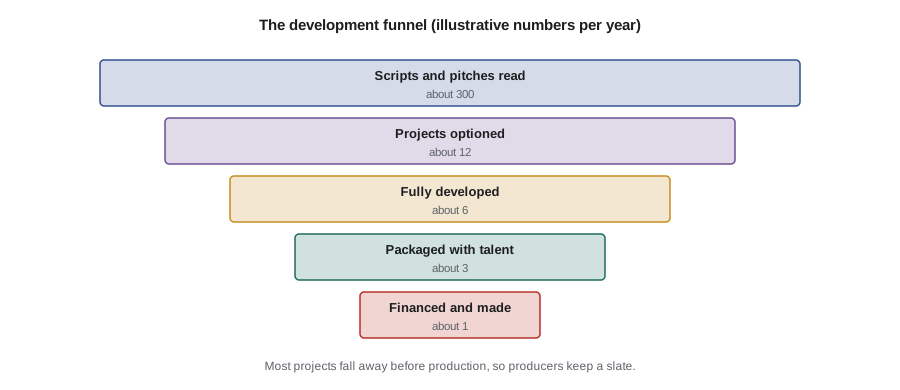
Development is the phase in which an idea becomes a film that someone will pay to make. It is slow, uncertain and mostly invisible. Producers read hundreds of scripts, books and pitches a year, option a few, develop fewer and see only a handful reach production. A producer's development slate, the set of projects in active development, is their pipeline of future work. A slate that is too small leaves the company idle when a project collapses; a slate that is too large spreads money and attention so thin that nothing advances.
This lesson covers where projects come from, how producers secure the rights to make them, how scripts are developed with writers, how projects are packaged with talent to attract money, and how producers pitch. FILM-210 covers the craft of screenwriting itself, and FILM-420 covers the law of rights, options and chain of title in depth. Here we look at development as a producer's business process.
Where projects come from
Projects reach producers in several ways. Original screenplays come from writers, often through agents or managers, competitions, labs and personal networks. Adaptations come from books, articles, podcasts, plays, true stories and existing films. Some projects begin with a producer's own idea, for which the producer hires a writer. Others begin with a director or actor who brings a passion project to a producer they trust.
Each source carries different rights questions. An original script requires a deal with its writer. An adaptation requires the rights to the underlying work as well as a writer. A true story may require life-rights agreements with the people portrayed, depending on how the story is told and the legal risks involved. A remake requires rights from the owner of the original film. Before spending money on development, the producer must know who owns what.
| Source | Rights usually needed | Typical risk |
|---|---|---|
| Original screenplay | Option or purchase from the writer | Competing versions or unclear co-authorship |
| Novel or short story | Option on film and television rights from the author or publisher | Rights already sold or split by medium or territory |
| Article or podcast | Option on the work, sometimes plus life rights | Underlying facts are free, but the expression is protected |
| True story | Life-rights agreements where appropriate, plus research files | Privacy and defamation claims |
| Remake or sequel | Rights from the owner of the earlier film | Complex ownership chains |
| Producer's own idea | Writer's agreement assigning the script to the producer | Ideas are hard to protect before they are written down |
Options and chain of title
Producers rarely buy rights outright at the start. Instead, they take an option: an exclusive right, for a set period, to buy the rights at an agreed price. The producer pays an option fee, which secures the period, and pays the full purchase price only if the film goes ahead, usually on or before the first day of principal photography. If the option expires without the producer exercising it, the rights return to the owner, who keeps the option fee.
Option deals typically set the option period, often 12 to 18 months, with the right to extend for a further fee; the option fee, often a small percentage of the purchase price and frequently applicable against it; the purchase price, sometimes expressed as a percentage of the production budget with a floor and a ceiling; and any further payments, such as bonuses if the film is made or profit participation. These terms are negotiated and vary widely. The figures in this lesson are illustrative.
Every right the producer acquires becomes part of the chain of title: the documents that prove the producer owns the rights needed to make and exploit the film. Financiers, insurers, distributors and broadcasters all review the chain of title before they commit. A broken link, such as an unsigned writer agreement or an expired option, can stop a film from closing its financing or being sold. FILM-420 covers chain of title in detail; for producers, the practical rule is to paper every deal properly and keep the documents organized from the first day.
Worked problem
Calculating an option and purchase price
The producer of Stillwater Road options the novel it is based on. The option fee is 10 per cent of a purchase price set at 2 per cent of the final production budget, with a floor of 40,000 and a ceiling of 120,000. The option fee is applicable against the purchase price. The final budget is 1,400,000. What does the producer pay at the option and at the start of principal photography?
Show solution
- Compute the purchase price: 2 per cent of 1,400,000 is 28,000, which is below the floor, so the floor applies: 40,000.
- The option fee is 10 per cent of the floor price agreed at signing: 4,000.
- Because the option fee is applicable, the producer pays the balance at exercise: 40,000 minus 4,000 equals 36,000.
- If the producer extended the option for a second period, a non-applicable extension fee would be paid in addition.
Answer: The producer pays 4,000 at signing and 36,000 on exercise, for a total of 40,000. Currency amounts are illustrative and would follow the deal's currency.
Developing the script
Once rights are secured, the producer works with a writer to develop the script. Writer agreements usually set out steps: a treatment or outline, a first draft, a set of revisions and a polish, with payments at each step. The producer can usually stop development after any step, paying only for work done. Union agreements set minimums for these payments and govern credits.
In English-language Canada, screenwriters are represented by the Writers Guild of Canada (WGC), whose Independent Production Agreement with the CMPA sets minimum fees, script fees as a percentage of the budget, and credit rules. In Quebec, the Société des auteurs de radio, télévision et cinéma (SARTEC) plays a similar role for French-language work. Public funders often require that writers on funded projects be paid at least guild minimums.
Good development is collaborative. The producer gives notes, often with a director, story editor or financier, and the writer revises. Notes should be specific, prioritized and aimed at the story the writer is trying to tell rather than at a different film the producer would prefer. Too many notes from too many voices can flatten a script; a producer's job is to filter, prioritize and protect the writer from contradictory demands. FILM-320 lesson 2 describes script analysis from the director's side, and the same tools help producers give notes.
Development money
Development costs money: option fees, writer payments, research, legal work, budgets and schedules prepared for financiers, and the producer's own time and overheads. Independent producers pay for development from their own resources, from development funding programs, or from partners who receive an interest in the project in return.
Canadian producers can draw on several sources. Telefilm Canada and the Canada Media Fund have offered development support through various programs, generally requiring Canadian ownership and eligible creative teams; program names and criteria change from year to year, so producers check current guidelines. Private funds created through broadcasting benefits, such as the Harold Greenberg Fund for English-language feature development, and provincial agencies such as Ontario Creates and Creative BC, also support development. Broadcasters and distributors sometimes pay development fees in exchange for first rights.
Development money comes with strings. A funder may require repayment on the first day of principal photography, a credit, or a share of profits. A partner who pays for development may expect to be a producer on the film. The producer must keep track of every such obligation, because they all land in the budget and recoupment schedule later.
import random
random.seed(410)
# Each project: development cost, chance it is produced, value to the company if made
# (producer fees and overhead; any back end is ignored)
slate = [
    ("Stillwater Road", 60000, 0.35, 300000),
    ("Ice Road Diner", 45000, 0.15, 350000),
    ("The Ferry", 80000, 0.10, 900000),
    ("Second Shift", 30000, 0.25, 180000),
    ("Low Tide", 25000, 0.20, 200000),
]
ev = sum(p * fee - cost for _, cost, p, fee in slate)
print(f"Expected net value of the slate: {ev:,.0f}")
for name, cost, p, fee in slate:
    print(f"  {name:<16} cost {cost:>7,} chance {p:>4.0%} value {fee:>8,} EV {p * fee - cost:>9,.0f}")
# Simulate many years to see the spread
results = []
for _ in range(10000):
    net = 0
    for _, cost, p, fee in slate:
        net -= cost
        if random.random() < p:
            net += fee
    results.append(net)
results.sort()
print(f"Median outcome: {results[5000]:,.0f}")
print(f"Chance of losing money: {sum(r < 0 for r in results) / len(results):.0%}")
print(f"Chance no project is made: {sum(r == -sum(c for _, c, _, _ in slate) for r in results) / len(results):.0%}")Expected net value of the slate: 92,500 Stillwater Road cost 60,000 chance 35% value 300,000 EV 45,000 Ice Road Diner cost 45,000 chance 15% value 350,000 EV 7,500 The Ferry cost 80,000 chance 10% value 900,000 EV 10,000 Second Shift cost 30,000 chance 25% value 180,000 EV 15,000 Low Tide cost 25,000 chance 20% value 200,000 EV 15,000 Median outcome: 60,000 Chance of losing money: 48% Chance no project is made: 31%
The simulation shows why development is risky even when a slate's expected value is positive: in a large share of years no project is made, and the producer loses everything spent. Producers manage this by keeping costs low early, sharing development costs with partners, and pursuing several projects at once.
Packaging
A script alone rarely raises money. Financiers want to know who will direct, who will star and who is producing. Packaging is the process of attaching these elements. A director with a strong track record, an actor whose name helps sales in key territories, and a producer with a history of delivering on budget all reduce perceived risk and increase the film's value to buyers.
Attachments take several forms. A letter of intent shows an actor's interest without a binding commitment. A pay-or-play offer commits the producer to pay the actor's fee whether or not the film is made, which is expensive but gives certainty. Directors are often attached through a development deal that becomes a directing agreement when financing closes. Agents and managers play a large role in packaging, especially in the American system, where an agency may represent the writer, director and stars of a single project.
Packaging has trade-offs. A famous actor may raise the budget, change the tone of the film or bring scheduling constraints. An actor attached early may lose interest or become unavailable while financing takes months. Producers balance the commercial value of attachments against the creative needs of the film and the director's vision.
| Element | What it adds | Typical caution |
|---|---|---|
| Director | Creative credibility, festival interest | Track record matters more than reputation alone |
| Lead actor | Pre-sales value in some territories | Availability windows and fee may reshape the budget |
| Producer | Confidence that the film will be delivered | A producer new to features may need an experienced partner |
| Sales agent | Market estimates and buyer access | Estimates are not commitments |
| Distributor | Domestic release commitment, often a minimum guarantee | Rights given away early reduce later options |
Pitching
Producers pitch constantly: to writers whose work they want, to directors and actors, to funders, broadcasters, distributors, sales agents and private investors. A pitch is a short, structured case for why a project deserves attention now. It is not a recitation of the plot.
A strong pitch usually covers the hook, a sentence or two that captures what makes the project distinctive; the story, told briefly with its central character, conflict and stakes; why now and why this team, explaining relevance and the team's ability to deliver; the audience and comparable titles, which help buyers picture the market; and the ask, the specific commitment the producer is seeking. Supporting materials include a one-page synopsis, a pitch deck, a look book, a budget top sheet, a finance plan and sometimes a proof-of-concept short or sizzle reel.
Comparable titles, or comps, deserve care. Buyers want comps that are recent, similar in budget, genre and audience, and commercially credible. Comparing a 1.4 million drama to a hit made for ten times that amount undermines a pitch. Honest comps show the producer understands the market.
Worked problem
Writing a one-line hook
Write a hook for Stillwater Road, a drama in which a woman returns to her river town to close her late father's marina and discovers he spent years quietly paying off the debts of the townspeople who shunned her family.
Show solution
- Identify the character, the situation and the twist: a returning daughter, a closing marina, a hidden generosity.
- Find the emotional question: can she forgive a town she thought had wronged her, and a father she thought had abandoned her?
- Draft: "A woman comes home to sell her father's failing marina and finds the ledger that proves the town owed him everything."
- Test it: it names a character, a goal, a discovery and implied conflict in one sentence.
Answer: The hook gives a buyer the story's engine and emotional promise in under thirty words, inviting the next question rather than answering every one.
Common mistakes
MistakeSpending heavily on a script before securing the rights
InsteadOption or acquire the underlying rights and paper every deal before investing in development.
MistakeAssuming an expired option still protects the project
InsteadTrack option periods and extensions; when an option lapses, the rights return to the owner.
MistakeGiving every financier's notes equal weight
InsteadFilter and prioritize notes so the writer receives a clear, consistent direction.
MistakeAttaching talent without considering cost and availability
InsteadWeigh commercial value against budget, schedule and the director's vision before making offers.
MistakeUsing famous high-budget films as comparable titles
InsteadChoose recent comps that match the project's budget, genre and audience.
Summary and key terms
- Development turns ideas into financeable projects; most projects never reach production, so producers keep a slate.
- Every source of material carries rights questions that must be answered before money is spent.
- Options secure exclusive rights for a period at an agreed purchase price, paid if the film goes ahead.
- The chain of title proves the producer owns the rights; financiers and buyers review it before committing.
- Writer agreements and guild rules govern script steps, payments and credits.
- Packaging attaches a director, actors and other elements that reduce risk and increase value.
- A pitch is a structured case: hook, story, why now, audience and comps, and a specific ask.
- Option
- An exclusive right, for a set period, to buy rights at an agreed price.
- Option fee
- The payment that secures an option period, often applicable against the purchase price.
- Purchase price
- The amount paid to acquire rights when an option is exercised.
- Chain of title
- The documents proving a producer owns the rights needed to make and exploit a film.
- Development slate
- The set of projects a producer is actively developing.
- Packaging
- Attaching a director, actors and other elements to make a project financeable.
- Pay-or-play
- An offer committing the producer to pay a fee whether or not the film is made.
- Letter of intent
- A non-binding written expression of interest, often from an actor or financier.
- Comparable titles
- Recent films similar in budget, genre and audience used to show a project's market.
- Hook
- A short statement capturing what makes a project distinctive.
Practice problems
Work each problem on paper first, then reveal the answer to check.
What does an option give a producer?
Show answer
An exclusive right, for a set period, to buy the rights at an agreed price.
When is the purchase price usually paid?
Show answer
When the option is exercised, often by the first day of principal photography.
What happens when an option expires unexercised?
Show answer
The rights return to the owner, who keeps the option fee.
Why do financiers review the chain of title?
Show answer
To confirm the producer owns the rights needed to make and sell the film.
Name two sources of development funding available to producers in your country.
Show answer
For example, in Canada Telefilm, the CMF, the Harold Greenberg Fund or provincial agencies; in the US, production companies, labs, grants or private investors.
Why might a slate with positive expected value still lose money in a given year?
Show answer
Because each project has a low chance of being made, so often none is.
What is a pay-or-play offer?
Show answer
A commitment to pay a fee whether or not the film is made.
Give one risk of attaching a famous actor early.
Show answer
The actor may become unavailable, raise the budget or change the film's tone.
List the main parts of a pitch.
Show answer
Hook, story, why now and why this team, audience and comps, and the ask.
What makes a comparable title useful?
Show answer
It is recent and similar in budget, genre and audience.
Lesson quiz · 5 questions
Score 60% or more to complete this lesson.
Create a free account to save your progress, take quizzes and earn a certificate.