
FILM-310 · Lesson 9 of 12 · 26 min
Foley
Foley is the art of performing everyday sounds in sync with picture: footsteps, the rustle of clothing, a hand picking up a glass, keys in a lock, a body falling onto a couch. It is named after Jack Foley, who developed the technique at Universal Studios in the early sound era, recording sounds live to projected film. Foley gives a film intimacy and physical presence. Without it, characters seem to float through scenes, their movements weightless and strangely silent. With it, the audience feels the texture of a wool coat, the tension in a hand gripping a chair, the difference between a nervous shuffle and a confident stride.
Why Foley exists
Production sound teams focus on dialogue, so movement sounds on set are often quiet, off-microphone or masked. Foley also solves a practical problem for international distribution: when a film is dubbed into another language, the original dialogue tracks are removed, and any footsteps or cloth sounds recorded with the dialogue disappear too. The music and effects version therefore needs a complete set of movement sounds that does not depend on production dialogue. Foley provides that, which is why distributors often require full Foley coverage for every scene, even when the production sound seems to contain enough.
Foley also offers control. Performed sounds can be chosen to match the character and the story: heavier steps for a menacing figure, light and quick for a child, dragging for an exhausted soldier. Foley artists act with their hands and feet, and the best of them give each character a recognizable physical voice.
The Foley team and the stage
A Foley team usually includes Foley artists, also called Foley walkers, who perform the sounds; a Foley mixer, who records them; and a Foley editor, who cuts and syncs the recordings and prepares them for the mix. The Foley stage is an acoustically quiet, fairly dead room with a screen, a collection of surfaces set into the floor, called pits, and an enormous store of props and shoes.
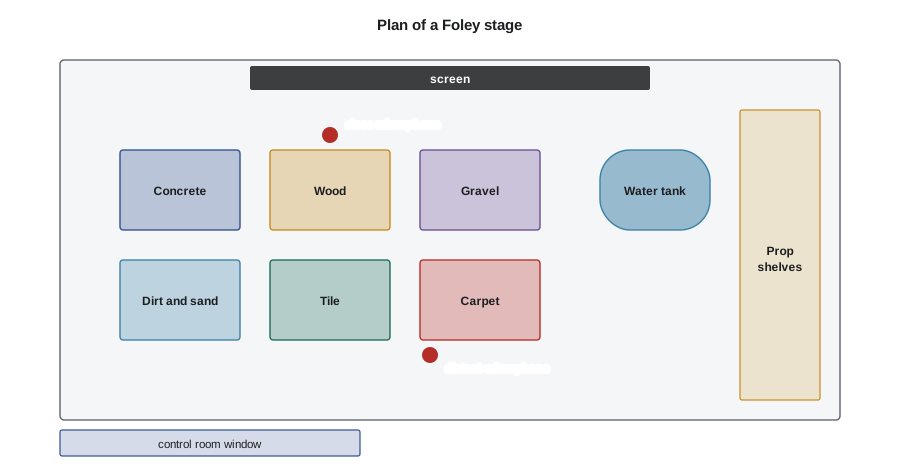
| Surface or prop | Used for | Notes |
|---|---|---|
| Concrete and stone pits | Streets, sidewalks, warehouses | Different finishes for clean and gritty |
| Wood floors and decks | Houses, stages, docks | Hollow and solid sections for different resonance |
| Gravel, dirt and sand pits | Paths, fields, beaches | Can be wetted for mud |
| Tile and marble | Bathrooms, offices, hospitals | Hard, bright reflections |
| Carpet and rugs | Homes, offices | Soft, quiet steps that still need detail |
| Water tank | Splashes, wading, rain on objects | Waterproof flooring and careful electrics |
| Shoes | Every character | Matched to costume and character |
| Prop store | Keys, cutlery, doors, phones, bags | Often found at thrift stores and markets |
The three main categories: feet, cloth and props
Foley work divides into three passes. Footsteps, or feet, are performed by artists walking in place on the appropriate surface while watching the screen, matching each step to the character's gait and shoes. Cloth, also called moves, is the subtle rustle of clothing as characters move; artists rub fabrics that match the costumes close to the microphone. Props, or specifics, cover objects handled by characters: cups, papers, phones, weapons, food, doors handled by hand rather than slammed, and anything else the scene requires.
Feet are usually recorded one character at a time on separate tracks so the mixer can balance them and so they match the character's position on screen. Cloth is often recorded as one pass per main character in a scene, sometimes with all characters combined for crowd scenes. Props are recorded individually for important actions and sometimes in groups for background activity.
Worked problem
Planning a Foley spotting for a kitchen argument
A two-minute scene shows two characters arguing in a small kitchen. One wears heeled boots and a leather jacket; the other is barefoot in a cotton dress. She slams a drawer, he drops keys on the counter, and she pours a glass of water. Plan the Foley passes.
Show solution
- Feet: character A in heeled boots on tile; character B barefoot on tile, recorded with bare feet or a soft sole on a damp surface for skin texture.
- Cloth: leather jacket pass for A (creaks and rubs), cotton dress pass for B (soft, quieter), each on its own track.
- Props: drawer slam (with cutlery rattle inside), keys dropped on a laminate counter, glass picked up, water poured, glass set down; each on separate tracks.
- Extras: chair scrape if visible, hand slap on counter, kettle touched.
Answer: About seven to ten tracks for two minutes. Each element matches costume, surface and character, so the mix can bring out the tension in small movements as well as the loud moments.
Performing to picture
Foley artists watch the scene several times, rehearse the movements, then perform in sync while the Foley mixer records. Matching sync is a performance skill: artists anticipate each step and movement, often by watching the actor's shoulders and knees rather than the feet. Experienced artists can perform long scenes in a single take, adjusting weight, speed and surface as the character moves. Small inaccuracies are fixed by the Foley editor, but well-performed Foley needs little editing.
Footstep timing follows the actor's pace. A brisk walk might be about two steps per second, a relaxed stroll around one and a half, and a run three or more. At 24 frames per second, a step every 12 frames is two steps per second. Foley editors often check rhythm by counting frames between steps and comparing with the picture.
fps = 24
gaits = {'stroll': 1.5, 'brisk walk': 2.0, 'jog': 2.8, 'sprint': 3.6}   # steps per second, illustrative
for name, sps in gaits.items():
    print(f'{name:11s}: {sps} steps/s = one step every {fps / sps:4.1f} frames')
scene_seconds = 42
steps = [('Mara, boots on tile', 'brisk walk', 18), ('Dev, sneakers on tile', 'stroll', 30)]
for who, gait, walking_s in steps:
    n = round(gaits[gait] * walking_s)
print(f'{who}: about {n} steps in {walking_s} s of walking (scene {scene_seconds} s)')stroll : 1.5 steps/s = one step every 16.0 frames brisk walk : 2.0 steps/s = one step every 12.0 frames jog : 2.8 steps/s = one step every 8.6 frames sprint : 3.6 steps/s = one step every 6.7 frames Mara, boots on tile: about 36 steps in 18 s of walking (scene 42 s) Dev, sneakers on tile: about 45 steps in 30 s of walking (scene 42 s)
Microphones, perspective and the room
Foley is usually recorded with a high-quality condenser microphone, often a shotgun or hypercardioid, placed at a consistent distance from the performance, typically 60 cm to 1.5 m, with a second microphone further away for a roomier option. Close miking captures detail but can sound unnaturally intimate; more distant miking sounds more natural for wide shots. Many Foley mixers record close and distant microphones on separate tracks so the re-recording mixer can choose or blend. Perspective is matched to the shot: a character walking away into a corridor needs steps that grow quieter and roomier, achieved by the artist stepping more softly and by the mixer's choices.
The Foley stage itself is kept quiet and dry so that the recordings can be placed into any acoustic space with reverberation in the mix. A noisy stage, such as one with air conditioning or traffic, adds a background that accumulates over many tracks and muddies the mix, so Foley stages are built to very low noise levels.
Props, invention and the art of substitution
Foley artists are famous for substitution: using one object to sound like another. Celery and cabbage snapped and crushed become breaking bones and punches; cornstarch in a leather pouch becomes footsteps in snow; a chamois or wet cloth becomes skin contact; gloves flapped quickly become bird wings; a stapler can become a gun mechanism. The test is not what the object is but whether the sound reads correctly with picture. Audiences hear what they see, so a sound that is plausible in sync often works better than a literal recording of the real object.
| On screen | Foley prop | Why it works |
|---|---|---|
| Footsteps in snow | Cornstarch squeezed in a leather pouch | Crunchy squeak like compacted snow |
| Breaking bones | Celery stalks snapped | Crisp, fibrous crack |
| Punches to the body | Cabbage, raw meat or a leather jacket struck | Thick, dull impact with texture |
| Bird wings | Leather gloves flapped | Soft, rhythmic air movement |
| Fire crackle | Cellophane crumpled slowly | Irregular crackling texture |
| Horse hooves | Coconut shells on gravel or dirt | Hollow clops with surface detail |
| Kisses | Lips on the back of the hand | Intimate, close detail |
Editing and preparing Foley for the mix
The Foley editor syncs every element, cleans up mistakes and noises, and organizes tracks by character and type. Foley is usually edited frame-accurately, with steps aligned to the heel strike visible on screen. The editor removes any sounds that duplicate useful production effects or hard effects, or keeps both so the mixer can choose. Foley is often delivered as its own stem in the premix, then folded into the effects stem in the final deliverables.
Foley must also serve the music and effects version. For dubbing, the M and E needs complete Foley for every scene, including subtle cloth and handling that may be buried under dialogue in the original mix. Supervising sound editors check M and E coverage carefully, because distributors reject versions with gaps.
Running a Foley session
A Foley session is planned like a small shoot. Before the session, the Foley editor or supervising sound editor prepares a Foley cue list from the spotting notes, listing each scene, character, surface, shoes, costume fabrics and props, with timecodes. The Foley artists use the list to gather props and choose shoes, and the Foley mixer sets up microphones and tracks so each pass lands on a predictable track. A typical day might cover 10 to 15 minutes of finished picture for a dialogue-heavy drama with careful cloth and props, and much less for complex action sequences full of fights, falls and handled weapons.
During the session, the mixer records each pass, marks the takes the team prefers and keeps notes on anything that needs fixing in editing. Artists rehearse difficult moves, such as a fall onto a couch or a struggle over a bag, before recording, and the mixer listens for sync, perspective and unwanted noises such as squeaky shoes or breathing near the microphone. Directors rarely attend Foley sessions, so the supervising sound editor reviews the work against the spotting notes and the character choices agreed earlier.
| Scene | Character | Pass | Surface or props | Notes |
|---|---|---|---|---|
| 12 | Mara | Feet | Heeled boots on tile | Tired, slower after the argument |
| 12 | Dev | Feet | Sneakers on tile | Light, restless shifting |
| 12 | Mara | Cloth | Cotton dress, cardigan | Quiet; detail only in close-ups |
| 12 | All | Props | Drawer, cutlery, keys, glass, water pour | Drawer slam is a story beat |
| 13 | Crowd | Feet | Street, mixed shoes | Group pass for passers-by |
Foley on smaller productions
Low-budget productions rarely have access to a professional Foley stage, but good Foley is still possible. A quiet room with a rug, some floor tiles, a board, a tray of gravel, a box of props and a decent microphone can produce convincing results. The key principles are the same: quiet recording space, consistent microphone distance, separate passes for feet, cloth and props, careful sync and matching to character. Libraries of pre-recorded Foley can fill gaps, but performed Foley in sync almost always sounds more natural.
Foley artists and Foley mixers in Canada may work on union or non-union productions; post-production sound facilities in Toronto, Montreal and Vancouver serve both domestic and international productions, often supported by provincial tax credits for post-production services.
Common mistakes
MistakeRelying on production audio for movement sounds
InsteadRecord full Foley so the music and effects version has complete coverage.
MistakeUsing the same shoes for every character
InsteadMatch shoes and gait to each character and costume.
MistakeRecording Foley in a noisy room
InsteadUse a quiet, dry space so tracks do not accumulate background noise.
MistakeCombining all characters' footsteps on one track
InsteadRecord feet per character on separate tracks for balance and placement.
MistakeInsisting on the literal object for every sound
InsteadUse substitutions that read correctly with picture.
Summary and key terms
- Foley is performed movement sound in sync with picture, named after Jack Foley.
- It provides intimacy and character and is essential for complete music and effects versions.
- Foley divides into feet, cloth and props, usually recorded in separate passes.
- Stages have surface pits, water tanks, prop stores and quiet, dry acoustics.
- Artists anticipate movements; footstep rhythm can be checked in frames per step.
- Consistent microphone distance with optional distant microphones gives the mixer perspective choices.
- Substitution, careful editing and M and E coverage complete the craft.
- Foley
- Movement sounds performed in sync with picture.
- Foley artist
- The performer who creates Foley sounds, also called a Foley walker.
- Foley mixer
- The engineer who records Foley sessions.
- Pit
- A section of floor on a Foley stage filled with a particular surface.
- Feet
- Foley footsteps.
- Cloth
- Foley clothing movement, also called moves.
- Props
- Foley sounds of handled objects, also called specifics.
- Substitution
- Using one object to create the sound of another.
- Heel strike
- The moment a heel contacts the ground, used to sync footsteps.
- M and E coverage
- Complete effects and Foley in the music and effects version, independent of dialogue.
Practice problems
Work each problem on paper first, then reveal the answer to check.
Why is Foley needed for the music and effects version?
Show answer
Removing dialogue also removes movement sounds recorded with it.
What are the three main Foley categories?
Show answer
Feet, cloth and props.
What is a Foley pit?
Show answer
A floor section filled with a surface such as gravel, wood or concrete.
Why are feet recorded per character?
Show answer
So each can be balanced and placed to match the character on screen.
How many frames between steps at two steps per second at 24 fps?
Show answer
12 frames.
Why should a Foley stage be quiet and dry?
Show answer
Background noise accumulates across tracks, and reverberation is added in the mix.
What prop is traditionally used for footsteps in snow?
Show answer
Cornstarch in a leather pouch.
What does an artist watch to anticipate footsteps?
Show answer
The actor's shoulders and knees.
Why record close and distant Foley microphones?
Show answer
To give the mixer a choice of perspective.
Name three items useful for Foley on a small budget.
Show answer
A rug, floor tiles, a tray of gravel (also a board, props, a quiet room).
Lesson quiz · 5 questions
Score 60% or more to complete this lesson.
Create a free account to save your progress, take quizzes and earn a certificate.