
FILM-310 · Lesson 7 of 12 · 26 min
ADR and loop group
Automated dialogue replacement, universally called ADR, is the process of re-recording an actor's lines in a studio while they watch the picture, so the new recording can replace or add to the production dialogue. It is sometimes called looping, after the old practice of cutting film into loops that ran repeatedly while actors matched their lines. ADR rescues lines ruined by noise, adds lines that clarify the story, changes performances, removes profanity for broadcast versions, and creates the off-screen voices that fill out a scene. Loop group, or group ADR, is the related craft of recording crowds, background conversations and incidental voices with a team of specialized voice actors. This lesson covers when to use ADR, how to prepare and run a session, how to make ADR match production sound, and how loop group works.
Why and when to replace dialogue
ADR has a cost beyond money: it is very hard for actors to recreate the energy and spontaneity of a performance given months earlier on set, surrounded by other actors and the real location. Many directors prefer imperfect production dialogue to a technically clean but lifeless replacement. Good production sound reduces ADR; good dialogue editing, with alts and careful repair, reduces it further. ADR is the last resort for technical problems, but it is also a creative tool.
| Reason | Example | Notes |
|---|---|---|
| Technical | Line lost to an aircraft, wind or a generator | Try alts and repair first |
| Performance | Director wants a different reading or emphasis | Must still match lip movements |
| Story and clarity | New line added over a back-of-head shot to explain a plot point | Often called a wild or off-screen line |
| Broadcast and airline versions | Replacing profanity with alternative words | Cover lines recorded in the same session |
| Off-screen and walla voices | Announcements, phone voices, crowd reactions | Often recorded as loop group |
| Language and accents | Correcting pronunciation or accent consistency | Requires coaching and careful matching |
The ADR list and cue sheets
The ADR supervisor, often working with the dialogue editor, builds the ADR list from spotting notes and the dialogue edit. Each line becomes a cue with a cue number, the character, the timecode in and out, the original line as spoken, any new wording, and the reason. Cues are grouped by actor because studio time is booked per actor. The list goes to the director for approval and then to the producers, who book the actors and the studio.
Cue numbering systems vary, but a common format combines the reel, the character and a sequence number, such as 2MAR15 for Mara's fifteenth cue in reel 2. The cue sheet given to the studio lists each cue with its timecodes and text so the ADR mixer can set up each loop quickly.
| Cue | Character | TC in | TC out | Line | Reason |
|---|---|---|---|---|---|
| 2MAR14 | Mara | 01:14:02:10 | 01:14:05:02 | I told you not to wait for me. | Fridge noise |
| 2MAR15 | Mara | 01:14:09:20 | 01:14:11:08 | Go home, Dev. | Performance: softer |
| 2DEV07 | Dev | 01:14:12:00 | 01:14:16:14 | (off-screen) The bus leaves at six. | Story: added line |
| 2DEV08 | Dev | 01:15:30:05 | 01:15:31:20 | Damn it. / Darn it. | TV cover line |
def tc_to_frames(tc, fps=24):
    h, m, s, f = map(int, tc.split(':'))
    return ((h * 60 + m) * 60 + s) * fps + f
cues = [('2MAR14', '01:14:02:10', '01:14:05:02'), ('2MAR15', '01:14:09:20', '01:14:11:08'),
        ('2DEV07', '01:14:12:00', '01:14:16:14'), ('2DEV08', '01:15:30:05', '01:15:31:20')]
total = 0
for name, tin, tout in cues:
    secs = (tc_to_frames(tout) - tc_to_frames(tin)) / 24
    total += secs
    print(f'{name}: {secs:4.1f} s')
minutes_per_cue = 5          # illustrative average for rehearsal, takes and playback
print(f'{len(cues)} cues, {total:.1f} s of dialogue; plan about {len(cues) * minutes_per_cue} minutes of studio time')2MAR14: 2.7 s 2MAR15: 1.5 s 2DEV07: 4.6 s 2DEV08: 1.6 s 4 cues, 10.4 s of dialogue; plan about 20 minutes of studio time
Studio time per cue varies widely: a simple technical replacement may take two or three minutes, while an emotional scene with a director's notes may take twenty. A planning figure of about 10 to 15 cues per hour for straightforward technical replacement, and fewer for performance cues, is common, but supervisors adjust for each actor and director.
The ADR studio and session
An ADR stage is a quiet, acoustically controlled room, often large enough to allow different microphone distances and some movement, with a screen showing the picture and a window or camera link to the control room. The ADR mixer runs the recording system, which plays the picture and the original production line in the actor's headphones, then records new takes on demand. The director and ADR supervisor sit in the control room and give notes; the actor performs to picture.
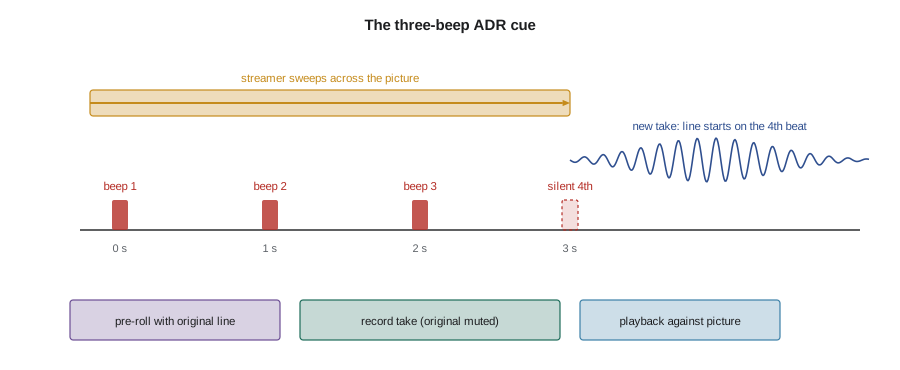
Actors cue themselves using a sequence of audible beeps and visual streamers. The common convention is three beeps at one-second intervals, with the line beginning where a fourth beep would fall; a streamer, a vertical line moving across the screen, ends at the start of the line. Many actors prefer to listen to the original production line several times, then perform with it muted in their headphones, matching its rhythm. Some studios use rhythm-based approaches with the text scrolling over picture, a method borrowed from dubbing.
Each cue is recorded several times. The ADR mixer marks takes the director likes and the editor will later choose from, and may record a second microphone at a different distance to give the editor options for matching perspective. Multiple takes of the whole line are better than piecing words together later, though editors routinely combine the best parts of several takes.
In Canada, performers recording ADR on productions covered by an ACTRA agreement, such as the Independent Production Agreement, are paid and scheduled under that agreement's rules for post-production sessions. Producers and supervisors should check the current agreement before booking sessions.
Remote ADR
Remote ADR sessions, in which the actor records in a studio or a well-treated room in another city while the director and supervisor listen online, became routine during the pandemic years and remain common. Low-latency streaming tools carry picture and audio between locations, and the remote studio records the high-quality files locally for upload. Remote sessions save travel and allow actors on other productions to record between commitments, but they require careful planning: matched microphones where possible, a reliable connection, a local engineer, and a test session to check sound and timing.
Making ADR match
The hardest part of ADR is making it sound as if it were recorded on set. A studio recording is clean, close and dry; the production recording carries the room's reflections, the location's background, a particular microphone and distance, and the actor's physical state, such as walking, running or lying down. Matching starts in the session and continues in editing and mixing.
In the session, the ADR mixer chooses a microphone similar to the production boom, often the same model, and places it at a similar distance and angle. Actors are encouraged to move as they did on set: walking on the spot, holding a prop, lying on a couch. Energy matters: a line shouted across a field must be performed with the same effort, not just the same volume. The production line is played before each take so the actor can match pitch and rhythm.
In editing, the ADR editor syncs each take to picture, adjusting individual words and syllables by a few frames with time-stretching tools when needed, and checks lip sync on close-ups. In mixing, the re-recording mixer applies equalization to match the production microphone's tone, adds reverberation that matches the location, often using impulse responses recorded on set, and lays production room tone underneath so the ADR line sits in the same background as the lines around it.
Worked problem
Matching an ADR line into a scene
A character says one ADR line in the middle of a production scene in a small tiled bathroom. The line sounds clean and close compared with the surrounding production lines. What steps make it match?
Show solution
- In the session, record with the same boom model at a similar distance, with the actor standing and speaking at the same energy.
- Edit the take into sync, checking lip closures on b, p and m sounds.
- Apply equalization to match the production boom's tone in that room, often a slight low-mid rise and high-frequency roll-off.
- Add a short, bright reverberation matching the bathroom, ideally from an impulse response recorded on location or a similar small tiled room.
- Lay the scene's production room tone under the line and crossfade it with the surrounding backgrounds.
Answer: With matched microphone, energy, sync, tone, reverberation and background, the ADR line sits inside the scene. The final check is to play the scene for someone who does not know which line was replaced.
Loop group and walla
Loop group is a team of voice actors who record the voices of crowds, background characters and incidental dialogue: restaurant chatter, hospital announcements, police radio, reactions in a courtroom, children in a playground. Walla is the term for indistinct crowd murmur; the name comes from the old practice of actors repeating "walla walla" to create a murmur without intelligible words. Modern loop groups do much more than murmur. They research the setting and improvise period-appropriate, culturally accurate and story-specific dialogue, because audiences notice when background voices say the wrong thing.
A loop group session might record a busy restaurant in several layers: general murmur from the whole group, small groups of two or three at specific tables matching people visible in the shot, a waiter's lines, cutlery reactions and laughter. Specific lines that can be heard clearly may need clearance: they must not include real names, real phone numbers or brands without permission, and they must match the film's rating and broadcast standards. Loop group performers also provide efforts, the breaths, grunts and exertion sounds of characters in fights and action, when the principal actors cannot.
| Layer | Performers | Content |
|---|---|---|
| General walla | Whole group, 8 to 12 voices | Indistinct conversation, varied ages and voices |
| Specific tables | Two or three performers per table | Improvised conversations matching visible extras |
| Featured lines | Individual performers | Waiter's order, host greeting, phone call |
| Reactions | Whole group | Laughter, gasps, cheers in sync with picture |
| Efforts | Selected performers | Breaths and exertion for stunt doubles |
Language, accents and authenticity
Background voices must be authentic to the setting. A scene set in Montreal may need French and English walla with appropriate accents; a scene in a Toronto market may need several languages; a scene in a New Orleans club may need voices that fit the region. Loop group coordinators cast performers who speak the languages and dialects needed and research what people would plausibly say. Inauthentic or stereotyped background voices can undermine a film's credibility and offend the communities depicted. Where real languages are used, check the content with fluent speakers.
Canadian productions often need French and English loop group versions and, for some projects, Indigenous languages, which call for consultation with the relevant community and fluent speakers.
Editing and delivering ADR
ADR editors cut the chosen takes into the dialogue session on dedicated ADR tracks, keeping the original production lines muted underneath for comparison. Loop group is edited on its own tracks, often by a separate editor, and organized so the mixer can control density. ADR and loop group are delivered as part of the dialogue stem, because they are speech. For the music and effects version used in dubbing, background walla in a foreign language may be kept or removed depending on whether it is part of the setting; specifics are set by the distributor's deliverable requirements.
Common mistakes
MistakeBooking ADR before trying alts and repair
InsteadExhaust alts, repair and processing before replacing a line.
MistakeRecording ADR with a close studio microphone that does not match the boom
InsteadUse a similar microphone and distance, and match energy and movement.
MistakeLeaving ADR dry and clean against reverberant production lines
InsteadMatch tone with equalization, add matching reverberation and lay production room tone under it.
MistakeUsing generic walla with intelligible lines that include real names or brands
InsteadClear featured lines and use invented names and numbers.
MistakeCasting background voices without regard to language and region
InsteadCast performers with the right languages and dialects and check authenticity.
Summary and key terms
- ADR replaces or adds dialogue recorded in a studio to picture; it is the last resort for technical problems and a creative tool.
- The ADR list records cue numbers, characters, timecodes, lines and reasons, grouped by actor.
- Actors time lines to three beeps and a streamer, with the line starting on the invisible fourth beep.
- Matching requires similar microphones, distance, energy and movement, then equalization, reverberation and room tone.
- Remote ADR is common but needs careful technical planning.
- Loop group records crowds, walla, featured background lines and efforts, researched for authenticity.
- Performer agreements govern ADR sessions; check the current terms before booking.
- ADR
- Automated dialogue replacement: re-recording dialogue in a studio to picture.
- Looping
- An older term for ADR, from loops of film run repeatedly.
- ADR cue
- A single line or group of lines to be replaced, with timecodes.
- Streamer
- A moving vertical line on screen that ends at the start of a line.
- Three-beep cue
- Beeps one second apart with the line starting on the fourth, silent beat.
- Loop group
- A team of voice actors who record background voices and crowds.
- Walla
- Indistinct crowd murmur.
- Efforts
- Breaths, grunts and exertion sounds added to action.
- Cover line
- An alternative line recorded to replace profanity for broadcast versions.
- Impulse response
- A recording of how a space responds to a short sound, used to recreate its reverberation.
Practice problems
Work each problem on paper first, then reveal the answer to check.
Why is ADR considered a last resort for technical problems?
Show answer
It is hard to recreate the original performance's energy and spontaneity.
Name three reasons for ADR other than noise.
Show answer
Performance changes, story clarity lines, broadcast cover lines (also off-screen voices, accents).
What information does an ADR cue sheet include?
Show answer
Cue number, character, timecodes, line, new wording and reason.
Describe the three-beep convention.
Show answer
Three beeps one second apart; the line starts where a fourth beep would fall.
Why play the production line before an ADR take?
Show answer
So the actor can match its pitch, rhythm and timing.
How does a mixer place ADR in the production space?
Show answer
Equalization to match tone, matching reverberation and production room tone underneath.
What is walla?
Show answer
Indistinct crowd murmur recorded by a loop group.
Why must featured loop group lines be cleared?
Show answer
Real names, numbers or brands may create legal or rating problems.
Which stem do ADR and loop group belong to?
Show answer
The dialogue stem.
Which performer agreement often governs ADR in Canada and in the US?
Show answer
ACTRA agreements in Canada; SAG-AFTRA agreements in the US.
Lesson quiz · 5 questions
Score 60% or more to complete this lesson.
Create a free account to save your progress, take quizzes and earn a certificate.