
FILM-310 · Lesson 10 of 12 · 26 min
Music for film
Music is the most direct route to an audience's emotions, and also the element of the sound track most likely to cause legal and financial trouble. This lesson looks at music from the sound department's point of view: the temp track and its pitfalls, working with a composer, spotting and editing music to picture, the rights needed to use existing recordings, cue sheets, and how music is prepared for the mix and deliverables. FILM-220 lesson 9 introduced music rights for picture editors, and FILM-420 covers copyright law in depth; here we focus on the workflow that connects music to the rest of the sound track.
What music does in a film
Music can establish time and place, reveal what a character feels but cannot say, build tension, provide continuity across a sequence of cuts, set the pace of an edit, and signal genre. It can also work against the picture: a gentle melody over violence can be more disturbing than a dramatic score. Diegetic music, also called source music, comes from within the story world, such as a radio, a band at a party or a character singing. Non-diegetic music, the score, exists only for the audience. Many films move between the two, as when a song on a car radio swells into the score.
Music competes with dialogue and effects. Its frequency range overlaps strongly with the human voice, so busy music under dialogue reduces intelligibility. Composers and mixers solve this with arrangements that leave space around dialogue, lower instrumentation in the vocal range, and careful levels. Deciding where not to use music is just as important as deciding where to use it.
Temp tracks
During editing, picture editors place temporary music, called temp, to help shape scenes and show the director and producers how the film will feel. Temp is usually drawn from other film scores and commercial recordings that the production cannot afford or has no right to use in the final film. Temp is valuable as a communication tool but dangerous in two ways. First, directors can become so attached to the temp that any new score sounds wrong, a problem known as temp love. Second, temp music sometimes survives into festival screenings or online cuts without clearance, creating legal exposure.
Good practice is to tell the composer what the temp is meant to do emotionally rather than asking for a copy, to replace temp with original or cleared music before any public screening, and to keep a list of every temp cue so none slips through to delivery.
Working with a composer
The composer writes original music, the score, for the film. On most productions the composer is hired during editing, attends the spotting session, and writes cues to timings provided by the music editor. A cue is a single piece of music with a start and end in the film, numbered by reel and order, such as 2M3 for the third music cue in reel 2. The composer delivers mock-ups, synthesized versions of each cue, for the director's approval, then records the final music with live musicians or produces it electronically.
Composer agreements cover fees, delivery schedules, whether the composer owns the copyright or the production does, and who pays for musicians and recording. A package deal, in which the composer receives a lump sum that includes recording costs, is common on independent films. The production usually needs, at minimum, the right to synchronize the music with the film and exploit it in all media worldwide, while the composer often keeps the writer's share of performance royalties collected by their performing rights organization.
Spotting and editing music to picture
The music spotting session identifies where each cue starts and ends, what it should do, and what happens at important moments within it, called hit points: a door opening, a cut to a new scene, a character's realization. The music editor prepares spotting notes with timecodes and works with the composer to make sure cues fit the picture exactly. When the composer writes to a click track, a metronome at a chosen tempo, the tempo determines how many frames each beat lasts, which lets the composer place hits precisely.
At 24 fps and 120 beats per minute, each beat lasts 12 frames. Composers sometimes choose tempos that give whole numbers of frames per beat, or use frame-based click tracks expressed as frames per beat, to make hits easier to land.
fps = 24
for bpm in [60, 90, 96, 100, 120, 144]:
    print(f'{bpm:4d} BPM: {60 * fps / bpm:5.2f} frames per beat')
start_tc_frames = 0
hit_frames = 24 * 37 + 6          # a hit 37 seconds and 6 frames into the cue
best = []
for bpm10 in range(800, 1400):     # 80.0 to 139.9 BPM in steps of 0.1
    bpm = bpm10 / 10
    beats = (hit_frames - start_tc_frames) / (60 * fps / bpm)
    best.append((abs(beats - round(beats)), bpm, round(beats)))
best.sort()
for err, bpm, n in best[:3]:
print(f'{bpm:.1f} BPM puts the hit on beat {n} (error {err * 60 * fps / bpm:.2f} frames)')60 BPM: 24.00 frames per beat 90 BPM: 16.00 frames per beat 96 BPM: 15.00 frames per beat 100 BPM: 14.40 frames per beat 120 BPM: 12.00 frames per beat 144 BPM: 10.00 frames per beat 90.2 BPM puts the hit on beat 56 (error 0.01 frames) 104.7 BPM puts the hit on beat 65 (error 0.02 frames) 135.3 BPM puts the hit on beat 84 (error 0.01 frames)
Music editors also edit existing music to fit scenes: shortening or lengthening cues by cutting on beats and phrases, creating endings that land on picture, and transitioning smoothly between cues. A skilled music edit is undetectable, preserving musical phrasing while serving the picture. Music editors also build the temp track, prepare playback for scenes where actors sing or dance to music on set, and manage the music in the final mix.
Music rights: what you need to use existing music
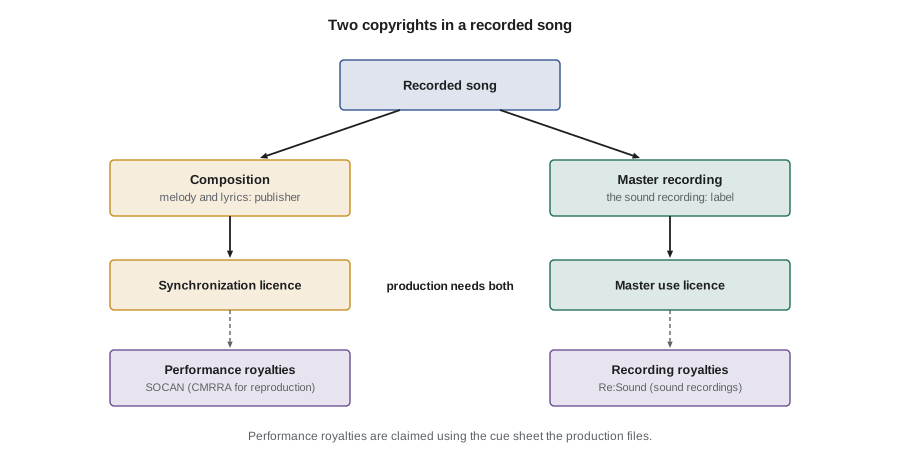
Using an existing song in a film usually requires two separate licences, because a recorded song involves two copyrights. The composition, meaning the melody and lyrics, is owned by the songwriter or their music publisher. The sound recording, the master, is owned by the record label or the artist. A synchronization licence from the publisher allows the composition to be used in timed relation with the picture. A master use licence from the label allows the specific recording to be used. If the production records its own version of a song, called a cover, it still needs a synchronization licence for the composition but not a master use licence.
| Use | Composition | Recording | Notes |
|---|---|---|---|
| Existing commercial song as released | Sync licence from publisher | Master use licence from label | Both needed; fees vary widely |
| Cover version recorded by production | Sync licence from publisher | Production owns its recording | Musicians' agreements may apply |
| Original score | Composer agreement | Composer agreement or production recording | Ownership set by contract |
| Production music library | Library licence | Library licence | Often one licence covers both |
| Public domain composition, new recording | No licence needed for composition | Licence or own recording | Check that the arrangement is also free |
Sync and master fees are negotiated and depend on the song's popularity, the length of the use, whether it is background or featured, the media and territories, the term, and the film's budget. Festival licences, which cover only festival screenings for a limited time, are cheaper and common for independent films, but if the film is later sold, the producer must upgrade to full licences, and the price may be much higher. Many independent producers instead use production music libraries or commission original music to avoid this risk.
Worked problem
Budgeting music for an independent short
A short film wants to use one well-known pop song for 40 seconds under a montage, plus original score. A festival licence has been quoted at 1,500 dollars for sync and 1,500 dollars for the master, with an option to upgrade to all media for 12,000 dollars each. The original score package costs 4,000 dollars. What are the total music costs in each scenario (illustrative figures)?
Show solution
- Festival only: \( 1{,}500 + 1{,}500 + 4{,}000 = 7{,}000 \) dollars.
- If the film sells and needs all-media rights: \( 12{,}000 + 12{,}000 + 4{,}000 = 28{,}000 \) dollars, unless the upgrade price was already counted.
- Alternative: commission the composer to write an original track in a similar spirit, adding perhaps 1,500 dollars to the score package, for a total of 5,500 dollars with all rights.
Answer: The festival route is affordable now but creates a 21,000-dollar risk later. An original song avoids the risk, and the composer's agreement can grant all rights from the start.
Performing rights organizations and cue sheets
When a film is broadcast, streamed or shown in public, the composers and publishers of its music may be entitled to public performance royalties, collected by performing rights organizations (PROs). PROs need to know exactly which music appears in the film, for how long, and how it is used. The production provides this information on a music cue sheet: a document listing every cue with its title, composers, publishers, PRO affiliations, timing, duration and type of use, such as background instrumental, background vocal, visual vocal or main title.
In Canada, the main organization for public performance and reproduction rights in musical works is SOCAN, which also absorbed the former SODRAC. The CMRRA licenses reproduction rights for many publishers, and Re:Sound collects certain royalties for the public performance and communication of sound recordings on behalf of artists and labels. Canadian cinemas pay SOCAN under a tariff for music in films they exhibit, and broadcasters and online services pay under their own tariffs, so accurate cue sheets matter for Canadian composers' income. Producers should file cue sheets with SOCAN and supply them to broadcasters and distributors (organizations and roles checked October 2026).
| Cue | Title | Composer | Publisher | Usage | Duration |
|---|---|---|---|---|---|
| 1M1 | Main Title | J. Rivera | Lantern Music | Main title theme | 1:12 |
| 1M2 | Corridor | J. Rivera | Lantern Music | Background instrumental | 0:48 |
| 2M1 | Neon Bus (licensed song) | A. Chen, R. Okafor | Blue Fern Publishing | Background vocal | 0:40 |
| 3M4 | Birthday Song (sung on screen) | Public domain arrangement | None | Visual vocal | 0:22 |
Cue sheets are a common source of errors: missing cues, wrong durations, uncredited co-writers or incorrect usage types. Errors cost composers money and can delay delivery. The music editor or music supervisor usually prepares the cue sheet from the final mix, measuring each cue's duration in the locked cut.
Music in the mix and deliverables
In the final mix, music is balanced against dialogue and effects, and music stems are delivered separately so that distributors can create versions. Composers often deliver their score as stems too, such as strings, brass, percussion, synths and choir, so the mixer can shape the music around dialogue without asking for new mixes. The music stem in the final deliverables contains all score and source music. The music and effects version keeps music, unless a song contains English lyrics that a distributor wants to replace, in which case special instrumental versions may be required.
Licensing terms follow the music into the deliverables. If a song is licensed only for certain territories or a limited term, the distributor needs to know so it can be removed or replaced in other versions. Music clearance documents, licences, cue sheets and composer agreements form part of the delivery package and are checked by the distributor's legal team and errors and omissions insurers.
Canadian producers working with Telefilm Canada, the Canada Media Fund or broadcasters must usually provide music cue sheets and clearance documentation as part of delivery, and Canadian content rules may count Canadian composers toward certification points (see FILM-410).
Common mistakes
MistakeLetting temp music slip into a public screening uncleared
InsteadReplace temp with cleared or original music before any public screening.
MistakeLicensing the composition but forgetting the master recording
InsteadGet a sync licence and a master use licence for an existing recording.
MistakeBuying festival-only licences without planning for a sale
InsteadBudget the upgrade or use original or library music with full rights.
MistakeAsking a composer to copy the temp score
InsteadDescribe the emotional job of the temp and let the composer write original music.
MistakePreparing the cue sheet from an early cut
InsteadMeasure cue durations from the final locked mix and check every credit.
Summary and key terms
- Music shapes emotion, pace and meaning but competes with dialogue for frequency space.
- Temp music helps communication but creates temp love and legal risk if not replaced.
- Composers write cues to timings; click tempos set frames per beat for precise hits.
- Existing recordings need a sync licence for the composition and a master use licence for the recording.
- Festival licences are cheaper but must be upgraded if the film sells.
- Cue sheets tell performing rights organizations what music was used, for how long and how.
- Music stems and clearance documents are part of the final deliverables.
- Score
- Original music composed for the film, heard by the audience but not the characters.
- Source music
- Music that exists within the story world, also called diegetic music.
- Temp track
- Temporary music used during editing.
- Music cue
- A single piece of music with a start and end point in the film.
- Hit point
- A moment in the picture that the music is timed to emphasize.
- Click track
- A metronome used to keep music in tempo with picture.
- Synchronization licence
- Permission from the publisher to use a composition with picture.
- Master use licence
- Permission from the recording owner to use a specific recording.
- Performing rights organization
- A body that licenses public performances and pays royalties to composers and publishers.
- Cue sheet
- A document listing every music cue in a film with credits, timings and usage.
Practice problems
Work each problem on paper first, then reveal the answer to check.
What is the difference between score and source music?
Show answer
Score is heard only by the audience; source music exists in the story world.
What is temp love?
Show answer
A director's attachment to temp music that makes the new score seem wrong.
How many frames per beat at 24 fps and 96 BPM?
Show answer
15 frames.
What two licences does an existing commercial recording need?
Show answer
A synchronization licence and a master use licence.
Why is a cover version cheaper to clear than the original recording?
Show answer
No master use licence is needed because the production owns its recording.
What is a festival licence?
Show answer
A limited licence covering festival screenings only, for a set time.
What does a cue sheet list?
Show answer
Each cue's title, writers, publishers, affiliations, usage type and duration.
Name a performing rights organization in Canada.
Show answer
SOCAN.
Name two performing rights organizations in the US.
Show answer
ASCAP and BMI (also SESAC and GMR).
Why do composers deliver score stems?
Show answer
So the mixer can shape the music around dialogue without new mixes.
Lesson quiz · 5 questions
Score 60% or more to complete this lesson.
Create a free account to save your progress, take quizzes and earn a certificate.