
FILM-220 · Lesson 11 of 12 · 32 min
Conform, finishing, VFX turnovers and delivery
When the creative edit is approved, the film is still not finished. The offline cut must be rebuilt from full-quality media, visual effects must be completed and cut in, the image must be graded, the soundtrack must be edited and mixed, and a long list of deliverables must be produced for distributors, broadcasters and festivals. The picture editor and assistant editors sit at the centre of this process, because every department works from the editor's timeline. This lesson follows the film from picture lock to delivery: reels, edit decision lists and interchange files, visual effects turnovers, the conform and online, change management after lock, and the deliverables that end the process. Colour grading is studied in CINE-310 and full delivery specifications in CINE-430; here the focus is on what editorial must prepare and track.
Picture lock and what it means
Picture lock means the timing of every shot is approved and will not change. Lock matters because other departments, especially sound, music and visual effects, need fixed timing to do their work. In practice, changes sometimes happen after lock, which is why some teams speak of a soft lock and a hard lock. Every change after lock costs time and money, because each department must update its work to match.
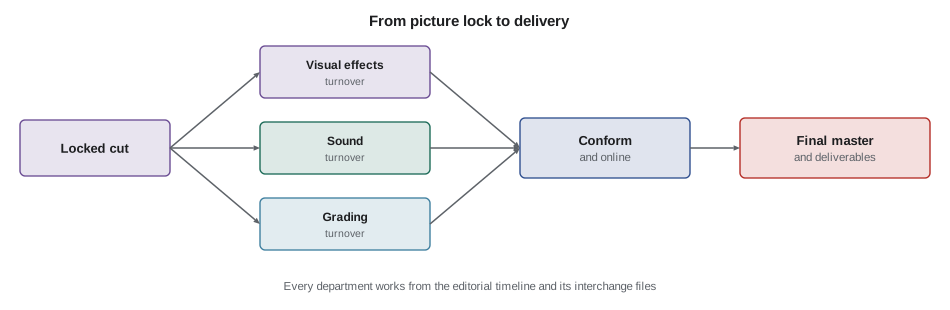
- Picture lock fixes the timing of every shot.
- Music, sound and visual effects schedules depend on lock.
- Changes after lock must be documented in change lists and sent to every department.
- The later a change, the more departments must redo work.
Reels
Long films are divided into reels for post-production, a convention inherited from film projection, where each reel of 35 mm film held about 20 minutes. Digital workflows keep reels because shorter sections are easier to manage, render, grade and mix in parallel, and because changes in one reel do not disturb the timecode of others. Each reel usually starts at its own hour of timecode, so reel 1 starts at 01:00:00:00, reel 2 at 02:00:00:00 and so on.
Worked problem
Dividing a film into reels
A locked feature runs 1 hour 47 minutes 30 seconds. The post team wants reels no longer than 20 minutes, breaking only at scene changes. What is the minimum number of reels, and what is the average reel length?
Show solution
- Running time in minutes: \( 60 + 47.5 = 107.5 \).
- Minimum reels: \( 107.5 / 20 = 5.375 \), so at least 6 reels.
- Average length: \( 107.5 / 6 \approx 17.9 \) minutes.
Answer: Six reels averaging about 18 minutes. Editors choose break points at scene changes without music or sound running across the cut, so the reels can be mixed separately and joined invisibly.
EDLs, XML and AAF
To move a timeline between systems, editors export interchange files. The oldest is the edit decision list, or EDL, a plain-text list of events, each with a source reel or clip name, a track, a transition type and source and record timecodes. The widely used CMX 3600 format is simple and robust but limited: it handles one video track per list and has limits on clip-name length and effects. XML and AAF files carry much richer information, including multiple tracks, effects, speed changes and metadata, and are used for exchanges with colour, visual effects and sound departments.
| Format | Content | Typical use |
|---|---|---|
| EDL (CMX 3600) | Events with source and record timecodes, one video track per list | Conform checks, simple exchanges, visual effects lists |
| XML (various schemas) | Multiple tracks, effects, metadata | Exchanges between editing and grading systems |
| AAF | Timeline structure with media references or embedded media | Picture and sound exchanges, especially to audio software |
| OMF | Older audio exchange with embedded media | Legacy sound turnovers |
Worked problem
Estimating EDL events
A 17-minute reel has an ASL of 3.4 seconds on its main video track, plus 40 shots on a second video track for titles and composites. How many events will the EDLs for this reel contain?
Show solution
- Shots on the main track: \( 17 \times 60 / 3.4 = 1\,020 / 3.4 = 300 \) events.
- The second track needs a separate EDL, since CMX 3600 handles one video track per list: 40 events.
- Total: 340 events across two EDLs.
Answer: About 300 events in the main EDL and 40 in the second. Assistants check event counts against the timeline to catch missing shots during the conform.
Visual effects turnovers
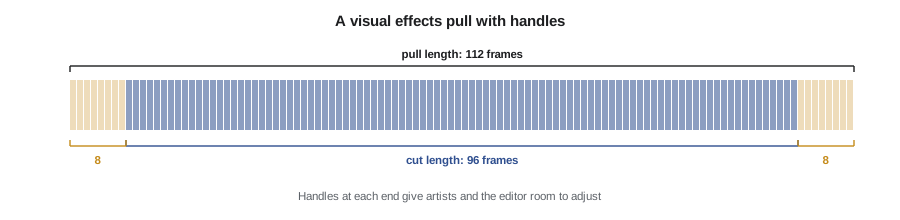
Any shot that needs visual effects work, from a simple screen replacement to a complex creature, goes to the visual effects team in a turnover. Editorial prepares a list of effects shots, each with a unique identifier, the source media with handles, a reference clip showing the temp effect or editorial intent, and notes. Handles, extra frames before and after the cut, give the effects artists room for adjustments and let the editor trim slightly after the shot returns.
Worked problem
Frames to pull for effects shots
A reel contains 42 effects shots with an average cut length of 4 seconds at 24 fps. The vendor requires 8-frame handles at each end. How many frames must be pulled in total, and how much does that add compared with the cut lengths alone?
Show solution
- Average cut length: \( 4 \times 24 = 96 \) frames.
- Pull length per shot: \( 96 + 2 \times 8 = 112 \) frames.
- Total: \( 42 \times 112 = 4\,704 \) frames, compared with \( 42 \times 96 = 4\,032 \) frames of cut length.
- Extra frames: \( 4\,704 - 4\,032 = 672 \), about 17 per cent more.
Answer: 4,704 frames. Effects are often priced per shot and by complexity, so tracking shot counts and lengths matters to the budget. Pulls are typically delivered as high-quality image sequences, such as EXR or DPX frames, in the colour space the vendor specifies.
- Give every effects shot a unique, permanent identifier.
- Include handles, typically 8 to 16 frames per end depending on the vendor.
- Send reference clips and temp comps so artists understand intent.
- Track versions as shots return, cutting each into the timeline and noting approvals.
Colour and sound turnovers
For colour, editorial sends the colourist an interchange file and reference video so the colourist can rebuild the timeline from original media. Editors note any reframing, speed changes and temporary effects so they are recreated accurately. For sound, editorial sends an AAF with audio clips and handles, a reference video with burned-in timecode and the guide mix, as lesson 9 described. Both turnovers depend on accurate metadata linking every clip back to its source.
The conform and online
The conform rebuilds the edit from original high-quality media. Using the interchange files, the online editor or colourist relinks every shot to its camera original, recreates repositions, speed changes and dissolves, and cuts in finished visual effects and titles. Assistants then check the conform against a reference export of the offline cut, often by placing the two side by side or superimposing them in a difference view, to catch any shot that is wrong, missing or out of sync.
- Compare the conform to the offline reference frame by frame.
- Check reframing, speed ramps and flipped shots carefully, as they often fail to translate.
- Confirm that the latest version of every visual effects shot is in.
- Verify titles and credits for spelling and order.
Changes after lock
If a change is made after turnovers, editorial sends a change list describing what moved, so sound, music and visual effects can update their work. Change lists name each edit by reel and timecode, describe what was added, removed or trimmed, and state how much the following material has moved.
Worked problem
Tracking a change after lock
In reel 3, the director removes 2 seconds 6 frames from a shot at 03:12:04:10 (24 fps). What should the change list tell the sound team about everything after that point?
Show solution
- Change in frames: \( 2 \times 24 + 6 = 54 \) frames.
- All material after 03:12:04:10 in reel 3 moves earlier by 54 frames.
- The reel's total running time is 54 frames shorter; other reels are unaffected because each starts at its own hour.
Answer: Everything after the change in reel 3 moves up by 54 frames, or 00:00:02:06. Sound and music editors use this to conform their sessions; music cues crossing the change may need re-editing.
Deliverables
A finished film is delivered as a package of files and documents specified by each distributor, broadcaster or platform. Common items include a digital cinema package, or DCP, for theatres; a high-quality master file, often ProRes 422 HQ or 4444 or an IMF package for streaming; audio stems separating dialogue, music and effects; a music and effects track for foreign-language versions; closed captions and subtitles; a textless version for graphics; and paperwork such as music cue sheets, credits and rights documents. CINE-430 covers technical specifications in depth.
Worked problem
Estimating deliverable sizes
A 107.5-minute feature is delivered as a UHD ProRes 422 HQ master at 23.976 fps (about 707 Mb/s) and as a DCP using JPEG 2000 at up to 250 Mb/s. Estimate the size of each.
Show solution
- Running time in seconds: \( 107.5 \times 60 = 6\,450 \).
- ProRes master: \( 707 \times 6\,450 / 8\,000 \approx 570 \) GB.
- DCP: \( 250 \times 6\,450 / 8\,000 \approx 202 \) GB at the maximum rate, often less in practice.
Answer: About 570 GB for the master and up to about 200 GB for the DCP. Adding stems, textless material and alternate versions can easily double the total delivery.
Canadian broadcasters and funders usually specify closed captioning in line with CRTC standards and may require described video for some programmes, so delivery schedules should allow time for captioning and description.
| Item | Purpose |
|---|---|
| DCP | Theatrical projection |
| Master file or IMF package | Broadcast and streaming source |
| Stems: dialogue, music, effects | Remixing and versioning |
| Music and effects track | Foreign-language dubbing |
| Captions and subtitles | Accessibility and translation |
| Textless master | Localized titles and graphics |
| Cue sheets, credits, rights documents | Legal and royalty requirements |
Archiving the project
When delivery is complete, the production archives the project so the film can be revisited later for new versions, remasters or disputes. A typical archive includes the camera originals, the final project files and interchange files, the finished masters and stems, visual effects deliveries, graphics files and documentation such as cue sheets and contracts. Archives are usually stored on long-term media such as LTO tape, with at least two copies in separate locations. Editors help by leaving the project organized and clearly labelled, so someone opening it years later can understand what each sequence is.
Quality control
Before delivery, masters usually pass through quality control, in which a technician or automated software checks every frame and every second of audio for problems such as dropped frames, digital artefacts, out-of-range video levels, sync drift, loudness errors and caption timing. Distributors may reject a master that fails, so finding problems before delivery saves time and money.
Common mistakes
MistakeMaking changes after lock without telling other departments
InsteadSend a change list with reel, timecode and offset to every affected team
MistakePutting reel breaks across music or dialogue
InsteadBreak reels at clean scene changes without sound running across
MistakeSending effects pulls without handles
InsteadInclude the vendor's required handles on each end
MistakeTrusting the conform without checking
InsteadCompare against the offline reference frame by frame
MistakeLeaving deliverables to the last week
InsteadPlan captions, stems, textless and paperwork from the start of post
Summary and key terms
- Picture lock fixes timing so other departments can finish their work.
- Reels divide long films into manageable sections, each starting at its own hour.
- EDLs are simple and limited; XML and AAF carry richer timeline data.
- Effects turnovers include unique identifiers, handles and reference clips.
- The conform rebuilds the edit from original media and must be checked against the offline.
- Change lists keep every department in sync after lock.
- Deliverables include DCPs, masters, stems, captions, textless versions and paperwork.
- Picture lock
- Approval of final shot timing
- Reel
- A section of a long programme managed separately in post-production
- EDL
- Edit decision list, a text list of edit events with timecodes
- Turnover
- A package of media and information sent to another department
- Pull
- The frames extracted from source media for effects work
- Conform
- Rebuilding an edit from original media
- Online
- The high-quality finishing stage after the offline edit
- Change list
- A record of edits made after turnover
- DCP
- Digital cinema package for theatrical projection
- Stems
- Separate audio mixes of dialogue, music and effects
Practice problems
Work each problem on paper first, then reveal the answer to check.
A 96-minute film has reels of at most 20 minutes. How many reels at minimum?
Show answer
5 reels.
An effects shot cuts at 72 frames with 12-frame handles. What is the pull length?
Show answer
96 frames.
How many GB is a 90-minute DCP at 250 Mb/s?
Show answer
\( 250 \times 5400 / 8000 = 168.75 \), about 169 GB.
A trim removes 1 second 12 frames at 24 fps. How many frames does later material move?
Show answer
36 frames.
Why does each reel start at its own hour of timecode?
Show answer
So changes in one reel do not shift timecode in others.
How many video tracks does a CMX 3600 EDL handle?
Show answer
One per list.
Name three items in a typical delivery.
Show answer
A DCP, audio stems and captions, among others.
What does a conform check compare?
Show answer
The rebuilt online against the offline reference.
Twenty effects shots average 120 frames with 8-frame handles. Total pull frames?
Show answer
20 times 136 is 2,720 frames.
Why break reels at scene changes without sound across the cut?
Show answer
So reels can be mixed separately and joined invisibly.
Lesson quiz · 5 questions
Score 60% or more to complete this lesson.
Create a free account to save your progress, take quizzes and earn a certificate.