
FILM-220 · Lesson 1 of 12 · 29 min
The editor's role and the post-production pipeline
Editing is sometimes called the final rewrite. By the time footage reaches the cutting room, the script has been written, the actors have performed and the camera has rolled, but the film still does not exist. It exists only as hours of separate shots, sound files and notes. The editor turns that raw material into a sequence that holds an audience for ninety minutes, or ninety seconds. Editors decide which take is used, which moment of a performance survives, how long a look lasts, what the audience sees first and what it never sees at all. Many filmmakers say a film is written three times: once on the page, once on set and once in the edit. This lesson introduces the editor's job, the people the editor works with and the stages a project passes through between the last day of shooting and the finished master. Later lessons go deep into the craft; this one gives you the map.
What an editor actually does
The editor's basic task is selection and arrangement. From everything that was shot, the editor selects the pieces that tell the story best and arranges them in an order and rhythm that make the audience feel what the film intends. That simple description hides an enormous number of decisions. A single dialogue scene might have been covered from six camera positions, with eight takes from each, and every take contains dozens of small variations in performance and timing. The editor watches all of it, often several times, and builds the scene from the strongest moments.
Editors also shape structure. They may move scenes, cut them, combine them or reorder whole sections. A scene that worked on the page might slow the film down; a subplot might confuse the audience; an ending might need a different final image. Because editors see the material fresh, without the memory of how hard a shot was to get, they are often the first person to notice what the film actually is, as opposed to what everyone planned.
Finally, editors manage time. Film time is elastic: an editor can stretch a moment of suspense far beyond its real duration or compress a decade into a few cuts. Choosing when to cut, and therefore how long each shot lasts, is the editor's central tool. You studied the basics of continuity and montage in FILM-101; this course turns those ideas into working practice.
Who the editor works with
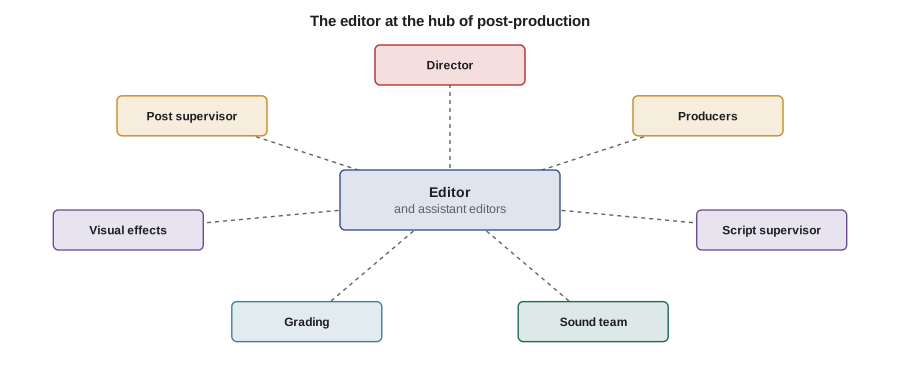
Editing is collaborative, and the editor sits at the centre of post-production. Knowing who does what helps you understand the workflow and communicate clearly.
- Director: the editor's main creative partner. On most narrative projects the editor builds a first cut alone, then works side by side with the director for weeks or months.
- Producers and executives: they give notes on story, length, audience and deliverables, and they approve the schedule and budget.
- Assistant editors: they ingest and organize media, sync sound, prepare bins, manage turnovers and keep the project running technically. Lesson 12 covers the assistant's role.
- Script supervisor: their notes record which takes were good, which lines changed and how each shot matches. These notes are gold in the cutting room.
- Sound team: dialogue editors, sound effects editors, Foley artists, the composer and the re-recording mixer take the locked picture and build the final soundtrack.
- Colourist: grades the locked picture for look and consistency. You met grading in CINE-310.
- Visual effects team: receives shots that need work, returns finished effects, and depends on accurate turnovers from editorial.
- Post supervisor: plans and tracks the whole process, from dailies to delivery.
The post-production pipeline
Post-production follows a broadly similar path on most projects, although the details depend on budget, format and whether the work is fiction, documentary, commercial or series television.
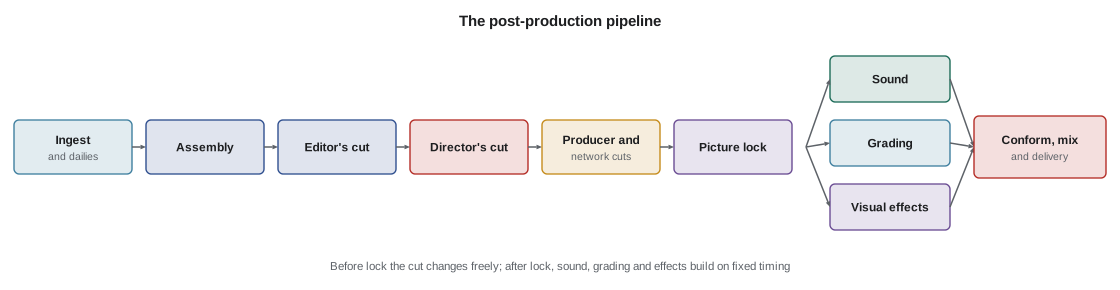
- Ingest and dailies: footage from each shooting day is copied, verified, backed up and synced with sound. Editors and directors review dailies to see what was captured.
- Assembly: the editor puts scenes together in script order, usually while the shoot continues. The assembly is long and rough; its job is to show what exists.
- Editor's cut: the editor's own best version, delivered a set time after the end of shooting under many agreements.
- Director's cut: the director and editor work together to shape the film to the director's vision.
- Producer, studio or network cuts: notes from the people paying for the film lead to further revisions, sometimes with test screenings.
- Picture lock: the edit is declared final. Changes after lock are expensive because every other department is working from the locked timeline.
- Sound, colour and visual effects: these run partly in parallel once the picture is locked, or earlier on fast schedules.
- Conform, final mix and delivery: the high-resolution media is reassembled to match the edit, the final sound mix is married to picture and the required deliverables are produced. Lesson 11 covers this in detail, and CINE-430 covers streaming deliverables.
Offline and online editing
Traditionally, editing happens in two passes. The offline edit is the creative edit, done with lightweight copies of the footage called proxies so that the computer stays fast. The online edit, or conform, rebuilds the finished timeline using the original high-quality camera files for colour and finishing. Today's computers can often edit camera originals directly, but many productions still use the offline-online split, especially for high-resolution or raw formats and for projects shared by many people.
Worked problem
How long does the footage take to watch?
A low-budget feature shot 38 hours of picture over 20 days. The editor plans to watch every take once at normal speed during assembly. If the editor can watch productively for about 5 hours a day, how many working days does a single viewing take?
Show solution
- Total viewing time is 38 hours.
- Days needed: \( 38 \div 5 = 7.6 \) days.
- Round up to 8 working days, because partial days are rarely efficient.
Answer: About 8 working days just to watch everything once. This is why editors start assembling while the shoot continues, why script supervisor notes matter, and why assistants often prepare select reels.
Shooting ratio
The shooting ratio compares how much footage was recorded with how much appears in the finished film. It tells the editor, and the budget, how much material must be managed and reviewed.
| Kind of project | Typical ratio | Why |
|---|---|---|
| Tightly planned low-budget drama | 5:1 to 15:1 | Few takes, limited coverage |
| Studio feature drama | 20:1 to 60:1 | More coverage and takes |
| Comedy with improvisation | 50:1 or more | Many alternate lines and takes |
| Observational documentary | 50:1 to 200:1 or more | Events unfold unpredictably |
| Commercial | 30:1 to 100:1 | Many variations for a short spot |
Worked problem
Shooting ratio for the feature
The feature above recorded 38 hours of footage and the finished film runs 95 minutes. What is the shooting ratio?
Show solution
- Convert hours to minutes: \( 38 \times 60 = 2280 \) minutes.
- Ratio: \( 2280 \div 95 = 24 \).
Answer: A shooting ratio of 24:1, typical of a reasonably well-covered drama. The editor will use about one minute of every 24 recorded.
How long editing takes
Editing schedules vary widely, but planning needs rough numbers. A common way to budget is minutes of finished screen time per working day, or editing days per finished minute.
| Project | Typical editing period | Notes |
|---|---|---|
| Short film of 10 minutes | 2 to 6 weeks | Often part-time for students |
| Independent feature | 10 to 20 weeks to picture lock | Longer for documentary |
| Studio feature | 6 months or more | Often several editors |
| One-hour series episode | 2 to 4 weeks per episode | Editors work on several episodes in rotation |
| Feature documentary | 6 to 12 months or more | The story is often found in the edit |
Worked problem
Budgeting a short film edit
A student short will run about 12 minutes. The editor works part-time and estimates one finished minute per two working days for the first cut, plus 40 % more time for revisions to picture lock. How many working days are needed?
Show solution
- First cut: \( 12 \times 2 = 24 \) days.
- Revisions: \( 24 \times 0.40 = 9.6 \) days.
- Total: \( 24 + 9.6 = 33.6 \), about 34 days.
Answer: About 34 working days, or roughly seven weeks of five-day weeks. Building in revision time is essential; first cuts are never final.
What makes a good editor
Technical skill with editing software matters, but most editors say the job is mainly about taste, patience and people. Good editors watch closely and remember what they saw. They feel rhythm, notice when a performance is truthful and know when a scene has said what it needs to say. They are also calm under pressure, discreet with confidential material and able to hear criticism of their work without taking it personally. An editor spends long hours in a dark room with a director who may be anxious about the film; trust and diplomacy are part of the craft.
- Watch everything, then forget what was hard to shoot. The audience never sees the effort, only the result.
- Serve the story first, then the performance, then technical polish.
- Keep a fresh eye by taking breaks and watching cuts at full length, not just scene by scene.
- Learn the language of every department so you can explain what you need from sound, colour and effects.
In Canada, editors on many productions are represented by the Directors Guild of Canada in its districts, and the Canadian Cinema Editors is the professional honour society that recognizes excellence in the craft with the letters CCE.
How this course works
Each lesson combines ideas, worked examples and practical exercises. Lessons 2 to 7 build the core craft: theory applied, cuts and transitions, continuity, rhythm, dialogue and montage. Lessons 8 and 9 cover documentary editing and sound. Lessons 10 and 11 cover the technical side: systems, media management, conform and delivery. Lesson 12 covers working as an editor and the capstone, in which you plan and cut a short scene from a described coverage plan. All films discussed are described in words; we never reproduce frames from other works, and you should not either.
Reading the footage before cutting
Before an editor makes a single cut, they watch. Many editors insist on viewing all of a day's dailies at full speed, making notes on performances, camera moves and technical problems, before they start assembling. This first viewing is the only time the editor sees the footage as an audience might, without knowing what comes next. Impressions from that viewing, such as a moment that made them laugh or a take that felt false, are valuable later when familiarity has dulled their reactions. Some editors keep these first-viewing notes for the whole project and return to them when a scene stops working.
Common mistakes
MistakeThinking editing begins after the shoot
InsteadBegin assembling during production so problems in coverage are found while reshoots are still possible
MistakeJudging a take by how hard it was to get
InsteadJudge every shot only by what it gives the story on screen
MistakeTreating picture lock as a suggestion
InsteadLock picture firmly, because sound, colour and effects all build on the locked timeline
MistakeIgnoring script supervisor notes
InsteadUse the script notes and logs to find the best takes and track continuity
MistakeUnderestimating viewing time
InsteadBudget time to watch all footage at least once and plan selects with assistants
Summary and key terms
- The editor selects and arranges footage, shaping story, performance and time.
- Editors work with directors, producers, assistants, sound, colour, effects and post supervisors.
- The pipeline runs from ingest and dailies through assembly, cuts and picture lock to sound, colour, effects, conform and delivery.
- Picture lock fixes the timeline so other departments can build on it.
- Offline editing uses proxies; online editing conforms the camera originals.
- The shooting ratio compares recorded footage with finished running time.
- Editing schedules depend on project type, and revision time must be budgeted.
- Assembly
- The first rough arrangement of scenes in script order
- Editor's cut
- The editor's own complete version before the director's cut
- Picture lock
- The point at which the edit is declared final
- Dailies
- Footage from each shooting day, synced and reviewed
- Offline edit
- The creative edit made with lightweight proxy media
- Online edit
- Rebuilding the edit with full-quality media for finishing
- Conform
- Matching high-resolution media to the locked edit
- Shooting ratio
- Recorded footage divided by finished running time
- Proxy
- A smaller, lighter copy of a camera file used for editing
- Post supervisor
- The person who plans and tracks post-production
Practice problems
Work each problem on paper first, then reveal the answer to check.
A documentary recorded 120 hours and runs 80 minutes. What is the shooting ratio?
Show answer
\( 7200 \div 80 = 90 \), a ratio of 90:1.
Why do editors assemble during production?
Show answer
To find gaps in coverage while reshoots or pickups are still possible and to save time.
What happens at picture lock?
Show answer
The edit is declared final so sound, colour and effects can work from a fixed timeline.
Name three departments that receive the locked picture.
Show answer
Sound, colour and visual effects.
What is the difference between offline and online editing?
Show answer
Offline is the creative edit with proxies; online rebuilds it with full-quality media.
A 20-minute short is cut at one finished minute per day, plus 50 % revision time. How many days?
Show answer
20 days plus 10 days, about 30 days.
Who records which takes were good and how shots match?
Show answer
The script supervisor.
Why might an editor see a film more clearly than the crew?
Show answer
They see only what is on screen, without memories of the effort on set.
What do the letters CCE and ACE signify after an editor's name?
Show answer
Membership in the Canadian Cinema Editors or the American Cinema Editors honour societies.
An editor watches 4 hours a day. How long to view 30 hours of footage?
Show answer
7.5 days, so about 8 working days.
Lesson quiz · 5 questions
Score 60% or more to complete this lesson.
Create a free account to save your progress, take quizzes and earn a certificate.