
FILM-210 · Lesson 9 of 12 · 31 min
Visual storytelling: writing for the camera
Film is a visual medium, and the best screenwriters think in images. They write scenes that would make sense with the sound turned off, they plant visual motifs that grow in meaning, and they choose locations and actions that express character and theme. This lesson looks at how writers tell stories through images: showing rather than telling, using objects and settings, planting and paying off, building visual motifs, and writing action that suggests shots without directing the camera. It connects the craft of writing to the film form you studied in FILM-101.
Show, don't tell, revisited
You met the principle of showing rather than telling in lesson 1. Here we look at it more closely. "Telling" in a screenplay usually means dialogue or description that states information or feelings directly. "Showing" means finding behaviour, images and situations that let the audience infer the same thing. Showing is more engaging because the audience participates; it is also more efficient, because a single image can carry several layers.
| Telling | Showing |
|---|---|
| "I'm so lonely since Dad died." | He sets two cups out for tea, then puts one back in the cupboard. |
| "She's very successful." | Her assistant hands her three phones; she answers all of them. |
| "They don't get along anymore." | They sit at opposite ends of a long table, passing the salt without looking up. |
| "He's nervous about the interview." | In the waiting room, he reties the same shoelace three times. |
A useful test is the silent film test: imagine your scene with the sound off. Could the audience still understand what is happening and roughly how the characters feel? If so, the scene is working visually. If the meaning lives entirely in dialogue, look for ways to externalize it.
Objects, props and settings
Objects carry meaning on screen. A ring, a key, a letter, a photograph or a tool can stand for a relationship, a secret or a change. When a character's relationship to an object changes, their inner state changes too. Settings work the same way. Choosing a location is a storytelling decision: a breakup in a crowded food court plays very differently from a breakup on an empty beach.
- Choose objects that matter to the character and can change hands, break or be transformed.
- Use settings that pressure the characters: a cramped car, an echoing church, a busy hospital corridor.
- Let weather, light and time of day express mood, but avoid clichés such as rain for every sad scene.
- Consider how a location reflects character: a tidy desk, a chaotic kitchen, a bedroom unchanged since childhood.
Planting and paying off
A plant, or setup, is a detail introduced early whose significance becomes clear later, in the payoff. Planting makes endings feel inevitable rather than convenient. If a character uses a skill at the climax, the audience should have seen that skill earlier. The playwright Anton Chekhov is often quoted on this idea: if a gun appears in the first act, it should go off later. The reverse also holds: a payoff with no plant feels like a cheat, and a plant with no payoff leaves the audience wondering why it mattered.
Worked problem
Planting a payoff in a short
In a 10-page short, the climax has a shy teenager calm a panicking younger child on a stalled ski lift by teaching her to count breaths, a technique the teenager's grandmother taught her. Where and how should this be planted?
Show solution
- Plant early: on page 1 or 2, show the grandmother teaching the breathing count during an ordinary moment, such as before a swim lesson, without emphasis.
- Reinforce lightly: around page 5, the teenager uses the count herself, quietly, when she is anxious.
- Payoff: at the climax around page 9, she teaches it to the child, completing her shift from being helped to helping.
Answer: Plant on page 1 or 2, echo around page 5 and pay off near page 9. The plant must be natural enough not to telegraph the ending but clear enough that the payoff feels earned.
Visual motifs
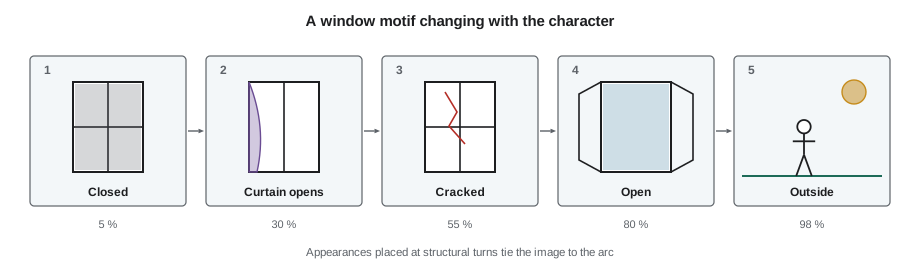
A motif is a recurring image, object, colour, sound or composition that gathers meaning through repetition. Motifs give a film unity and let images carry theme without dialogue. A story about confinement might repeat images of windows, fences and frames within frames; a story about connection might repeat hands reaching or touching. Writers can plant motifs in the script, though directors, cinematographers and designers will develop them further.
Worked problem
Mapping a motif across a feature
A writer plans a window motif to appear at 5 %, 30 %, 55 %, 80 % and 98 % of a 100-page script, each time showing a different state. On which pages do the appearances fall, and what might each show?
Show solution
- Pages: about 5, 30, 55, 80 and 98.
- Page 5: the protagonist looks out through a closed, dirty window.
- Page 30: she cleans the window after committing to her goal.
- Page 55: at the midpoint, she opens it for the first time.
- Page 80: at the low point, it is boarded up after a storm.
- Page 98: in the final image, she stands outside, the window open behind her.
Answer: Pages 5, 30, 55, 80 and 98. Placing motif appearances at structural turns ties the image to the character's arc, so the final image completes both.
Writing that suggests shots
Screenwriters generally avoid camera directions, but they shape how a reader imagines the film through their writing. This is sometimes called directing on the page.
- Paragraph breaks suggest cuts or new images.
- Short lines focusing on details suggest close-ups: "Her thumb. Rubbing the ring."
- Ordering information controls revelation: describe the room, then the body on the floor, then the open window.
- Precise verbs suggest movement and pace: "slams," "drifts," "freezes."
- Sound cues suggest off-screen space: "A car door slams outside."
Worked problem
Revealing information through order
Rewrite this description so the order of images creates suspense: "There is a dead man by the open window in the tidy living room, and a cat sits on the sofa."
Show solution
- Start with the ordinary: the tidy room establishes normality.
- Add a small odd detail: the cat, watching something.
- Then the cause for alarm: a curtain moving at an open window.
- Finally the reveal: the man on the floor.
- Rewrite: "A tidy living room. Cushions straight. A CAT on the sofa stares, unblinking, toward the window. A curtain lifts in the breeze. Below it: a MAN, face down, not moving."
Answer: The new order builds from calm to dread and ends on the reveal, the way a well-cut sequence would. The writer has shaped the scene's visual rhythm without a single camera direction.
Point of view and perspective
Whose eyes do we see the story through? Writers can control perspective by restricting information to what the protagonist sees, by describing events from a particular character's viewpoint, or by showing the audience things no character sees. Subjective moments, such as a character's distorted view when drunk or the slow-motion sense of an accident, can be suggested in action lines when they matter. Point of view connects to the choices about information in lesson 6: whether the audience knows more, less or the same as the characters.
Sound as storytelling
Sound is half of cinema. Writers can tell stories through sound as well as image: a phone that keeps ringing, an absence of birdsong, footsteps overhead, music a character always hums. Off-screen sound creates suspense and expands the world beyond the frame. Silence after noise can be devastating. Including key sounds in action lines helps the director and sound team understand the story's design.
The National Film Board of Canada has a long tradition of films that tell stories almost entirely through image and sound, especially in animation and documentary, and studying them is useful training for visual writing.
Exercise: a silent scene
Write a two-page scene with no dialogue at all. Give the protagonist a clear goal, an obstacle and a turn, and convey everything through action, objects, setting and sound. Then show it to a classmate and ask them to describe what happened and how the character felt. If they understood, your visual storytelling is working.
- Choose a goal that can be pursued physically, such as retrieving a letter, fixing a car or escaping a room.
- Use at least one object whose meaning changes.
- Include one sound cue that matters.
- End on an image that implies the character's new state.
Opening and final images
The first and last images of a film are among its most important. The opening image establishes tone, world and often the protagonist's situation before change begins. The final image shows where the story has arrived. Many films design the two as a pair, so that the final image echoes the opening but with a crucial difference that expresses the character's arc. A character first seen alone at a crowded party might end the film at a small table with two friends; a closed door at the start might be open at the end.
- Make the opening image specific and visual, not a generic establishing shot.
- Suggest the protagonist's problem or flaw in the opening image if you can.
- Design the final image to answer the opening, showing change.
- Avoid closing with dialogue that explains the ending; let the image speak.
Worked problem
Pairing opening and final images
A short follows a teenage boy who refuses to speak to his stepfather. Design an opening and a final image that express his arc without dialogue.
Show solution
- Opening image: at breakfast, the boy wears headphones while his stepfather talks; the boy's plate sits at the far end of the table.
- Arc: through the story, a crisis forces them to work together to repair a broken boat motor.
- Final image: at breakfast again, the headphones sit on the counter, and the boy's plate is beside his stepfather's.
Answer: The paired images use the same setting and objects with a key change, the headphones off and the plates together, to show the relationship has shifted. The audience reads the arc without a word being said.
Writing images for collaborators
Remember that your images will be interpreted by a director, a cinematographer, a production designer and actors. Write images that are specific enough to convey meaning but leave room for their artistry. "A cramped kitchen, every surface covered in unopened mail" gives a designer a clear idea and freedom to create it. "A kitchen with exactly forty-three envelopes stacked in three piles on the left counter" over-specifies details that rarely matter to the story.
Revising for images
In revision, go through the script and highlight every line of dialogue that states a feeling or a fact the audience could see instead. For each one, ask whether an action, object or setting could carry the same meaning. You will not replace every line, and some statements are exactly right, but this pass usually turns several flat moments into memorable images and shortens the script at the same time.
Common mistakes
MistakeRelying on dialogue to explain feelings
InsteadExternalize inner states through behaviour, objects and settings
MistakePayoffs without plants
InsteadSet up skills, objects and information before the climax depends on them
MistakePlants so heavy they telegraph the ending
InsteadIntroduce setups naturally inside other action
MistakeChoosing locations only for convenience
InsteadPick settings that pressure the characters and express theme
MistakeWriting camera directions to control images
InsteadSuggest shots through paragraphing, detail and the order of information
Summary and key terms
- Visual storytelling shows behaviour and images that let the audience infer meaning.
- The silent film test checks whether a scene works without dialogue.
- Objects and settings carry meaning and change as characters change.
- Plants set up details that later pay off, making endings feel earned.
- Visual motifs repeat and develop images to express theme across a film.
- Writers suggest shots through paragraph breaks, detail lines, verbs and the order of information.
- Sound, including off-screen sound and silence, is a major storytelling tool.
- Visual storytelling
- Telling a story mainly through images and action rather than words
- Silent film test
- Imagining a scene without sound to check that it works visually
- Plant
- A detail introduced early whose importance becomes clear later
- Payoff
- The later moment that gives a plant its meaning
- Motif
- A recurring image, object, sound or composition that gathers meaning
- Chekhov's gun
- The principle that significant details introduced early should matter later
- Directing on the page
- Shaping how readers imagine shots through the style of writing
- Off-screen sound
- Sound whose source is outside the frame
- Subjective point of view
- Presenting events as a character perceives them
- Externalize
- To show an inner state through visible behaviour or images
Practice problems
Work each problem on paper first, then reveal the answer to check.
What is the silent film test?
Show answer
Imagining the scene without sound to see if it still makes sense.
Show "she's nervous" without dialogue.
Show answer
For example, she reties the same shoelace three times.
What is a plant and payoff?
Show answer
A detail set up early that becomes important later.
What happens if a payoff has no plant?
Show answer
The ending feels convenient or like a cheat.
On which page is 30 % of a 110-page script?
Show answer
Page 33.
How does a writer suggest a close-up without camera directions?
Show answer
A short separate line focused on a detail.
Why does the order of description matter?
Show answer
It controls when the audience learns information and builds suspense or surprise.
What is a visual motif?
Show answer
A repeated image or element that gathers meaning.
Give one example of off-screen sound creating suspense.
Show answer
Footsteps overhead in an empty house.
Why choose a location carefully?
Show answer
It pressures characters and expresses mood and theme.
Lesson quiz · 5 questions
Score 60% or more to complete this lesson.
Create a free account to save your progress, take quizzes and earn a certificate.