
FILM-210 · Lesson 3 of 12 · 27 min
Character: want, need, flaw and arc
Audiences follow stories because they care about people. Plot gives a story shape, but character gives it life. A clever plot with flat characters feels mechanical; a simple plot with vivid characters can be unforgettable. This lesson introduces the tools screenwriters use to build characters an audience will follow: the want and the need, the flaw or wound, the arc, and the supporting cast that tests the protagonist. It also covers how to reveal character on screen, where the camera cannot read minds and every trait must be shown through behaviour.
The protagonist
The protagonist is the character whose goal drives the story and whose choices move it forward. In most films the audience experiences events mainly through the protagonist. A strong protagonist is active: they make decisions, take risks and cause things to happen. A passive protagonist, who only reacts to events, tends to make a story drift. Being active does not mean being loud or heroic. A quiet character who makes small, brave choices can be just as compelling as an action hero.
Protagonists need not be likeable, but they must be compelling. Audiences will follow a difficult, even unpleasant character if they understand what that character wants and why, if the character is skilled or determined, or if the character is treated unfairly. Writers sometimes call this engagement rather than sympathy.
- Give the protagonist a clear, concrete goal the audience can track.
- Make them make choices, especially hard ones, at key moments.
- Show competence or determination early.
- Let the audience understand their motivation, even if they disagree with it.
Want and need
Many screenwriting teachers distinguish between what a character wants and what they need. The want is the external, conscious goal: to win the race, get the job, find the stolen painting, get home for Christmas. The need is the internal change the character must make to be whole: to learn to trust, to forgive a parent, to accept help, to stop running from grief. Often the character does not know their need at the start, and the story forces them to face it.
The most satisfying stories connect the two. Pursuing the want puts the character in situations that expose the need. At the climax, the character often has to choose between them, or discovers that getting the want requires changing in the way they need to.
| Character | Want (external) | Need (internal) |
|---|---|---|
| A perfectionist chef | Win a televised cooking contest | Accept that mistakes do not make her worthless |
| A teenage runaway | Reach his estranged mother's town | Let someone take care of him |
| A retired detective | Solve one last cold case | Forgive himself for the case he got wrong |
| A shy student | Win the debate final | Speak up for herself at home |
Flaw, wound and lie
Characters become believable through their weaknesses. A flaw is a trait that causes problems: arrogance, fear, stubbornness, dishonesty, impatience. A wound is a past experience that explains the flaw, such as a betrayal, a loss or a humiliation. Some writers describe a lie the character believes because of the wound: "If I depend on anyone, I'll be abandoned." The story challenges that lie.
Use backstory carefully. Writers need to know their characters' pasts, but audiences need only what helps them understand present choices. Long flashbacks and dialogue explaining a character's history usually slow a film down. The wound is most powerful when it is revealed late, briefly and through action.
Worked problem
Building a character from flaw to arc
Create a character for a 10-page short with a want, a need, a flaw, a wound and a final choice that shows change.
Show solution
- Character: Rosa, 58, a ferry deckhand who has worked the same route for 30 years.
- Want: to keep her job when the ferry company announces automation.
- Flaw: she refuses help and hides her failing eyesight.
- Wound: years ago she lost a co-worker in an accident she blames on her own mistake.
- Need: to admit vulnerability and trust others.
- Final choice: during a storm crossing, she asks a young new hire to read the instruments for her, saving the crossing but revealing her eyesight.
Answer: Rosa's arc moves from hiding weakness to accepting help. Her external want, keeping her job, is put at risk by the choice that shows her internal growth, which gives the ending emotional weight.
The character arc
An arc is the change a character undergoes across the story. A positive arc moves the character toward a truth: they overcome the flaw. A negative arc moves them away: they give in to it, often tragically. A flat arc keeps the character's values constant while they change the world around them, as in many detective stories and some hero stories. All three can work; what matters is that the arc is clear and earned.
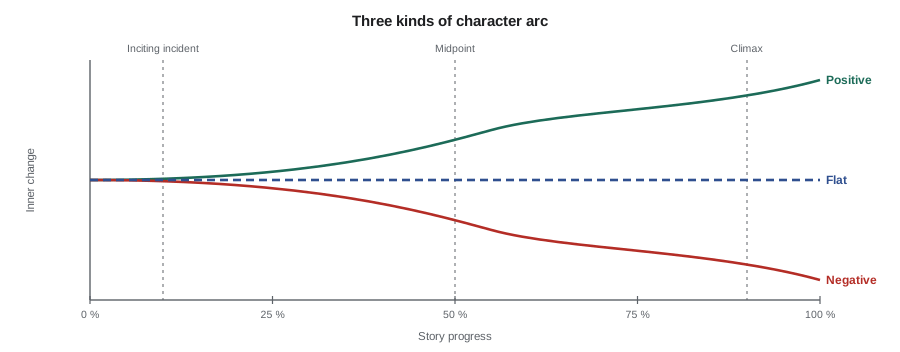
Change must be earned through pressure. A character who suddenly becomes brave in the final scene, without earlier steps, feels false. Plot each step of change. In a feature, the protagonist might resist change in act one, try new behaviour in act two, fall back at the low point and finally choose differently at the climax. In a short, you may have room for only one decisive step, so the moment of change must be prepared carefully.
Supporting characters and their functions
Supporting characters are not decoration. Each should serve the story, usually by helping or hindering the protagonist, or by representing a different answer to the theme. Some common functions:
- Antagonist: the main opposing force, not necessarily a villain. It can be a rival, a parent, an institution or nature.
- Mentor: someone who guides or teaches the protagonist, often with a flaw of their own.
- Ally or friend: someone the protagonist can talk to, which helps reveal inner life without voice-over.
- Love interest: someone whose relationship with the protagonist tests the need.
- Mirror or foil: a character who faces a similar situation but chooses differently, showing what the protagonist could become.
A useful test is to remove a character from your outline. If nothing important changes, merge them with another character or cut them. In shorts, every character costs screen time, casting effort and money, so economy matters even more.
Worked problem
Cutting the cast of a short
A 12-page short has eight speaking characters. Each speaking actor costs about 350 dollars a day on a low-budget shoot, and the film shoots over 3 days with each actor needed for an average of 1.5 days. How much would reducing the cast to four speaking characters save, and what else is gained?
Show solution
- Eight actors: \( 8 \times 1.5 \times 350 = 4200 \) dollars.
- Four actors: \( 4 \times 1.5 \times 350 = 2100 \) dollars.
- Saving: \( 4200 - 2100 = 2100 \) dollars.
- Fewer characters also mean fewer introductions, clearer relationships and more screen time for each remaining character.
Answer: About 2,100 dollars, roughly half the acting budget in this illustrative example. More importantly, a tighter cast gives the audience fewer people to track and lets the key relationships deepen.
Revealing character on screen
On the page you cannot write "Maya is generous" and expect it to appear on screen. You must show generosity through behaviour. Screenwriters reveal character through:
- Choices under pressure: what a character does when it costs them something is the strongest evidence of who they are.
- Action and habit: how they make coffee, park a car or answer a phone.
- Dialogue: what they say, how they say it and, often more revealing, what they avoid saying.
- How others treat them: respect, fear, affection or contempt from other characters.
- Environment: their room, car, clothes and objects, which the production designer will build from your hints.
- Contradiction: a tough foreman who keeps a child's drawing on the dashboard.
The first appearance of a character matters most. Screenwriters craft introductions carefully, because the audience forms an impression in seconds. A good introduction combines a brief physical description with an action that reveals something essential. For example: "DELPHINE (40s), courier jacket over a wedding dress, sprints through traffic holding a parcel above her head." In one line we sense urgency, contradiction and a story.
Character descriptions in the script
Script descriptions are short. Standard practice is to capitalize a character's name the first time they appear, give an approximate age, and add a phrase or two that captures their essence. Avoid long lists of physical details, which limit casting and slow reading. Focus on attitude and energy.
| Weak | Stronger |
|---|---|
| JOHN, 35, tall, brown hair, blue eyes, wearing jeans and a T-shirt. | JOHN (30s), the kind of man who apologizes to furniture he bumps into. |
| SARAH is a nice old lady. | SARAH (70s) feeds the pigeons and argues with each one by name. |
| MARCUS enters. He is angry. | MARCUS (20s) shoulders the door open, already mid-argument with someone on his headset. |
Diverse and authentic characters
Audiences are diverse, and so are the people writers write about. Writing characters from backgrounds different from your own is part of the job, but it calls for research, empathy and humility. Avoid stereotypes, including flattering ones. Give every character, including minor ones, their own goals and dignity. Ask readers from the relevant communities for feedback. Many funders and broadcasters in both countries now ask applicants how they approach representation, both on screen and in the writing team.
Canadian funders such as Telefilm Canada and the Canada Media Fund have programs and targets supporting Indigenous, Black and racialized creators and creators from official language minority communities, which can shape both who tells a story and how characters are portrayed.
Exercise: the character questionnaire
Before you draft, many writers fill in a short character questionnaire. Keep it practical and connected to the story.
- What does the character want in this story, concretely?
- What do they need, and do they know it?
- What is their flaw, and what wound explains it?
- What would they never do, and what would make them do it?
- How do they speak: vocabulary, rhythm, favourite phrases, silences?
- What object would they save from a fire?
- How does the audience first meet them, in one line of action?
Testing characters with a scene of choice
Before drafting, write a short scene, which may never appear in the film, in which your protagonist must choose between two things they value. Put them under time pressure and give them something to lose. Watch what they do. If you cannot decide what your character would choose, you do not yet know them well enough. If the choice surprises you, follow it: surprise during drafting often signals that the character has come alive. Keep these exercise scenes in a separate file; they become a useful reference for voice and behaviour when you write the real script.
Common mistakes
MistakeWriting a passive protagonist who only reacts
InsteadGive the protagonist a goal and make them drive the story through choices
MistakeDescribing traits instead of showing them
InsteadReveal character through choices, action, dialogue and environment
MistakeFront-loading backstory in long flashbacks or speeches
InsteadReveal only the backstory the audience needs, late and briefly
MistakeChanging the character suddenly at the end
InsteadEarn the arc through escalating pressure and small steps of change
MistakeKeeping characters who serve no function
InsteadMerge or cut characters who do not help, hinder or reflect the protagonist
Summary and key terms
- The protagonist drives the story through an active pursuit of a clear goal.
- The want is the conscious external goal; the need is the internal change the story forces.
- Flaws, wounds and the lie a character believes make characters believable and create inner conflict.
- Arcs can be positive, negative or flat, but change must be earned through pressure.
- Supporting characters serve functions such as antagonist, mentor, ally, love interest and foil.
- Character is revealed through choices, action, dialogue, how others react and environment.
- Script introductions are brief: name in capitals, approximate age and a phrase or action that captures essence.
- Protagonist
- The main character whose goal drives the story
- Antagonist
- The main opposing force, which may be a person, group, institution or nature
- Want
- A character's conscious, external goal
- Need
- The internal change a character must make to be whole
- Flaw
- A character trait that causes problems and resists change
- Wound
- A past experience that explains a character's flaw
- Character arc
- The change a character undergoes over the course of a story
- Foil
- A character who contrasts with the protagonist and highlights their traits
- Backstory
- Events in a character's life before the story begins
- Engagement
- The audience's interest in a character, which need not depend on liking them
Practice problems
Work each problem on paper first, then reveal the answer to check.
What is the difference between want and need?
Show answer
Want is the conscious external goal; need is the internal change the character must make.
Name three kinds of character arc.
Show answer
Positive, negative and flat.
Why are passive protagonists a problem?
Show answer
The story drifts because events happen to them rather than because of their choices.
How should a script introduce a character?
Show answer
Name in capitals, approximate age and a brief phrase or action capturing their essence.
Give one way to reveal generosity without stating it.
Show answer
Show the character giving away something they clearly need.
What is a foil?
Show answer
A character who contrasts with the protagonist, showing a different choice.
What does cutting a short's cast from 6 to 3 speaking roles save if each costs 350 dollars a day for 2 days?
Show answer
\( 3 \times 2 \times 350 = 2100 \) dollars.
Why reveal backstory late and briefly?
Show answer
Backstory slows the story; it is most powerful when it explains a present choice.
What is a wound?
Show answer
A past experience that explains a character's flaw.
Does an antagonist have to be a villain?
Show answer
No; it can be a rival, a parent, an institution or nature.
Lesson quiz · 5 questions
Score 60% or more to complete this lesson.
Create a free account to save your progress, take quizzes and earn a certificate.