
FILM-210 · Lesson 11 of 12 · 30 min
Storyboards, animatics and previs
A storyboard is a sequence of drawings showing how a film will look, shot by shot. It translates the script and shot list into images that the director, cinematographer, production designer, effects team and producers can all understand. Storyboards range from rough thumbnails drawn by the director to polished panels by professional artists, and they increasingly lead to animatics and digital previsualization. This lesson covers why and when to storyboard, how to draw simple but useful boards even if you cannot draw well, the notation for camera movement and framing, and how animatics and previs extend the process.
Why storyboard?
Not every film needs a full storyboard. Many dramas are planned with shot lists and floor plans, and some directors prefer to discover shots on set with the actors. But storyboards are invaluable when shots are complex, expensive or dependent on precise timing.
- Action, stunts and effects: everyone must understand exactly what each shot needs.
- Animation: storyboards are the foundation of the whole production.
- Commercials and music videos: clients approve boards before shooting.
- Complex camera moves and visual gags: timing must be planned.
- Communication: a board shows the team what the director imagines faster than words.
- Budget control: unnecessary shots can be identified and cut before shooting.
For your short films, boarding at least the key scene helps you think visually, check coverage and communicate with your cinematographer.
The anatomy of a storyboard panel
A storyboard panel is a rectangle in the film's aspect ratio, showing the framing of a single shot or a key moment within a shot. Under or beside the panel, notes give the shot number, a description of the action, dialogue or sound, and camera movement. Panels are read in order like a comic strip, but each represents a shot or a change within a shot rather than a moment in a story told on paper.
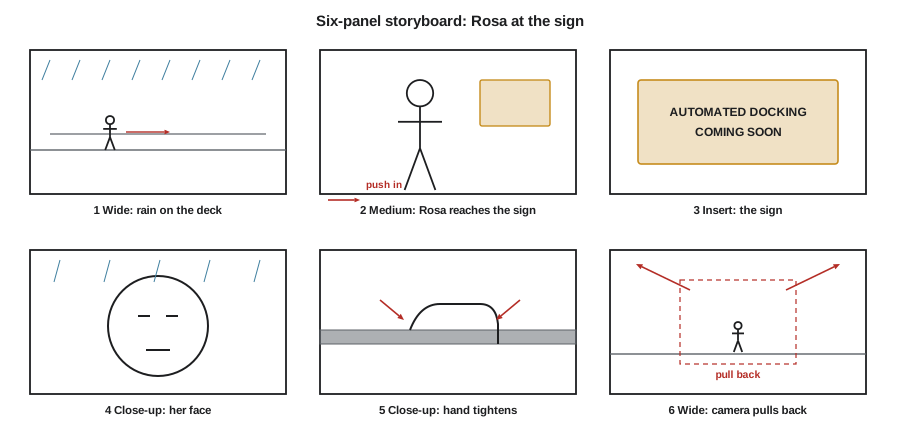
| Item | Purpose |
|---|---|
| Panel in aspect ratio | Shows the framing of the shot |
| Shot number | Links the panel to the shot list |
| Action description | What happens in the shot |
| Dialogue or sound | Key lines or sound effects |
| Camera movement | Arrows and notes for pans, tilts, dollies and zooms |
| Transition | How the shot connects to the next, such as a cut or dissolve |
Drawing simple boards
You do not need to be an artist to storyboard. Clear stick figures, simple shapes and a few conventions are enough for most student and low-budget work. What matters is framing, composition and movement, not beauty.
- Draw the frame first, in the correct aspect ratio, such as 16:9 or 2.39:1.
- Use stick figures with simple heads, adding a line for the nose to show which way the character faces.
- Show shot size by how much of the figure fills the frame: whole body for a wide shot, waist up for a medium, head and shoulders for a close-up.
- Use perspective lines and a horizon line to show the camera's height and angle.
- Add arrows: inside the frame for character movement, outside or on the frame for camera movement.
- Shade or hatch shadows if lighting is important.
Worked problem
Drawing frames in the right aspect ratio
You want storyboard panels 12 cm wide for a film framed at 16:9 and a second film framed at 2.39:1. How tall should each panel be?
Show solution
- For 16:9, height is \( 12 \times 9 \div 16 = 6.75 \) cm.
- For 2.39:1, height is \( 12 \div 2.39 \approx 5.0 \) cm.
- The wider ratio gives a much shallower frame, changing how compositions are drawn.
Answer: About 6.75 cm for 16:9 and about 5.0 cm for 2.39:1. Drawing in the correct ratio from the start shows you how much space is available on each side of a character.
Notation for camera movement and framing
Storyboard artists use a few common conventions so that boards read clearly.
- Pan and tilt: a curved arrow outside the frame showing the direction the camera turns.
- Dolly or tracking: a straight arrow showing the camera moving toward, away from or alongside the subject.
- Zoom: a smaller frame drawn inside a larger one, with arrows from corner to corner showing the direction.
- Character movement: arrows inside the frame, sometimes with a second position of the figure drawn lightly.
- Long moves: several panels for one shot, with the same shot number and letters such as 4A, 4B, 4C.
- Transitions: notes such as CUT, DISSOLVE or MATCH CUT between panels.
How many panels?
The number of panels depends on the complexity of the scene. A static dialogue shot may need one panel; a complex action shot with camera movement may need four or five to show its key positions. Productions sometimes estimate boarding time by panel counts.
Worked problem
Estimating panels and drawing time
A 3-page action scene has 22 shots. About half are simple and need one panel; the rest involve movement and need an average of three panels. A storyboard artist draws rough panels at about 12 per hour. How many panels are needed, and how long will roughs take?
Show solution
- Simple shots: \( 11 \times 1 = 11 \) panels.
- Moving shots: \( 11 \times 3 = 33 \) panels.
- Total: \( 11 + 33 = 44 \) panels.
- Time: \( 44 \div 12 \approx 3.7 \) hours of rough drawing.
Answer: About 44 panels and nearly 4 hours of rough drawing, before cleanup and revisions. Action and effects scenes often need many more panels per page than dialogue scenes.
Animatics
An animatic is a storyboard edited into a timed sequence, often with temporary dialogue, sound effects and music. Panels hold on screen for the length of the planned shot, and simple moves or pans across panels suggest camera movement. Animatics let directors test timing and rhythm before shooting, and in animation they are essential: an animated feature is usually built and revised as an animatic long before final animation begins.
Worked problem
Timing an animatic
An animatic for a 90-second scene uses 30 panels. If each panel holds for the same length of time, how long is each on screen? If one key panel must hold for 9 seconds, how long are the others?
Show solution
- Equal timing: \( 90 \div 30 = 3 \) seconds per panel.
- With one 9-second panel: \( 90 - 9 = 81 \) seconds remain for 29 panels.
- Others: \( 81 \div 29 \approx 2.8 \) seconds each.
Answer: Three seconds each if equal, or about 2.8 seconds each when one key panel holds for 9 seconds. Real animatics vary hold times to match the planned rhythm of the cut.
Previsualization
Previsualization, or previs, uses 3D computer animation to plan shots, especially for action, effects and complex camera work. Previs artists build simple virtual sets and characters and place virtual cameras with real lens choices, so the team can test framing, movement and timing. Related techniques include pitchvis, used to sell a project, techvis, which works out technical details such as crane positions and lens heights, and postvis, which adds temporary effects to shot footage. Virtual production with LED volumes, introduced in CINE-330, often relies on previs to plan scenes before stage time.
| Tool | What it is | Typical use |
|---|---|---|
| Thumbnails | Tiny rough sketches | Director's first thinking |
| Storyboards | Panel drawings of shots | Communicating plans to crew and clients |
| Animatic | Timed edited storyboard with sound | Testing rhythm; animation planning |
| Previs | Simple 3D animation of shots | Action, effects and complex camera work |
| Techvis | Technical data from previs | Crane heights, lens choices, rig positions |
Storyboards in your workflow
For your capstone short, you will board the key scene. A practical workflow is to start from your shot list and floor plan, draw thumbnails for every shot, then refine the most important ones into clearer panels. Show the boards to your cinematographer early, and expect them to change after location scouting and rehearsal. Storyboards are tools for thinking, not contracts.
Canada has a large animation and visual effects industry, centred in cities such as Vancouver, Montreal and Toronto, where storyboard artists and previs teams work on both domestic and international productions.
Boarding dialogue scenes
Dialogue scenes are often boarded more simply than action, but boarding them is still useful. Boards show the coverage pattern, such as wide, over-the-shoulder and close-ups, and help the director decide where to move in for emphasis. They also reveal whether the coverage respects the line of action and whether the eye lines match. For a short, boarding the key dialogue scene can show you how many set-ups you need and where you could save time by covering two angles from one position.
- Board the master or wide shot first to establish geography.
- Add the over-the-shoulder and single shots for each character.
- Mark the moment of the scene's turn, where you might cut to a close-up.
- Add inserts for any object that matters to the scene.
Shot sizes for storyboard artists
Storyboard panels depend on a shared vocabulary of shot sizes, which you met in FILM-101. Drawing the right amount of the figure in the frame tells the reader the shot size at a glance.
| Shot size | What fills the frame | Drawing tip |
|---|---|---|
| Extreme wide | Landscape with tiny figures | Small figure near the horizon line |
| Wide | Whole body with surroundings | Head near the top third, feet near the bottom |
| Medium | Waist up | Frame cuts at the waist |
| Medium close-up | Chest up | Frame cuts at the chest |
| Close-up | Head and shoulders | Face fills most of the frame |
| Extreme close-up | A detail such as eyes or a hand | Draw only the detail |
Worked problem
Counting set-ups from a board
A storyboard for a dialogue scene has 9 panels: 1 wide, 3 over-the-shoulder shots favouring character A, 3 favouring character B, and 2 inserts of a letter. If each angle on each character is one set-up, the wide is one set-up and both inserts can be shot from one position, how many set-ups are there?
Show solution
- Wide: 1 set-up.
- Character A's over-the-shoulder shots from one position: 1 set-up.
- Character B's over-the-shoulder shots from one position: 1 set-up.
- Inserts: 1 set-up.
- Total: \( 1 + 1 + 1 + 1 = 4 \) set-ups.
Answer: Four set-ups for nine panels. Seeing panels grouped by camera position helps the director and cinematographer plan an efficient day.
Sharing and revising boards
Storyboards are most useful when the whole team sees them. Print them or share them on a tablet at production meetings, pin them up on set and update them when shots change. Number every panel to match the shot list so anyone can find a shot quickly. After the shoot, compare the boards with what was filmed; the differences often teach you more about visual planning than the boards themselves.
Common mistakes
MistakeThinking you must draw well to storyboard
InsteadUse clear stick figures, frames in the right aspect ratio and arrows for movement
MistakeDrawing panels in the wrong proportions
InsteadDraw frames in the film's actual aspect ratio
MistakeLeaving out camera movement
InsteadMark pans, tilts, dollies and zooms with standard arrows and multiple panels
MistakeTreating boards as fixed contracts
InsteadRevise boards after scouting, rehearsal and discussion with the crew
MistakeBoarding everything in equal detail
InsteadFocus detail on complex, expensive or timing-critical shots
Summary and key terms
- Storyboards show a film shot by shot and are essential for action, effects, animation and commercials.
- A panel shows framing in the correct aspect ratio, with notes for action, sound and camera movement.
- Simple stick figures, shapes and arrows are enough for clear storyboards.
- Standard arrows show pans, tilts, dollies and zooms; long moves use several panels.
- Panel counts help estimate boarding time, which rises sharply for action scenes.
- Animatics time storyboards with sound to test rhythm, especially in animation.
- Previs, techvis and postvis use 3D tools to plan and refine complex shots.
- Storyboard
- A sequence of drawings showing a film's shots in order
- Panel
- One frame of a storyboard, showing a shot or key moment
- Thumbnail
- A tiny rough sketch used for early planning
- Aspect ratio
- The ratio of frame width to height, such as 16:9 or 2.39:1
- Animatic
- A storyboard edited into a timed sequence with sound
- Previsualization
- Planning shots with simple 3D animation
- Techvis
- Technical planning data derived from previs
- Postvis
- Temporary effects added to footage to guide editing and effects
- Pan
- A horizontal rotation of the camera
- Dolly
- Moving the camera toward, away from or alongside a subject
Practice problems
Work each problem on paper first, then reveal the answer to check.
When is storyboarding most valuable?
Show answer
For action, effects, animation, commercials and timing-critical shots.
How tall is a 10 cm wide panel at 16:9?
Show answer
5.625 cm.
How is a zoom shown on a storyboard?
Show answer
A smaller frame inside a larger one with arrows between corners.
What is an animatic?
Show answer
A timed edit of storyboard panels with sound.
How long does each of 40 panels hold in a 2-minute animatic?
Show answer
3 seconds.
What is previs?
Show answer
Planning shots with simple 3D computer animation.
How many panels do 10 simple shots and 10 moving shots at three panels each need?
Show answer
40 panels.
Why draw panels in the correct aspect ratio?
Show answer
It shows how much space the composition actually has.
Why should boards be revised after scouting?
Show answer
Real locations and rehearsals change what is possible and best.
What is techvis?
Show answer
Technical data such as crane heights and lens choices derived from previs.
Lesson quiz · 5 questions
Score 60% or more to complete this lesson.
Create a free account to save your progress, take quizzes and earn a certificate.