
ENGG-100 · Lesson 9 of 12 · 26 min
Project management and teamwork
Almost all engineering work is done in projects: temporary efforts with a defined goal, a budget, a schedule and a team, from a two-week design change to a ten-year hydroelectric dam. Many projects that fail do so not because the engineering was wrong but because the scope was unclear, the schedule unrealistic, costs uncontrolled, risks ignored or the team dysfunctional. Engineers move into project roles early in their careers, often as project engineers coordinating a piece of a larger job, and many become project managers. This lesson introduces the essentials: the project life cycle and the balance of scope, time and cost; breaking work down; scheduling with the critical path method; estimating and controlling cost with earned value; managing risk; project delivery methods and contracts; and the human side of making teams work.
Projects and the project life cycle
A project differs from ongoing operations in having a start and an end and producing a unique result. Most engineering projects pass through similar phases: initiation (defining the need and confirming the project is worth doing), planning (scope, schedule, budget, risks and team), execution (design, procurement, construction or manufacturing), monitoring and control (comparing progress with the plan and correcting course), and closeout (commissioning, handover, documentation and lessons learned).
Decisions made early have the greatest influence on the result and cost least to change. Moving a wall on a drawing costs minutes; moving it after the concrete is poured costs thousands of dollars and weeks. That is why careful definition and design reviews (Lesson 2) pay for themselves many times over.
Every project balances three linked constraints, often drawn as a triangle: scope (what will be delivered, at what quality), time and cost. Changing one affects the others. Adding features without adding time or money squeezes quality; cutting the schedule usually raises cost. A large part of project management is making these trade-offs explicit and getting the client to choose, rather than letting them happen by accident.
Defining scope: the work breakdown structure
The scope statement describes the deliverables, what is included and, equally important, what is excluded. The work is then divided into a work breakdown structure (WBS): a hierarchy that splits the project into deliverables and then into work packages small enough to estimate, schedule, assign to one person or group, and track. For the community water pump of Lesson 2, the top level might be investigation, design, approvals, procurement, construction and commissioning; construction might divide into tank foundation, tank installation, pump installation, solar array and piping.
Uncontrolled growth of the scope, known as scope creep, is one of the commonest causes of overruns. Small additions, each reasonable on its own, accumulate until the project is late and over budget. The remedy is a formal change control process: every proposed change is documented, its effect on cost, schedule and risk assessed, and it is approved or rejected by the client before work proceeds.
Scheduling: the critical path method
Once the work packages are known, the team estimates the duration of each activity and identifies the logical dependencies between them: the tank cannot be installed until its foundation is built; equipment cannot be ordered until the design is finished and funding approved. The critical path method (CPM) uses these dependencies to find the project duration and the activities that control it.
A forward pass through the network computes each activity's earliest start (ES) and earliest finish (EF): an activity can start only when all its predecessors have finished. The latest finish of the last activity is the project duration. A backward pass then computes the latest start (LS) and latest finish (LF) each activity can have without delaying the project. The difference LS − ES is the activity's total float, the amount it can slip without delaying completion. Activities with zero float form the critical path: any delay to them delays the whole project.
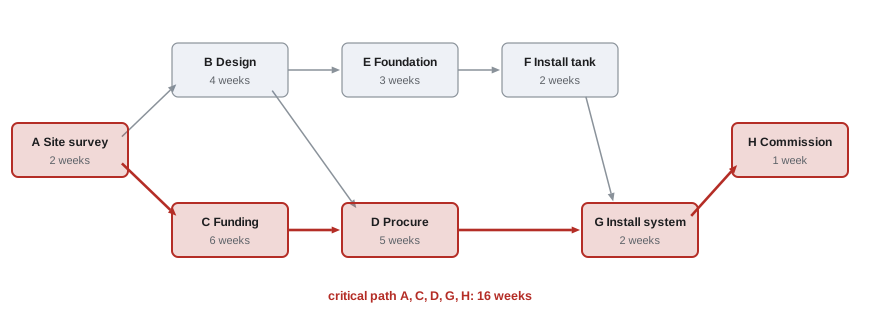
# Critical path method for the community water pump project (durations in weeks)
acts = {                      # name: (duration, predecessors), listed in a valid order
    "A Site survey":       (2, []),
    "B Design":            (4, ["A Site survey"]),
    "C Funding approval":  (6, ["A Site survey"]),
    "D Procure equipment": (5, ["B Design", "C Funding approval"]),
    "E Tank foundation":   (3, ["B Design"]),
    "F Install tank":      (2, ["E Tank foundation"]),
    "G Install system":    (2, ["D Procure equipment", "F Install tank"]),
    "H Commission":        (1, ["G Install system"]),
}
ES, EF = {}, {}
for a, (d, pre) in acts.items():                    # forward pass
    ES[a] = max([EF[p] for p in pre], default=0)
    EF[a] = ES[a] + d
finish = max(EF.values())
LS, LF = {}, {}
for a in reversed(list(acts)):                      # backward pass
    succ = [s for s, (d, pre) in acts.items() if a in pre]
    LF[a] = min([LS[s] for s in succ], default=finish)
    LS[a] = LF[a] - acts[a][0]
print("Activity              ES  EF  LS  LF  Float")
for a in acts:
    fl = LS[a] - ES[a]
    tag = "  critical" if fl == 0 else ""
    print(f"{a:20s} {ES[a]:3d} {EF[a]:3d} {LS[a]:3d} {LF[a]:3d} {fl:5d}{tag}")
print(f"Project duration: {finish} weeks")Activity ES EF LS LF Float A Site survey 0 2 0 2 0 critical B Design 2 6 4 8 2 C Funding approval 2 8 2 8 0 critical D Procure equipment 8 13 8 13 0 critical E Tank foundation 6 9 8 11 2 F Install tank 9 11 11 13 2 G Install system 13 15 13 15 0 critical H Commission 15 16 15 16 0 critical Project duration: 16 weeks
The project takes 16 weeks, and the critical path runs through the site survey, funding approval, procurement, installation and commissioning. The design, foundation and tank installation each have two weeks of float. This tells the project manager where to focus: speeding up the design would not shorten the project at all, but a one-week delay in funding approval would delay completion by a week. Practical responses might be to push the funding application early, or to order the long-lead pump and panels on a conditional basis.
Schedules are usually displayed as Gantt charts, horizontal bars on a time scale, which are easy to read and update. Real schedules also contain milestones (zero-duration events such as "funding approved"), resource limits (one crane, one crew), and allowances for weather and approvals, and they are updated regularly as work progresses. On large projects, specialized software manages thousands of activities, but the logic is exactly that of the eight-activity example.
Estimating and controlling cost
Cost estimates become more accurate as the project is defined. An order-of-magnitude estimate made at the concept stage, from the cost of similar projects, may be off by −30 to +50 % or more; a detailed estimate based on completed design drawings and quotations may be within ±10 %. Engineers should always state the accuracy of an estimate and the assumptions behind it, and add contingency for unknowns. Many failed projects began with an optimistic early estimate that became fixed in the client's mind.
During execution, earned value management compares three quantities at any date:
- Planned value (PV): the budgeted cost of the work scheduled to be done by now.
- Earned value (EV): the budgeted cost of the work actually done.
- Actual cost (AC): what has actually been spent.
From these, the schedule performance index SPI = EV/PV and the cost performance index CPI = EV/AC show whether the project is behind schedule (SPI < 1) or over budget (CPI < 1). If performance continues, the estimate at completion is roughly the original budget divided by the CPI.
Worked problem
Earned value at week 8
The pump project has a budget at completion (BAC) of $45,000. At week 8, the plan called for $20,000 of work; work worth $16,000 (by the budget) has been done; $19,000 has been spent. Assess the project.
Show solution
- SPI = EV/PV = 16,000/20,000 = 0.80: the project has done only 80 % of the planned work.
- CPI = EV/AC = 16,000/19,000 = 0.84: each dollar spent has produced 84 cents of planned work.
- Estimate at completion: EAC ≈ BAC/CPI = 45,000/0.84 = $53,400.
Answer: The project is behind schedule and over budget, heading for about $53,000, roughly $8,000 over. Earned value shows this at week 8, early enough to act: find out why (perhaps the survey revealed a deeper water level, requiring more design work), then decide with the client whether to add funds, reduce scope or find savings. Without earned value, comparing spending alone ($19,000 against a planned $20,000) would have suggested all was well.
Managing risk
Project risks are uncertain events that would affect scope, schedule or cost if they occurred: a late equipment delivery, a ground condition different from the borehole logs, a key person leaving, a permit delay, a price increase. Managing them follows the same logic as the safety risk assessment of Lesson 6. Teams identify risks early, rate each by likelihood and impact, and record them in a risk register with an owner and a response. Responses are to avoid the risk (change the plan so it cannot occur), reduce it (lower its likelihood or impact), transfer it (to an insurer or a contractor better able to manage it), or accept it, with a contingency allowance in the budget or schedule. Risks are reviewed regularly, because new ones appear and old ones pass. Opportunities, uncertain events that would help the project, are managed in the same way.
| Risk | Likelihood | Impact | Response | Owner |
|---|---|---|---|---|
| Funding approval delayed | Medium | High (critical path) | Submit early; conditional equipment order | Project manager |
| Well yield lower than tested | Low | High | Pump test before design freeze | Design lead |
| Pump delivery late | Medium | Medium | Order early; identify second supplier | Procurement |
| Extreme cold during installation | Medium | Medium | Schedule installation for summer | Site lead |
Project delivery methods and contracts
Owners choose how to organize the design and construction of a project. In design-bid-build, the traditional method, the owner hires an engineer or architect to complete the design, then invites contractors to bid, usually awarding the work to the lowest compliant bidder; it gives the owner control of the design and competitive prices but separates the designer from the builder and takes longer. In design-build, one organization is responsible for both design and construction, often faster and with fewer disputes between designer and builder, but with less owner control over details. Other methods include construction management, where a construction manager joins during design to advise on cost and constructability, and public-private partnerships, in which a private consortium designs, builds, finances and often operates a facility for decades.
In Canada, construction contracts are commonly based on standard forms from the Canadian Construction Documents Committee, such as CCDC 2 (stipulated price) and CCDC 14 (design-build), and engineering services agreements on forms such as ACEC-Canada's. Public owners award contracts through formal tendering, governed by the law of tendering established in cases such as the Supreme Court's Ron Engineering decision (1981).
Contracts allocate risk between the parties: who pays if ground conditions differ, if prices rise or if the design has an error. Engineers involved in contract administration must read the contract carefully, document everything, and act fairly between owner and contractor where the contract gives them that role. Engineering law courses later in the program cover contracts in depth.
Teamwork
Engineering teams combine people of different disciplines, experience, cultures and personalities, and their effectiveness depends as much on how they work together as on individual skill. The psychologist Bruce Tuckman described a common sequence of team development: forming (polite, uncertain), storming (conflict over roles and approaches), norming (agreement on how to work) and performing (productive collaboration). Storming is normal; teams that work through it openly perform better than those that suppress it.
Good teams share several practices:
- A clear, shared goal and clearly assigned roles and responsibilities, so that everyone knows who does what and who decides.
- A team charter or agreement covering communication, meetings, deadlines, quality standards and how conflicts and missed commitments will be handled. Student design teams that write one at the start have far fewer disputes at the end.
- Effective meetings: a purpose and agenda, the right people, decisions and action items recorded with owners and dates, and minutes circulated promptly.
- Open communication and psychological safety (Lesson 5), so that problems surface early.
- Constructive conflict about ideas, not people. Disagreement about the technical approach often improves the result; personal conflict damages it.
- Respect for diversity of background and thinking style, which research associates with better problem solving, and inclusive behaviour so that every member can contribute.
Engineers also lead without formal authority, coordinating colleagues, contractors and other disciplines who do not report to them. That requires credibility built on competence and reliability, clear communication (Lesson 8), and the habit of keeping commitments.
Common mistakes
MistakeAccepting small scope changes informally.
InsteadRun every change through change control, with its cost and schedule effect.
MistakeTrying to speed a project by accelerating activities with float.
InsteadOnly critical-path activities control the finish date.
MistakeJudging cost performance by comparing spending with the plan.
InsteadUse earned value; compare spending with the value of work actually done.
MistakeGiving an early estimate as a single number.
InsteadState its accuracy range and assumptions, and include contingency.
MistakeAvoiding all conflict in a team.
InsteadEncourage constructive debate about ideas while keeping respect for people.
Summary and key terms
- Projects pass through initiation, planning, execution, control and closeout; early decisions matter most.
- Scope, time and cost are linked; make trade-offs explicit.
- A work breakdown structure defines the work; change control prevents scope creep.
- CPM finds the project duration, float and the critical path.
- Estimates gain accuracy with definition; earned value (SPI, CPI) tracks performance.
- Risk registers identify, rate and assign responses to risks.
- Delivery methods and contracts allocate roles and risks; effective teams have clear roles, charters and constructive conflict.
- Project
- A temporary effort to produce a unique result.
- Work breakdown structure
- A hierarchical division of project work into manageable packages.
- Scope creep
- Uncontrolled growth of a project's scope.
- Critical path
- The sequence of zero-float activities that determines project duration.
- Total float
- How long an activity can be delayed without delaying the project.
- Gantt chart
- A bar chart of activities against time.
- Earned value
- The budgeted cost of the work actually completed.
- Cost performance index
- Earned value divided by actual cost.
- Risk register
- A list of project risks with ratings, responses and owners.
- Design-build
- A delivery method in which one entity designs and constructs.
Practice problems
Work each problem on paper first, then reveal the answer to check.
Name the five phases of the project life cycle.
Show answer
Initiation, planning, execution, monitoring and control, closeout.
What are the three linked project constraints?
Show answer
Scope (including quality), time and cost.
If the funding approval in the example took 8 weeks instead of 6, what would the project duration be?
Show answer
18 weeks; C is critical.
If the design took 5 weeks instead of 4, what would the duration be?
Show answer
Still 16 weeks; B has 2 weeks of float.
If the tank foundation took 6 weeks instead of 3, what would the duration be?
Show answer
E would finish at week 12, F at week 14, so G starts at week 14 and the project takes 17 weeks.
PV = $50,000, EV = $55,000, AC = $60,000. Find SPI and CPI and interpret.
Show answer
SPI = 1.10 (ahead of schedule); CPI = 0.92 (over budget).
With BAC = $200,000 and CPI = 0.92, estimate the cost at completion.
Show answer
About $217,000.
Give one example each of avoiding, reducing and transferring a risk.
Show answer
For example: reroute to avoid a wetland; test the well early; buy insurance or use a fixed-price subcontract.
State one advantage and one disadvantage of design-build.
Show answer
Faster with single responsibility; less owner control over design details.
What are Tuckman's four stages?
Show answer
Forming, storming, norming, performing.
Lesson quiz · 5 questions
Score 60% or more to complete this lesson.
Create a free account to save your progress, take quizzes and earn a certificate.