
ENGG-100 · Lesson 10 of 12 · 32 min
Engineering economics and decision-making
Engineering is the art of doing for one dollar what anyone can do for two. Nearly every design decision has a cost side: whether to buy a more efficient motor, whether to repair a bridge now or replace it in ten years, whether a solar pump justifies its higher price, whether a new production line will pay for itself. Engineers are expected to compare such options in money terms, and to do it correctly, because money now and money later are not worth the same. This lesson introduces engineering economics: the time value of money, interest and equivalence, the standard formulas, present worth, annual worth, rate of return and payback, life-cycle cost, inflation, and how to handle uncertainty with sensitivity analysis. It finishes by placing economic analysis among the other factors, such as safety, environment and fairness, that money alone cannot capture.
The time value of money
A dollar today is worth more than a dollar a year from now, for three reasons: today's dollar can be invested to earn a return, future money is uncertain, and inflation erodes purchasing power. Interest is the price of using money over time. With simple interest, interest is paid only on the original amount; with compound interest, which is how almost all real finance works, interest is earned on accumulated interest too.
If an amount P is invested at an interest rate i per period, after n periods it grows to a future amount F:
Turning a future amount into its present equivalent is called discounting, and the rate used is the discount rate. For engineering decisions, the discount rate represents the organization's cost of capital or the return it could earn on other investments, often called the minimum attractive rate of return (MARR).
Worked problem
Compounding and discounting
A municipality deposits $100,000 in a reserve fund earning 4 % per year. (a) What will it be worth in 25 years? (b) What single payment today is equivalent to a $250,000 bridge deck replacement in 15 years, at 4 %?
Show solution
- (a) F = 100,000 × 1.04²⁵ = 100,000 × 2.666 = $266,600.
- (b) P = 250,000/1.04¹⁵ = 250,000/1.801 = $138,800.
Answer: (a) About $267,000; compounding more than doubles the money in 25 years. (b) About $139,000; a cost 15 years away is worth only 56 % of its face value today at 4 %. The rule of 72 gives a quick check: money doubles in about 72/i years, 18 years at 4 %.
Equivalence and uniform series
Two cash flows are equivalent if they have the same present value at the given interest rate. Equivalence lets engineers compare options whose costs occur at different times by converting everything to a common basis. Many engineering cash flows are uniform series, equal amounts A every period for n periods: annual maintenance, energy costs, loan payments. Their present value is:
The second formula, the capital recovery factor, converts a present amount into an equivalent annual amount, exactly as a mortgage payment spreads the price of a house over its term.
Worked problem
Loan payment and the value of savings
(a) What annual payment repays a $45,000 loan over 20 years at 5 %? (b) An energy retrofit saves $6,000 a year for 15 years. What is it worth today at 6 %?
Show solution
- (a) A = 45,000 × 0.05 × 1.05²⁰/(1.05²⁰ − 1) = 45,000 × 0.0802 = $3,611 per year.
- (b) P = 6,000 × (1.06¹⁵ − 1)/(0.06 × 1.06¹⁵) = 6,000 × 9.712 = $58,300.
Answer: (a) About $3,610 a year, for total payments of $72,200. (b) About $58,300: the retrofit is worth paying up to that amount today, even though its undiscounted savings total $90,000.
Comparing alternatives: present worth and annual worth
To compare mutually exclusive options, such as two ways to supply power to the community pump of Lessons 2 and 9, engineers list each option's cash flows over the same study period, discount them at the MARR, and compare. The present worth method sums the present values; for options that provide the same service, the one with the lowest present cost wins. The annual worth method converts the present worth to an equivalent uniform annual amount, which is often easier to explain ("the solar option costs the equivalent of $4,700 a year") and convenient when options have different lives.
# Life-cycle cost of two ways to power the community pump (20 years)
N = 20
solar  = {"capital": 45000, "annual": 800,        "year10": 6000}   # pump replacement in year 10
diesel = {"capital": 18000, "annual": 5500 + 2000, "year10": 8000}  # fuel + maintenance; overhaul

def cashflows(opt):
    c = [opt["capital"]] + [opt["annual"]] * N
    c[10] += opt["year10"]
    return c                                   # costs by year 0..N

def npv(flows, i):
    return sum(f / (1 + i) ** t for t, f in enumerate(flows))

def annual_equiv(pv, i):                       # capital recovery factor A/P
    return pv * i * (1 + i) ** N / ((1 + i) ** N - 1)

i = 0.05
for name, opt in [("Solar", solar), ("Diesel", diesel)]:
    pv = npv(cashflows(opt), i)
    print(f"{name:6s}: present cost ${pv:9,.0f}, equivalent annual cost ${annual_equiv(pv, i):7,.0f}")

# Incremental investment: extra capital for solar, repaid by lower running costs
inc = [d - s for s, d in zip(cashflows(solar), cashflows(diesel))]   # savings by year
lo, hi = 0.0, 1.0
for _ in range(60):                            # internal rate of return by bisection
    mid = (lo + hi) / 2
    if npv(inc, mid) > 0:
        lo = mid
    else:
        hi = mid
print(f"Incremental IRR of solar over diesel: {lo:.1%}")
cum, year = inc[0], 0
while cum < 0:
    year += 1
    cum += inc[year] / (1 + i) ** year
print(f"Discounted payback at 5%: {year} years")
for r in [0.03, 0.08, 0.12]:
    diff = npv(cashflows(diesel), r) - npv(cashflows(solar), r)
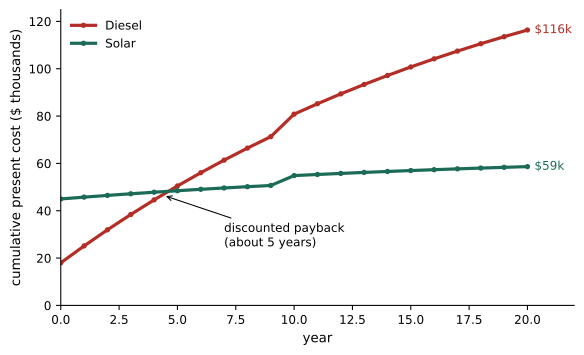
print(f"At {r:.0%}: solar saves ${diff:8,.0f} in present value")Solar : present cost $ 58,653, equivalent annual cost $ 4,706 Diesel: present cost $ 116,378, equivalent annual cost $ 9,338 Incremental IRR of solar over diesel: 24.7% Discounted payback at 5%: 5 years At 3%: solar saves $ 74,167 in present value At 8%: solar saves $ 39,708 in present value At 12%: solar saves $ 23,689 in present value
The solar option costs $27,000 more to build but saves $6,700 a year in fuel and maintenance, and its 20-year present cost is about half the diesel option's. The extra investment earns an internal rate of return of about 25 %, far above any reasonable MARR, and pays back, even after discounting, in five years. The conclusion holds across a wide range of discount rates. Notice that the diesel option looked cheaper on first cost alone; choosing on purchase price is the most common economic mistake in engineering, and the pump example in Lesson 11 makes the same point.
Rate of return and payback
The internal rate of return (IRR) is the discount rate at which an investment's present worth is zero: the effective interest the investment earns. An investment is attractive if its IRR exceeds the MARR. When comparing options, the correct approach is to compute the IRR of the incremental investment, the extra money spent on the more expensive option, as the code does, because the option with the higher IRR on its own is not necessarily the better choice.
Payback period, the time for savings to repay the initial investment, is popular because it is easy to understand, and a short payback indicates low risk. But simple payback ignores the time value of money and everything after the payback date, so it can favour quick, small savings over larger long-term ones. Use it as a screening tool alongside present worth or IRR, not alone.
Worked problem
Simple payback of a motor upgrade
A premium-efficiency motor costs $1,800 more than a standard one and saves 6,200 kWh a year at $0.12/kWh. Find the simple payback and the present worth of the savings over a 15-year life at 7 %.
Show solution
- Annual savings: 6,200 × 0.12 = $744.
- Simple payback: 1,800/744 = 2.4 years.
- Present worth of savings: 744 × (1.07¹⁵ − 1)/(0.07 × 1.07¹⁵) = 744 × 9.108 = $6,780.
- Net present worth: 6,780 − 1,800 = $4,980.
Answer: Payback 2.4 years and a net present worth of about $5,000: an excellent investment. Electricity prices that rise over time would make it better still.
Life-cycle cost
Life-cycle cost analysis adds up all the costs of owning an asset over its life: design and construction, operation and energy, maintenance and repair, replacement of components, and disposal or salvage, all discounted to a common basis. For many engineered assets, such as pumps, motors, lighting, buildings and pavements, operating and maintenance costs over the life far exceed the purchase price. Public owners increasingly require life-cycle cost analysis for major decisions, and Lesson 11 links it to life-cycle environmental assessment, which counts carbon and other impacts in the same way.
Life-cycle thinking also reveals the cost of deferring maintenance. A road resurfaced at the right time costs a fraction of one allowed to deteriorate until it must be rebuilt; a bridge whose drains are cleaned and joints sealed lasts decades longer. Asset management, the systematic planning of maintenance, renewal and replacement for a whole network of assets, is a growing field for civil, mechanical and electrical engineers.
Inflation, taxes and depreciation
Inflation, the general rise in prices, means that a dollar in the future buys less. Analyses can be done in nominal (actual, inflated) dollars with a nominal discount rate, or in real (constant, today's) dollars with a real discount rate; mixing the two is a common error. The real rate is approximately the nominal rate minus the inflation rate: a 7 % nominal rate with 2 % inflation is about a 5 % real rate. Costs that rise faster than general inflation, such as energy in some periods, can be modelled with their own escalation rate.
For businesses, taxes reduce both the income from an investment and, through depreciation deductions, its effective cost. Depreciation spreads the cost of an asset over its useful life for accounting and tax purposes, and tax rules specify how quickly each class of asset may be written off.
In Canada, depreciation for tax purposes is claimed as capital cost allowance (CCA), with rates set for each asset class by the Income Tax Act; some clean energy equipment qualifies for accelerated rates.
Detailed after-tax analysis is the subject of a full engineering economics course; for now, recognize that taxes can change which option is best and that accountants and engineers need to work together on major investment decisions.
Uncertainty and sensitivity analysis
Every economic analysis rests on estimates: costs, savings, lives, interest rates, future prices. Rather than pretending to precision, good analyses test how sensitive the conclusion is to the inputs. A sensitivity analysis changes one input at a time over a plausible range and sees whether the preferred option changes; the code above does this for the discount rate. A break-even analysis finds the value of an input at which two options are equally attractive: for example, the diesel price below which diesel would be preferred. Scenario analysis combines several inputs into optimistic, likely and pessimistic cases. If the decision is the same across all plausible values, it is robust; if it flips, the uncertain input deserves more study before committing.
Worked problem
Break-even fuel cost
In the pump comparison, at 5 % over 20 years, how low would diesel fuel costs (now $5,500 a year) have to fall before diesel matches solar?
Show solution
- The present cost difference is 116,378 − 58,653 = $57,725.
- The uniform series factor for 20 years at 5 % is (1.05²⁰ − 1)/(0.05 × 1.05²⁰) = 12.46.
- Fuel must fall by 57,725/12.46 = $4,630 a year, to about $870 a year.
Answer: Diesel would need to cost about one-sixth of its current price before it matched solar, so the solar decision is robust to fuel prices. A similar check on the solar capital cost would show how much it could rise before the choice changed.
Beyond the numbers
Economic analysis is a tool for decision-making, not the decision itself. Some important factors are hard to express in money: safety, reliability, environmental impact, effects on communities, fairness between groups and between generations, and the preferences of the people who will live with the result. A diesel generator brings noise, fumes, fuel deliveries over winter roads and spill risk; a solar system brings independence and fewer moving parts. Benefit-cost analysis, used for public projects, attempts to value some of these effects, such as travel time saved or injuries avoided, but always involves judgements that should be stated openly. Discounting itself raises questions: at high discount rates, costs that fall on future generations, such as climate impacts or the cost of replacing infrastructure that has been neglected, almost vanish from the analysis.
Engineers should therefore present economic results alongside the other criteria, often in a decision matrix (Lesson 1), state their assumptions, and recognize that the code of ethics places the safety and welfare of the public above economic gain.
Common mistakes
MistakeChoosing the option with the lowest first cost.
InsteadCompare life-cycle costs over the same study period.
MistakeAdding costs that occur in different years without discounting.
InsteadConvert all cash flows to a common time basis at the MARR.
MistakeRelying on simple payback alone.
InsteadUse present worth, annual worth or IRR; payback ignores later cash flows.
MistakeMixing real and nominal values.
InsteadUse real dollars with a real rate, or nominal with nominal.
MistakePresenting a single number as certain.
InsteadTest sensitivity and break-even values, and state assumptions.
Summary and key terms
- Money has time value: F = P(1 + i)ⁿ; discounting converts future amounts to present ones.
- Uniform series and capital recovery factors convert between present and annual amounts.
- Compare options by present worth or annual worth over the same study period at the MARR.
- IRR is the rate at which present worth is zero; compare incremental investments.
- Payback is a screening tool; life-cycle cost captures operating, maintenance and replacement costs.
- Do not mix real and nominal values; taxes and depreciation affect business decisions.
- Sensitivity and break-even analysis test robustness; economics informs but does not replace judgement.
- Time value of money
- The principle that money now is worth more than the same amount later.
- Compound interest
- Interest earned on both principal and accumulated interest.
- Discount rate
- The rate used to convert future amounts to present values.
- MARR
- Minimum attractive rate of return required of an investment.
- Present worth
- The sum of all cash flows discounted to the present.
- Capital recovery factor
- The factor converting a present amount to an equivalent annual series.
- Internal rate of return
- The discount rate at which present worth equals zero.
- Payback period
- The time for savings to recover an initial investment.
- Life-cycle cost
- The total discounted cost of owning an asset over its life.
- Sensitivity analysis
- Testing how a conclusion changes as inputs vary.
Practice problems
Work each problem on paper first, then reveal the answer to check.
Find the future value of $5,000 after 10 years at 6 %.
Show answer
5,000 × 1.791 = $8,950.
Find the present value of $20,000 due in 8 years at 5 %.
Show answer
20,000/1.477 = $13,540.
Using the rule of 72, how long does money take to double at 8 %?
Show answer
About 9 years.
Find the annual payment on a $100,000 loan over 10 years at 6 %.
Show answer
100,000 × 0.1359 = $13,590.
Find the present worth of $1,000 a year for 20 years at 5 %.
Show answer
1,000 × 12.46 = $12,460.
A $3,000 upgrade saves $500 a year. What is the simple payback?
Show answer
6 years.
From the code output, what are the equivalent annual costs of the two pump options?
Show answer
About $4,700 for solar and $9,300 for diesel.
A nominal discount rate is 6 % and inflation is 2.5 %. Estimate the real rate.
Show answer
About 3.5 %.
Why should IRR comparisons be made on incremental investments?
Show answer
The option with the higher stand-alone IRR may create less total value; the increment shows whether extra spending pays.
Name three factors that economic analysis may not capture well.
Show answer
For example: safety, environmental impact, community effects, fairness, reliability.
Lesson quiz · 5 questions
Score 60% or more to complete this lesson.
Create a free account to save your progress, take quizzes and earn a certificate.