
ENGG-100 · Lesson 12 of 12 · 26 min
Careers, lifelong learning and an integrated case
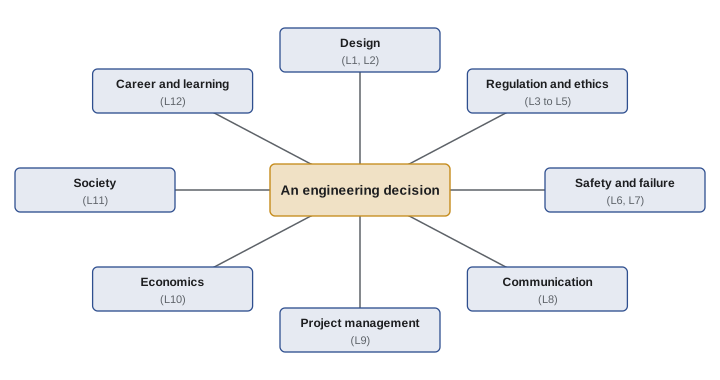
This course has covered what engineers do, how they design, how the profession is regulated, the ethics that bind it, safety and risk, learning from failure, communication, project management, economics and engineering's place in society. In practice these never arrive separately: a single decision about an aging piece of infrastructure involves all of them at once. This final lesson looks first at the shape of an engineering career, how to start it well and how to keep learning throughout it, and then works through an integrated case that draws on every lesson. It ends with the course project, in which you carry out a similar analysis yourself.
The shape of an engineering career
Engineering degrees lead to a remarkably wide range of careers. Many graduates work in design and analysis for consulting firms, manufacturers, utilities or governments; others work in construction and field engineering, operations and maintenance, research and development, testing and quality assurance, technical sales, regulation and inspection, project and program management, teaching, or start their own companies. Some move into business, law, medicine, finance or public policy, where engineering's quantitative problem solving is valued. The first job rarely defines a career; most engineers change roles, employers and even disciplines several times.
Early careers typically follow a pattern. In the first years, a graduate engineer works under the supervision of licensed engineers, building practical skills and judgement, often rotating through different roles. This is the period of supervised experience that counts toward licensure (Lesson 3). With licensure and experience comes responsibility for independent work, then for leading projects and teams, and eventually, for some, for technical specialties, departments or whole organizations. Two broad paths are common: a technical path toward recognized expertise in a specialty, and a management path toward leading projects and people. Good organizations value both.
In Canada, graduates normally register with their provincial or territorial regulator as engineers-in-training (EIT) as soon as they graduate, accumulate at least four years of acceptable engineering experience (in most provinces including at least one year in Canada), pass the National Professional Practice Exam on law and ethics, and then apply for the P.Eng. licence. Registering early matters: experience gained before registration may still count, but the EIT program provides guidance and records experience as it happens.
Starting well
The habits formed in the first few years of practice last a career. Experienced engineers advise new graduates to:
- Ask questions. No one expects a new engineer to know everything; everyone expects them to ask rather than guess. Asking "why is it done this way?" often teaches more than any course.
- Check your work, and have it checked. Estimate before calculating, compare with similar designs, and welcome review (Lessons 1 and 2).
- Learn the practical side. Spend time in the field, the plant or the shop. Talk to technicians, operators and tradespeople, who know things no textbook records and who will build and run what you design.
- Keep good records. Keep an engineering notebook or project log, record decisions and their reasons, and confirm important conversations in writing (Lesson 8).
- Know the limits of your competence. Taking on work you are not qualified to do is a breach of the code of ethics (Lesson 4); say so, and seek help.
- Find mentors. A mentor, formal or informal, can explain unwritten rules, advise on difficult situations, open doors and help you plan your development. Many regulators and societies run mentoring programs.
- Look after yourself. Engineering can be demanding, with deadlines, travel and responsibility. Sustainable working habits, physical and mental health, and life outside work make for better engineering and longer careers.
Lifelong learning
Engineering knowledge changes fast. Codes are revised every few years, new materials and methods appear, software tools change constantly, and fields such as renewable energy, battery storage, data science and AI barely existed in many curricula a generation ago. An engineer who stops learning at graduation becomes dangerous within a decade. Regulators therefore require licensed engineers to maintain their competence.
Canadian regulators require continuing professional development. APEGA, for example, requires members to earn 240 professional development hours over each three-year cycle, spread across categories such as professional practice, formal activity (courses and seminars), informal activity (self-study, conferences), participation in societies, presentations and contributions to knowledge, and to report them annually. Other provinces have similar programs, and regulators may audit members' records.
Learning comes in many forms: formal courses and graduate degrees, short courses and webinars, conferences, reading technical journals and standards, committee work on codes and standards, teaching and mentoring others, and simply working on unfamiliar problems with skilled colleagues. Graduate study, a master's degree for advanced practice or a doctorate for research, suits some careers; part-time and online programs allow engineers to study while working.
Professional and technical societies are central to lifelong learning. They publish journals, hold conferences, develop standards, offer courses and give engineers a network beyond their employer.
In Canada these include the Engineering Institute of Canada and its member societies such as the Canadian Society for Civil Engineering and the Canadian Society for Mechanical Engineering, IEEE Canada, the Chemical Institute of Canada, provincial professional societies such as the Ontario Society of Professional Engineers, and groups that support diversity in the profession. Students can join most of them at low cost.
An integrated case: the arena refrigeration plant
A town of 15,000 people owns a community arena whose ice plant, an ammonia refrigeration system installed in 1988, is near the end of its life. The compressors are worn, the brine piping under the slab is corroding, and the plant leaked small amounts of ammonia twice last winter. Ammonia is an efficient refrigerant with no ozone depletion or global warming effect, but it is toxic and, in some concentrations, flammable. In October 2018, an ammonia leak at an arena in Fernie, British Columbia, killed three workers, and arena refrigeration safety has since received close attention from regulators across North America. The town's recreation manager asks the town's engineer, who has three years of experience, for a recommendation to council within two months.
Defining the problem (Lessons 1 and 2)
The engineer begins by restating the request as a need: provide reliable, safe ice for the arena's October-to-April season for at least the next 25 years, at the lowest reasonable life-cycle cost and environmental impact. She gathers requirements by talking to the arena staff, user groups and the refrigeration contractor who maintains the plant, and lists constraints: the town's capital budget, the need to keep the arena open for the season, refrigerant regulations, and the town's target to cut its greenhouse gas emissions.
Competence and ethics (Lessons 3, 4 and 5)
Refrigeration plant design is a specialty, and the engineer recognizes that it is outside her competence. Her role is to define the problem, manage the study and present options honestly; she recommends that the town retain a firm with specialist refrigeration engineers to assess the existing plant and design the replacement. During the study, a council member who runs the local hockey association suggests that the leaks have been minor and that the study could simply recommend patching the plant for a few more years, avoiding a tax increase in an election year. The engineer explains that the specialists' assessment, not political convenience, must decide whether the existing plant can continue safely, and that she will report its findings fully. She documents the conversation.
Safety and risk (Lessons 6 and 7)
The specialists find that the plant's machinery room ventilation and ammonia detection do not meet the current refrigeration safety code, that the emergency shutdown has not been tested in years, and that the leaks came from a corroded valve stem, a common-cause risk because several similar valves are of the same age. Applying the hierarchy of controls, they recommend immediate interim measures for this season: replace the corroded valves, upgrade detection and alarms, test the emergency ventilation and shutdown, and train staff in emergency response. For the long term, the options include eliminating the hazard (a non-toxic refrigerant) or substituting a much smaller charge of ammonia.
Economics (Lesson 10)
Worked problem
Comparing the options
Three options are compared over 25 years at a 4 % discount rate (uniform series factor 15.62): (A) repair the existing plant for $350,000, with energy and maintenance of $90,000 a year, and full replacement still needed in year 8 at $1.5 million; (B) a new low-charge packaged ammonia system for $1.4 million, with running costs of $60,000 a year; (C) a new transcritical CO₂ system for $1.6 million, with running costs of $55,000 a year less $25,000 a year of heat recovered for the building's hot water and space heating. Find the present costs.
Show solution
- A: 350,000 + 90,000 × 15.62 + 1,500,000/1.04⁸ = 350,000 + 1,405,800 + 1,096,000 = $2.85 million.
- B: 1,400,000 + 60,000 × 15.62 = 1,400,000 + 937,200 = $2.34 million.
- C: 1,600,000 + 30,000 × 15.62 = 1,600,000 + 468,600 = $2.07 million.
Answer: Option C has the highest first cost but the lowest life-cycle cost, about $780,000 less than repairing, and it eliminates toxic ammonia from a public building. Repairing, the cheapest choice in this year's budget, is the most expensive over 25 years. CO₂ systems operate at high pressures and need suitably trained technicians, risks that the specialists must address in design and that the town must plan for in staffing and training.
Project and communication (Lessons 8 and 9)
The replacement must be built between April and August so the arena loses no season. The engineer prepares a schedule showing that equipment ordering, with a lead time of 20 weeks, is on the critical path, so council must approve the project by December for a spring start. Her risk register lists late equipment delivery, slab problems discovered during demolition and contractor availability. Her report to council puts the recommendation first, in plain language: carry out the interim safety measures immediately, and replace the plant with a CO₂ system next summer. It explains the options, costs, risks and environmental benefits, states the assumptions, and attaches the specialists' report. At the council meeting she answers questions directly, including the one about patching the plant, explaining why that option is both less safe and more costly.
Society (Lesson 11)
The arena is a community centre as much as an ice rink. The engineer meets user groups to explain the summer construction schedule and the safety measures, which reassures parents who remember news of the Fernie tragedy. The heat recovery and the elimination of ammonia support the town's climate goals, and the project qualifies for a provincial and federal infrastructure grant, which the town applies for. Council approves the project; the arena reopens on schedule the following October, and the engineer writes up a lessons-learned summary for other municipalities facing the same decision.
Course project
The course project asks you to analyze a real engineering decision in your community or field of interest, as the integrated case does, and present your findings in a short professional report and presentation. Suitable topics include a piece of local infrastructure needing repair or replacement, a safety improvement at a workplace or campus facility, a product redesign, an energy efficiency upgrade, or the response to a recent engineering failure. Your report, about ten pages, should:
- Define the problem as a need, with requirements and constraints (Lesson 2).
- Identify the regulatory and professional context, including who would need to be licensed and which codes apply (Lessons 3 and 4).
- Discuss at least one ethical issue the decision raises, using a structured approach (Lessons 4 and 5).
- Assess the main hazards and risks and propose controls (Lesson 6), and if relevant analyze a past failure (Lesson 7).
- Compare at least two options, including a life-cycle cost comparison with a short Python script (Lesson 10).
- Outline a schedule and risk register for the recommended option (Lesson 9).
- Consider the effects on the community and environment (Lesson 11).
- Present a clear recommendation, executive summary first (Lesson 8).
Looking ahead
Engineering is a profession of privilege and responsibility. Society allows engineers to design the structures, machines and systems on which lives depend, and in return expects competence, honesty and care for the public good. The technical courses ahead will give you the tools; this course has tried to show the setting in which you will use them. Engineers who combine technical skill with sound judgement, clear communication, ethical courage and concern for the people their work affects have built the modern world, and the problems ahead, from climate change to aging infrastructure to the responsible use of AI, will need many more of them.
Common mistakes
MistakeBelieving your first job sets your whole career.
InsteadMost engineers change roles and fields several times; build broad skills.
MistakeHiding gaps in your knowledge from supervisors.
InsteadAsk questions and seek help; work within your competence.
MistakeTreating learning as finished at graduation.
InsteadPlan continuing development; regulators require it.
MistakeRecommending the option with the lowest budget impact this year.
InsteadCompare life-cycle costs, safety and environmental impact.
MistakeLetting political or commercial pressure shape technical findings.
InsteadReport findings fully and honestly, and document pressure.
Summary and key terms
- Engineering degrees lead to many careers; most engineers change roles several times.
- Early careers involve supervised experience toward licensure; register or take the first exam early.
- Good early habits: ask, check, learn the practical side, keep records, know your limits, find mentors.
- Regulators require continuing professional development throughout a career.
- Professional and technical societies support learning and networks.
- Real decisions combine design, ethics, safety, economics, project management, communication and society.
- The course project applies all of these to a real decision.
- Engineer-in-training
- A graduate registered with a regulator while gaining experience toward licensure.
- Mentor
- An experienced practitioner who advises and supports a less experienced one.
- Continuing professional development
- Ongoing learning to maintain and extend competence.
- Professional development hour
- A unit of continuing education, typically one hour of qualifying activity.
- Technical society
- An organization advancing knowledge in an engineering field.
- Technical path
- A career progression based on growing specialist expertise.
- Management path
- A career progression based on leading projects and people.
- Transcritical CO₂ system
- A refrigeration system using carbon dioxide above its critical point on the high-pressure side.
- Heat recovery
- Capturing rejected heat for a useful purpose.
- Lessons-learned summary
- A record of what went well and what should change, shared for future projects.
Practice problems
Work each problem on paper first, then reveal the answer to check.
Name six kinds of work engineering graduates do.
Show answer
For example: design, construction, operations, research, testing, sales, regulation, project management, teaching, entrepreneurship.
Why should you register or take the first licensing exam soon after graduating?
Show answer
It starts the formal path to licensure while knowledge is fresh, and career plans change.
Give three habits experienced engineers recommend for new graduates.
Show answer
For example: ask questions, check your work, spend time in the field, keep records, find a mentor.
Why do regulators require continuing professional development?
Show answer
Knowledge, codes and tools change; competence must be maintained to protect the public.
In the arena case, why did the engineer recommend hiring specialists?
Show answer
Refrigeration design was outside her competence.
How should she respond to the council member's suggestion to patch the plant?
Show answer
Explain that the technical findings will decide, report them fully, and document the conversation.
Which interim measures follow from the hierarchy of controls?
Show answer
Engineering controls (replace valves, detection, ventilation) and administrative controls (testing, training).
Recompute option B's present cost if its running costs were $70,000 a year.
Show answer
1,400,000 + 70,000 × 15.62 = $2.49 million.
Why is equipment ordering on the critical path for the arena project?
Show answer
Its 20-week lead time means approval must come early for summer installation.
List three non-economic benefits of option C.
Show answer
No toxic ammonia, lower emissions through heat recovery, and alignment with community climate goals.
Lesson quiz · 5 questions
Score 60% or more to complete this lesson.
Create a free account to save your progress, take quizzes and earn a certificate.