
ELV-330 · Lesson 8 of 12 · 21 min
Brakes and stopping distances
Every escalator stop is a small test of the brake. When a passenger presses an emergency stop button at the bottom of a crowded down escalator, the brake must stop the step band quickly enough that the people at the bottom are not pushed into the comb by those behind them, and gently enough that the people on the incline do not fall forward. Nell explained it to Tamsin at the transit station while they waited for the evening peak to end: "An elevator brake has to stop a car. An escalator brake has to stop a crowd standing on a staircase. Too hard and they fall over each other. Too soft and the bottom of the escalator becomes a pile of people. The code gives us a window, and our job is to keep every brake inside it." This lesson covers the machine brake and the auxiliary brake, the code's requirements for stopping, and the tests that prove the brakes work.
The machine brake
The machine brake is a spring-applied, electrically released brake, like an elevator machine brake. Springs press the brake shoes or pads against a drum or disc on the motor shaft or gearbox input, and an electromagnet or thruster pulls them off when the escalator runs. If power is lost for any reason, whether a safety device opens, the mainline disconnect is opened or the building loses power, the springs apply the brake. That fail-safe principle is the most important thing about the brake, and it is why the brake must never be held open by any mechanical means in normal service. The brake's linings, springs, pins and release mechanism are checked at every maintenance visit, and the brake is adjusted to the maker's settings, usually by setting spring length or a measured air gap.
Many modern escalators also control the stop electrically. When a safety device opens, the drive first slows the escalator along a controlled ramp and the brake then holds it, which gives a smoother stop. But the brake alone must still be able to stop the escalator within the code's limits if the drive cannot, so brake tests are always done with the brake doing the work.
The auxiliary brake
The auxiliary brake acts directly on the main drive shaft, so it still holds the step band if the main drive chain breaks or the gearbox fails, which would disconnect the machine brake from the steps. The code requires one on escalators above a certain rise, on units where the machine is connected to the main shaft by a chain, and in some other arrangements; transit guidelines ask for one on every heavy-duty unit. Auxiliary brakes are usually a disc brake or a pawl that engages a ratchet wheel on the main shaft, and they apply when the broken drive chain device, the speed governor or the non-reversal device operates, and on some designs on every stop. Because an auxiliary brake usually sits idle for months, its mechanism can seize, and testing that it applies and stops the escalator is part of the periodic tests.
What the code requires
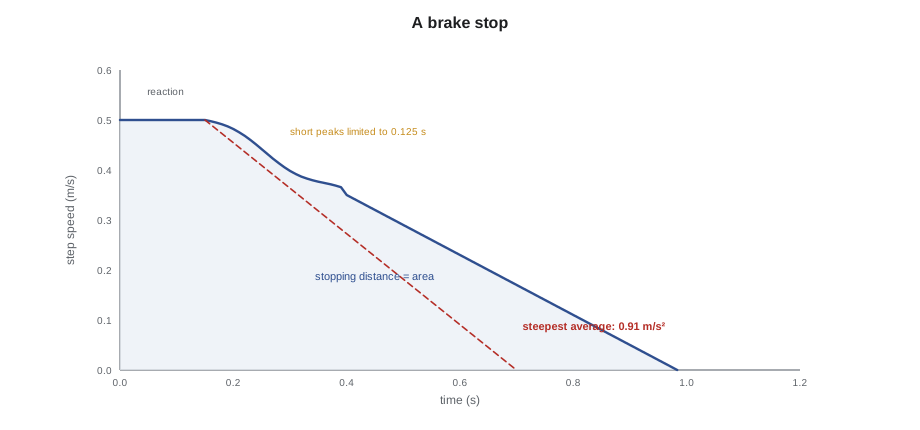
The code sets three main requirements for escalator and moving walk brakes. First, the brake must stop and hold the escalator when it is carrying its brake-rated load, a heavy load on every exposed step on the incline, in the down direction, because that is the worst case. Second, when stopping, the average deceleration must not exceed 0.91 m/s² (3 ft/s²), and any peak above that value must last no more than 0.125 seconds; this protects passengers from being thrown forward. Third, the brake's torque setting must be shown on a data plate on the brake, so that a mechanic can check that the brake has been set to the value the maker designed. Older editions of the code expressed the stopping requirement as a range of stopping distances for each rated speed, a minimum to protect passengers from too sudden a stop and a maximum to stop the crowd in time; many older units in service were tested that way, and their test records still show distances.
The limit of 0.91 m/s² (3 ft/s²) is gentle compared with an elevator's emergency stops. From a speed of 0.5 m/s (100 ft/min), it means an escalator stopping at the limit takes more than half a second and travels at least about 140 mm (5.5 in) after the brake begins to act. In practice the stopping distance is longer, because there is a short reaction time while the brake releases its stored energy and the shoes or pads close their gap, and because a lightly loaded down escalator or an up escalator is easier to stop than the worst case.
# Brake test results: average deceleration from speed and measured stopping distance
speed = 0.5          # m/s at the start of the stop
limit = 0.91          # m/s2, maximum average deceleration
tests = {"down, no load": 0.31, "down, brake-rated load": 0.47, "up, no load": 0.22}   # m
for name, s in tests.items():
    a = speed ** 2 / (2 * s)
    print(f"{name:<24} stop {s} m -> average {a:.2f} m/s2  {'ok' if a <= limit else 'too sudden'}")
reaction = 0.15      # seconds before the brake starts to act
s_min = speed * reaction + speed ** 2 / (2 * limit)
print(f"shortest stop at the limit, including {reaction} s reaction: {s_min:.2f} m")down, no load stop 0.31 m -> average 0.40 m/s2 ok down, brake-rated load stop 0.47 m -> average 0.27 m/s2 ok up, no load stop 0.22 m -> average 0.57 m/s2 ok shortest stop at the limit, including 0.15 s reaction: 0.21 m
The formula used here is the simple constant-deceleration relation, average deceleration equals speed squared divided by twice the stopping distance, and it slightly overstates the deceleration because part of the distance is covered during the reaction time. All three of these Brackenridge results are within the limit. The up stop is the shortest, as expected, because gravity helps stop an up escalator. If a down stop is much shorter than the last test, the brake may be set too hard; if it is much longer, the linings may be worn, contaminated or glazed, or the springs may have weakened.
How much torque the brake must hold
The brake's job is easiest to understand at the main drive shaft. The passengers on the incline pull the step band down the slope with a force equal to their weight times the sine of the incline angle. To stop them, the brake must hold that force and also decelerate the moving mass of the passengers, steps, chains and handrails. The force acts at the radius of the step chain sprockets, so the torque at the main shaft is that force times the sprocket radius, and dividing by the reduction between the brake and the main shaft gives the torque the brake itself must provide. Makers do this calculation with their own load figures and efficiencies; the illustrative version below shows the shape of it.
import math
# Brake torque needed to stop a loaded down escalator (illustrative)
steps, load_per_step = 27, 140          # exposed incline steps, kg brake-rated load per step
band_mass = 4000                         # kg of steps, chains and handrails in motion
angle, decel = 30.0, 0.91                  # degrees, m/s2 average deceleration
radius = 0.3415                              # m, step chain sprocket pitch radius
reduction = 104                           # brake shaft to main shaft
passengers = steps * load_per_step
hold = passengers * 9.81 * math.sin(math.radians(angle))
slow = (passengers + band_mass) * decel
main_shaft = (hold + slow) * radius
print(f"force to hold the load on the slope: {hold:,.0f} N")
print(f"extra force to decelerate the moving mass: {slow:,.0f} N")
print(f"torque at the main shaft: {main_shaft:,.0f} N m")
print(f"torque at the brake (before losses): {main_shaft / reduction:,.0f} N m")force to hold the load on the slope: 18,541 N extra force to decelerate the moving mass: 7,080 N torque at the main shaft: 8,749 N m torque at the brake (before losses): 84 N m
Holding the load on the slope takes most of the torque, and the brake must also provide enough extra to bring the moving parts to rest at the allowed deceleration. The figure on the brake data plate is the maker's setting for this unit, including losses and margins, and it is the value the mechanic checks. Setting a brake much harder than its data plate value is not a safe margin: it produces sudden stops that can throw passengers down the steps, which is exactly what the deceleration limit is there to prevent.
Testing the brakes
Brake tests are part of the periodic tests. The simplest is the no-load stopping test: the escalator is run empty in the down direction, a mark is made on a step or the handrail beside a fixed reference, the stop button is pressed, and the distance the mark travels is measured. A modern test uses a deceleration meter on the step instead of a tape, recording the whole stop. The brake-rated load test is harder, because it needs heavy test weights on many steps: hundreds of kilograms per step on a transit escalator. Many jurisdictions now accept an alternative method based on measuring the brake torque and the no-load stopping performance, then showing by calculation that the brake will stop the loaded escalator within the limits, which avoids loading tonnes of weights onto a staircase. The method allowed, and the records required, depend on the edition in force and the jurisdiction.
At the transit station, the agency's specification asks for brake-rated load tests with weights when a unit is commissioned and alternative tests in later years. Nell's crew uses a torque wrench on the brake drum or disc to confirm the brake's holding torque matches its data plate, a deceleration meter for the stopping tests in both directions, and a check that the auxiliary brake applies and stops the unit when its trigger device is operated by hand. Every result is recorded beside the previous years' results, and a brake whose stopping distance changes noticeably from year to year is inspected even if it is still within limits.
| Test | How it is done | What it shows |
|---|---|---|
| No-load stop, down | run empty, press stop, measure distance or record deceleration | brake condition and setting |
| No-load stop, up | as above in the up direction | comparison; should be shorter |
| Brake-rated load stop, down | test weights on the incline steps, stop and measure | the brake meets the worst case |
| Brake torque check | torque wrench against the brake, compare with data plate | setting matches the maker's design |
| Auxiliary brake test | operate its trigger device, confirm it stops and holds | the backup brake works |
| Brake monitoring | confirm the controller detects a brake that fails to lift or set | the brake's own supervision works |
Worked problem
Interpreting a change in stopping distance
Brackenridge E8's no-load down stop measured 0.33 m (1.08 ft) last year and 0.52 m (1.71 ft) this year from the same speed. Both are inside the deceleration limit. Nell asks Tamsin whether anything needs doing.
Show solution
- The stop is about 60 % longer than last year, which means the brake is producing much less retarding force than it did.
- The result is still within the code limit, which sets only a maximum deceleration, but a brake that has lost that much force in a year is not in the condition it should be.
- Likely causes are worn or contaminated linings, a weakened spring, a binding pin or a brake out of adjustment.
- Inspect the linings and drum or disc for oil and glazing, check the spring length against the data plate setting, free and lubricate the pins, readjust, check the torque and retest.
Answer: Yes: a stop that has grown so much shows lost braking force, so inspect, clean or replace the linings, check the springs and pins, readjust to the data plate and retest.
Common mistakes
MistakeSetting the brake harder than its data plate value for safety.
InsteadA hard brake causes sudden stops that throw passengers forward; set it to the maker's value.
MistakeTesting the brake only in the up direction.
InsteadThe down direction with load is the worst case; test both directions.
MistakeAccepting a large change in stopping distance because it is still within limits.
InsteadInvestigate trends; they show worn linings, weak springs or binding before a failure.
MistakeAssuming the auxiliary brake works because it has never been needed.
InsteadOperate its trigger and confirm it stops and holds the unit at the periodic tests.
MistakeMeasuring a stop without noting the starting speed.
InsteadDeceleration depends on speed squared; record the speed with the distance.
Summary and key terms
- The machine brake is spring-applied and electrically released, so it applies whenever power is removed.
- The auxiliary brake acts on the main drive shaft and holds the steps if the drive chain or gearbox fails.
- Brakes must stop and hold the brake-rated load going down, with average deceleration no more than 0.91 m/s² (3 ft/s²) and only brief peaks above it.
- Average deceleration can be estimated as speed squared over twice the stopping distance.
- Most of the brake torque holds the load on the slope; the rest decelerates the moving mass.
- Brake tests include stopping tests in both directions, load or alternative tests, torque checks against the data plate and auxiliary brake tests, with results compared year to year.
- Machine brake
- The spring-applied, electrically released brake on the drive machine.
- Auxiliary brake
- A brake on the main drive shaft that acts if the drive train fails.
- Brake-rated load
- The heavy load per exposed step used to design and test the brake.
- Average deceleration
- The speed lost divided by the stopping time over a whole stop.
- Brake data plate
- The plate on the brake showing its torque setting.
- Alternative brake test
- A torque and no-load method that replaces loading test weights, where allowed.
Practice problems
Work each problem on paper first, then reveal the answer to check.
An escalator at 0.5 m/s (1.67 ft/s) stops in 0.25 m (0.82 ft). What is the average deceleration?
Show answer
About 0.50 m/s² (1.7 ft/s²).
Why must the brake never be held open mechanically in service?
Show answer
Because it must apply automatically whenever power is removed.
Which direction and load is the worst case for an escalator brake?
Show answer
Down, with the brake-rated load on the incline steps.
What does the auxiliary brake protect against?
Show answer
Failure of the main drive chain or gearbox, which would disconnect the machine brake from the steps.
A stop is much shorter than last year. What might that mean?
Show answer
The brake may be set too hard, which risks sudden stops.
Lesson quiz · 5 questions
Score 60% or more to complete this lesson.
Create a free account to save your progress, take quizzes and earn a certificate.