
ELV-330 · Lesson 10 of 12 · 21 min
Installation and commissioning
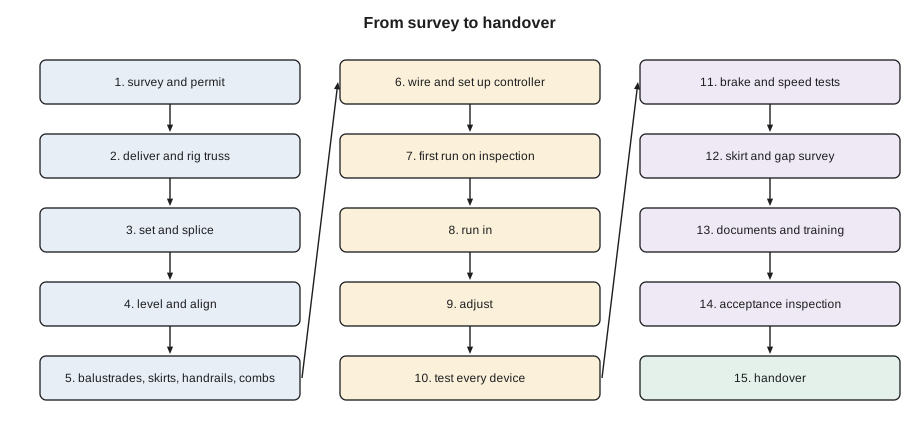
Tamsin had last seen Brackenridge E7 hanging from chain hoists in the parking ramp, when its two truss sections were rigged into the building in ELV-130. Six months later the truss was set, spliced and clad, and the installation crew had handed the unit to Nell for adjustment, testing and handover. "Installation puts the parts in the building," Nell said. "Commissioning proves that every one of them does what the code and the maker say, and leaves a record that the inspector, the owner and the next mechanic can trust." This lesson follows a new escalator from the survey before it arrives to the day it carries its first passengers: setting and aligning the truss, completing the unit, adjusting it, testing it and getting it accepted.
Before the escalator arrives
Installation starts with paperwork and a tape measure. The installer receives the maker's layout drawings, which show the truss support points, the loads on them, the pit dimensions at each end and the clearances around the unit, and compares them with the building as built. The survey checks the floor-to-floor rise, which must match the ordered rise closely because the truss is made to it, the positions and levels of the support steel or concrete, the pit depths, the opening in the floor, the headroom, and the building's power supply and disconnect location. At Brackenridge, the survey also checked the access route from the loading dock, the ramp gradient and the floor loadings along it, because the truss sections had to be rolled through the parking level before being lifted.
Permits come next. In British Columbia, the contractor registers the installation with Technical Safety BC and submits the required design documents before work starts. The escalator's design must meet the code edition in force for the jurisdiction, and any variance must be approved in writing.
Setting and aligning the truss
Once the truss sections are in the building, they are set on their supports, joined at the splice and aligned. The splice bolts are tightened to the maker's torque, or the splice is welded by qualified welders to the maker's procedure. The truss is then set level across its width, so that the steps will not lean toward one skirt, and straight along its length, so that the tracks will be in line. Alignment is checked with a precision level across the truss at several stations and with a taut wire or optical line along it, and the supports are shimmed until the readings are within the maker's tolerances. Finally the bearing at the free end is checked for its overlap and its free gap, the seismic restraints are fitted, and the support fixings are tightened.
# Truss levelling record: cross-level readings along E7 against the maker's tolerance
tolerance = 0.5                     # mm per metre across the truss
stations = {"upper landing": 0.2, "upper transition": -0.3, "mid incline": 0.7,
            "lower transition": 0.1, "lower landing": -0.2}   # mm per metre, + means right side high
worst = max(stations, key=lambda k: abs(stations[k]))
for name, r in stations.items():
    print(f"{name:<17} {r:+.1f} mm  {'ok' if abs(r) <= tolerance else 'reshim'}")
print(f"worst station: {worst}, {stations[worst]:+.1f} mm")upper landing +0.2 mm ok upper transition -0.3 mm ok mid incline +0.7 mm reshim lower transition +0.1 mm ok lower landing -0.2 mm ok worst station: mid incline, +0.7 mm
The mid-incline station on E7 was out of tolerance, with the right side high, because the intermediate support under it had been shimmed before the lower section was spliced. The crew lowered the right side of that support by removing a shim, and the reading came back within tolerance. A truss that is not level across its width makes every step lean toward one skirt, which closes the gap on one side and opens it on the other; fixing it now saves fighting the skirt gaps for the life of the escalator.
Completing the unit
Modular escalators like E7 arrive with much of their machinery fitted in the factory: the drive, the tracks, the step chains and often the steps. Other parts are fitted on site after the truss is set, because they would be damaged in transport or because they must be fitted to the building: the balustrade panels, which are often glass, the interior and exterior decks, the skirt panels, the handrails, the comb plates and landing plates, the lighting, the signs and the final wiring. The handrail is fitted to its guides and spliced to length on site. The installer then fits the controller connections, sets the motor overloads and the drive parameters from the maker's data, and runs the escalator for the first time on inspection operation, slowly, watching every step pass the combs and skirts.
Running in and adjusting
A new escalator is run in before it is tested. It runs for many hours, often several days, in both directions with no passengers, while the chains, gears and handrails bed in and the crew watches for noises, hot bearings, oil leaks and steps rubbing. After running in, the step chains are checked for initial stretch and the tension carriage reset, the gearbox oil is checked and sometimes changed, and the main adjustments are made: the step position between the skirts, the comb mesh at both landings, the handrail tension and drive pressure, the brake to its data plate setting, and every safety device to its gauge. On E7, Nell found the left handrail running 2.4 % faster than the steps after running in; she adjusted the drive to bring it within the maker's target and recorded both readings.
Acceptance tests
Before the escalator can carry passengers, the installer carries out the acceptance tests in the code, and the authority's inspector witnesses them or checks the records. The tests prove that every safety device operates and stops the escalator, including manual reset where required; that the brake stops the escalator within the deceleration limits and holds the brake-rated load in the down direction, with weights or by the alternative method where the authority accepts it; that the speed is correct with and without load; and that the step-to-skirt loaded gaps, the step and skirt performance index, the comb mesh, the handrail speed, the lighting, the signs and the safety zones meet the code. The tests and their results are recorded on the authority's forms or the maker's equivalent.
| Test or check | Criterion (where the code gives one) | E7 result |
|---|---|---|
| Every safety device | operates and stops the unit; manual reset where required | all operated, all stopped |
| Brake, down, brake-rated load | stops and holds; average deceleration within the limit | within limit |
| Rated speed, no load and full load | within the maker's and code's tolerance | within tolerance |
| Handrail speed | moves with the steps; maker's target 0 to +2 % | +0.8 % left, +0.6 % right |
| Loaded gaps | 5 mm (0.2 in) or less | largest 3.6 mm (0.14 in) |
| Step and skirt performance index | within the code limit for a new unit | within limit |
| Comb mesh and comb impact devices | maker's depth; devices stop the unit | correct; devices stopped the unit |
| Lighting at the combs and steps | at least 50 lux (5 footcandles) | above 50 |
| Caution signs and safety zones | as required by the code | fitted; zones clear |
Documents, training and handover
The installer leaves a set of documents with the escalator: the wiring diagrams, the maker's maintenance instructions, the maintenance control program for the unit, the data plates on the machine, brake and controller, the test records and the code data the authority requires. The maintenance control program sets out what is checked and when, and it is the document that the inspector will ask for at every periodic inspection; lesson 11 describes it. The building's staff who will start and stop the escalator are trained in how to start it safely, what to do when it stops, how to deal with an emergency stop and what they must not do, such as restarting after a manual-reset device without calling the mechanic.
With the tests passed and the documents in place, the inspector carries out the acceptance inspection, and Technical Safety BC issues the authority to operate and the unit's operating permit. Only then may the escalator carry the public. E7's acceptance inspection took most of a night, and the inspector asked for one correction, a caution sign that had been fixed at the wrong height on the lower newel. The sign was moved the next night and E7 opened to shoppers that weekend, with slow-speed standby switched on as the mall had asked.
Worked problem
Planning the acceptance night
Nell is asked to plan the acceptance inspection night for E7 so that the inspector's time is used well. Tamsin is asked what must be ready before the inspector arrives.
Show solution
- All adjustments must be finished and every pre-test done by Northcrest, with results recorded, so the inspector witnesses tests that will pass rather than watching the crew adjust.
- The test equipment must be on site and calibrated: test weights or the alternative brake test equipment, deceleration meter, tachometer, loaded gap tool and skirt friction tester, light meter and gauges.
- The documents must be on site: wiring diagrams, maintenance control program, data plates checked, and the record forms prepared.
- The mall must have closed the area, barricades must be in place, and the crew must know the order of the tests so that the escalator is not loaded and unloaded twice.
Answer: Finish all adjustments and pre-tests, bring calibrated test equipment and the documents, and arrange the site and the test order before the inspector arrives.
Replacing an escalator in a building that stays open
Much of the escalator work in both cities is not new installation but replacement: an old unit removed and a new one put in its place in a building that must keep working. The transit agencies in both cities are in the middle of such programs, replacing original escalators one at a time so that every station keeps at least one way up and down. A replacement adds steps to the installation sequence. The old unit is surveyed first, because the new truss must fit the old opening and supports or the building must be altered; the old steps, handrails, balustrades and drive are stripped out; the old truss is cut into sections and removed through the same route the new one will use; and the supports are checked and modified before the new truss arrives. Throughout, the work area is enclosed with solid hoarding, dust and noise are controlled, and the public route around the work is kept clear and signed.
Some owners choose a modernization instead, keeping the old truss and replacing everything inside it: steps, chains, tracks, drive, controller, handrails and balustrades. A modular replacement like E7's is quicker and gives a new truss built to the current code, while a modernization avoids the cost and disruption of removing the truss. Either way, the finished unit must meet the code edition that applies to the alteration, and it goes through the same acceptance tests as a new escalator before it carries passengers.
| Common commissioning finding | Usual cause | Fix |
|---|---|---|
| Steps rub one skirt | truss out of level across its width, or step side guides set off-centre | re-level or re-centre the steps |
| Handrail runs fast or slow | drive pressure or ratio not yet adjusted after running in | adjust to the maker's target |
| Nuisance step device trips | devices set before running in | reset to the gauge after running in |
| Brake stop too short or too long | brake not yet bedded in or set to the data plate | bed in, set and retest |
| Caution sign or lighting wrong | fitted from a generic drawing | correct to the code and the inspector's comments |
Common mistakes
MistakeStarting installation before checking the building's rise and supports against the layout.
InsteadSurvey first; a truss is made to a rise and cannot be stretched to fit.
MistakeLeaving the truss slightly out of level across its width.
InsteadIt makes every step lean to one skirt and causes gap problems for the life of the unit.
MistakeTesting before running in.
InsteadRun in first, then reset the chains, oil and adjustments, then test.
MistakeMaking adjustments while the inspector watches.
InsteadPre-test everything so the acceptance inspection witnesses finished work.
MistakeOpening the escalator to the public after passing the tests but before the authority accepts it.
InsteadWait for the authority's acceptance and operating permit.
Summary and key terms
- Installation begins with a survey of the building against the maker's layout and with the permit.
- The truss is set, spliced, levelled across and aligned along its length, and its free-end bearing and seismic restraints are checked.
- Balustrades, decks, skirts, handrails, combs and wiring are completed on site, and the first runs are on inspection.
- Running in beds the parts in, after which chains, oil and all adjustments are reset.
- Acceptance tests cover every safety device, the brake, speeds, handrail speed, gaps and index, combs, lighting, signs and safety zones.
- The installer leaves documents, including the maintenance control program, trains building staff, and the unit carries passengers only after the authority accepts it.
- Layout drawing
- The maker's drawing showing supports, loads, pits and clearances for the escalator.
- Splice
- The joint between truss sections, bolted or welded on site.
- Running in
- Running a new escalator for many hours before testing so its parts bed in.
- Acceptance test
- The tests that prove a new or altered escalator meets the code before use.
- Maintenance control program
- The document setting out what is maintained and tested, and when.
- Operating permit
- The authority’s permission for an escalator to carry the public.
Practice problems
Work each problem on paper first, then reveal the answer to check.
Why must the rise be checked before the truss arrives?
Show answer
The truss is made to the ordered rise and cannot be altered to fit a different one.
What happens if the truss is not level across its width?
Show answer
The steps lean toward one skirt, closing the gap on one side and opening it on the other.
Why is a new escalator run in before testing?
Show answer
So the chains, gears and handrails bed in and can be reset before the final adjustments and tests.
Name four things the acceptance tests check.
Show answer
Safety devices, brake, speed and handrail speed, plus gaps, index, combs, lighting, signs and safety zones.
When may a new escalator carry the public?
Show answer
Only after the authority's acceptance inspection and permission to operate.
Lesson quiz · 5 questions
Score 60% or more to complete this lesson.
Create a free account to save your progress, take quizzes and earn a certificate.