
ELV-330 · Lesson 12 of 12 · 22 min
Capstone: a skirt obstruction trip and a step chain inspection
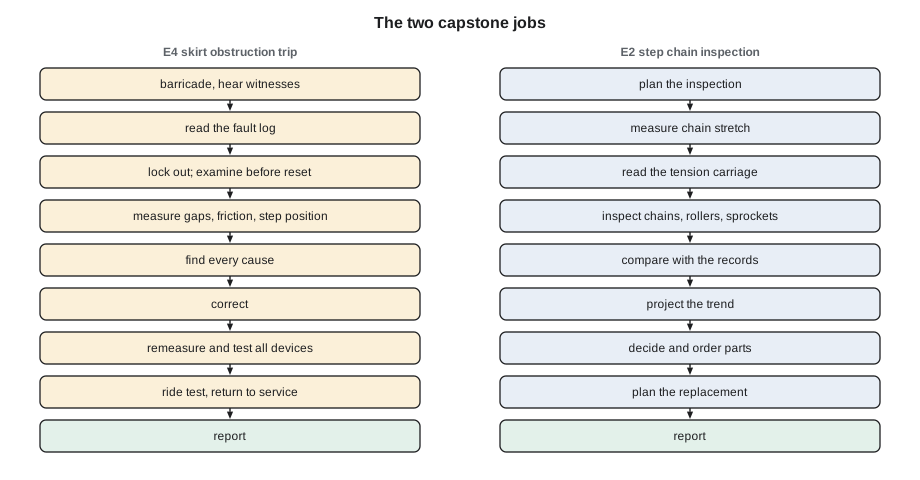
The capstone for the term was two jobs at Brackenridge in the same week, one that nobody planned and one that had been on the calendar for a year. The unplanned one came on a Saturday afternoon, when E4, a down escalator from the main level to the lower mall, stopped itself with a child standing near the bottom. The planned one was E2's annual step chain inspection, booked for the following Tuesday night. Lena gave both to Tamsin, with Nell beside her but under instructions to stay quiet unless something unsafe was about to happen. "One job tests whether you can investigate," Lena said. "The other tests whether you can measure and plan. Between them they use everything from this term." This lesson follows both jobs from the first call to the written reports.
Part 1: the call
Mall security called Northcrest's dispatch at 15:42. E4 had stopped while a family was riding down; a seven-year-old's soft rubber shoe had been pressed against the right skirt near the bottom, and the escalator had stopped with the child's foot against the skirt. The child's father had lifted the child off, the shoe was scuffed and the child was not hurt. Security had barricaded both landings, kept the family's names, and asked the family to wait so that someone could hear what had happened. Tamsin and Nell arrived at 16:20. Before touching anything, Tamsin spoke to the father and the security officer, wrote down where the family had been standing, which side and how close to the bottom, and photographed the shoe with the father's permission. Then she read the controller's fault log: one stop at 15:41 from the lower right skirt obstruction device, a manual-reset device, with no other faults that day.
Nell's rule for an entrapment or near-entrapment is that the unit stays out of service until the cause is understood and corrected, even if it looks fine, and that nothing is changed before it has been measured, because the measurements are the evidence. Lena called the mall's manager to explain that E4 would stay out of service until the following morning at least, and, because a passenger's shoe had been caught, made the report the jurisdiction requires and kept a copy with the job file. The family were thanked and given the mall manager's contact.
Part 2: the investigation
With E4 locked out, Tamsin examined the lower right skirt before resetting anything. The skirt obstruction device itself had operated correctly: its switch was open, and the skirt panel in front of it showed a fresh scuff at about the height of a child's foot. The skirt deflector brush along the lower right was worn short over about 1.5 m (5 ft) just above the lower transition, with several tufts missing, where a cleaning machine had been driven against it, the mall's cleaning contractor later admitted. The skirt panel there had a sticky film; the mall's night cleaners had been using a general-purpose spray polish on the skirts for some weeks, despite the maker's instructions.
Then she measured. She surveyed the loaded gaps along the right skirt at the lower end with the loaded gap tool, measured the skirt friction with the maker's friction tester on the polished panel and on a clean panel further up, and checked the steps' position between the skirts. The steps were running about 1 mm (0.04 in) toward the right skirt at the lower end, because the side guide pads on the lower right had worn more than the maker's limit. The measurements are below.
import math
# E4 lower right skirt: survey before and after correction
before = {"gaps": [4.1, 4.8, 5.3, 5.1, 4.4], "friction": 0.47}
after = {"gaps": [3.2, 3.4, 3.6, 3.5, 3.3], "friction": 0.27}
limit = 5.0                                   # mm loaded gap limit
def index(gap, mu):
    y = -3.77 + 2.37 * mu + 0.37 * gap * 1
    return math.exp(y) / (1 + math.exp(y))
for name, d in (("before", before), ("after", after)):
    worst = max(d["gaps"])
    over = sum(1 for g in d["gaps"] if g > limit)
    print(f"{name:>6}: largest loaded gap {worst} mm, {over} of {len(d['gaps'])} points over the limit, "
f"friction {d['friction']}, index {index(worst, d['friction']):.3f}")before: largest loaded gap 5.3 mm, 2 of 5 points over the limit, friction 0.47, index 0.333 after: largest loaded gap 3.6 mm, 0 of 5 points over the limit, friction 0.27, index 0.142
Before correction, two points were over the loaded gap limit, the skirt friction was very high, and the index was well above the limit for the unit. No single fault had caused the incident. The worn side guide pads had let the steps drift toward the right skirt and open the gap; the sticky polish had made the skirt grip a rubber shoe instead of letting it slide; and the worn deflector brush had stopped pushing feet away from the gap. The skirt obstruction device had done its job by stopping the escalator before the shoe reached the comb, which is exactly what it is for.
Part 3: the correction
The corrections followed the causes. The lower right side guide pads were replaced with the maker's parts on the steps that had them worn beyond the limit, and the steps' position between the skirts was rechecked along the whole lower end. The skirt panels were cleaned of the polish with the maker's cleaner and treated with the maker's approved low-friction product along their full length on both sides. The worn section of deflector brush was replaced and the rest of both brushes inspected. Then the measurements were repeated, giving the results above: every gap well inside the limit, friction back to normal and the index low.
Before resetting the skirt obstruction device, Tamsin tested every skirt obstruction device on the unit with the maker's test tool and confirmed that each stopped the escalator, then tested the comb impact devices and the step level devices at the lower end, because the side guide work had disturbed the steps near them. Nell rode the escalator with her, both pressing a test shoe against the skirt at the lower end as the maker's procedure describes, and the shoe slid freely along the treated skirt. E4 returned to service at 03:10 on Sunday, and the authority's inspector visited on the Monday, reviewed the measurements and photographs, and accepted the corrections.
| Time | Event |
|---|---|
| 15:41 | E4 stops: lower right skirt obstruction device |
| 15:42 | security calls dispatch; landings barricaded |
| 16:20 | Northcrest on site; witnesses heard, shoe photographed, fault log read |
| 16:45 | unit locked out; skirt, brush and device examined before reset |
| 17:30 | loaded gaps, friction and step position measured |
| 19:00 | parts collected; mall agrees unit stays out overnight |
| 22:00 | side guide pads replaced, skirts cleaned and treated, brush replaced |
| 01:40 | remeasured; all devices at the lower end tested |
| 03:10 | unit returned to service after a ride test |
| Monday | inspector reviews the record and accepts the corrections |
Part 4: the step chain inspection
The following Tuesday, Tamsin led E2's annual step chain inspection. The plan, written the week before, set out the scope: measure the stretch of both step chains over the same 30-link runs used in previous years, record the tension carriage position, inspect the chains, rollers and sprockets through the step window, check the broken step chain device, and compare everything with the unit's record. E2 runs about thirteen hours a day, every day, and its chains are the original ones, eighteen years old.
With E2 stopped on the incline so the chains were in tension, locked out and barricaded, Tamsin and Nell measured the marked runs on both sides, then read the tension carriage scale. The left chain measured 1.33 % elongation and the right 1.21 %, and the carriage had used 78 % of its travel. The chain rollers were in fair condition, but several on the left showed flats, and the step chain sprocket teeth on the main shaft had started to hook at their working faces. The broken step chain device tested correctly.
# E2 step chain stretch: trend and projection to the maker's limit (illustrative records)
years = [2021, 2022, 2023, 2024, 2025, 2026]
left = [0.71, 0.82, 0.93, 1.06, 1.18, 1.33]      # percent elongation each year
right = [0.66, 0.76, 0.85, 0.96, 1.08, 1.21]
limit = 1.5
def fit(xs, ys):
    n = len(xs); mx = sum(xs) / n; my = sum(ys) / n
    slope = sum((x - mx) * (y - my) for x, y in zip(xs, ys)) / sum((x - mx) ** 2 for x in xs)
    return slope, my - slope * mx
for side, ys in (("left", left), ("right", right)):
    slope, icpt = fit(years, ys)
    reach = (limit - icpt) / slope
    recent = ys[-1] - ys[-2]
    print(f"{side:>5}: now {ys[-1]:.2f} %, average rise {slope:.3f} %/yr, last year {recent:.2f} %, limit reached about {reach:.1f}")
print("difference between sides now:", round(left[-1] - right[-1], 2), "%")left: now 1.33 %, average rise 0.123 %/yr, last year 0.15 %, limit reached about 2027.5 right: now 1.21 %, average rise 0.109 %/yr, last year 0.13 %, limit reached about 2028.8 difference between sides now: 0.12 %
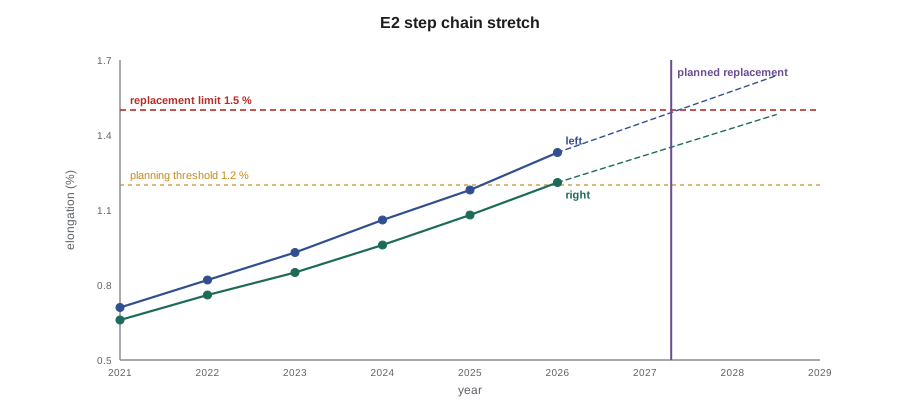
The trend made the decision. Both chains had stretched steadily, but the rise had sped up in the last two years, and the left chain had gained 0.15 % in the past year alone. The trend line puts the left chain at the maker's limit around the middle of 2027, only about eight months away, and the carriage would run out of travel at about the same time. The difference between the sides, now 0.12 %, was growing too, which is how steps begin to run out of square and rub one skirt, the same mechanism behind part of the E4 incident.
Part 5: the plan
Tamsin's recommendation, which Nell and Lena approved, had four parts. First, replace both step chains on E2 in the spring of 2027, before the left chain reaches the limit, together with the step chain sprockets on the main shaft, because new chains on hooked sprockets wear quickly and run rough; replace the step rollers at the same time, since every step must come out anyway. Second, until then, measure the chains every quarter instead of every year, and investigate at once if any reading jumps. Third, check the chain lubricator's delivery and the oil grade now, because accelerating stretch can mean lubrication has fallen off; Tamsin found one of the left-side brushes clogged and cleaned it. Fourth, order the chains and sprockets at once, because the maker's lead time was about four months, which left little time to spare.
The replacement job itself was planned as a set of night shifts. All the steps are removed and stacked in order, the old chains are separated and lowered out of the truss in sections, the sprockets are changed on the main shaft with their alignment marks set, the new chains are fed in and joined, the tension carriage is reset to its new-chain position, the steps are refitted with new rollers, and the unit is run in, adjusted and tested as a major repair, including the safety devices, the brake, the handrail speeds and the skirt survey. Because a step chain replacement is a repair to a load-bearing part, Lena checked whether the authority required a permit and an inspection for it, as many jurisdictions do for chain replacement, and added the permit to the plan.
| Item | Finding | Action |
|---|---|---|
| Left step chain | 1.33 % elongation, rising faster | replace in spring 2027; measure quarterly |
| Right step chain | 1.21 % elongation | replace with the left |
| Tension carriage | 78 % of travel used | reset at replacement |
| Chain rollers | flats on several left-side rollers | replace all rollers with the chains |
| Step chain sprockets | teeth starting to hook | replace with the chains |
| Chain lubricator | one left brush clogged | cleaned; delivery checked |
| Broken step chain device | tested correctly | none |
Part 6: the reports
Both jobs ended in written reports, which became part of Tamsin's apprenticeship record and of the units' records. The E4 report described the incident as the witnesses and the fault log recorded it, the measurements before and after with the photographs, the three contributing causes, the corrections, the tests and the inspector's acceptance. It also made two recommendations to the mall: that its cleaning contractor use only the escalator maker's skirt and handrail products, with the products named and a label fixed inside each controller cabinet; and that cleaning machines be kept away from the skirt brushes. The E2 report set out the chain measurements and trend, the projection, the inspection findings, the plan, the parts ordered and the permit question, and gave the mall a budget figure for the replacement in the coming year.
Nell's comment on the E4 report was short. "You didn't fix the escalator," she wrote. "You fixed three things that together made it unsafe, and you proved it with numbers. That's the job."
Worked problem
Deciding whether a unit can return to service
At 01:40 on Sunday, after the corrections on E4, a member of the mall's management asks whether the escalator can simply be reset and run, since the skirt device "only tripped because it was working". Tamsin is asked how to answer.
Show solution
- The device did trip because it was working, but it was working because a shoe was caught, and the investigation found three faults that made that possible.
- Those faults have now been corrected and measured: gaps within the limit, friction normal, index low, brushes replaced.
- Every device at the lower end has been tested and stopped the unit, and the ride test with a test shoe has been done.
- So the unit can return to service now, with the report to follow and the inspector's review on Monday; it could not have returned before the corrections and tests.
Answer: Yes, now: because the causes have been corrected, measured and tested, not because the device was working.
Common mistakes
MistakeResetting a skirt obstruction device as soon as the unit is barricaded.
InsteadMeasure and examine first; the device's state and the skirt are evidence.
MistakeLooking for one cause of an entrapment.
InsteadGaps, friction, brushes and step position usually combine; measure all of them.
MistakeWaiting for a chain to reach the maker's limit before ordering a replacement.
InsteadPlan from the trend and the lead time, and replace well before the limit.
MistakeFitting new chains on worn sprockets.
InsteadReplace hooked sprockets with the chains, and the rollers while the steps are out.
MistakeLeaving the cause of contaminated skirts with the building.
InsteadName the approved products in writing and label them at the unit.
Summary and key terms
- After an entrapment or near-entrapment, the unit stays out of service and is measured before anything is reset or changed.
- E4's incident had three causes: worn side guides opening the gap, polish raising skirt friction, and a worn deflector brush.
- Corrections followed the causes, and remeasurement, device tests and a ride test proved the unit safe before return to service.
- E2's step chains were stretching faster each year; the trend and the lead time set the replacement date, before the limit is reached.
- Chain replacement includes sprockets and rollers, run-in, adjustment and full testing, and may need a permit.
- Clear written reports record the evidence, causes, corrections and recommendations for the owner, the authority and the next mechanic.
- Near-entrapment
- An incident in which a passenger or object is caught but nobody is seriously hurt.
- Contributing cause
- One of several conditions that together allowed an incident to happen.
- Side guide pads
- Wear pads on the steps or tracks that keep the steps centred between the skirts.
- Trend projection
- Estimating from past readings when a measurement will reach its limit.
- Lead time
- The time between ordering parts and receiving them.
- Major repair
- A repair of a load-bearing or safety part that needs full testing and may need a permit.
Practice problems
Work each problem on paper first, then reveal the answer to check.
Why was E4 kept out of service even though the skirt device worked?
Show answer
Because a shoe had been caught, and the causes had to be found and corrected before passengers rode it again.
Name E4's three contributing causes.
Show answer
Worn side guide pads letting the steps drift right, polish raising skirt friction, and a worn deflector brush.
Why measure before changing anything?
Show answer
The measurements are the evidence of the condition that caused the incident.
Why were E2's sprockets replaced with its chains?
Show answer
Their teeth had started to hook, and new chains on worn sprockets wear quickly and run rough.
What set the date for E2's chain replacement?
Show answer
The projected date of reaching the maker's limit, the faster recent rise and the four-month lead time.
Lesson quiz · 5 questions
Score 60% or more to complete this lesson.
Create a free account to save your progress, take quizzes and earn a certificate.