
ELV-330 · Lesson 4 of 12 · 21 min
Step chains, steps and pallets
On her third night at Brackenridge, Tamsin learned how to take a step out of an escalator. Nell ran E6 on inspection until the step to be removed sat over the window at the lower landing, locked the unit out, released the step's axle clips and lifted the step out by its tread, then set it on the step cart with its tread down. "Every step is a passenger's floor," she said. "When it goes back in, it goes back exactly as it came out, and you check the step on each side of it before you run anything." The removed step had a cracked cleat at its front edge; the new one went in, and the next three steps were examined through the window as the band was inched past on inspection. This lesson covers the step band itself: the chains that pull it, the steps that make it, and the pallets that take their place on moving walks.
The step chains
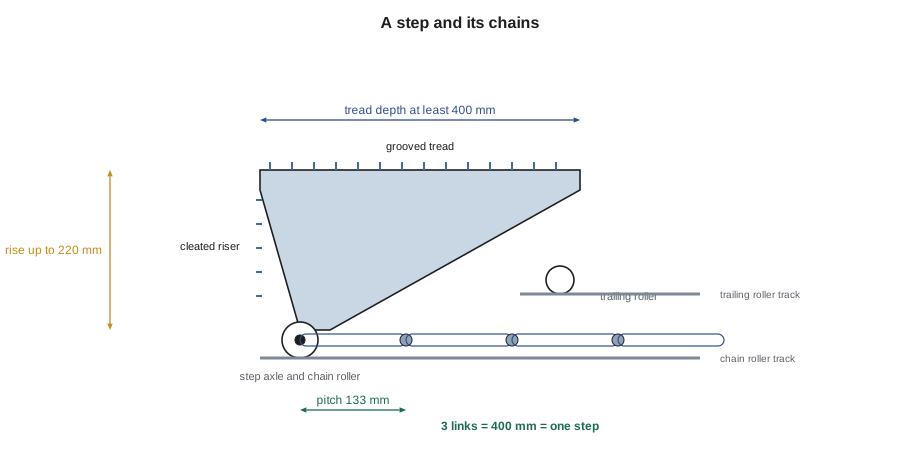
An escalator has two step chains, one on each side of the step band. Each is a long roller chain with large rollers that run on the chain roller track, and the steps hang between the two chains on step axles. On most units the chain pitch is about 133 mm (5.25 in), so three chain links make up the 400 mm (15.75 in) length of one step, and every third pin is a step axle. The chains pass around the step chain sprockets on the main drive shaft at the top and around the tension carriage at the bottom. Transit guidelines ask for heat-treated roller chains with a safety factor of at least six on their breaking strength and large rollers built for very long bearing lives, because a transit chain runs for most of the day under heavy loads.
At the lower landing, the step chains wrap around a pair of sprockets or a curved track on the tension carriage, which is pushed away from the upper end by springs. The springs keep the chains taut as they wear, and the carriage slides in guides as the chains stretch. The carriage has a limit to how far it can travel; when the chains have stretched enough to use most of that travel, they must be shortened by removing links or, more usually, replaced. A broken step chain device, described in lesson 7, watches the carriage position and stops the escalator if a chain breaks or stretches suddenly.
Chain stretch and wear
A roller chain stretches because its pins and the bushes they turn in wear, so each link becomes a little longer than new. The stretch does not change the strength of the chain much at first, but it changes how the chain meets the sprocket teeth, and stretched chains climb the teeth, run rough and wear the sprockets. On an escalator, stretch has two extra effects. The tension carriage moves to take up the slack, and when it reaches the end of its travel the chains go slack. And because the two chains rarely stretch by exactly the same amount, the steps can begin to run out of square, which shows as a step rubbing the skirt on one side or a gap opening between steps.
The code's periodic tests include a check of the permissible stretch of escalator chains, and the limit comes from the maker, who knows the chain's design. The usual field method is to measure the length of a run of links under tension, either with the escalator stopped and the chain in tension on the incline or with a chain gauge, and compare it with the length of the same number of new links. The result is expressed as a percentage elongation. Nell's crew also records how far the tension carriage has moved from its position when the chains were new, because the carriage travel left shows how long the chains have before they must be dealt with.
# Step chain elongation check (maker's limits are illustrative)
pitch = 133.33            # new chain pitch, mm
links = 30             # links in the measured run
limit, plan_at = 1.5, 1.2   # percent: maker's replacement limit and planning threshold
readings = {"E6 left": 4036.0, "E6 right": 4031.5}
for side, measured in readings.items():
    new = links * pitch
    stretch = 100 * (measured - new) / new
    status = "replace" if stretch >= limit else ("plan replacement" if stretch >= plan_at else "in service")
    print(f"{side}: {measured} mm over {links} links, new {new:.1f} mm, elongation {stretch:.2f} %  -> {status}")
diff = abs(readings["E6 left"] - readings["E6 right"])
print(f"difference between sides: {diff:.1f} mm over the measured run")E6 left: 4036.0 mm over 30 links, new 3999.9 mm, elongation 0.90 % -> in service E6 right: 4031.5 mm over 30 links, new 3999.9 mm, elongation 0.79 % -> in service difference between sides: 4.5 mm over the measured run
E6's chains are inside the planning threshold, with a small difference between the two sides. Nell entered the readings in the unit's record beside the readings from the last three years, which showed a steady rise of about a tenth of a percent a year, so replacement could be planned years ahead. A sudden jump between readings would be a different matter: it suggests a damaged chain, poor lubrication or a seized roller, and it is investigated at once.
Lubrication of the chains
Step chains and the main drive chain are lubricated by an automatic lubricator on most modern escalators: a pump and reservoir in the upper machine space that delivers a measured amount of oil to brushes or nozzles over the chains at set intervals. Too little oil and the pins and bushes wear quickly; too much and the oil drips into the truss, collects dirt and becomes a fire load and a mess on the return steps. The lubricator's reservoir level, its timer setting and the condition of its brushes and lines are checked at every maintenance visit, and the oil must be the grade the maker specifies. Some newer units use chains with sealed or self-lubricating bushes that need no oil, which is part of the reason modern escalators run cleaner than the units of the 1980s.
The steps
Most modern steps are one-piece aluminium die-castings, with a grooved tread on top and a cleated riser at the front. The grooves, or cleats, on the tread mesh with the comb teeth at the landings so that a passenger's shoe is lifted off the step rather than drawn into the comb, and the cleats on the riser mesh with the grooves at the back of the step in front, so that the gap between the steps stays small as they change from a stair to a flat surface. The step's front axle hangs on the step chains, and its trailing rollers run on the trailing roller track. Yellow demarcation lines, either painted or moulded inserts, mark the back and sides of each tread so that passengers can see where one step ends and where the skirt begins.
The code sets the main dimensions of the step. The tread depth must be at least 400 mm (15.75 in) and the step rise no more than 220 mm (8.5 in). The step width between the skirts must be between 560 mm (22 in) and 1,020 mm (40 in). The tread grooves are limited in width and spacing so that they cannot trap a heel or a small finger, and the clearance between the tread of one step and the riser of the next is limited too. Steps are also designed for a heavy load: transit guidelines ask for a step to carry its design load with a safety factor of eight on its ultimate strength.
| Step dimension or feature | Code requirement | Why |
|---|---|---|
| Tread depth | at least 400 mm (15.75 in) | room for a passenger's foot |
| Step rise | no more than 220 mm (8.5 in) | a comfortable stair height |
| Width between skirts | 560 mm to 1,020 mm (22 in to 40 in) | standard step sizes |
| Tread groove width | no more than 6.5 mm (1/4 in) | heels and fingers cannot enter |
| Tread groove spacing | no more than 9.5 mm (3/8 in) on centres | the comb teeth mesh closely |
| Tread to riser clearance | no more than 6 mm (1/4 in) | fingers and shoes cannot be drawn in between steps |
| Demarcation | yellow lines at the back and sides of the tread | passengers see the edge of each step |
Inspecting and replacing steps
Steps are inspected through a window at the lower landing, where a few steps are removed and the band is moved past on inspection operation. Each step is checked for cracked or broken cleats on the tread and riser, worn or loose demarcation inserts, cracked castings near the axle bosses, worn or flat-spotted rollers, and loose fixings. A cracked cleat at the front edge of the tread is the most common fault, usually caused by a cart wheel or a stroller catching the comb, and it matters because a broken cleat lets the comb teeth drop into the gap. Rollers are replaced in sets when they wear flat or their tyres separate, because a worn roller lets the step run low. A step replaced with a new one must be of the same type and fitted with the same axle clips or fixings; mixing step types on one escalator is not allowed unless the maker approves it.
When steps are out of the escalator, the truss is open. The step gap is guarded, the escalator is moved only on inspection with someone watching the gap, and nobody climbs into the truss through the window while the step band can move. Removed steps are stacked on a cart in the order they came out, tread down so the cleats are not damaged, and every step is accounted for before the window is closed.
Pallets on moving walks
Moving walks use pallets instead of steps. A pallet is a flat, grooved platform, usually aluminium, carried between two pallet chains in the same way as a step, but it never forms a stair, so it has no riser. The pallets overlap or butt against each other with a small gap that is limited by the code, and adjacent pallet ends must stay level with each other within about 1.6 mm (1/16 in), because a pallet edge that stands proud is a trip hazard for a traveller pulling a suitcase. At the airport, the pier walks have 1,400 mm (56 in) pallets, wide enough for a passenger with a luggage cart, and a pallet level device that stops the walk if a pallet drops at its trailing edge. Some older or very long walks use a rubber belt over rollers instead of pallets; belts have their own groove rules and tracking adjustments.
Worked problem
Deciding what a step fault means
During a step inspection on E6, Tamsin finds one step whose left trailing roller has worn flat on one side, and the step behind it has a cracked tread cleat at the front edge. Nell asks her what to do with each and whether they are connected.
Show solution
- The flat roller lets the step sit low on the left as it passes the comb, so its front edge can strike the comb teeth.
- A step running low at the comb can crack the cleats of the next step as it meets the comb, so the two faults may well be connected.
- Replace the roller and the cracked step, then check the comb teeth at both landings for breaks and the comb plate for impact marks.
- Record both faults and check the other trailing rollers for wear, since rollers wear at similar rates.
Answer: Replace the worn roller and the cracked step, check the combs for damage, and inspect the remaining rollers, since the low step probably caused the cracked cleat.
Common mistakes
MistakeMeasuring chain stretch without tension on the chain.
InsteadMeasure under tension or with a chain gauge, over the same number of links each time.
MistakeRecording stretch only as pass or fail.
InsteadRecord the actual percentage and the tension carriage position so the trend shows when to plan replacement.
MistakeOver-oiling the chains to be safe.
InsteadExcess oil collects dirt in the truss and becomes a fire load; set the lubricator to the maker's rate.
MistakeReplacing a cracked step and ignoring why it cracked.
InsteadLook for a low step, a worn roller or a damaged comb that caused it.
MistakeClimbing into the truss through a step window.
InsteadNever enter the truss with the step band able to move; guard the gap and move the band only on inspection.
Summary and key terms
- Two step chains carry the steps on step axles; on most units three links make one step.
- The tension carriage at the lower landing keeps the chains taut and shows how much they have stretched.
- Chain stretch is measured as a percentage over a counted run of links and compared with the maker's limit; the trend matters as much as the reading.
- Automatic lubricators oil the chains; both too little and too much oil cause trouble.
- Steps have grooved treads and cleated risers that mesh with the combs and with each other; the code limits their dimensions, grooves and clearances.
- Moving walks use flat pallets or a belt, with limits on pallet gaps and on level differences between pallets.
- Step axle
- The pin at the front of a step that hangs it between the two step chains.
- Tension carriage
- The spring-loaded assembly at the lower landing that keeps the step chains taut.
- Chain elongation
- The stretch of a chain from wear of its pins and bushes, expressed as a percentage.
- Cleat
- A raised rib on a step tread or riser that meshes with the comb or the next step.
- Demarcation line
- A yellow line marking the edges of a step tread.
- Pallet
- A flat platform forming the moving surface of a moving walk.
Practice problems
Work each problem on paper first, then reveal the answer to check.
A 30-link run of 133.33 mm (5.25 in) pitch chain measures 4,040 mm (159.1 in). What is the elongation?
Show answer
New length 4,000 mm (157.5 in); elongation is about 1.0 %.
Why does the tension carriage move as chains wear?
Show answer
Its springs push it away to take up the slack as the chains stretch.
What is the minimum tread depth of an escalator step?
Show answer
400 mm (15.75 in).
Why do steps have cleated risers?
Show answer
The cleats mesh with the back of the step in front so the gap between steps stays small as they change from a stair to a flat surface.
What does a pallet level device do on a moving walk?
Show answer
It stops the walk if a pallet drops at its trailing edge.
Lesson quiz · 5 questions
Score 60% or more to complete this lesson.
Create a free account to save your progress, take quizzes and earn a certificate.