
ELV-230 · Lesson 8 of 12 · 20 min
Wire ropes: construction, inspection and replacement criteria
Every traction car on Route 7 has a rope record: a page in the maintenance control program for each set of suspension ropes, listing the rope maker, construction, diameter and installation date, and every inspection since, with the measured diameters, broken wire counts and remarks. Tillicum car 1's page had been filled in for nineteen years. The last three entries, in Ray's handwriting, showed the diameter creeping down, a few broken crown wires appearing in the worst section and, at the last visit, a faint red-brown dust in the valleys of two ropes. "That's rouge," he told Tamsin, pointing with a pencil while the car sat stopped on inspection. "Rust from wear inside the rope, worked out by the strands. Those ropes are telling us they're near the end." This lesson is about steel wire ropes for elevators: how they are made, how strong they must be, how they are inspected and when they must be replaced.
How a wire rope is made
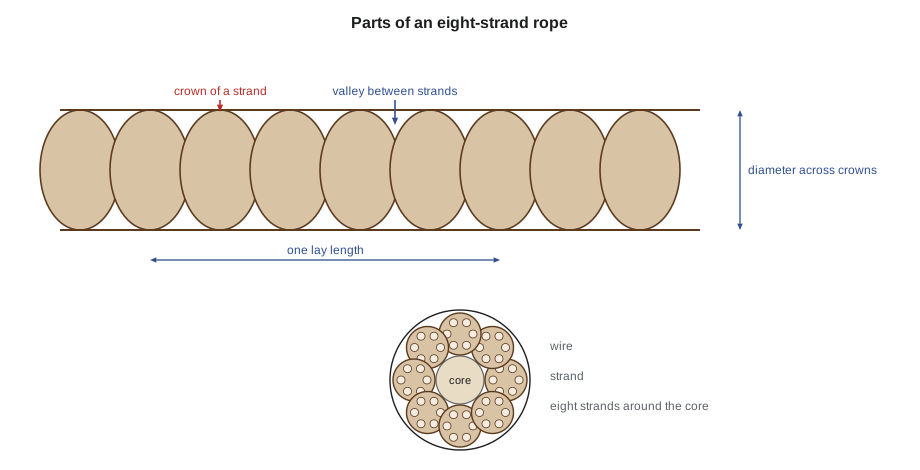
An elevator rope is built in three levels. Steel wires, drawn to precise diameters, are twisted together into strands. Strands are laid, or twisted, around a core to form the rope. Elevator suspension ropes typically have eight or nine strands, sometimes six on older or smaller ropes, around a core that is either natural or synthetic fibre or steel. A fibre core holds lubricant and gives the rope flexibility; a steel core, often an independent wire rope core, makes the rope stronger, stretch less and keep its diameter better on small sheaves under high pressure, which suits MRL machines. The wires in each strand are arranged in a pattern that sets the rope's flexibility and wear resistance. A common elevator construction is called Seale, with large outer wires that resist wear over smaller inner wires that give flexibility.
The direction of the lay matters. In regular lay, also called ordinary lay, the wires in each strand are twisted in the opposite direction to the strands in the rope, so the outer wires run roughly along the rope's length. Regular lay ropes resist crushing and untwisting and are standard for elevators. In Lang lay, wires and strands are twisted in the same direction, which gives more wearing surface but makes the rope prone to untwisting and is rarely used for elevator suspension. The lay length is the distance along the rope in which one strand makes one complete turn around it; broken wire counts are made per lay length, because that is the natural repeating unit of the rope.
Rope strength and the factor of safety
Every rope has a minimum breaking force given by its maker. The factor of safety is the ratio of the combined breaking force of all the ropes to the load they carry. Elevator codes set the minimum factor of safety according to the rope speed, from a little under 8 for slow cars to about 12 for the fastest, higher for passenger elevators than for freight. The factor rises with speed because faster ropes bend more often and stop harder. On 2:1 roping the rope speed is twice the car speed, so it is the rope speed, not the car speed, that sets the factor.
Here N is the number of ropes, S the minimum breaking force of one rope, r the roping ratio and W the load: the car, its rated load and the weight of ropes and compensation the ropes carry in the worst position. The codes also set a minimum number of ropes, usually three for a traction car, and a minimum rope diameter, which current editions allow to be smaller than the older 9.5 mm (3/8 in) minimum on machines designed for them.
# Factor of safety for the suspension ropes, compared with the minimum for passenger cars
table = [(50, 7.60), (100, 7.95), (200, 8.60), (300, 9.20), (400, 9.75), (500, 10.25),
         (600, 10.70), (700, 11.00), (800, 11.25), (900, 11.45), (1000, 11.55)]   # rope speed in ft/min, factor

def minimum(fpm):
    for (s1, f1), (s2, f2) in zip(table, table[1:]):
        if s1 <= fpm <= s2:
            return f1 + (f2 - f1) * (fpm - s1) / (s2 - s1)
    return table[0][1] if fpm < table[0][0] else table[-1][1]

g = 9.81 / 1000
cars = [
    # name, ropes, breaking force each (kN), roping ratio, car + rated load + ropes and compensation (kg), car speed (m/s)
    ("Quayside car 2", 6, 35.0, 2, 3400, 2.5),
    ("Tillicum car 1", 5, 64.5, 1, 2475, 1.0),
]
for name, n, s, r, w, v in cars:
    fs = n * s * r / (w * g)
    rope_fpm = r * v * 196.85
    need = minimum(rope_fpm)
print(f"{name:<15} factor of safety {fs:5.1f}, minimum {need:5.2f} at rope speed {rope_fpm:5.0f} ft/min: {'meets' if fs >= need else 'BELOW'}")Quayside car 2 factor of safety 12.6, minimum 11.53 at rope speed 984 ft/min: meets Tillicum car 1 factor of safety 13.3, minimum 8.58 at rope speed 197 ft/min: meets
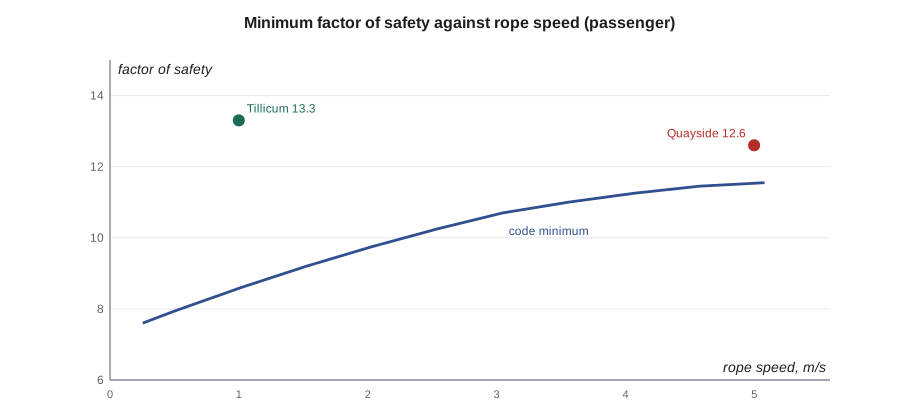
Both cars meet their minimum, Quayside with less margin because its rope speed is high. Note that the factor of safety is calculated for new ropes with their full rated strength. It says nothing about how much strength a worn rope has left, which is why ropes are not kept in service until their calculated factor falls to the minimum; they are replaced by condition, using the criteria below.
Terminations
Each end of each rope is fastened to the car, the counterweight or a dead-end hitch with a termination, often called a shackle or fastening. Older cars use tapered sockets filled with babbitt, a molten white metal poured around the broomed-out wires of the rope end; the rope must be cut, seized, broomed, cleaned and poured exactly as the procedure requires, by a mechanic trained to do it. Most newer cars use wedge sockets, in which the rope loops around a wedge that is pulled into a tapered body by the load, or factory-made swaged or resin terminations. Rope clips, the U-bolt clips common in rigging, are not used to terminate suspension ropes. Each termination usually has a threaded rod with a spring or rubber pad and two nuts with a cotter pin, used to equalize the rope tensions, as Lesson 11 describes. Terminations are inspected at every examination: the socket body, the wedge position, the rope at its entry into the socket where broken wires often start, the rods, nuts and pins, and the springs.
Inspecting a rope
Rope inspection is done with the car on inspection operation, at slow speed or in steps, so that every part of every rope, especially the sections that pass over the drive sheave when the car stops at the busiest floors, can be seen. The worst section of a rope is usually where it lies on the drive sheave or a car or counterweight sheave when the car is at the lobby or another busy floor, because that section is bent hardest and most often. Tamsin's inspection at Tillicum followed the order in the program.
- Clean a short length if needed, with a rag and no solvent that would strip the lubricant, so the wires can be seen.
- Measure the diameter with a rope caliper across the crowns of opposite strands, never across two adjacent strands, at the worst section and at a section that does not pass over the sheave, which shows the rope's original size. Take two measurements at right angles at each point. A rope's diameter falls as the core compresses, the wires wear and the strands bed in; a sudden reduction in one place often means a damaged or broken core.
- Count broken wires in the worst lay length of each rope, separating crown breaks, on the outside of the strands where they touch the sheave, from valley breaks, in the gaps between strands. Valley breaks start inside the rope and are much more serious, because they show that the rope is failing from within where it cannot be seen.
- Look for rouge, the red-brown powder of iron oxide that wear inside a dry rope produces, especially in the valleys. Rouge means the inside of the rope is wearing without lubricant, and on small ropes in particular it can mean serious internal loss of strength with little to see outside.
- Look for corrosion, kinks, birdcaging, where the strands open up like a cage, flattening, waviness and any damage from contact with the hoistway.
- Check the lubrication against the rope maker's instructions, and the terminations as above.
| Break pattern in the worst lay length | 6-strand rope | 8- or 9-strand rope |
|---|---|---|
| Crown breaks distributed among the strands | 24 | 32 |
| Crown breaks concentrated in one or two strands | 8 | 10 |
| Four or more adjacent crown breaks across one strand | 12 | 16 |
| Valley breaks | more than one per lay | more than one per lay |
The codes' maintenance tables set the number of broken wires at which a rope must be replaced, and lower numbers apply when the rope also shows rouge or has lost diameter. Any valley break where rouge is present, or more than one valley break in a lay, means replacement. A rope that is kinked, birdcaged or otherwise deformed is replaced whatever its broken wire count. When one rope in a set must be replaced, all the ropes are usually replaced together, because a single new rope stretches differently from the old ones and takes more than its share of the load.
# Tillicum car 1 rope inspection: broken wires in the worst lay length of each 8-strand rope
limits = {"distributed": 32, "concentrated": 10, "adjacent": 16}     # normal wear conditions
unfavourable = {"distributed": 16, "concentrated": 5, "adjacent": 8}  # with rouge or diameter loss
ropes = [
    # rope, crown breaks distributed, largest number in one or two strands, adjacent breaks, valley breaks, rouge
    (1, 14, 4, 2, 0, False),
    (2, 18, 5, 3, 1, True),
    (3, 11, 3, 2, 0, False),
    (4, 21, 6, 3, 2, True),
    (5, 12, 3, 1, 0, False),
]
for rope, dist, conc, adj, valley, rouge in ropes:
    lim = unfavourable if rouge else limits
    reasons = []
    if dist >= lim["distributed"]: reasons.append("distributed crown breaks")
    if conc >= lim["concentrated"]: reasons.append("concentrated crown breaks")
    if adj >= lim["adjacent"]: reasons.append("adjacent breaks")
    if valley > 1 or (valley >= 1 and rouge): reasons.append("valley breaks")
print(f"rope {rope}: {'REPLACE (' + ', '.join(reasons) + ')' if reasons else 'serviceable'}")rope 1: serviceable rope 2: REPLACE (distributed crown breaks, concentrated crown breaks, valley breaks) rope 3: serviceable rope 4: REPLACE (distributed crown breaks, concentrated crown breaks, valley breaks) rope 5: serviceable
Ropes 2 and 4 both show rouge, so the lower limits for unfavourable conditions apply to them, and both fail on several counts: distributed and concentrated crown breaks as well as valley breaks. The other three are still serviceable by the numbers, but they have the same age and history. With two ropes condemned and the others close behind, Ray recommended replacing the full set of five, and the owner agreed. Lesson 12 follows that job.
Rope life and rope records
A rope's life depends on the number of bends it makes, the sheave sizes, the groove condition, the tension equalization, the lubrication and the environment. A busy office car with small sheaves may need new ropes in eight or ten years; a lightly used car with large sheaves may run thirty. The rope record is what turns inspections into a prediction: diameter, broken wire counts and remarks recorded at the same sections at every examination show how fast a rope is aging, so that replacement can be planned and budgeted before an inspector or a failure forces it. Northcrest's program records, for each car, the rope data, the measurement points used, every reading and the date and reason for each replacement.
Worked problem
Factor of safety after a change
A 1:1 car with four ropes of 50 kN (11,200 lbf) breaking force each carries a car and rated load with ropes of 2,000 kg (4,400 lb). The car's rope speed is 1.0 m/s (200 ft/min), where the minimum factor is 8.60. Does it meet the minimum?
Show solution
- Combined strength 4 × 50 = 200 kN (4 × 11,200 = 44,800 lbf).
- Load 2,000 × 9.81 = 19.6 kN (4,400 lbf).
- Factor 200 / 19.6 = 10.2 (44,800 / 4,400 = 10.2).
Answer: 10.2, above the minimum of 8.60.
Common mistakes
MistakeMeasuring across two adjacent strands.
InsteadMeasure across the crowns of opposite strands, at right angles, at the worst section and an unused section.
MistakeCounting broken wires along the whole rope.
InsteadCount in the worst lay length and separate crown from valley breaks.
MistakeIgnoring rouge on a rope with few broken wires.
InsteadRouge means internal wear; lower limits apply and valley breaks with rouge mean replacement.
MistakeReplacing only the worst rope.
InsteadReplace the set so all ropes stretch and share the load alike.
MistakeTerminating a suspension rope with rope clips.
InsteadUse the approved socket or wedge termination made by a trained mechanic.
Summary and key terms
- Elevator ropes are wires laid into strands around a fibre or steel core, usually in regular lay.
- The factor of safety N S r / W must meet a minimum that rises with rope speed.
- Terminations are babbitted sockets, wedge sockets or factory terminations, inspected at every examination.
- Inspection measures diameter, counts crown and valley breaks per lay, and looks for rouge, corrosion and deformation.
- Replacement is by condition, with lower limits where rouge or diameter loss is present.
- Rope records turn inspections into a prediction of rope life.
- Strand
- A group of wires twisted together; strands are laid around the core to make the rope.
- Core
- The centre of the rope, of fibre or steel, that supports the strands.
- Regular lay
- Wires twisted opposite to the strands, the standard for elevator ropes.
- Lay length
- The length of rope in which one strand makes a full turn.
- Crown break
- A broken wire on the outside of a strand.
- Valley break
- A broken wire in the gap between strands, showing internal failure.
- Rouge
- Red-brown iron oxide dust from internal wear in a dry rope.
Practice problems
Work each problem on paper first, then reveal the answer to check.
Why are broken wires counted per lay length?
Show answer
It is the rope's natural repeating unit, so counts are comparable.
What is the factor of safety of six ropes of 35 kN (7,900 lbf) on 2:1 roping carrying 3,000 kg (6,600 lb)?
Show answer
6 × 35 × 2 / 29.4 = 14.3 (6 × 7,900 × 2 / 6,600 = 14.4).
Why is a valley break more serious than a crown break?
Show answer
It starts inside the rope and shows internal failure that cannot be seen.
Where is the worst section of a rope usually found?
Show answer
Where it lies on a sheave when the car stops at the busiest floor.
Why is the rope diameter measured at a section that does not pass over the sheave?
Show answer
To know the rope's original size for comparison.
Lesson quiz · 5 questions
Score 60% or more to complete this lesson.
Create a free account to save your progress, take quizzes and earn a certificate.