
ELV-230 · Lesson 7 of 12 · 21 min
Machine-room-less elevators
At Quayside Tower there is no machine room. The four passenger cars' machines are bolted to the rails at the top of their hoistways, beside the car's path, and each car's controller and drive are in a narrow steel cabinet built into the wall beside the top landing's hoistway doors, behind a locked panel that matches the corridor finish. On Tamsin's first maintenance visit, Priya opened the panel and showed her the display: car position, speed, door state and a brake release switch under a hinged guard. "Everything you'd do from a machine room, you do from here, or from the car top," Priya said. "Including getting people out when the car stops between floors. That's the part you practise until you can do it in the dark." This lesson is about machine-room-less elevators: where their equipment is, how a mechanic reaches it safely, and how a stalled car is moved to a floor without a machine room.
What makes an elevator machine-room-less
An MRL elevator has its driving machine inside the hoistway. The machine may be mounted on the car rails or the counterweight rails at the top, on a beam across the top of the hoistway, on the car itself in a few designs, or in the pit. The controller and drive are outside the hoistway in a control space or control room near a landing, or in some designs inside the hoistway with access from a landing. Removing the machine room saves building space and cost, avoids a penthouse on the roof and, with a permanent-magnet gearless machine, uses little energy. Since their introduction in the late 1990s, MRL cars have become the usual choice for new mid-rise buildings, and both codes have added rules for them.
Those rules address the problems an MRL creates. A mechanic must be able to work on the machine and its brake without being exposed to a moving car or counterweight. The controller must be where a mechanic can see whether the car is moving and where it is. And people trapped in a car must be rescued without anyone needing to stand on top of a machine in an open hoistway. The codes require, among other things, safe access to the machinery spaces, a means of moving the car to a landing from outside the hoistway for rescue, a way to see or display the car's position and movement from where that is done, and means to hold the car and counterweight still while work is done on the machine or brake.
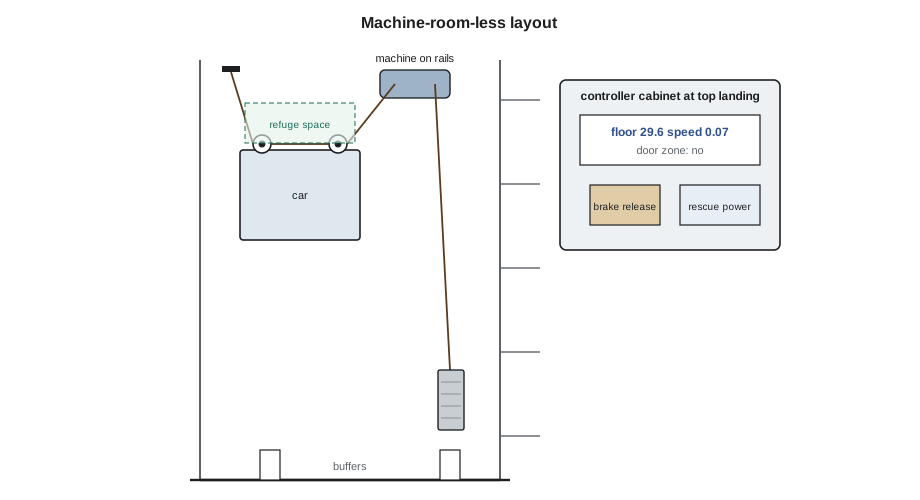
Where things are at Quayside
| Equipment | Location | Usual access |
|---|---|---|
| Machine and brake | on the rails at the top of the hoistway | from the car top, car on inspection, at the top landing |
| Controller and drive | cabinet beside the top landing doors | from the corridor with the landing key |
| Rescue controls and display | in the controller cabinet | from the corridor |
| Governor | at the top of the hoistway beside the machine | from the car top |
| Rope hitches | top of the hoistway | from the car top |
| Buffers, compensation guide, pit stop switch | pit | pit ladder from the lowest landing |
Because the machine is above the car's path, the car top is the main working platform for it. The car is brought to the top on inspection operation, with the mechanic on the car top, and stopped where the machine is in reach. At that point the counterweight is near the bottom and the car's position is limited by the final limit and, ultimately, by the counterweight buffer, so the space above the car top, the refuge space the codes require, is what protects the mechanic. Priya's rule at Quayside was that no one works on the machine until the car is stopped by the car-top stop switch, the stop is proved by trying to run, and the machine's own brake is set; for work on the brake itself, or anything that could let the sheave turn, the car and counterweight are secured mechanically according to the maker's procedure before the brake is touched.
Rescuing passengers from a stalled MRL car
An elevator stops between floors for many reasons: a power failure, a safety circuit opening, a drive fault. Most of the time the controller brings the car to a floor itself, using battery or emergency power if the building power has failed. When it cannot, a mechanic or a trained emergency responder must move it. On a car with a machine room, that is done in the machine room, with the brake released by hand and, on a geared machine, a handwheel on the motor shaft to move the car. On an MRL car, nobody can stand by the machine, so the rescue is done from the controller cabinet.
Two methods are used, and Quayside has both. In the first, an emergency power supply, a battery-backed unit in the controller, runs the drive at low speed and moves the car to the nearest floor in the direction of its unbalance, or in either direction under drive control. In the second, the brake is released from the controller cabinet, electrically from a battery or mechanically by a cable, and gravity moves the car. With the motor windings shorted, as Lesson 6 explained, the car moves slowly in the direction of the heavier side, and the display shows its speed and position so the person releasing the brake can stop at a floor by letting the brake set again. Brake release is done in short pulses, never by holding the brake open, and the codes and makers limit the speed the car may reach.
Gravity rescue has one weakness: the car moves only if it is unbalanced. With a load close to the overbalance, the car and counterweight balance and the car will not move when the brake is released. Then the emergency power supply must drive it, or, as a last resort under the maker's procedure, the counterweight or car must be unbalanced, which needs a mechanic in the hoistway. Before a rescue, the person in charge talks to the passengers through the car's emergency communication, tells them what will happen and estimates how many there are, because the load decides which way the car will move.
# Quayside car 2 rescue: which way will the car move with the brake released, and how fast?
import math
g = 9.81
rated, ob = 1600, 0.45
d, r = 0.40, 2                    # sheave pitch diameter (m), roping ratio
k_short = 95.0                   # braking torque with windings shorted, N m per rpm (illustrative)
person = 75                     # average passenger, kg
to_floor_up, to_floor_down = 1.9, 1.1    # distance to the next floor above and below, m
for people in (1, 10, 21):
    unbalance = people * person - ob * rated       # positive: car side heavier
    torque = abs(unbalance) * g * d / (2 * r)
    rpm = torque / k_short
    speed = math.pi * d * rpm / r * 1 / 60           # car speed, m/s
    if speed < 0.01:
        print(f"{people:2d} passengers: car and counterweight nearly balance; use the emergency power supply")
        continue
    way = "down" if unbalance > 0 else "up"
    dist = to_floor_down if unbalance > 0 else to_floor_up
print(f"{people:2d} passengers: car moves {way} at about {speed:.3f} m/s, next floor in about {dist / speed * 1:.0f} s")1 passengers: car moves up at about 0.070 m/s, next floor in about 27 s 10 passengers: car and counterweight nearly balance; use the emergency power supply 21 passengers: car moves down at about 0.092 m/s, next floor in about 12 s
With one passenger, the counterweight is heavier and the car rises slowly to the floor above. With a full car, the car side is heavier and the car descends. With ten passengers, close to the overbalance load, the car hardly moves and the emergency power supply is needed. The speeds are low because of the shorted windings; without them, the unbalanced car would accelerate until the brake was set again or the governor tripped.
Practising the rescue
Northcrest trains its mechanics on each MRL model they maintain, and many building owners have their own staff or the fire department trained for the first, simplest steps. Priya's rescue procedure for Quayside follows the maker's instructions, and Tamsin practised it on car 2 with the car empty and then with test weights, before she was allowed to do it for real.
- Confirm the car is stopped and why, using the controller's display and fault log. Talk to the passengers; tell them help is there and the car will move slowly.
- Make sure no one is in the hoistway or on the car top, and that all hoistway doors are closed and locked.
- Switch the controller to the rescue mode the maker specifies, which disconnects normal operation and connects the motor shorting circuit.
- Try the emergency power supply first if it is available. If not, release the brake in short pulses with the release switch, watching the speed and position display, and let the brake set as the car reaches the door zone of a floor.
- When the display shows the car level within the door zone, open the hoistway and car doors with the landing key under the procedure, help the passengers out and close the doors again.
- Leave the car out of service, find and correct the cause of the stop, and record the rescue.
Ray, who learned on machines with handwheels, admitted that MRL rescues made him nervous at first. "On a geared car you can feel the machine through the wheel. Here you're watching numbers on a screen and trusting a circuit." The answer, Priya said, is to understand exactly what the circuit does and to test it: the rescue functions, the emergency power supply's battery and the brake release are tested at the intervals in the maintenance control program, because they are useless if they fail on the one night they are needed.
Other MRL considerations
- Loads on the rails and building. On rail-mounted machines, the rails carry the machine weight and the rope loads down to the pit floor, so rail brackets, rail joints and the pit floor take loads they do not take on a conventional car. Their fastenings are inspected accordingly.
- Heat in the hoistway. The machine's losses, and on some designs the drive's, are released in the hoistway. Ventilation and the temperature range the maker allows for the hoistway must be respected; a hot hoistway in summer can trip the drive or age the encoder and brake coils.
- Noise. The machine is close to the building's occupied spaces, often beside an apartment wall at the top floor. Vibration isolation and brake noise matter more than in a machine room, and a noisy brake or bearing is soon a complaint.
- Lighting and access. Work on the machine is done from the car top in a hoistway lit by the hoistway lighting and the car-top light. Tools, parts and the mechanic's own position must be planned so nothing falls and nobody leans into the counterweight's path.
- Reduced pit and overhead. Some MRL designs use reduced pit depths or overhead clearances, with additional devices to make the reduced spaces safe for maintenance. These devices must be in place and working before anyone enters the space.
Worked problem
Does the car move?
An MRL car with a rated load of 1,135 kg (2,500 lb) and 40 percent overbalance stalls with four passengers of about 75 kg (165 lb) each. Which way will it move when the brake is released?
Show solution
- Overbalance load 0.40 × 1,135 = 454 kg (0.40 × 2,500 = 1,000 lb).
- Load in the car 4 × 75 = 300 kg (4 × 165 = 660 lb).
- The counterweight side is heavier by 154 kg (340 lb).
Answer: The car will rise toward the floor above.
Common mistakes
MistakeHolding the brake release open.
InsteadRelease in short pulses, watching the speed and position display.
MistakeAssuming a released brake always moves the car.
InsteadNear the balance load the car may not move; use the emergency power supply.
MistakeWorking on the machine from a car top that is not stopped and secured.
InsteadStop the car with the car-top stop switch, prove it, and secure car and counterweight as the procedure requires.
MistakeOpening the doors before the car is in the door zone.
InsteadWait until the display shows the car level within the door zone of a floor.
MistakeLeaving rescue functions untested.
InsteadTest the emergency power supply, battery and brake release at the program intervals.
Summary and key terms
- An MRL elevator has its machine in the hoistway and its controller in a control space near a landing.
- The car top is the main platform for machine work, protected by the refuge space and secure stopping.
- Rescue is done from the controller: by emergency power supply or by pulsed brake release with shorted windings.
- The car moves toward the heavier side; near the balance load it may not move by gravity.
- Rescue functions and batteries are tested regularly, and mechanics practise the procedure.
- Rail loads, hoistway heat, noise, access and reduced clearances need attention on MRL cars.
- Machine-room-less (MRL)
- An elevator whose driving machine is inside the hoistway.
- Control space
- The space outside the hoistway, often a wall cabinet at a landing, holding the controller.
- Emergency power supply
- A battery-backed unit that can drive the car slowly to a floor during a power failure or rescue.
- Brake release
- A switch or cable that opens the machine brake from outside the hoistway for rescue.
- Door zone
- The short distance above and below a floor within which the doors may be opened.
- Refuge space
- The clear space on the car top and in the pit the codes require to protect a person there.
Practice problems
Work each problem on paper first, then reveal the answer to check.
Why does a gravity rescue sometimes fail to move the car?
Show answer
With a load near the overbalance, car and counterweight balance.
A car with 45 percent overbalance and a rated load of 1,600 kg (3,500 lb) has 15 passengers of 75 kg (165 lb). Which way does it move?
Show answer
Load 1,125 kg against 720 kg: down (Load 2,475 lb against 1,575 lb: down).
What does the motor shorting circuit do during a brake-release rescue?
Show answer
It makes the motor brake the sheave so the car moves slowly.
Where is the main platform for working on a rail-mounted MRL machine?
Show answer
The car top, with the car stopped near the top on inspection.
Why are brake releases done in pulses?
Show answer
So the car's speed stays low and it can be stopped at a floor.
Lesson quiz · 5 questions
Score 60% or more to complete this lesson.
Create a free account to save your progress, take quizzes and earn a certificate.