
ELV-230 · Lesson 3 of 12 · 20 min
Roping arrangements and sheave geometry
The week after the traction lessons at Tillicum, Lena sent Tamsin to Quayside Tower for the first quarterly maintenance visit on the four machine-room-less cars. Priya Sandhu, Northcrest's senior adjuster, met her at the top landing with a printed roping diagram for car 2. "Before you go on top of a car with ropes running past your head, you need to know where every one of them goes," Priya said. "Which ones move, how fast, and which way. On a 2:1 car the ropes at the machine run at twice the car's speed, and the sheaves on the car top are turning right beside you." This lesson is about the ways ropes are run between the machine, the car and the counterweight, the sheaves they pass over, and the numbers that follow from the geometry.
Roping ratio
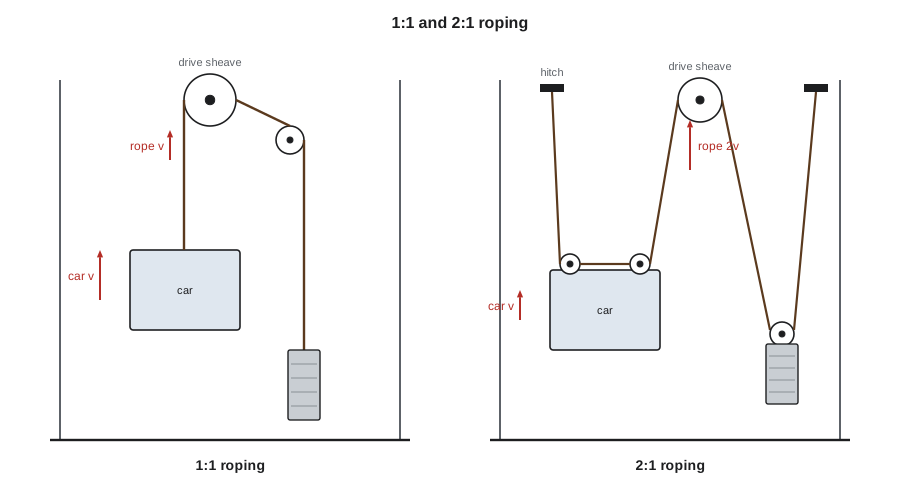
The roping ratio compares how far the ropes move at the drive sheave with how far the car moves. On 1:1 roping, the ropes are fastened to the car crosshead, run up over the drive sheave and down to the counterweight. The car moves exactly as far as the rope, at the same speed. Each rope carries its share of the car's full weight. Tillicum's cars are 1:1.
On 2:1 roping, one end of each rope is fastened to a dead-end hitch at the top of the hoistway. The rope runs down, under a sheave on the car, back up over the drive sheave, down under a sheave on the counterweight and up again to a second dead-end hitch. The car hangs on two falls of each rope, so each fall carries half the car's weight, and when the machine pulls a metre (a foot) of rope over the drive sheave, the car rises half a metre (half a foot). Quayside's cars are 2:1. Freight elevators for very heavy loads sometimes use 3:1 or 4:1 roping, with more falls and more sheaves on the car, so that a small machine can lift a heavy load slowly.
Here r is the roping ratio (1 for 1:1, 2 for 2:1), v is speed, W is the weight on one side and n is the number of ropes. For the same car, 2:1 roping halves the load on each rope and doubles the speed of the ropes, which means the sheave turns twice as fast and the machine needs only half the torque. That suits a compact high-speed gearless motor. The price is more sheaves, more rope and more bends: every time a rope runs over a sheave it is bent and straightened, and those cycles, not the steady load, are what eventually wear a rope out.
Single wrap, double wrap and underslung
Within a roping ratio, the ropes can be run in several ways. On a single-wrap machine, the ropes touch the drive sheave once, over about half its circumference or a little less if a deflector sheave pulls the counterweight side away. On a double-wrap machine, the ropes run over the drive sheave, down and around a secondary sheave below it, and back over the drive sheave in a second set of grooves before going down to the counterweight; the wrap angle is close to 360 degrees. Double wrap is used on high-speed gearless machines, where round grooves protect the ropes and the extra wrap supplies the traction.
On an underslung car, the 2:1 sheaves are mounted under the car platform instead of on the crosshead, and the ropes pass down one side of the car, under it and up the other. Underslung roping is common on MRL cars because it keeps the ropes clear of the space above the car where the machine is. Quayside's cars have two sheaves on the car top; Larchmont's belts run under the car. Each arrangement changes where a mechanic's hands, tools and body are in relation to moving ropes, and the roping diagram on the controller door or in the maintenance control program is the first thing to read before working on an unfamiliar car.
Sheave speed
The drive sheave's speed in revolutions per minute follows from the rope speed and the sheave's pitch diameter, measured to the centre of the ropes in their grooves. The machine's motor turns at that speed on a gearless machine, or faster by the gear ratio on a geared one.
For Quayside car 2, the car runs at 2.5 m/s (500 ft/min) and the ropes at twice that. The sheave has a pitch diameter of 0.40 m (16 in). The code below works out the sheave speed for the cars in this course, and the frequency the drive must supply to the 24-pole permanent-magnet motor at Quayside, which ELV-210 met in its drive lessons.
# Rope speed, sheave speed and diameter ratio for the cars in this course
import math
cars = [
    # name, car speed, roping ratio, sheave pitch diameter, rope diameter
    ("Quayside car 2", 2.5, 2, 0.40, 0.008),
    ("Tillicum car 1", 1.0, 1, 0.76, 0.013),
]
for name, v_car, r, d_sheave, d_rope in cars:
    v_rope = r * v_car
    rpm = 60 * v_rope / (math.pi * d_sheave)
    ratio = d_sheave / d_rope
    print(f"{name:<15} rope speed {v_rope:5.1f} m/s, sheave {rpm:5.1f} rpm, D/d = {ratio:4.1f}  ({'meets' if ratio >= 40 else 'below'} 40)")
poles = 24
rpm_q = 60 * 2 * 2.5 / (math.pi * 0.40)
print(f"Quayside motor frequency at rated speed: {poles * rpm_q / 120:4.1f} Hz")Quayside car 2 rope speed 5.0 m/s, sheave 238.7 rpm, D/d = 50.0 (meets 40) Tillicum car 1 rope speed 1.0 m/s, sheave 25.1 rpm, D/d = 58.5 (meets 40) Quayside motor frequency at rated speed: 47.7 Hz
The gearless Quayside sheave turns at about 240 rpm, slow for an electric motor but fast for an elevator sheave; the motor supplies that speed directly with 24 poles at under 50 Hz. Tillicum's sheave turns at about 25 rpm, so its motor, turning at about 1,150 rpm, needs a worm gear of about 46 to 1. Lesson 5 takes up the gear.
Sheave diameter and rope life
A rope bent over a sheave has its outer wires stretched and its inner wires compressed, and the wires slide against each other as the rope bends and straightens. The smaller the sheave compared with the rope, the sharper the bend, the higher the bending stress and the shorter the rope's life. Rope life falls steeply as the ratio of sheave diameter to rope diameter, D/d, falls. For that reason the codes set a minimum ratio for sheaves carrying suspension ropes; for drive and deflector sheaves the familiar minimum is 40 times the rope diameter, and many machines are built well above it. Governor ropes and compensation ropes have their own limits.
Small ropes allowed small sheaves. The 8 mm (5/16 in) ropes at Quayside can run on a 0.40 m (16 in) sheave and still exceed the minimum ratio; the same sheave with 13 mm (1/2 in) ropes would be far below it. Small sheaves mean small, low-torque motors that fit inside a hoistway. Coated steel belts, Lesson 9, go further: their thin steel cords bend easily, so the sheave can be much smaller again. For rope or belt, the number of bends per trip matters as much as the sheave size. A 1:1 car with a deflector bends each rope twice per trip; a 2:1 car with two car-top sheaves, a drive sheave and a counterweight sheave bends each rope four times, and some of those bends are reverse bends, where the rope bends one way over one sheave and the other way over the next, which wear a rope faster than bends in the same direction.
| Car | Roping | Sheaves each rope passes over | Bends per trip | Reverse bends |
|---|---|---|---|---|
| Tillicum car 1 | 1:1, single wrap with deflector | drive, deflector | 2 | no |
| Quayside car 2 | 2:1, car-top sheaves | two car sheaves, drive, counterweight sheave | 4 | some, at the car sheaves |
| Double-wrap high-rise car | 1:1 double wrap | drive (twice), secondary | 3 | yes |
Deflector sheaves and wrap angle
A deflector sheave, sometimes called an idler or secondary sheave, guides the ropes from the drive sheave to a position over the counterweight so that the car and counterweight do not hit each other in the hoistway. It does not drive the ropes. Its position sets the wrap angle on the drive sheave: the farther it pulls the counterweight ropes toward the car side, the less of the drive sheave the ropes touch. At Tillicum, the deflector sits below and to the car side of the drive sheave, and the counterweight ropes leave the drive sheave at about 15 degrees from vertical, so the wrap is about 165 degrees.
Here θ is the angle of the counterweight ropes from vertical as they leave the drive sheave, x is the horizontal distance the deflector moves them and y the vertical distance between the two sheaves. The simple form ignores the sheave radii, which a full layout includes, but it shows the effect: moving the deflector a little changes the wrap angle and, by the capstan equation, the traction.
Worked problem
Wrap angle at Tillicum
At Tillicum, the rope line from the drive sheave to the deflector moves 0.24 m (9.5 in) sideways over a vertical distance of 0.90 m (35.5 in). What is the approximate wrap angle?
Show solution
- tan θ ≈ 0.24 / 0.90 = 0.267 (9.5 / 35.5 = 0.268).
- θ ≈ 15 degrees.
- α ≈ 180 − 15 = 165 degrees.
Answer: About 165 degrees, the value used in the traction check in Lesson 2.
Fleet angle and rope alignment
Ropes must run straight into their grooves. If a sheave is out of line with the rope's path, the rope enters the groove at an angle, called the fleet angle, and rubs on one side of the groove. That wears the groove into an uneven shape, twists the rope and can make the rope jump to another groove. Sheaves are set in line and plumb during installation, and alignment is checked whenever a machine, a deflector or a car-top sheave is replaced or a rope is seen running on one side of its groove. Priya's check at Quayside is simple: from the car top, at slow speed, she watches each rope enter the car-top sheaves and looks for ropes touching the groove flanks, for fresh bright rubbing marks and for ropes that do not lie in a straight line from sheave to sheave.
Dead-end hitches deserve the same attention. On 2:1 roping, both ends of every rope are fastened at the top of the hoistway, through rope shackles or wedge sockets on a hitch plate, often with springs or rubber pads that help equalize the rope tensions. The hitch plate and its fastenings carry the whole suspended load. Their bolts, lock nuts and cotter pins are checked on every inspection, and the springs are watched for uneven compression, which shows an uneven tension that Lessons 8 and 11 show how to correct.
Rope length and rope stretch
Rope length matters when ropes are replaced and when they stretch. A 1:1 car's ropes run from the car crosshead up the hoistway to the sheave and down to the counterweight, so each rope is a little longer than the rise plus the overhead. A 2:1 car's ropes are about twice as long, because each rope makes two trips up and down the hoistway. New ropes stretch in their first months as the strands bed into the core, and keep stretching slowly for their whole life. As they stretch, the counterweight runs closer to its buffer when the car is at the top. Ropes are shortened at the shackles or wedge sockets to restore the counterweight's runby, the clearance between counterweight and buffer with the car level at the top landing, before it falls below the minimum. A shrinking runby recorded at each visit is one of the earliest signs of how a set of ropes is aging.
Common mistakes
MistakeAssuming the ropes at the machine of a 2:1 car move at car speed.
InsteadThey move at twice the car speed; the car-top sheaves turn beside you.
MistakeCounting only the drive sheave when thinking of rope wear.
InsteadEvery sheave bends the rope; reverse bends wear it fastest.
MistakeTreating a deflector sheave as cosmetic.
InsteadIts position sets the wrap angle and so the traction.
MistakeIgnoring a rope running on one side of its groove.
InsteadThat is a fleet angle or alignment problem that wears the groove unevenly.
MistakeLetting the counterweight runby shrink unrecorded.
InsteadRope stretch reduces runby; it must be measured and the ropes shortened before it reaches the minimum.
Summary and key terms
- On 1:1 roping the car moves at rope speed; on 2:1 at half rope speed, with half the load per rope.
- Double wrap nearly doubles the wrap angle; underslung roping keeps ropes clear of the space above the car.
- Sheave speed is n = 60 v / (π D); a gearless motor turns at that speed, a geared motor faster by the gear ratio.
- The D/d ratio, usually at least 40, and the number of bends per trip set rope life.
- A deflector's position sets the wrap angle on the drive sheave.
- Alignment, hitches and counterweight runby are checked regularly; rope stretch shows in a shrinking runby.
- Roping ratio
- The ratio of rope speed at the drive sheave to car speed.
- Dead-end hitch
- The fixed point at the top of the hoistway where the ends of 2:1 ropes are fastened.
- Underslung
- Roping with the car sheaves under the platform.
- D/d ratio
- Sheave pitch diameter divided by rope diameter.
- Reverse bend
- A bend in the opposite direction to the previous bend, which shortens rope life.
- Fleet angle
- The angle between a rope and the plane of its groove.
- Runby
- The clearance between the counterweight and its buffer when the car is level at the top landing.
Practice problems
Work each problem on paper first, then reveal the answer to check.
A 2:1 car runs at 1.75 m/s (350 ft/min). What is the rope speed at the drive sheave?
Show answer
3.5 m/s (700 ft/min).
A sheave with a pitch diameter of 0.64 m (25 in) carries ropes at 2.0 m/s (400 ft/min). What is its speed?
Show answer
60 × 2.0 / (π × 0.64) = 59.7 rpm (400 / (π × 25 / 12) = 61.1 rpm).
Is a 0.32 m (12.5 in) sheave acceptable for 10 mm (3/8 in) ropes under a 40 times minimum?
Show answer
D/d = 32, below 40: no (D/d = 33, below 40: no).
Why do 2:1 MRL cars often use underslung roping?
Show answer
It keeps the ropes away from the space above the car, where the machine is.
What does a counterweight runby that falls between visits indicate?
Show answer
The ropes are stretching; they will need shortening before the runby reaches its minimum.
Lesson quiz · 5 questions
Score 60% or more to complete this lesson.
Create a free account to save your progress, take quizzes and earn a certificate.