
ELV-230 · Lesson 6 of 12 · 21 min
Gearless and permanent-magnet machines
Tillicum car 2's new machine is half the length of the geared machine beside it and makes almost no sound. The crane lift that set it last term was the capstone of Tamsin's rigging course; this term she learned what was inside. Priya took her through the machine one afternoon with the car parked and locked out. "No gear, no oil bath, no worm to wear," Priya said, "so people think there's nothing to maintain. There's less. But what there is matters more, because the brake is right on the sheave shaft, the encoder is the only thing telling the drive where the rotor is, and the motor is full of magnets that make voltage any time the sheave turns." This lesson covers gearless machines, from the large DC gearless machines in older high-rise buildings to the compact permanent-magnet machines that now drive most new traction elevators.
What gearless means
On a gearless machine, the drive sheave is mounted on the motor shaft, or the motor's rotor is built around the sheave. The sheave turns at motor speed, so the motor must be a low-speed, high-torque motor: tens to a few hundred revolutions per minute instead of the thousand or more of a geared machine's motor. The first gearless elevator machines, early in the twentieth century, were large DC motors fed by motor-generator sets, and they made high-rise buildings practical because they were smooth, quiet and could run at high speed without a gear. Many of those machines still run, now usually fed by solid-state DC drives.
AC induction gearless machines followed when variable-frequency drives could control them precisely at low speed. The biggest change came with permanent-magnet synchronous motors, in which the rotor carries strong rare-earth magnets instead of windings. A permanent-magnet rotor needs no current to make its field, so the motor is efficient and can have many poles in a short, large-diameter frame. With the small sheaves that small ropes and belts allow, such a motor can be thin enough to fit in the hoistway beside the car. Quayside's machines and Tillicum car 2's new machine are permanent-magnet gearless machines; Quayside's are thin enough to be mounted on the rails at the top of the hoistway.
Torque and power at the sheave
Without a gear, the motor must supply all the sheave torque directly. The torque is the difference between the two rope tensions times the sheave's pitch radius. On 2:1 roping, each rope carries half the weight on its side, so the torque for a given unbalance is halved, which is one reason 2:1 roping suits gearless machines.
Here ΔW is the unbalance, g the acceleration of gravity, D the sheave's pitch diameter, r the roping ratio and ω the sheave's angular speed in radians per second. The speed of a permanent-magnet synchronous motor is locked to the frequency the drive supplies, through the number of poles.
# Quayside car 2: sheave torque, power and drive frequency for a full car going up
import math
g = 9.81
rated, ob = 1600, 0.45
d = 0.40                          # sheave pitch diameter, m
r = 2                            # 2:1 roping
v_car = 2.5                      # m/s
eta = 0.85
unbalance = (1 - ob) * rated
torque = unbalance * g * d / (2 * r)
rpm = 60 * r * v_car / (math.pi * d)
power_out = torque * rpm * 2 * math.pi / 60 / 1000
poles = 24
print(f"sheave torque {torque:,.0f} N m at {rpm:.0f} rpm")
print(f"mechanical power {power_out:.1f} kW, input with losses about {power_out / eta:.1f} kW")
print(f"drive frequency at rated speed {poles * rpm / 120:.1f} Hz")
counts = 4 * 2048                # encoder counts per revolution
step = math.pi * d / counts / r * 1000
print(f"one encoder count moves the car about {step:.3f} mm")sheave torque 863 N m at 239 rpm mechanical power 21.6 kW, input with losses about 25.4 kW drive frequency at rated speed 47.7 Hz one encoder count moves the car about 0.077 mm
The torque is large for a motor of its size, but small compared with the geared machine's sheave torque at Tillicum, thanks to the small sheave and 2:1 roping. The power is the same as Lesson 1 found from the unbalance and speed, as it must be. The drive supplies just under 50 Hz at rated speed, and the encoder resolves the car's position to less than a tenth of a millimetre (a few thousandths of an inch), which is what lets a modern drive stop a car level with the floor without a separate levelling zone.
The parts of a permanent-magnet machine
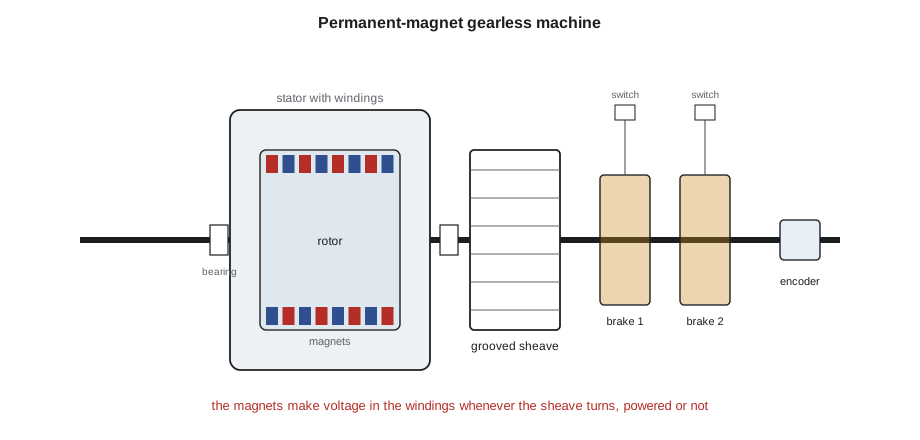
- Stator. The fixed outer part, with the copper windings fed by the drive. Its insulation is tested like any motor's, as ELV-210 showed, with the drive leads disconnected.
- Rotor and magnets. The rotating part, carrying rare-earth magnets. The magnets are very strong; a rotor removed from its stator attracts tools and steel with great force and can trap fingers. Machines are not dismantled in the field except under the maker's procedure, with special fixtures.
- Sheave. Machined into the rotor hub or bolted to it. On some machines the grooves are hardened and the sheave cannot be regrooved; it is replaced as a unit or with the machine.
- Bearings. Two large bearings carry the rotor and the full rope load. Most are sealed and greased for life, or for a long interval; a few have grease fittings. Their condition is judged by noise, vibration and temperature.
- Brake. Usually two independent brake units, each acting on a disc or drum on the sheave shaft, either one able to stop and hold the car. Because the brake acts directly on the sheave shaft, it is also an emergency brake for the protection against unintended movement and ascending car overspeed that Lesson 10 describes.
- Encoder. An absolute or incremental encoder on the shaft that tells the drive the rotor's angle and speed. A permanent-magnet motor cannot be run without knowing the rotor angle, so after an encoder is replaced, the drive must learn the angle again in a procedure often called an encoder alignment, pole position or angle learn. A wrong angle makes the motor draw high current, run rough or run away.
The motor is a generator
The most important safety point about a permanent-magnet machine is that its rotor's field is always there. Whenever the sheave turns, the stator windings produce a voltage in proportion to the speed, whether or not the drive is connected or powered. If a car with an unbalanced load starts to move with the brake lifted, the motor becomes a generator; if a mechanic is working on the drive's output terminals or on the motor leads while the sheave turns, those conductors are live. Lockout on a permanent-magnet machine therefore includes preventing the sheave from turning: the car must be at rest on a set brake, with the car or counterweight blocked or landed when the work requires it, and the motor leads treated as live until the sheave is proved stationary.
The same property is used for safety. Most permanent-magnet machines have a motor shorting contactor, or a shorting circuit in the drive, that connects the stator windings together whenever the drive is not running. If the brake is opened with the drive off, as in a manual rescue, the shorted windings turn the motor into a brake: the current that flows opposes the motion, so an unbalanced car accelerates to a low, steady speed instead of running away. The car's speed with the windings shorted depends on the unbalance and the machine, typically a small fraction of rated speed. Lesson 7 uses this effect in the rescue procedure for an MRL car.
| Feature | Geared (worm) | DC or induction gearless | Permanent-magnet gearless |
|---|---|---|---|
| Sheave speed | motor speed / gear ratio | motor speed | motor speed |
| Typical efficiency | 50 to 70 percent | 80 to 90 percent | 85 to 95 percent |
| Oil | gear oil bath | bearing lubricant only | bearing grease only |
| Noise | gear hum, motor | low | very low |
| Generates voltage when turned | only with field energized | only with field energized | always |
| Typical use | existing mid-rise, freight | existing high-rise | most new traction cars |
From geared to gearless at Tillicum car 2
Tillicum car 2's modernization last term shows what changes when a geared car becomes gearless. The old worm machine, its motor-generator set and its relay controller were all removed. The new permanent-magnet machine sits on the same steel beams on a new bedplate, with a new deflector position worked out by the machine maker so that the wrap angle and the rope line to the counterweight stayed close to the original. The car kept its 1:1 roping and its 13 mm (1/2 in) ropes, which were replaced at the same time, and the sheave is larger than Quayside's, about 0.64 m (25 in), because larger ropes need a larger sheave to keep the D/d ratio above the minimum. A larger sheave turning at only about 30 rpm means a high torque, which is why the machine is a heavy, large-diameter motor rather than a thin MRL machine.
The motor-generator set's absence alone cut the car's standby losses to almost nothing, because a motor-generator set runs whenever the car is in service, even when it is parked. The new regenerative drive returns energy to the building when the empty car goes up or the full car goes down. The new machine's two brake units replaced the single brake of 1962, bringing the car up to the current requirements for unintended movement and ascending car overspeed at the same time, and the new controller monitors each brake unit separately. The alteration needed a permit and an acceptance inspection, with full-load, brake and traction tests like those Tamsin will do on car 1 in Lesson 12.
Maintaining a gearless machine
Priya's checklist for Quayside's machines is shorter than Tillicum's but more exacting. It follows the maker's maintenance instructions, which form part of Northcrest's maintenance control program for the car.
- Brake: the air gap or plunger stroke of each brake unit, the lining wear, the brake monitoring switches, and the brake test that proves each unit can hold the car on its own. Lesson 10 covers these.
- Encoder: its cable and connector, secure mounting and the absence of fault codes. Encoder faults are among the most common causes of a gearless car shutting down.
- Bearings: noise and vibration, compared with the readings at commissioning; any grease due at the maker's interval.
- Sheave and grooves: groove wear, rope or belt tracking, and signs of slip, as in Lesson 11.
- Motor: winding temperature sensor readings, insulation resistance at the interval in the program, and the shorting contactor's operation.
- Fastenings: the machine's mounting bolts on its beam or rails, which on an MRL car also carry the full rope load.
At Quayside, Priya also reads the drive's history for each car. A modern drive records motor current, torque, speed error and faults for thousands of runs, and a slow change, such as torque rising for the same load over months, shows a developing problem before anyone in the building notices it. Rising torque at constant load can mean dragging brakes, worn bearings, worn guide rollers or a balance that has changed.
Worked problem
Rescue speed with shorted windings
A permanent-magnet machine with its windings shorted settles at a speed where the braking torque equals the unbalance torque. For a certain machine, the shorted braking torque is about 95 N·m per rpm (70 lb-ft per rpm) at low speed. With an empty car, the unbalance is the overbalance of 720 kg (1,575 lb) and the sheave torque from it is 706 N·m (525 lb-ft). About how fast does the sheave turn, and what is the car speed?
Show solution
- Speed where braking torque equals unbalance torque: 706 / 95 = 7.4 rpm (525 / 70 = 7.5 rpm).
- Rope speed π × 0.40 × 7.4 / 60 = 0.155 m/s (π × 16 / 12 × 7.5 = 31 ft/min).
- On 2:1 roping the car moves at half that: about 0.08 m/s (about 16 ft/min).
Answer: About 0.08 m/s (16 ft/min), slow enough to bring the car to a floor under control (illustrative machine values).
Common mistakes
MistakeTreating motor leads as dead because the drive is off.
InsteadA turning permanent-magnet rotor makes voltage; prevent the sheave from turning first.
MistakeReplacing an encoder and running the car.
InsteadThe drive must relearn the rotor angle before normal running.
MistakeOpening a permanent-magnet machine in the field.
InsteadThe magnets exert huge forces; only the maker's procedure and fixtures are used.
MistakeIgnoring a slow rise in running torque.
InsteadIt can show dragging brakes, worn bearings or a changed balance long before failure.
MistakeThinking a gearless machine needs no maintenance.
InsteadIt needs less, but brake, encoder, bearings, grooves and fastenings must be checked.
Summary and key terms
- On a gearless machine the sheave turns at motor speed, so the motor is a low-speed, high-torque motor.
- Permanent-magnet synchronous motors made compact gearless machines and MRL elevators practical.
- Sheave torque is ΔW g D / (2r); motor frequency is f = p n / 120.
- The encoder gives rotor angle and speed; a replaced encoder must be aligned before running.
- A permanent-magnet motor generates voltage whenever it turns; shorted windings are used to limit rescue speed.
- Maintenance centres on brakes, encoder, bearings, grooves, fastenings and the drive's records.
- Gearless machine
- A traction machine with the sheave on the motor shaft and no gear.
- Permanent-magnet synchronous motor
- An AC motor whose rotor field comes from permanent magnets and whose speed is locked to the supply frequency.
- Encoder
- A shaft-mounted sensor giving the rotor angle and speed to the drive.
- Encoder alignment
- The procedure by which the drive learns the rotor angle relative to the encoder.
- Motor shorting contactor
- A contactor that connects the motor windings together when the drive is off, so the motor brakes the sheave.
- Pole count
- The number of magnetic poles in the motor, which sets speed for a given frequency.
Practice problems
Work each problem on paper first, then reveal the answer to check.
A 1:1 gearless machine has a sheave of 0.64 m (25 in) and an unbalance of 680 kg (1,500 lb). What is the sheave torque?
Show answer
680 × 9.81 × 0.64 / 2 = 2,135 N·m (1,500 × 25 / 24 = 1,563 lb-ft).
What frequency does a 32-pole motor need to turn at 30 rpm?
Show answer
f = 32 × 30 / 120 = 8 Hz.
Why must the sheave be prevented from turning before working on the motor leads of a permanent-magnet machine?
Show answer
The motor generates voltage whenever it turns.
What does the shorting contactor do during a manual brake release?
Show answer
It makes the motor brake the sheave, so the car moves slowly instead of running away.
What must be done after an encoder is replaced?
Show answer
The drive must relearn the rotor angle before the car runs normally.
Lesson quiz · 5 questions
Score 60% or more to complete this lesson.
Create a free account to save your progress, take quizzes and earn a certificate.