
ELE-455 · Lesson 10 of 12 · 21 min
Wireless standards and spectrum regulation
Before choosing a cellular module, Amara steps back and asks whether cellular is the right backhaul at all. A cabinet needs to send a status report every few minutes, an alarm within seconds when a detector fails or a cabinet door opens, and occasionally a firmware image of a few hundred kilobytes. There are several ways to carry that traffic, each defined by a standard, and each standard operates in spectrum governed by rules that differ between Canada and the United States. This lesson surveys the standards that matter for machine connections, compares them for TLR-2's needs, and then covers the rules and the certification steps that every radio product must pass before it can be sold.
A map of the standards
Wireless standards for devices like TLR-2 fall into a few families. Short-range standards such as Bluetooth Low Energy and IEEE 802.15.4 (the basis of Zigbee and Thread) connect devices over tens of metres with very little energy. Wi-Fi (IEEE 802.11) gives high data rates over similar distances at much higher power. Low-power wide-area networks (LPWAN) trade data rate for range and battery life: LoRaWAN and other licence-exempt systems on one side, and the cellular LTE-M and NB-IoT on the other. Mainstream cellular, LTE and 5G New Radio (NR), gives high data rates and mobility at higher cost and power, and its reduced-capability version, 5G RedCap, aims at wearables and industrial sensors.
| Standard | Spectrum | Typical range | Data rate | Notes for TLR-2 |
|---|---|---|---|---|
| Bluetooth LE | 2.4 GHz licence-exempt | About 10–100 m | Up to 2 Mb/s | Phone already has it; the maintenance link |
| Wi-Fi | 2.4, 5 and 6 GHz licence-exempt | About 50 m | Tens to hundreds of Mb/s | Needs an access point; high power |
| LoRaWAN | 902–928 MHz in North America | Several km | 0.3–5.5 kb/s | Needs a gateway network; long airtime |
| LTE-M (Cat-M1) | Licensed LTE bands | Cellular coverage | Up to about 1 Mb/s | Mobility, voice, firmware updates practical |
| NB-IoT | Licensed LTE bands | Deepest coverage | Tens of kb/s | Static devices; long latency |
| 5G RedCap | Licensed 5G bands | Cellular coverage | Tens of Mb/s | Newer, higher module cost |
Bluetooth Low Energy
BLE divides the 2.4 GHz band into 40 channels 2 MHz apart. Three advertising channels, placed between the busiest Wi-Fi channels, carry the short broadcasts by which devices announce themselves; the other 37 carry connections, which hop among them. The basic physical layer uses GFSK at 1 Mb/s, and newer versions add a 2 Mb/s mode and coded modes at 500 and 125 kb/s that extend range by about a factor of two to four. Phones support BLE universally, which is decisive for the maintenance link: a technician needs only an app.
BLE security deserves attention because the maintenance link can change a unit's settings. Cedarline's app uses BLE's authenticated pairing with a code shown on the cabinet's display, encrypted connections, and an additional application-level authorization tied to the technician's account, and the pole and cabinet units refuse configuration changes from unpaired devices. These are defensive measures to keep the city's equipment under the city's control.
LoRaWAN and other licence-exempt LPWAN
LoRa is a chirp spread-spectrum modulation, introduced in ELE-350, in which each symbol is a frequency sweep across a 125 kHz or wider channel. Its spreading factor SF, from 7 to 12, sets how many chips represent each symbol: each step up doubles the symbol time and buys about 2.5 dB of sensitivity. LoRaWAN is a network protocol on top of LoRa, with gateways that forward packets to a network server. In North America it uses the 902–928 MHz band under the same frequency-hopping and digital-modulation rules as the TLR-2 telemetry, including the 0.4 s limit on time spent on one channel.
import math

# 1. LoRa time on air (the formula published by the chip maker), 22-byte payload, 125 kHz, CR 4/5
def lora_toa(pl, sf, bw=125e3, cr=1, preamble=8, crc=1, ih=0):
    de = 1 if sf >= 11 and bw == 125e3 else 0          # low data-rate mode
    ts = 2**sf/bw
    n = 8 + max(math.ceil((8*pl - 4*sf + 28 + 16*crc - 20*ih)/(4*(sf - 2*de)))*(cr + 4), 0)
    return (preamble + 4.25)*ts + n*ts
print("SF   bit rate    time on air (22 B)")
for sf in (7, 9, 10, 12):
    rb = sf*125e3/2**sf*4/5
    print(f"{sf:2d}  {rb/1e3:6.2f} kb/s   {lora_toa(22, sf)*1e3:7.1f} ms")

# 2. Energy for one 22-byte report (illustrative currents): GFSK, LoRa SF10, LTE-M and NB-IoT with power saving
V = 3.6
cases = {
    'GFSK 50 kb/s, 14 dBm (TLR-1 pole)': [(9.68e-3, 0.045)],                     # one attempt incl. ack
    'LoRa SF10, 14 dBm':                 [(lora_toa(22, 10), 0.045), (0.10, 0.011)],  # tx, then two short receive windows
    'LTE-M, PSM wake, 23 dBm':           [(2.0, 0.060), (0.12, 0.220), (6.0, 0.018)],  # attach/sync, tx, connected tail
    'NB-IoT, PSM wake, 23 dBm':          [(3.0, 0.050), (0.60, 0.220), (8.0, 0.010)],
}
for name, segs in cases.items():
    e = sum(t*i for t, i in segs)*V
print(f"{name:36s} {e*1e3:8.1f} mJ per report")SF bit rate time on air (22 B) 7 5.47 kb/s 56.6 ms 9 1.76 kb/s 205.8 ms 10 0.98 kb/s 370.7 ms 12 0.29 kb/s 1482.8 ms GFSK 50 kb/s, 14 dBm (TLR-1 pole) 1.6 mJ per report LoRa SF10, 14 dBm 64.0 mJ per report LTE-M, PSM wake, 23 dBm 915.8 mJ per report NB-IoT, PSM wake, 23 dBm 1303.2 mJ per report
The program shows the cost of LoRa's range: a 22-byte report takes 57 ms at SF7 and 1.48 s at SF12, longer than the 0.4 s dwell limit, which is why the highest spreading factors are not used in the North American plan with 125 kHz channels. For TLR-2 the deciding factor is infrastructure: LoRaWAN needs gateways within a few kilometres of every cabinet, and the city does not have them.
LTE-M and NB-IoT
LTE-M (category M1) and NB-IoT (category NB1 and NB2) are features of the LTE standard designed for machines. LTE-M uses a 1.4 MHz slice of an LTE carrier, supports peak rates around 1 Mb/s, handovers between cells and even voice, and has latencies of tens to hundreds of milliseconds. NB-IoT uses a 200 kHz-wide carrier, can run inside an LTE carrier, in its guard band or on its own, supports lower rates and longer latencies, and reaches deeper coverage, as lesson 9 noted. Both include power-saving mode (PSM), in which the device stays registered with the network but sleeps for hours, and extended discontinuous reception (eDRX), in which it listens for incoming messages only at long intervals. A cabinet powered from the mains does not need those savings, but battery-backed operation during a power failure benefits from them.
The program estimates energy per report with illustrative currents. GFSK telemetry at 50 kb/s costs about 1.6 mJ per report, LoRa at SF10 about 64 mJ, LTE-M waking from PSM about 0.9 J and NB-IoT about 1.3 J. The cellular figures are dominated not by the transmission itself but by the time spent re-synchronizing with the network and the connected time afterwards. For a cabinet on mains power these energies are irrelevant; for a battery-powered sensor they would decide the design.
Amara chooses LTE-M as the primary backhaul. It is offered by the major carriers in both Canada and the United States, it moves firmware images quickly, it supports mobility should a unit ever be installed on a vehicle, and its module can fall back to NB-IoT where LTE-M coverage is weak. The older 2G and 3G networks that previous traffic equipment used have been shut down in the United States and are being retired in Canada, a reminder that a product expected to last fifteen years must pick a technology with a long future and keep its module replaceable.
Spectrum regulation
In Canada, radio spectrum is managed by Innovation, Science and Economic Development Canada (ISED). Licence-exempt equipment such as the telemetry and BLE radios must meet ISED's Radio Standards Specifications (RSS): RSS-Gen sets general requirements for all radio equipment, including labelling, user-manual statements in English and French and measurement methods, and RSS-247 covers frequency-hopping and digital transmission systems in the 902–928 MHz and 2400–2483.5 MHz bands, among others. Cellular equipment must meet the RSS for each band it uses: RSS-130 for the 700 MHz bands (LTE bands 12, 13, 17 and 71 among others), RSS-132 for the 850 MHz cellular band (band 5), RSS-133 for the 1900 MHz PCS band (bands 2 and 25) and RSS-139 for the AWS band (bands 4 and 66). RSS-102 sets radio-frequency exposure compliance. Cellular spectrum itself is licensed to carriers; a device transmits in it only under the carrier's licence, as a subscriber.
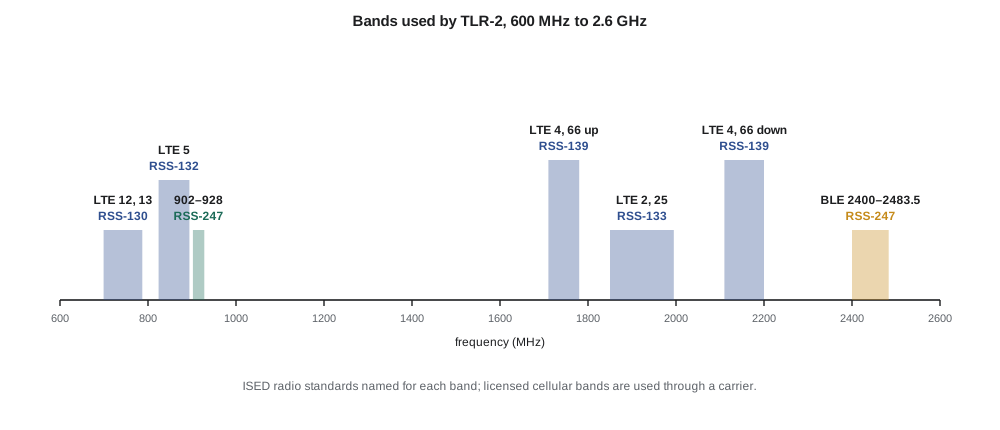
The licence-exempt bands are shared, which is both their attraction and their weakness. Anyone may use them within the rules, without paying for spectrum or coordinating with others, and in return no user is protected from interference by any other. The rules therefore limit power, require spreading or hopping, and set emission limits outside the band, but they do not guarantee a quiet channel. TLR-1's hopping, retries and margins are how a licence-exempt product earns its reliability. Licensed cellular spectrum is managed by the carrier, which plans the network so that its subscribers do not interfere with each other, at the cost of a subscription for each cabinet.
Equipment certification
Every radio product sold in Canada must be certified. A certification body recognized by ISED reviews test reports from an accredited laboratory showing compliance with the applicable RSS, and ISED lists the product with a certification number that must appear on its label. Products that contain a certified radio module can rely on the module's certification when the module is used within the conditions of its approval, including its antenna types and gains; the host product is then labelled with the module's number. Changes outside those conditions, such as a higher-gain antenna, require new testing. Unintentional emissions from the digital circuits of the whole product must also meet ICES-003.
Cedarline's telemetry radio is its own design, so it needs its own certification in both countries; the BLE system-on-chip is bought as a certified module with an integrated antenna option, and the cellular module is certified by its maker. Cedarline's plan uses one accredited laboratory that can test to both ISED and FCC requirements, so that one set of measurements supports both certifications.
Cellular devices also need approval from the networks they connect to. In North America, many carriers require certification by the PTCRB, an industry certification body for devices on cellular networks, or their own equivalent programmes, followed by carrier-specific testing. Using a module that already holds these approvals reduces the work for the host product to a smaller set of tests, typically over-the-air TRP and TIS with the product's actual antenna, which is why lesson 8 measured them. A product that uses the Bluetooth name must also complete the Bluetooth special interest group's qualification process.
Worked problem
Can the cabinet use a higher-gain telemetry antenna?
The telemetry radio is certified with antennas up to 6 dBi at 27 dBm conducted. A city asks for a 9 dBi antenna on a long cabinet-to-cabinet link. What does the rule on power and antenna gain imply?
Show solution
- ELE-350 found that the 902–928 MHz frequency-hopping rules allow 30 dBm conducted with antennas up to 6 dBi, and require the conducted power to be reduced by the amount the antenna gain exceeds 6 dBi.
- With a 9 dBi antenna the conducted limit becomes 30 − 3 = 27 dBm, so 27 dBm is still within the power limit.
- But the antenna is not one of those listed in the certification, so a permissive change or new testing is needed before it may be used, and the installation guide must not offer it until then.
Answer: The power is allowed, but the new antenna must be added to the certification first.
Common mistakes
MistakeAssuming licence-exempt operation means no rules apply.
InsteadPower, spreading, hopping, emissions and labelling are all regulated; only the licence is waived.
MistakeAssuming a certified module makes the whole product compliant.
InsteadOnly within the module's approval conditions; the host still needs unintentional-emission tests and, for cellular, carrier testing.
MistakeChoosing a cellular technology for its current coverage alone.
InsteadNetworks are retired; long-lived products need a technology with a long future and a replaceable module.
MistakeIgnoring the airtime of long-range modulations.
InsteadHigh spreading factors can exceed dwell limits and occupy channels for seconds.
Summary and key terms
- BLE, Wi-Fi, LoRaWAN, LTE-M, NB-IoT and 5G RedCap trade range, data rate, energy and infrastructure.
- BLE uses 40 channels at 2.4 GHz with GFSK; secure pairing protects the maintenance link.
- LTE-M offers about 1 Mb/s with mobility; NB-IoT offers deeper coverage at lower rates; both have power-saving modes.
- Energy per message in cellular LPWAN is dominated by network synchronization and connected time.
- In Canada, ISED's RSS-Gen, RSS-247 and the cellular RSS (130, 132, 133, 139) govern TLR-2's radios; RSS-102 covers exposure.
- Certification by an accredited process is required before sale; cellular devices also need network approvals.
- LPWAN
- Low-power wide-area network, a class of long-range, low-rate wireless systems.
- LTE-M
- A low-power LTE category with about 1 Mb/s and mobility support.
- NB-IoT
- A narrowband LTE technology for static, low-rate devices with deep coverage.
- Power-saving mode (PSM)
- A cellular state in which a device stays registered but sleeps for long periods.
- Spreading factor
- In LoRa, the number of chips per symbol, as a power of two.
- Radio Standards Specification (RSS)
- An ISED standard for radio equipment in Canada.
- Modular approval
- Certification of a radio module that a host product can rely on within stated conditions.
- PTCRB
- An industry body that certifies devices for use on participating North American cellular networks.
Practice problems
Work each problem on paper first, then reveal the answer to check.
How many BLE channels are used for advertising?
Show answer
Three.
Roughly how much sensitivity does each LoRa spreading-factor step add?
Show answer
About 2.5 dB.
Why is LoRa SF12 not practical for a 22-byte report in the North American plan with 125 kHz channels?
Show answer
It takes about 1.5 s on air, longer than the 0.4 s dwell limit.
What dominates the energy of an LTE-M report from power-saving mode?
Show answer
Re-synchronizing with the network and the connected time afterwards, not the transmission itself.
A product uses a certified module but a different antenna type. What is needed?
Show answer
Additional testing and a change to the certification before sale.
Why might a long-lived product avoid an older cellular generation?
Show answer
Carriers retire older networks; the product could lose its connection mid-life.
Lesson quiz · 5 questions
Score 60% or more to complete this lesson.
Create a free account to save your progress, take quizzes and earn a certificate.