
ELE-360 · Lesson 2 of 12 · 25 min
Electrostatics: charge, field and potential
On a dry January day a pedestrian walks across a carpeted bus shelter, steps to the curb and reaches for the APS-2 push button. Before the fingertip touches the metal cap, a spark jumps the last few millimetres. The pedestrian feels a small sting; the electronics inside the station feel a current pulse of tens of amperes that rises in under a nanosecond. Field returns from the first APS-2 pilot showed two units with damaged button-sense inputs after a cold, dry week. Daniel's question to Amara was simple: how much charge and energy does a person carry, what field does it produce, and why does the spark jump where it does? Answering it needs electrostatics, the study of charges at rest and the fields they produce.
Charge and Coulomb's law
Electric charge comes in two kinds, positive and negative, and is quantized in units of the electron charge e = 1.602 × 10⁻¹⁹ C. Charge is conserved: it can move from shoe to carpet, but it is not created or destroyed. Walking separates charge by friction and contact, a process called triboelectric charging, and because the human body is a reasonable conductor surrounded by insulating shoes and air, the separated charge stays on the body. Dry air makes it worse, because humid air leaves a slightly conductive film of water on surfaces that lets charge leak away.
Coulomb's law gives the force between two point charges Q₁ and Q₂ separated by a distance R in free space. The force is along the line joining them, repulsive for like charges and attractive for unlike ones, and it falls as 1/R². The constant 1/(4πε₀) ≈ 8.988 × 10⁹ m/F makes the units work. The electric field E is the force per unit charge that a small test charge would feel, so the field of a point charge Q is the same law with the test charge divided out. Its unit is newtons per coulomb, which is the same as volts per metre.
Fields add. The field of several charges is the vector sum of their individual fields, a property called superposition that follows from the linearity of Maxwell's equations. For charge spread continuously, we replace the sum with an integral over a line charge density ρ_L (C/m), a surface charge density ρ_S (C/m²) or a volume charge density ρ_v (C/m³). Each small element dQ contributes a field dQ/(4πε₀R²) along its own a_R, and we integrate the vector contributions. Superposition is the workhorse of numerical field solvers: they break a structure into many small pieces of charge and add.
Field of a charged ring and of a line charge
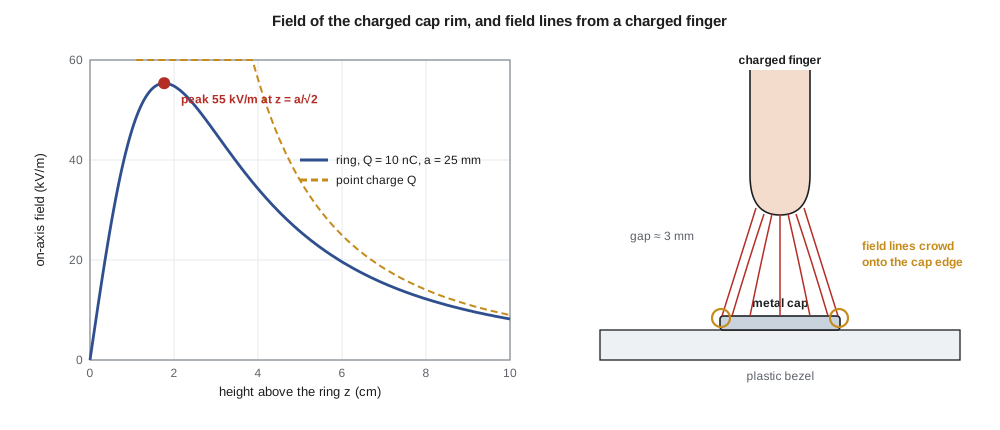
The button cap is a metal disc in a plastic bezel. Charge on a conductor gathers at edges, so as a first model Amara treats the charge on the cap's rim as a ring of radius a with total charge Q. On the axis of the ring, symmetry helps: each element's field has a component along the axis and a component across it, and the cross components of opposite elements cancel. Only the axial components survive, and integrating round the ring gives a closed form. The field is zero at the centre of the ring, rises to a maximum at a height z = a/√2 and then falls, approaching the field of a point charge Q/(4πε₀z²) far away, where the ring's size no longer matters.
Another standard result is the field of an infinitely long straight line of charge with density ρ_L. By symmetry the field points radially outward from the line and depends only on the distance ρ. Integrating along the line, or more quickly using Gauss's law below, gives E = ρ_L/(2πε₀ρ) a_ρ. The field falls as 1/ρ rather than 1/R², because a line is an extended source. This result describes the field near a long wire, a coaxial cable's centre conductor or the lead-in cable from a loop detector, and it reappears in the capacitance of transmission lines in lesson 9.
Gauss's law
Gauss's law is Coulomb's law rewritten as a statement about flux. Define the electric flux density D = ε₀E in free space (lesson 3 extends it to materials). The total flux of D out of any closed surface equals the total charge enclosed. In differential form, at each point, the divergence of D equals the volume charge density. The surface can be any shape and the charges inside can be arranged in any way; the flux depends only on the enclosed total. Charges outside contribute flux that enters on one side and leaves on the other, adding nothing.
Gauss's law always holds, but it gives the field directly only when symmetry lets you choose a Gaussian surface on which D is constant in magnitude and either parallel or perpendicular to the surface. For a point charge, choose a sphere: D times 4πR² equals Q. For a line charge, choose a coaxial cylinder of length L: D times 2πρL equals ρ_L L. For an infinite sheet of charge ρ_S, choose a short pillbox through the sheet: the field is ρ_S/(2ε₀) on each side, independent of distance. Between two parallel plates carrying ±ρ_S, the fields add between them and cancel outside, giving E = ρ_S/ε₀, the basis of the parallel-plate capacitor.
| Charge distribution | Gaussian surface | Field magnitude | Falls off as |
|---|---|---|---|
| Point charge Q | Sphere of radius R | Q/(4πε₀R²) | 1/R² |
| Infinite line, ρ_L | Coaxial cylinder of radius ρ | ρ_L/(2πε₀ρ) | 1/ρ |
| Infinite sheet, ρ_S | Pillbox through the sheet | ρ_S/(2ε₀) | Constant |
| Charged conducting sphere, radius a, charge Q | Sphere of radius R > a | Q/(4πε₀R²) outside, zero inside | 1/R² outside |
| Uniformly charged ball, radius a | Sphere of radius R < a | Q R/(4πε₀a³) inside | Grows linearly inside |
Electric potential
Because the static electric field has zero curl, the work done moving a test charge between two points does not depend on the path. That lets us define a scalar potential V such that the potential difference between points A and B is the negative of the line integral of E from B to A. Equivalently, the field is the negative gradient of the potential: E points from high potential to low, perpendicular to the equipotential surfaces, with a magnitude equal to the steepness of the potential. The potential of a point charge, taking V = 0 far away, is Q/(4πε₀R). Potentials are scalars, so superposition of potentials is simpler than superposition of fields: just add numbers.
Potential is what a voltmeter measures and what circuits use, so it is the bridge between fields and circuit theory. A conductor in electrostatic equilibrium is an equipotential: if there were a potential difference along it, charges would move until there was none. The field inside a conductor is therefore zero, any net charge sits on its surface, and the field just outside is perpendicular to the surface. These three facts explain why the button cap's edge, the tip of a screw or the sharp corner of a circuit-board trace is where breakdown begins.
Why sharp points concentrate the field
Consider two conducting spheres of radii a and b, far apart but joined by a thin wire so that they share one potential V. Each sphere's surface field is V divided by its radius, so the smaller sphere has the stronger field. Its surface charge density is also higher, because the charge per area of a sphere is ε₀ times its surface field. The same argument applies locally to any conductor: where the surface curves sharply, the radius of curvature is small and the field is strong. A fingertip, the edge of a metal cap and the corner of a pad all concentrate field. Lightning rods, corona on high-voltage lines and the sparks of electrostatic discharge all start at points.
Air breaks down when the field anywhere reaches roughly 3 MV/m at sea-level pressure in a uniform gap of a few millimetres; free electrons gain enough energy between collisions to ionize molecules and start an avalanche. The breakdown field depends on gap length, pressure and electrode shape, so treat 3 MV/m as an engineering rule of thumb rather than a constant. An isolated fingertip, modelled as a 5 mm sphere at 8 kV, has a surface field of about 1.6 MV/m: not quite enough on its own. As the finger approaches the cap, the field in the gap rises, and when the gap is a few millimetres the average field V/d exceeds the breakdown value and a spark forms.
Worked problem
A charged pedestrian
Electrostatic discharge testing models a person as a capacitance of 150 pF discharged through 330 Ω, and the most severe common contact test level is 8 kV. Amara wants the charge and energy, the field at an isolated fingertip of radius 5 mm and the gap at which a uniform-field estimate predicts breakdown.
Show solution
- \[Q = CV = 150\ \text{pF} \times 8000\ \text{V} = 1.20\ \mu\text{C}\]
- \[W = \tfrac12 CV^2 = \tfrac12 \times 150\times10^{-12} \times 8000^2 = 4.80\ \text{mJ}\]
- \[E_{\text{surface}} = \frac{V}{a} = \frac{8000}{0.005} = 1.6\ \text{MV/m}\]
- \[d \approx \frac{V}{E_{\text{bd}}} = \frac{8000}{3\times10^6} = 2.7\ \text{mm}\]
Answer: The person stores about 1.2 µC and 4.8 mJ, enough energy to destroy a small semiconductor junction if it is delivered into one. The spark should jump from about 3 mm away. The real gap varies with humidity and approach speed, but the estimate explains why the damage happens before contact: the pulse arrives through an arc, with a very fast rising edge.
import math
eps0 = 8.854e-12; k = 1 / (4 * math.pi * eps0)
# 1. A charged person: charge and stored energy
C, V = 150e-12, 8000.0
print(f"body charge Q = {C*V*1e6:.2f} uC, stored energy W = {0.5*C*V*V*1e3:.2f} mJ")
# 2. Fingertip as a sphere of radius 5 mm at 8 kV
a = 0.005
print(f"isolated fingertip surface field V/a = {V/a/1e6:.2f} MV/m (air breaks down near 3 MV/m)")
print(f"uniform-field gap that reaches 3 MV/m at 8 kV: {V/3e6*1e3:.1f} mm")
# 3. On-axis field of the charged cap rim: superposition of 360 point charges vs the formula
Qr, R, N = 10e-9, 0.025, 360
for z in (0.0, 0.01, 0.025, 0.05, 0.1):
    Ez = 0.0
    for n in range(N):
        t = 2 * math.pi * n / N
        dx, dy, dz = -R * math.cos(t), -R * math.sin(t), z     # vector from the charge to the field point
        d = math.sqrt(dx*dx + dy*dy + dz*dz)
        Ez += k * (Qr / N) * dz / d**3
    exact = k * Qr * z / (z*z + R*R)**1.5
    print(f"z = {z*100:4.1f} cm: superposition {Ez/1e3:7.2f} kV/m, formula {exact/1e3:7.2f} kV/m")
# 4. Gauss's law: flux of D from a 1 nC point charge placed away from the middle of a 10 cm cube
q, L, m = 1e-9, 0.1, 200
x0, y0, z0 = 0.02, -0.01, 0.015
h = L / m; flux = 0.0
for i in range(m):
    for j in range(m):
        u, v = -L/2 + (i + .5) * h, -L/2 + (j + .5) * h
        for (px, py, pz, nx, ny, nz) in ((L/2, u, v, 1, 0, 0), (-L/2, u, v, -1, 0, 0), (u, L/2, v, 0, 1, 0),
                                          (u, -L/2, v, 0, -1, 0), (u, v, L/2, 0, 0, 1), (u, v, -L/2, 0, 0, -1)):
            rx, ry, rz = px - x0, py - y0, pz - z0; d3 = (rx*rx + ry*ry + rz*rz) ** 1.5
            flux += eps0 * k * q * (rx*nx + ry*ny + rz*nz) / d3 * h * h
print(f"flux of D through the cube = {flux*1e9:.4f} nC (enclosed charge 1 nC)")body charge Q = 1.20 uC, stored energy W = 4.80 mJ isolated fingertip surface field V/a = 1.60 MV/m (air breaks down near 3 MV/m) uniform-field gap that reaches 3 MV/m at 8 kV: 2.7 mm z = 0.0 cm: superposition 0.00 kV/m, formula 0.00 kV/m z = 1.0 cm: superposition 46.04 kV/m, formula 46.04 kV/m z = 2.5 cm: superposition 50.84 kV/m, formula 50.84 kV/m z = 5.0 cm: superposition 25.72 kV/m, formula 25.72 kV/m z = 10.0 cm: superposition 8.21 kV/m, formula 8.21 kV/m flux of D through the cube = 1.0000 nC (enclosed charge 1 nC)
The ring calculation adds the fields of 360 point charges and matches the closed-form result at every height, peaking near z = a/√2 ≈ 1.8 cm at about 55 kV/m for 10 nC on a 25 mm ring (the printed heights bracket the peak). The Gauss's law check places a 1 nC charge off-centre in a 10 cm cube and integrates the normal component of D over all six faces on a 200 × 200 grid per face. The faces nearest the charge carry most of the flux, but the total is 1.0000 nC regardless of where the charge sits, exactly as Gauss's law promises. If you move the charge outside the cube in the code, the total becomes zero.
Poisson's and Laplace's equations
Combining Gauss's law with E = −∇V gives Poisson's equation, ∇²V = −ρ_v/ε₀. In regions without free charge, such as the air between conductors, it reduces to Laplace's equation, ∇²V = 0. These equations, together with the potentials on the conductors as boundary conditions, determine the field uniquely; this uniqueness theorem is why any method that satisfies the equation and the boundary values, however it was found, gives the right answer. Laplace's equation has a simple numerical meaning on a grid: the potential at each point is the average of its neighbours. Lesson 3 uses that idea to compute the capacitance and field of the button cap and its guard ring.
Energy in the electrostatic field
Assembling a charge distribution takes work, and that work is stored in the field. The energy is W = ½∫ρ_v V dv, or equivalently W = ½∫ε₀|E|² dv over all space. The second form says the energy lives where the field is, with a density of ½ε₀E² joules per cubic metre. In a uniform field of 1 MV/m in air, the energy density is only about 4.4 J/m³, which is why the total energy of a person's static charge is millijoules even though the voltage is kilovolts. What makes electrostatic discharge damaging is not the total energy but the speed and concentration with which it is delivered: 4.8 mJ released in tens of nanoseconds into a junction a few micrometres across.
What Amara takes back to the design
The calculations point to the fix. Because the spark jumps to the nearest metal, the cap should be bonded with a short, wide conductor to the enclosure's chassis ground, so the discharge current flows on the outside of the station to the pole rather than through the electronics. The button-sense input should see the cap only through a series resistor and a fast clamp to chassis. Sharp edges near sensitive traces should be rounded or kept back from openings in the bezel. These are electromagnetic design rules, and later lessons explain how fast-rising currents couple magnetically into nearby circuits (lesson 5) and why the length and shape of the ground connection matter as much as its resistance (lessons 9 and 11).
Electrostatic discharge immunity is part of the electromagnetic compatibility testing the APS-2 must pass for its customers. The basic test method is defined in IEC 61000-4-2, which Canadian and international product standards reference; the test levels a product must meet are set by the product family standard or the customer's specification. Amara plans pre-compliance tests with a rented discharge simulator before the formal test.
Common mistakes
MistakeAdding field magnitudes from several charges.
InsteadFields are vectors; add components, or use potentials, which are scalars.
MistakeUsing Gauss's law to find the field of an asymmetric distribution.
InsteadGauss's law always holds, but it gives the field directly only when symmetry makes D constant on the chosen surface.
MistakeAssuming the field inside a charged conductor is strong because its surface is charged.
InsteadIn electrostatic equilibrium the field inside a conductor is zero and the charge sits on the surface.
MistakeJudging electrostatic discharge risk by energy alone.
InsteadMillijoules delivered in nanoseconds into a tiny junction cause the damage; rise time and current path matter.
Summary and key terms
- Coulomb's law gives the force and field of point charges; superposition adds the vector fields of many charges.
- Gauss's law relates the flux of D through a closed surface to the enclosed charge and gives fields of symmetric distributions quickly.
- The static field is conservative, so a scalar potential exists with E = −∇V; potentials add as scalars.
- Conductors are equipotentials with zero internal field and charge on their surfaces; field is strongest where curvature is sharp.
- Air breaks down near 3 MV/m in millimetre gaps, which sets where electrostatic discharge sparks form.
- Field energy density is ½ε₀E²; Poisson's and Laplace's equations with boundary values determine potentials uniquely.
- Coulomb's law
- The inverse-square law for the force between two point charges.
- Electric field
- Force per unit charge, in volts per metre.
- Superposition
- The total field of several sources is the vector sum of their separate fields.
- Gauss's law
- The net flux of D out of a closed surface equals the charge enclosed.
- Electric potential
- Work per unit charge to bring a test charge from a reference point; E = −∇V.
- Equipotential
- A surface on which the potential is constant; field lines cross it at right angles.
- Dielectric breakdown
- Ionization of an insulator when the field exceeds its strength, producing a conducting path or spark.
- Laplace's equation
- ∇²V = 0, satisfied by the potential in charge-free regions.
Practice problems
Work each problem on paper first, then reveal the answer to check.
Two charges of +2 nC and −2 nC sit 10 cm apart. What is the field at the midpoint?
Show answer
Each contributes 7.19 kV/m toward the negative charge; total 14.4 kV/m toward −2 nC.
A long wire carries 50 nC/m. What is the field 2 cm away?
Show answer
ρ_L/(2πε₀ρ) = 44.9 kV/m, radially outward.
What is the potential of an isolated sphere of radius 0.1 m holding 10 nC?
Show answer
Q/(4πε₀a) = 899 V.
At what height above a ring of radius 25 mm is the on-axis field largest?
Show answer
z = a/√2 = 17.7 mm.
A person of 120 pF is charged to 12 kV. What charge and energy?
Show answer
1.44 µC and 8.64 mJ.
What is the energy density of a 2 MV/m field in air?
Show answer
½ε₀E² = 17.7 J/m³.
Lesson quiz · 5 questions
Score 60% or more to complete this lesson.
Create a free account to save your progress, take quizzes and earn a certificate.