
ECON-101 · Lesson 2 of 12 · 27 min
Trade-offs, specialization and gains from trade
Why do people trade? You could, in principle, grow your own food, sew your own clothes, write your own software and cut your own hair. Almost nobody does, because it is far more productive to specialize in a few tasks and trade for everything else. The same logic applies to regions and countries. Canada exports oil, potash, wheat, lumber and aircraft parts and imports fruit, electronics and clothing; the United States exports aircraft, software, soybeans and medical equipment and imports cars, phones and toys. This lesson explains why specialization and trade make people better off, using the idea of comparative advantage, one of the most important and least intuitive ideas in economics. It also examines why trade nonetheless creates losers as well as winners, and why trade policy remains politically contested. BUS-101 lesson 3 described global business and trade agreements from a manager's perspective; here we focus on the economic logic underneath.
Absolute and comparative advantage
A producer has an absolute advantage in a good if it can produce more of that good with the same resources, or the same amount with fewer resources, than another producer. A producer has a comparative advantage in a good if it can produce that good at a lower opportunity cost than another producer. The distinction matters because it is comparative advantage, not absolute advantage, that determines who should produce what. A person or country can have an absolute advantage in everything and still gain from trade, because no one can have a comparative advantage in everything.
Consider a lawyer who types faster than her assistant. She has an absolute advantage in typing as well as in law. But each hour she spends typing is an hour not spent billing clients at $300 an hour, while her assistant's alternative might be worth $30 an hour. Her opportunity cost of typing is far higher, so the assistant has a comparative advantage in typing. Both are better off if she practises law and he types, and she pays him for it. This simple example captures the essence of the theory that David Ricardo set out in 1817 using the example of English cloth and Portuguese wine.
A two-country example
To see comparative advantage at work, consider a stylized example with two countries, which we will call North and South, each with 100 worker-days of labour, producing two goods: wheat and solar panels. The numbers are illustrative, chosen to make the arithmetic clear rather than to describe any real country.
| Output per worker-day | Wheat (tonnes) | Solar panels |
|---|---|---|
| North | 6 | 3 |
| South | 2 | 2 |
North is more productive in both goods, so it has an absolute advantage in both. Now compute opportunity costs. In North, one solar panel requires one-third of a worker-day, which could have produced 2 tonnes of wheat, so the opportunity cost of a panel is 2 tonnes of wheat; equivalently, a tonne of wheat costs half a panel. In South, a panel costs 1 tonne of wheat and a tonne of wheat costs 1 panel. North therefore has the lower opportunity cost of wheat (0.5 panels against 1), and South has the lower opportunity cost of solar panels (1 tonne against 2). North has a comparative advantage in wheat and South in solar panels.
| Opportunity cost of | One tonne of wheat | One solar panel |
|---|---|---|
| North | 0.5 panels | 2 tonnes of wheat |
| South | 1 panel | 1 tonne of wheat |
Suppose that before trade each country splits its labour evenly. North produces 300 tonnes of wheat and 150 panels; South produces 100 tonnes and 100 panels. World output is 400 tonnes and 250 panels. Now suppose each country specializes according to comparative advantage. If South produces only panels, it makes 200. If North moves 85 worker-days to wheat and keeps 15 on panels, it produces 510 tonnes of wheat and 45 panels. World output becomes 510 tonnes and 245 panels: 110 more tonnes of wheat for only 5 fewer panels. With a little more adjustment, both goods can rise. Specialization has enlarged the total amount available to share.
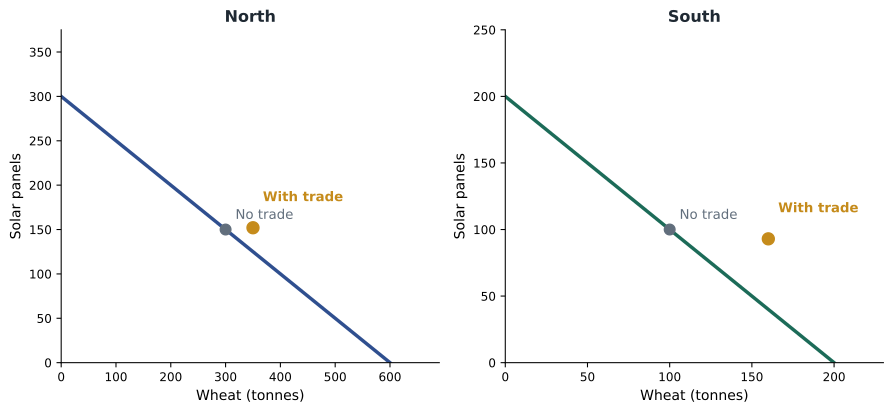
Trade lets each country share in the gain. Suppose they trade at a rate of 1.5 tonnes of wheat per panel, which lies between the two countries' opportunity costs (1 tonne in South and 2 tonnes in North). North exports 160 tonnes of wheat in exchange for 107 panels. North then consumes 350 tonnes and 152 panels, more of both than its 300 and 150 before trade. South consumes 160 tonnes and 93 panels, compared with 100 and 100 before; it has 60 more tonnes of wheat for 7 fewer panels, which at the world price is a clear gain. The key insight is that the terms of trade must lie between the two opportunity costs; within that range, both countries gain.
# Gains from trade in the North-South example (illustrative numbers)
days = 100
prod = {"North": {"wheat": 6, "panels": 3}, "South": {"wheat": 2, "panels": 2}}
# Opportunity cost of one panel in tonnes of wheat
for c, p in prod.items():
    print(f"{c}: 1 panel costs {p['wheat'] / p['panels']:.2f} t of wheat")
# Autarky: half the days on each good
aut = {c: (p["wheat"] * 50, p["panels"] * 50) for c, p in prod.items()}
# Specialization: South all panels; North 85 days wheat, 15 days panels
north = (6 * 85, 3 * 15); south = (0, 2 * 100)
print("world output before:", tuple(sum(v[i] for v in aut.values()) for i in (0, 1)))
print("world output after: ", (north[0] + south[0], north[1] + south[1]))
# Trade 160 t of wheat at 1.5 t per panel
exported, rate = 160, 1.5
panels_bought = round(exported / rate)
north_c = (north[0] - exported, north[1] + panels_bought)
south_c = (south[0] + exported, south[1] - panels_bought)
for name, before, after in (("North", aut["North"], north_c), ("South", aut["South"], south_c)):
print(f"{name}: before {before}, after trade {after}")North: 1 panel costs 2.00 t of wheat South: 1 panel costs 1.00 t of wheat world output before: (400, 250) world output after: (510, 245) North: before (300, 150), after trade (350, 152) South: before (100, 100), after trade (160, 93)
The sources of comparative advantage
Where does comparative advantage come from? Some of it reflects natural endowments: Canada's vast forests, mineral deposits and agricultural land give it a comparative advantage in resource products, and Florida's climate gives it one in oranges. Some reflects differences in factor abundance, the insight of the Heckscher–Ohlin model: countries tend to export goods that use their abundant factors intensively. A country with many skilled workers and much capital tends to export sophisticated manufactured goods and services, while a country with abundant low-wage labour tends to export labour-intensive goods such as clothing. Some comparative advantage is created rather than inherited, through education, infrastructure, research and the clustering of firms. Silicon Valley's advantage in software and Montreal's in visual effects and artificial intelligence research reflect accumulated skills, networks and institutions as much as natural endowments.
Modern trade also involves much exchange of similar goods between similar countries. Canada and the United States trade huge volumes of cars and car parts back and forth, sometimes crossing the border several times during production. This intra-industry trade reflects economies of scale and consumers' taste for variety: it is cheaper for a plant to specialize in a few models and serve the whole North American market than for each country to produce every model in small volumes. Global value chains, in which a product's components are made in many countries, are an extension of this logic.
Who gains and who loses
Trade increases the total size of the economic pie, but it does not make everyone better off. When a country opens to imports of a good, domestic consumers of that good gain from lower prices, while domestic producers of competing goods and their workers lose. When a country exports more of a good, its producers gain, while domestic consumers of that good may face higher prices. Economists can show that the gains to winners exceed the losses to losers, so the winners could in principle compensate the losers and everyone could be better off. Whether that compensation actually happens is a political question.
Research on the 'China shock' by David Autor, David Dorn and Gordon Hanson found that the rapid rise of Chinese imports after 2000 caused substantial and persistent job losses and wage declines in US communities that specialized in competing manufacturing, with effects lasting more than a decade. Studies of Canadian manufacturing regions found similar, if smaller, effects. These findings did not overturn the case that trade raises aggregate income, but they showed that adjustment costs can be large, concentrated and long-lasting, and they help explain the political backlash against trade in many countries. Programs such as trade adjustment assistance, retraining and wage insurance are attempts to share the gains more widely; evidence on their effectiveness is mixed.
Trade policy: tariffs and quotas
A tariff is a tax on imports. It raises the domestic price of the imported good, which helps domestic producers and the government (which collects the revenue) but hurts domestic consumers, and the losses to consumers usually exceed the gains to the others. Lesson 6 shows how to measure this deadweight loss with supply and demand diagrams. An import quota limits the quantity of a good that can be imported. Canada's supply management system for dairy, poultry and eggs combines production quotas with tariff-rate quotas that impose very high tariffs, often over 200 %, on imports above a set amount. Supporters argue that it provides stable incomes for farmers and secure domestic supply; critics argue that it raises food prices for consumers and is a frequent irritant in trade negotiations.
Canada's most important trade relationship is with the United States, governed since 2020 by the Canada–United States–Mexico Agreement (CUSMA), which replaced NAFTA. In 2025 and 2026, the relationship was disrupted by US tariffs on Canadian steel, aluminum, autos, lumber and other goods, and by Canadian counter-tariffs. BUS-230 lesson 12 traced how these tariffs affected supply chains and costs; as of October 2026 many goods that qualify under CUSMA rules of origin remained exempt from the broadest US tariffs, while sector-specific tariffs continued. The episode illustrates the economic logic of this lesson: tariffs raised costs for firms that use steel and aluminum, reduced trade flows and prompted retaliation, while protecting some domestic producers. Canada has also diversified its trade through agreements with the European Union (CETA) and Pacific economies (CPTPP).
Why do countries impose tariffs if they usually reduce total welfare? Several arguments are made. The national security argument holds that a country should not depend on imports for essential goods such as steel, semiconductors or medicines; it has force for some goods, though it is easily stretched. The infant industry argument holds that new industries need temporary protection until they become competitive; history offers both successes and many cases where protection became permanent. The strategic argument holds that tariffs can be used as bargaining chips or to counter unfair practices such as subsidies by other countries. And the political economy explanation notes that the benefits of protection are concentrated on a few producers, who lobby hard, while the costs are spread thinly across millions of consumers, who rarely organize.
Worked problem
The cost of protection per job
Suppose a tariff on imported bicycles raises the price consumers pay for 500,000 bicycles a year by $60 each, and it is estimated to preserve 400 jobs in domestic bicycle plants that pay $55,000 a year. What is the cost to consumers per job preserved?
Show solution
- Total cost to consumers: 500,000 × $60 = $30 million a year.
- Jobs preserved: 400.
- Cost per job: $30,000,000 ÷ 400 = $75,000 a year.
Answer: Consumers pay about $75,000 a year for each job preserved, more than the $55,000 salary of the job. This is typical of estimates for many tariffs, though the numbers here are illustrative; part of the consumer cost becomes government revenue or higher profits for domestic producers, so it is not all lost to the economy.
Specialization within an economy
Comparative advantage applies within countries as well as between them. Adam Smith's famous description of a pin factory in The Wealth of Nations (1776) showed how dividing the work into 18 distinct operations let ten workers produce about 48,000 pins a day, where each working alone could perhaps make 20. Specialization raises productivity because workers develop skill through repetition, time is not wasted switching between tasks, and specialized tasks are easier to mechanize. It is the reason a modern economy has hundreds of thousands of distinct occupations. But specialization also creates interdependence: we rely on others for almost everything we consume, so we are vulnerable when supply chains break, as the COVID-19 pandemic showed in 2020 and 2021.
Markets coordinate this vast division of labour without anyone being in charge. No single person knows how to make a pencil from scratch, as Leonard Read's essay 'I, Pencil' observed, yet pencils are produced reliably and cheaply because prices signal to each participant what to produce and how much. The next lesson develops the model of supply and demand that explains how prices are set and how they change.
Common mistakes
MistakeA country that is more productive at everything has nothing to gain from trade.
InsteadGains from trade depend on comparative advantage, which every country has in something, regardless of absolute advantage.
MistakeComparative advantage means producing what you are best at in absolute terms.
InsteadIt means producing what you can make at the lowest opportunity cost relative to others.
MistakeTrade makes everyone in both countries better off.
InsteadTrade raises total income, but some producers and workers lose; whether they are compensated is a policy choice.
MistakeTariffs are paid by the foreign country.
InsteadTariffs are paid by importers, and much of the cost is passed on to domestic buyers in higher prices.
MistakeAny terms of trade will benefit both countries.
InsteadBoth gain only if the terms of trade lie between the two countries' opportunity costs.
Summary and key terms
- Absolute advantage is producing more with the same resources; comparative advantage is producing at a lower opportunity cost.
- Specialization according to comparative advantage increases total output, and trade lets both sides consume beyond their own frontiers.
- Both countries gain when the terms of trade lie between their opportunity costs.
- Comparative advantage comes from natural endowments, factor abundance and accumulated skills and institutions.
- Intra-industry trade reflects economies of scale and the demand for variety.
- Trade creates winners and losers; adjustment costs can be large and concentrated.
- Tariffs and quotas protect some producers but usually reduce total welfare and invite retaliation.
- Specialization within an economy raises productivity but increases interdependence.
- Absolute advantage
- The ability to produce more of a good than another producer with the same resources.
- Comparative advantage
- The ability to produce a good at a lower opportunity cost than another producer.
- Terms of trade
- The rate at which one good is exchanged for another in trade.
- Specialization
- Concentrating on producing a limited range of goods or tasks.
- Tariff
- A tax on imported goods.
- Import quota
- A legal limit on the quantity of a good that can be imported.
- Intra-industry trade
- Two-way trade in similar goods between countries.
- Global value chain
- A production process split across several countries.
- Infant industry argument
- The claim that new domestic industries need temporary protection to become competitive.
- Division of labour
- The splitting of production into specialized tasks performed by different workers.
Practice problems
Work each problem on paper first, then reveal the answer to check.
Distinguish absolute from comparative advantage.
Show answer
Absolute: more output from the same resources. Comparative: lower opportunity cost.
In North, 1 panel costs 2 t of wheat; in South, 1 t. Who should make panels?
Show answer
South, which has the lower opportunity cost.
Between what limits must the price of a panel in wheat lie for both to gain?
Show answer
Between 1 and 2 tonnes of wheat per panel.
A doctor can do her own bookkeeping faster than a bookkeeper. Should she?
Show answer
Usually not; her opportunity cost of bookkeeping time is much higher.
Why does Canada trade cars with the United States in both directions?
Show answer
Economies of scale and variety: plants specialize in models and serve the whole continent.
Who gains and who loses from a tariff on steel?
Show answer
Domestic steel producers and the government gain; steel users and consumers lose.
A tariff costs consumers $12 million and saves 100 jobs. Cost per job?
Show answer
$120,000.
What did the China shock research find?
Show answer
Large, persistent job and wage losses in US regions exposed to Chinese import competition.
Give one argument for supply management in Canada and one against.
Show answer
For: stable farm incomes and domestic supply. Against: higher consumer prices and trade friction.
Portfolio task: choose a product you bought this week and trace where its main components were made.
Show answer
Answers vary; should identify a value chain and the comparative advantages involved.
Lesson quiz · 5 questions
Score 60% or more to complete this lesson.
Create a free account to save your progress, take quizzes and earn a certificate.